

The math on low‑paying specialties is brutal if you only look at a spreadsheet.
The Fear No One Wants To Admit Out Loud
You can love psych or peds or family med with your whole heart and still lie awake thinking: “What if this is financially stupid and I ruin my future?”
You’re not crazy. You’re not shallow. You’re not “in medicine for the wrong reasons” because you care about money a little. You’re staring down:
- $250k–$500k in loans
- 3–7 years of residency at garbage pay
- Then choosing a specialty where the peak salary might barely crack $250–300k, while your classmates in derm are making that in their early 30s working 4 days a week
Meanwhile, you’re imagining:
- 6-figure monthly loan balances that never seem to move
- Never owning a house in a decent area
- Being the “poor doctor” at your reunion
- Not being able to help your own parents financially
- Delaying kids because daycare + loans + rent looks impossible on paper
So you start thinking:
“Maybe I should just force myself into anesthesia or radiology or gas or ortho and suck it up. Maybe loving psych is a luxury I can’t afford.”
Here’s the uncomfortable truth:
You can pick a lower-paid specialty and still be okay financially — but only if you treat the money piece like a central part of your career plan, not an afterthought.
What “Low-Paying” Actually Means (Numbers, Not Vibes)
Let me be concrete. When people say “low-paying specialties,” they usually mean things like:
- Pediatrics (especially outpatient gen peds)
- Psychiatry (non-procedural, community/CMHC, academic)
- Family Medicine
- General Internal Medicine (outpatient, no procedures)
- Geriatrics
- PM&R in some settings
- Some primary care–leaning hospitalist jobs
| Specialty | Typical Starting Range |
|---|---|
| Pediatrics (outpt) | $180k–$230k |
| Psychiatry | $230k–$300k |
| Family Medicine | $210k–$260k |
| Hospitalist IM | $260k–$320k |
| EM | $330k–400k+ |
| Ortho/Neuro Surg | $500k–800k+ |
Are these exact? No. But they’re close enough for the emotional math your brain is doing at 2 a.m.
Now pair that with loans:
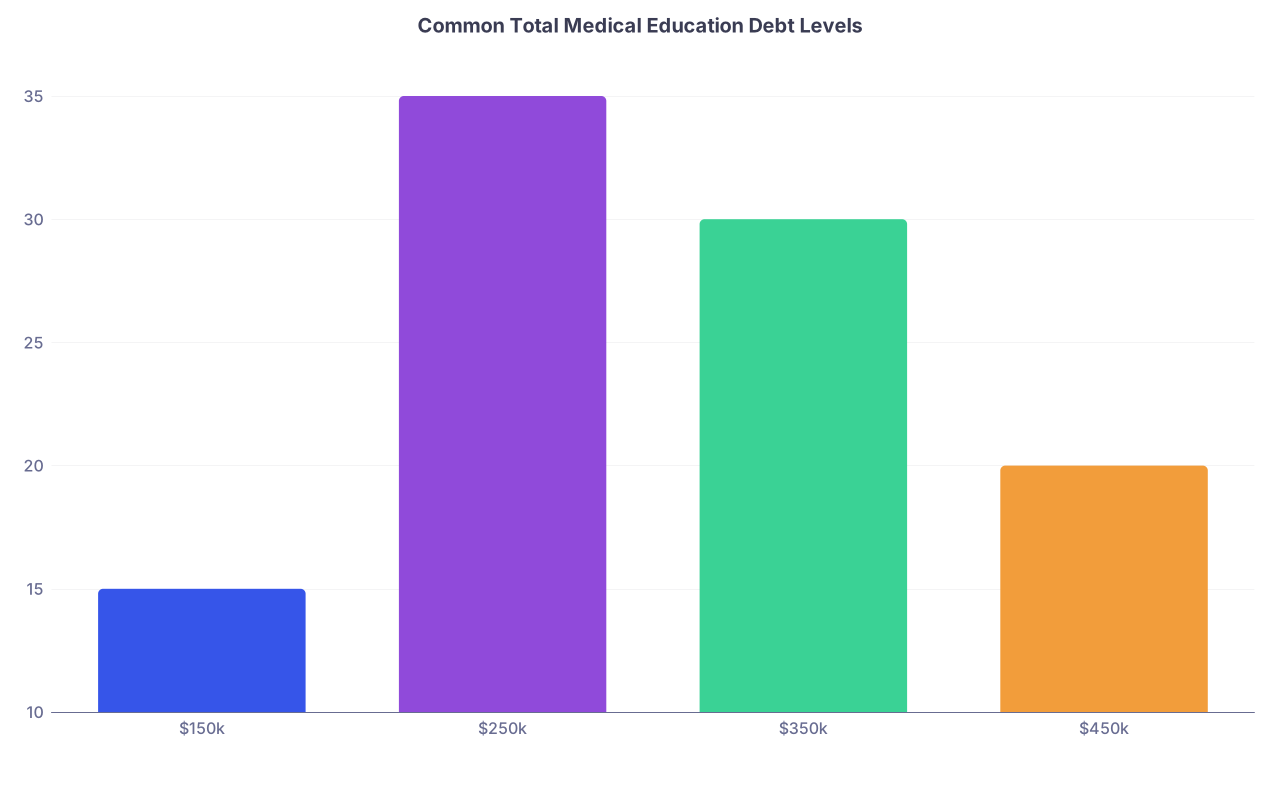
| Category | Value |
|---|---|
| $150k | 15 |
| $250k | 35 |
| $350k | 30 |
| $450k | 20 |
That could easily be you in the $250k–$450k bands.
The nightmare story in your head is usually some version of:
“I’ll make $200–230k, pay $3–4k/month in loans for 20 years, and still feel broke and behind forever.”
So let’s attack this from three angles:
- Are you actually doomed if you pick a low-paying specialty?
- What knobs can you turn to make a “low-paying” specialty less financially terrifying?
- How do you decide if loving the work is worth the financial tradeoff for you?
Worst-Case Scenario Thinking: Let’s Actually Play It Out
You’re already doing this in your head, but it’s fuzzy and catastrophic. Let’s make it specific.
Say:
- Loans: $350,000 at ~6.5%
- Specialty: Outpatient peds or FM
- Training: 3 years residency
- Plan: PSLF (Public Service Loan Forgiveness) or long-term income-driven repayment
Path 1: PSLF With a Low-Paying Specialty
You work for a qualifying nonprofit / academic / FQHC job. You do income-driven repayment the entire time (residency + attending). You hit 120 payments and the remainder gets forgiven.
During residency, your payments are low. As a new attending, they ramp up, but they’re still tied to income.
It’s not magic, but the math often looks roughly like:
- 3 years residency: $0–300/month
- 7 years attending: maybe $900–2000/month depending on exact salary and plan
- Remaining balance forgiven tax-free at year 10

| Step | Description |
|---|---|
| Step 1 | MS4 Pick Specialty |
| Step 2 | Residency 3 yrs |
| Step 3 | IDR Payments Low |
| Step 4 | Nonprofit Attending Job |
| Step 5 | IDR Payments Higher |
| Step 6 | 120 Qualifying Payments |
| Step 7 | PSLF Forgiveness |
Reality check: PSLF is not risk-free. Programs change. Paperwork gets screwed up. People get denied.
But I’ve watched actual physicians hit forgiveness with balances >$200k evaporating. That’s happening. Right now. Not hypothetical.
For someone in outpatient psych/peds/FM making $220–260k at a nonprofit system, PSLF can turn terrifying debt into something manageable and finite.
Path 2: No PSLF, Just You vs. The Loans
Let’s say you:
- Work private practice or for a for-profit hospital
- No PSLF. You’re on your own.
- Starting peds salary: $210–230k
Your catastrophizing brain says: “That’s it, game over.”
Not exactly.
Here’s the uncomfortable reality: as an attending making even $220k, you are in the top few percent of earners in the country. That doesn’t mean you feel rich. But it does mean you have tools.
A roughly realistic setup might look like:
- Take 1–2 years, live “resident plus” as an attending (modest apartment, old car, roommates/spouse working)
- Throw $4–6k/month at loans
- Also contribute some to retirement (even if tiny)
If you’re aggressive early, a $300–350k balance can realistically be gone in 7–10 years. That’s not “I’m fine at 32,” but it’s “I’m not shackled forever.”
Will it feel tight? Yes. Especially with daycare, housing, and adult life.
Will you be miserable and broke forever? No. But you will have to say no to some lifestyle things your higher-paid colleagues say yes to quickly.
Ways to Make a Low-Paying Specialty Less Financially Terrifying
This is the part almost no one walks you through: all the levers you can pull within a “low-paying” specialty.
1. Where You Practice Matters More Than You Think
Psych in Manhattan vs psych in mid-sized Midwest city? Not the same job financially.
There are primary care and psych jobs in:
- Rural areas
- Underserved regions
- Certain hospital systems
…that pay way better because they’re desperate. Same degree. Very different paycheck.
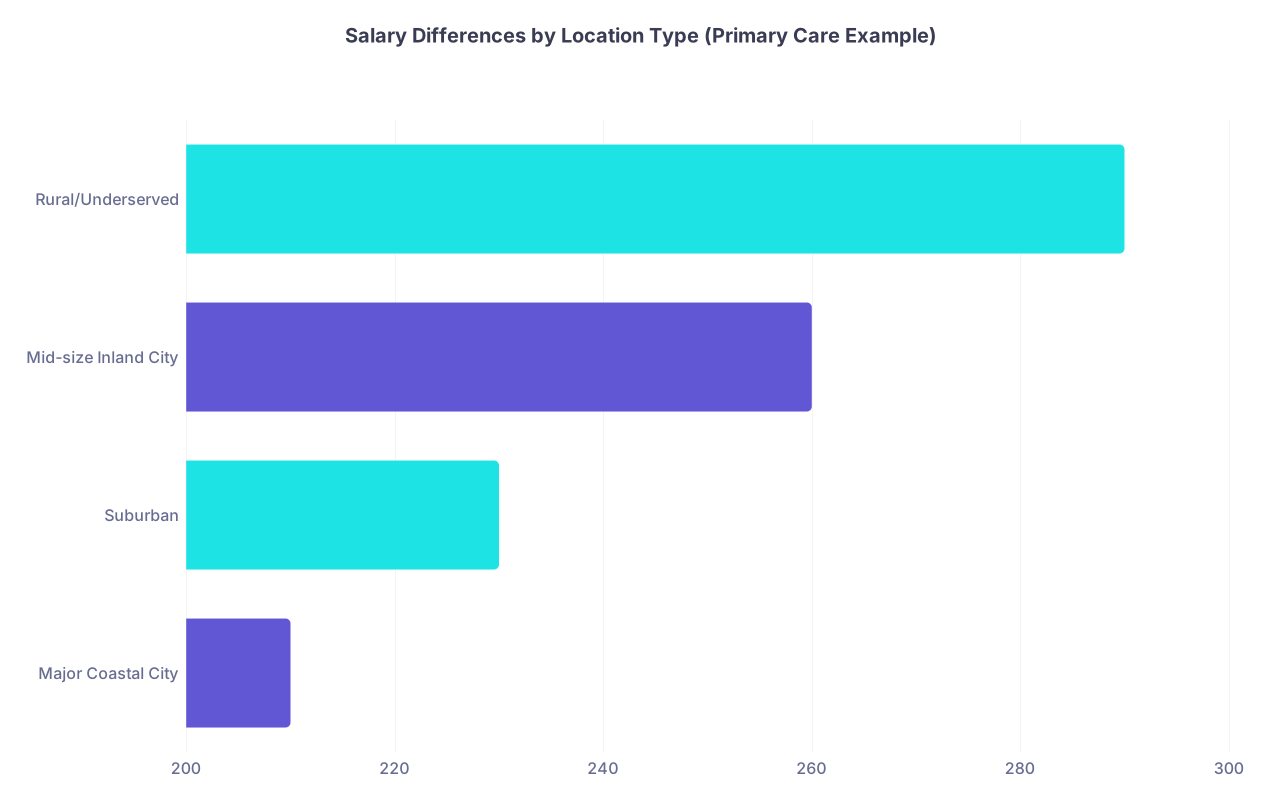
| Category | Value |
|---|---|
| Major Coastal City | 210 |
| Suburban | 230 |
| Mid-size Inland City | 260 |
| Rural/Underserved | 290 |
If your priority is: “I want to be a child psychiatrist and not panic every time I look at my loans,” it might be smarter to start in a higher-paying region for a few years, crush debt, then move back to your dream city once you’re not bleeding interest.
Not romantic. But very effective.
2. Job Type and Schedule: You Have More Options Than “Pure Outpatient”
Inside “low-paying” fields, there’s a whole spectrum:
- Outpatient clinic 4 days/week, academic, lots of teaching: lowest pay, best lifestyle for some
- Inpatient service / consults: usually higher comp
- Extra call shifts, moonlighting: money for pain
- Telepsych, telehealth primary care: flexible schedule, often decent pay
- Locums gigs: short-term, high hourly rates, sometimes travel + housing
Especially in psych and primary care, I’ve seen people:
- Work a solid 1.0 FTE at a nonprofit (for PSLF)
- Pick up extra tele/locums side work 1–2 evenings/week or 1 weekend/month
- Use that side money only for loans, not lifestyle
You don’t have to do that forever. But 2–3 years of that as a new attending? Loan damage control.
3. Subspecialty or Niche Work
Some “low-paying” fields have pockets that pay much better:
- Psych: interventional psych (ECT, TMS, ketamine) often pays more
- PM&R: pain management can be much higher comp than general rehab
- FM/IM: urgent care, occupational medicine, procedures (joint injections, scopes)
- Peds: NICU, PICU, some subspecialties, depending on setting
I’m not saying “pick a subspecialty just for money and hate your life.” That’s how people burn out and get weirdly bitter.
But if there’s a part of your specialty you genuinely like that also pays better? That’s a way to bend the math a little more in your favor.
4. PSLF + Intentional Job Choice
If you’re serious about PSLF, you can’t treat it like a vague idea.
You have to:
- Make sure loans are Direct loans (or consolidated to Direct)
- Get on an income-driven repayment plan early
- Work for qualifying employers on purpose (nonprofit hospitals, FQHCs, academic centers)
- Keep meticulous records of payments and employment certification forms
I’ve watched people lose years of progress because they didn’t file employment certifications or were on the wrong repayment plan. That’s the stuff that fuels the “PSLF is a scam” narrative.
But the ones who treat it like a project? They’re actually getting forgiveness.
The Part Everyone Pretends Isn’t Real: Lifestyle and Burnout
Here’s where the raw numbers mislead you.
If you force yourself into a high-paying specialty you don’t like, your brain goes:
“Well, at least I’ll be rich and hate my life, not poor and hate my life.”
But that’s not quite how it plays out.
Real scenario I’ve seen:
- Student loves psych, is fascinated by talking to patients, hates OR
- Chooses anesthesia because of money
- Residency is tolerable but draining
- As an attending: high income, but work feels meaningless, chronic dread before shifts
- Starts impulse-spending: luxury car, expensive vacations, high-rent place
- Not because of joy. Because they’re trying to buy relief from feeling trapped
- Burnout hits. Contemplates drastic career move that nukes income anyway
Compare that with:
- Student loves child psych (or peds, or FM)
- Chooses low-paying specialty, but:
- Does PSLF at an academic children’s hospital or psych institute
- Lives modestly for 5–7 years
- Builds a career they actually like enough to do for 30 years
- Money anxiety doesn’t disappear, but it moves from “paralyzing doom” to “annoying but manageable”
No specialty choice makes you magically content and financially serene. But choosing a field you actively dislike just to chase a bigger number? That’s how you end up burned out at 40 still not feeling “safe enough” to stop grinding.
The Ugly Middle Ground: Loving a Low-Paying Specialty AND Wanting a High-Cost Life
This is where it gets tight.
You want:
- Psych or peds or FM
- Big coastal city
- Kids in private school
- Fancy neighborhood
- Frequent travel
- Early-ish retirement
And you’ve got $300–400k in loans.
Can you do all of that at once in your 30s on $220–250k? Honestly? Probably not without:
- PSLF and
- Aggressively optimizing housing/commute and/or
- Partner with decent income and/or
- Side gigs/locums/tele
You might have to pick 2–3 of those goals to prioritize early on and delay the others.
That’s the part nobody tells you: not “you can’t have that,” but “you probably can’t have all of it, all at the same time, right away.”
Concrete Next Steps So This Stops Being Just Vague Panic
If your brain is just screaming “What if I regret this forever?”, here’s how to get out of pure anxiety mode and into actual planning.
Step 1: Get Real Numbers, Not Vibes
Today or this week:
- List your current loan balance(s) and interest rates
- Look up realistic starting salaries for the specialties you’re considering in the regions you might live
- Use a loan simulator (AAMC, studentaid.gov) and plug those in:
- PSLF scenario
- Non-PSLF, aggressive repayment scenario
It will still be scary. But specific scary is better than foggy apocalyptic scary.
Step 2: Talk to Attendings in That Specialty About Money Directly
Not vague “I love my job” talk. Actual questions:
- “What do new grads in this area actually start at?”
- “How long did it take you to feel like you weren’t drowning financially?”
- “Do people here commonly do PSLF?”
- “If you could go back, would you pick this specialty again knowing what you know about the money?”
You’ll hear a spread of answers, but watch for patterns. Especially from people 5–10 years out.
Step 3: Decide What You’re Willing to Trade
You are going to trade something:
- Higher income vs. day-to-day enjoyment of work
- Dream city vs. better pay region (at least for a few years)
- Faster debt payoff vs. nicer lifestyle in your early attending years
Write down, literally, “I’m willing to sacrifice X and Y, but I am not willing to sacrifice Z.”
Because if “I refuse to hate my daily work” is on that list, that should weigh heavily.
FAQs
1. What if I pick a low-paying specialty and then PSLF disappears?
Then you’re in the same boat as everyone else with loans: you pay them back over time. It’ll suck more, yes. But that’s why you don’t build a plan that only works if PSLF exists. You:
- Choose a field you can see yourself doing long term
- Factor in that even without PSLF, $220–260k is still enough to pay back loans over 10–20 years with intentional planning
- Keep your fixed costs (housing, car) flexible so you can adjust if policy changes
Counting on PSLF and then having a backup plan is smarter than forcing yourself into a miserable specialty purely out of fear that “what if PSLF dies someday.”
2. Is it stupid to care about money when choosing a specialty?
No. What’s stupid is pretending money doesn’t matter, then panicking later when you realize your student loan bill is the size of a mortgage and you’re locked into a job you hate just for the paycheck. Caring about money is adult. Letting money be the only thing that drives the decision is where people trap themselves. Aim for: “I like this work, I can tolerate the lifestyle, and I have a clear plan for how to not be destroyed by my loans.”
3. I love psych/peds/FM but I’m terrified of being the ‘poor doctor.’ Should I just pick a mid-paying specialty like EM or anesthesia as a compromise?
If you’re genuinely interested in EM or anesthesia, fine, explore them. But if you’re only using them as a “compromise” because you’re scared, that’s risky. Mid-paying fields come with their own burnout, lifestyle, and job market issues (ask any EM doc right now). You don’t solve anxiety by picking a field you’re lukewarm about. You solve it by choosing something you like and then ruthlessly planning the financial side instead of hoping it works out.
4. How much does having a high-earning partner change this?
A lot. But it’s dangerous to assume. You:
- Can’t guarantee you’ll have a partner
- Can’t guarantee they’ll stay high-earning
- Definitely can’t guarantee the relationship never changes
If you do end up with a partner who makes good money, great, that gives you more flexibility: maybe you can prioritize PSLF, work fewer hours, or take an academic job you love. But the plan for “How do I survive financially if it’s just me and my paycheck?” still has to stand on its own.
5. What should I do today if I’m an MS3/MS4 freaking out about this?
Do one concrete thing: pick one low-paying specialty you’re considering (say psych), then:
- Find 1 attending and 1 resident in that field
- Ask both specifically about money, loans, and lifestyle (not just “Do you like your job?”)
- Plug a realistic psych attending salary and your loans into a loan calculator and try PSLF vs. non-PSLF paths
Then open a blank doc and write: “If I choose psych, here’s how I’d handle money years 1–10 after graduation.” You don’t need perfect details. You just need a draft plan that shows you: “Okay. I wouldn’t be rich immediately. But I also wouldn’t be ruined.”
Open a notepad right now and write down three specialties you’re considering and your current total loan balance. Then for each specialty, write one sentence: “If I picked this, I’d probably… [PSLF? Rural job first? Subspecialty?]” Don’t solve everything today. Just force your brain to move from vague dread to specific options.


