

The myth that correctional medicine is “dangerous, low-status, and bottom-of-the-barrel pay” is lazy thinking—and often flat-out wrong.
You can build a smart, stable career inside jails and prisons. But you need to understand three things very clearly: how safe it actually is, how much autonomy you really get, and what the pay looks like when you strip away recruiter spin.
Let me break this down specifically, the way I’d talk to a resident sitting in the call room wondering if they should sign that state DOC contract in their inbox.
What “Correctional Medicine” Actually Means
Most people lump everything together: jail, prison, juvenile, ICE detention. That’s sloppy. The job, risk, autonomy, and pay shift a lot depending on where you land.
At a high level, you’re talking about four main environments:
County jails
Short-stay, high churn. Detox, acute psych, trauma from arrests, lots of undiagnosed chronic disease.State prisons
Longer-stay, chronic care heavy. Hep C, HIV, diabetes, COPD, psych disorders, geriatrics.Federal prisons (BOP)
Often better resourced, more standardized protocols, more stable schedules, sometimes more bureaucratic.Private/contract facilities (for-profit companies, ICE contracts, some state/county contracts)
Wide variability. Some are decent, some are absolutely disastrous from a clinical and ethical standpoint.
Most physicians working in correctional settings are:
- Family medicine
- Internal medicine
- Psychiatry
- Sometimes EM or med-peds, occasionally NP/PA-heavy with physician oversight
Surgery, ortho, OB, etc. mainly intersect through outside referrals and specialty clinics, not day-to-day on-site work.
So when people throw around “correctional medicine is low paid” or “correctional medicine is unsafe,” you need to translate that into: Which setting? Which state? Direct hire vs contractor? Physician vs mid-level heavy model?
Generalizations will burn you.
Safety: Is It Actually More Dangerous?
Short answer: not in the way most trainees imagine.
You are not walking alone down dark tiers with keys dangling and no support. If you are, the system is broken and you should walk away.
The Real Risk Profile
You’re practicing inside a hardened, controlled environment… filled with people with high rates of violent offenses, psych illness, and substance use. That combination sounds terrible until you look at what is actually in place:
- You are almost never alone with an inmate without security nearby or immediately accessible.
- Movement is controlled. Gates, doors, cameras, radios, call buttons.
- Patients are searched. They are often restrained or have very limited access to objects.
- There is a strong institutional incentive to keep staff safe. Because lawsuits. Because staffing crises. Because public scrutiny after an incident.
Compare that with:
- ED night shift with intoxicated, psychotic patients and no metal detectors at the ambulance bay.
- Outpatient clinics in unsafe neighborhoods where you walk alone to your car at 7 p.m.
- Home visits or street medicine.
In actual practice, many correctional physicians report feeling safer inside the facility than in some community settings.
Where Risk Does Go Up
Risk is not zero. But it is more about system failure and boundary issues than random violence.
Patterns I have seen over and over:
- Understaffed facilities where custody is stretched thin and cannot provide an escort or immediate backup.
- Poorly trained or disengaged officers who treat the clinic as “not my problem.”
- Providers forming inappropriate dual relationships—overfamiliar, sharing personal details, doing “favors” for inmates—leading to manipulation and escalating risk.
- Facilities ignoring basic safety practices: no clear emergency duress system, clinic doors without direct view, no panic buttons.
Your risk tolerance should be low for those red flags. If on your visit you see:
- No officer posted in medical when inmates are present.
- Exam rooms with no line-of-sight from security staff.
- Locked doors that trap you in, not doors that can be opened from inside in an emergency.
- Staff rolling their eyes about previous assaults as “part of the job.”
Walk away. There are better-run systems out there.
What “Safe Enough” Usually Looks Like
In a decently run facility, this is the norm:
- All patient movement to clinic is controlled and documented.
- At least one officer stationed in or at the clinic whenever inmates are present.
- Exam rooms with windows or open doors and clear sight lines.
- Panic buttons or radios within easy reach.
- Clear policy: you can refuse to see a patient if you feel unsafe. Full stop.
Security training is part of your onboarding. You learn:
- Where to stand in an exam room.
- What not to wear (no dangling jewelry, avoid items that can be grabbed).
- What never to share about your personal life.
- How to exit quickly if something shifts.
Is it risk-free? No. But neither is a Saturday night ED shift.
The bigger “safety” downside is psychological. You are inside a locked environment every day. You hear and see human brutality and suffering. If you do not have good boundaries and a life outside work, the emotional weight will crush you faster than any physical risk.
Autonomy: More Freedom or More Handcuffs?
This is where correctional medicine is wildly misunderstood. You can have enormous clinical autonomy—or be reduced to a protocol robot who signs off on meds written by others. Depends who is paying you and how the system is built.
Let’s separate three things that people blur:
- Clinical autonomy (what you can prescribe/order/decide)
- Operational autonomy (your schedule, visit lengths, clinic flow)
- Ethical/professional autonomy (your ability to say “no” to illegal/unsafe directives)
Clinical Autonomy
Most correctional physicians—especially in state DOC and federal BOP—have quite a lot of clinical autonomy within constraints:
- You manage chronic disease panels with minimal outside oversight.
- You decide when someone needs ED transfer vs. on-site management.
- You can push for outside specialty consults (though you may fight with utilization review).
But you are operating in:
- Closed formularies
- Strict protocols for controlled substances
- Infectious disease treatment algorithms that may be more rigid than in community care
Example: chronic pain management. In many prisons, long-term opioids for chronic non-cancer pain are essentially off the table. You will be using NSAIDs, topical agents, neuropathic pain meds, PT, and behavioral strategies. That is not you “under-treating” pain. That is institution policy driven by diversion and overdose risk.
So autonomy is real, but you are not running a boutique concierge clinic. If you need full independent prescribing freedom, you will be constantly irritated.
Operational Autonomy
This is where correctional medicine often beats hospital-employed jobs.
In many systems:
- You have defined clinic hours.
- You are not staying until 9 p.m. finishing notes while five more “urgent add-ons” appear.
- You are not being asked to round on weekends and take 1:3 call on top of clinic.
In a typical state prison medical director role, you might:
- Work Monday–Friday, 8–4 or 7–3.
- Have scheduled chronic care clinics (diabetes, hep C, HIV, psych follow-up) with protected time.
- Review segregation (solitary) patients regularly.
- Cover occasional after-hours calls, but rarely leave home.
In contrast, some private contractors will squeeze visit lengths, overbook, and understaff to protect margins. You lose operational control and end up doing “sick call mill” visits where you are constantly behind while admin complains about metrics.
So: direct state/federal employment or well-structured county systems usually equal more predictable, civilized schedules. For-profit contractors often mean less operational autonomy and more pressure.
Ethical and Professional Autonomy
This is the real landmine.
You are the clinician in a system whose primary mission is not health. It is control, security, and punishment. That tension shows up in ways you’ll feel in your gut:
- Custody pushing you to clear someone for segregation who is clearly decompensating psychotically.
- Pressure to declare someone “malingering” so they can be disciplined.
- Being asked to clear someone for restraint devices or use-of-force you know will cause harm.
- Referrals denied by non-clinical administrators worried about cost.
If you are spineless, you will become part of the machinery that harms people.
If you have a backbone, you actually have considerable power:
- You can write that segregation is medically contraindicated.
- You can document why someone requires urgent transfer out.
- You can refuse to clear certain uses of force.
- You can trigger external oversight via detailed documentation and, if necessary, reporting.
The best correctional physicians are a bit of a problem for custody and admin. In a good way. They insist on evidence-based care and know how to use policy, case law, and documentation as leverage.
That is autonomy of a different kind. It is not about writing whatever you want on a prescription pad. It is about defending your clinical judgment in a hostile environment.
Pay: “Lowest Paid Specialty” or Undervalued Niche?
Let’s talk money without the sugar-coating.
Correctional medicine is not radiology or ortho. It sits much closer to primary care and psychiatry. But the “lowest paid” label is sloppy because it ignores three key realities:
- Base salary vs total comp (overtime, bonuses, benefits)
- Direct government employment vs contractor middleman
- Geographic variation and cost of living
Typical Compensation Ranges
Numbers will move year to year, but rough ballparks for attendings in the US:
| Role / Setting | Typical Annual Range (USD) |
|---|---|
| State prison staff physician | $220,000 – $280,000 |
| State prison medical director | $260,000 – $330,000 |
| County jail contract physician (part-time) | $120,000 – $200,000 (scaled FTE) |
| Federal BOP staff physician | $230,000 – $300,000 (incl. bonuses) |
| Private contractor employed physician | $190,000 – $260,000 |
Now add:
- Pension in many state systems
- Strong health benefits
- Decent CME, paid time off, and very predictable hours
Compare that with outpatient FM/IM in some urban systems where people are grinding 60-hour weeks for $200–240k with minimal retirement match and high burnout.
To visualize where correctional medicine often sits relative to other primary-care-like roles:
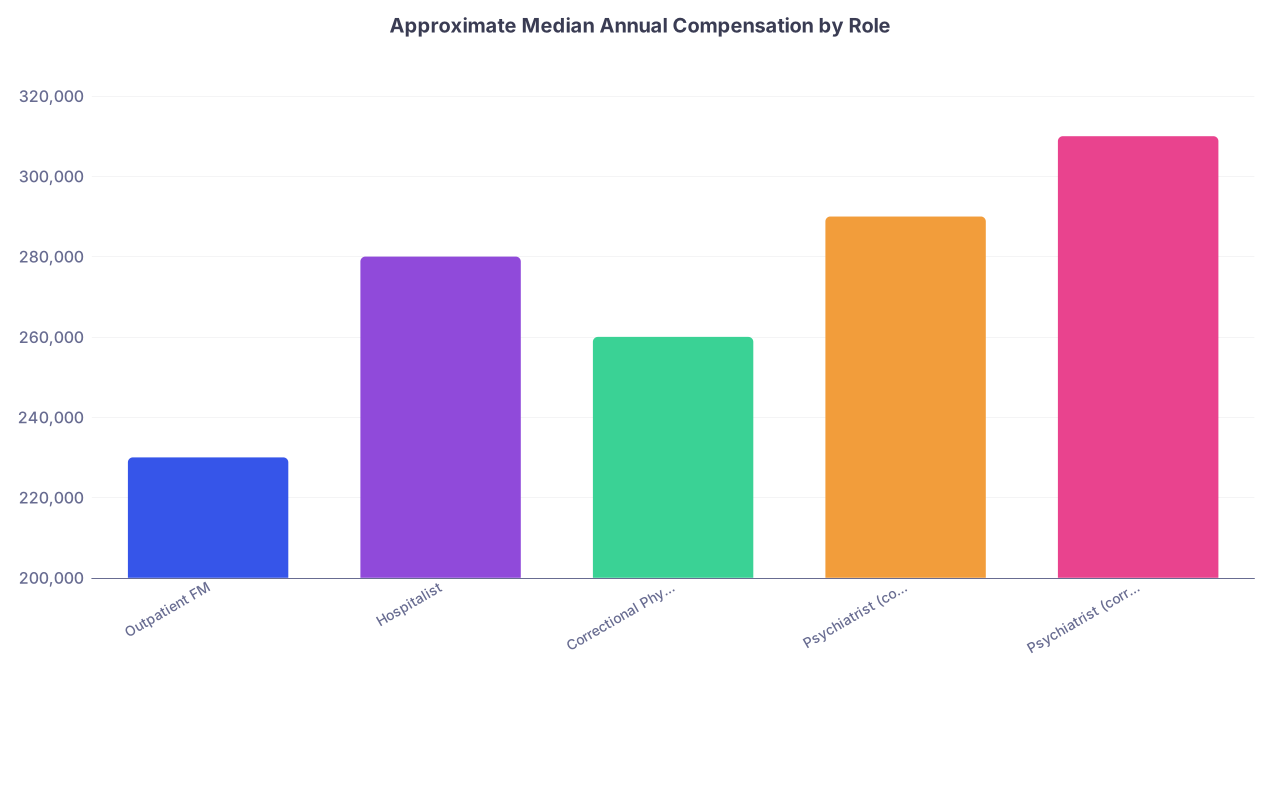
| Category | Value |
|---|---|
| Outpatient FM | 230000 |
| Hospitalist | 280000 |
| Correctional Physician | 260000 |
| Psychiatrist (community) | 290000 |
| Psychiatrist (correctional) | 310000 |
Again: not breath-taking, but not “bottom of the barrel.” For some people, the tradeoff (predictable hours, pension, no RVU nonsense) makes it a net win.
Where You Actually Lose Financially
There are ways to do correctional medicine badly financially:
- Signing with a national private contractor that takes a 20–30% cut off the top and pays you low-200s for a full FTE with high volume expectations.
- Taking a “per diem” or locums rate that looks great hourly, but offers no benefits, no retirement, no stability—and then filling only 0.5–0.7 FTE worth of shifts.
- Accepting an academic-correctional hybrid where the university keeps salary artificially depressed under the banner of “mission” while loading you with admin tasks.
If a contractor is paying you $200–220k to be the de facto medical director of a medium or large facility, you are underpaid. Period.
The Hidden Financial Upside
A lot of correctional physicians quietly hit FI (financial independence) in their 50s and walk away early. Why?
- Solid government pensions with 20–25 year vesting.
- No night shifts. No extra call. So they do low-risk moonlighting (telemedicine, urgent care) on top for a few years.
- Stable schedules, which make side hustles or academic adjunct work possible.
You can also use correctional work as a high-yield geographic arbitrage: high-salary state positions in low cost-of-living rural areas with very low competition for jobs.
If you want to see the tradeoffs laid out simply:
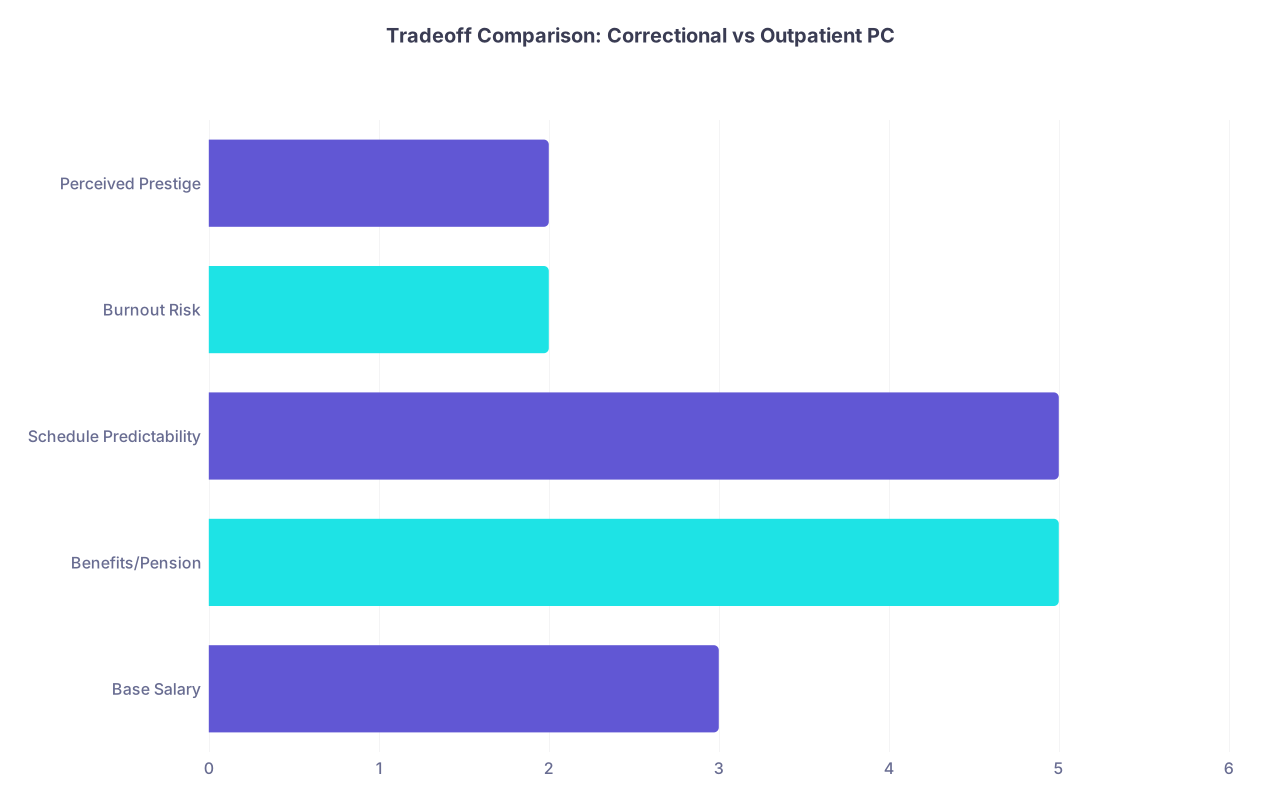
| Category | Value |
|---|---|
| Base Salary | 3 |
| Benefits/Pension | 5 |
| Schedule Predictability | 5 |
| Burnout Risk | 2 |
| Perceived Prestige | 2 |
(Think of 1–5 scale: 5 is best. Correctional medicine usually crushes on benefits and schedule, loses on prestige.)
Day-to-Day Work: What You Actually Do
Let’s make this concrete. A week for a state prison IM/FM physician might look like:
- Chronic care clinic: diabetes, HIV, hep C, HTN, COPD, CHF. Labs, medication adjustments, counseling (brief).
- Acute “sick call”: chest pain, abdominal pain, infections, injuries, withdrawal symptoms, wound care.
- Intake screening: new arrivals with unknown histories, med recon, TB screening, suicide risk assessment.
- Administrative: reviewing labs, imaging, nurses’ triage notes, telehealth consults, mortality/morbidity reviews.
- Segregation checks: brief but regular assessments of people in restrictive housing.
- Occasional emergencies: MI, strokes, overdoses, assaults, seizures—stabilize and send out.
Psychiatrists see:
- High-volume mood disorders, psychotic disorders, PTSD, personality disorders.
- Acute risk assessments for self-harm and violence.
- Medication management under close formulary constraints.
- Constant questions of “malingering” vs real illness in a context where secondary gain is real.
Is it glamorous? No. Is it clinically rich? Absolutely. You will become very, very good at:
- Bread-and-butter internal medicine
- Infectious disease management
- Risk assessment
- Talking to difficult, manipulative, or trauma-scarred patients without losing your mind
And because access to tertiary care is constrained, you learn to do more with less. That can either sharpen you or frustrate you, depending on your personality.
Training Pathways and How to Position Yourself
Nobody in med school says, “I want to be a prison doctor,” yet many people end up there. The ones who thrive usually build some of this on the way:
Best-Fit Residencies
Family Medicine or Internal Medicine are the default. Psychiatry is the other major on-ramp. EM is decent preparation for acute/jail settings.
What differentiates you:
- Residency programs with strong underserved or public health focus.
- Rotations in correctional facilities, safety-net clinics, addiction medicine, HIV clinics.
- Dual training or special interests: addiction, HIV/hep C, geriatrics, psych.
A few family medicine and IM programs now have explicit correctional health tracks or electives. If yours does, take them. If not, ask to set one up. Most departments have someone with a county or state contact.
Skills That Actually Matter
You will get far more mileage from:
- Being comfortable managing complex chronic disease with limited resources.
- Solid psychopharm basics.
- Strong motivational interviewing skills.
- Knowing how to write tight, defensible notes that survive legal scrutiny.
than from fancy procedures. Your job is cognitive heavy lifting and relationship management, not central lines.
Early Exposure: What to Look For
If you can rotate through a correctional facility as a student or resident, pay attention to:
- Staff morale in medical and custody. Are they burned out, cynical, or engaged?
- How often and how well medical pushes back when custody asks for questionable “clearances.”
- How much time docs get for documentation vs. being rushed through patient encounters.
- Whether the medical leadership has a seat at the table in operations or is completely sidelined.
If during your rotation the doctor tells you, “Never work in this place,” and the reasons are systemic (understaffing, retaliation for speaking up, routine rights violations), listen.
If they say, “It’s challenging, but we do good medicine and admin has our backs when we push,” that is the environment where you can build a career.
System-Level Realities You Cannot Ignore
You are not practicing in a vacuum. You are embedded in one of the most dysfunctional systems in American life: mass incarceration.
That has direct implications:
- High burden of trauma, addiction, untreated mental illness.
- Deep racial and socioeconomic inequities.
- Patients who do not trust you, often with good historical reasons.
- Legal and regulatory oversight that can either protect or hamstring you.
You will see:
- People cycling through jail for untreated psych illness and substance use.
- Patients who get better in the structure of prison and then crash immediately on release.
- Chronic disease poorly controlled because of chaotic care before incarceration and disrupted care after.
You have to decide: Are you treating this as just a job, or as a public health role?
The best physicians in this space:
- Build re-entry medication and follow-up plans when possible.
- Coordinate with community clinics and public health departments for HIV/hep C/TB.
- Advocate at the policy level for MAT (medication-assisted treatment), harm reduction, and better continuity of care.
That is not just idealism. It also makes your work more tolerable. If your only frame is “I fix what I can inside and forget what happens after,” the revolving door will demoralize you.

| Step | Description |
|---|---|
| Step 1 | Community |
| Step 2 | Arrest |
| Step 3 | County Jail |
| Step 4 | State or Federal Prison |
| Step 5 | Re entry Planning |
| Step 6 | Community Follow up |
How to Evaluate a Correctional Job Offer
If you are seriously considering this path, you cannot just look at the salary number and shrug.
Here is the quick and dirty checklist I tell residents to use:
Who is the actual employer?
- State DOC, county, federal BOP, academic med center, or private contractor?
- If private, what is their litigation history? Any DOJ investigations?
Staffing ratios
- How many physicians, NPs/PAs, nurses per 1,000 inmates?
- Is there dedicated psych, or is everything on the primary team?
Safety practices
- Is there always custody presence in clinic?
- Panic buttons, radios, clear policy for refusing unsafe situations?
Autonomy and support
- Who makes final calls on transfers, segregation clearance, and off-site referrals?
- Are providers supported when they say “this is not medically acceptable”?
Schedule and compensation structure
- Exact hours, call expectations, overtime, comp time.
- Pension eligibility, health benefits, loan repayment options (yes, some qualify for PSLF and state programs).
Put those answers into context with your own priorities. If you want lifestyle, patient complexity, and a pension, a state DOC job in a low-cost state may beat private practice primary care handily. If you want prestige, research, or procedure-heavy work, this is the wrong lane.

The Bottom Line: Who Actually Thrives in Correctional Medicine
Let me be blunt.
You will hate this job if:
- You need constant external validation and prestige.
- You cannot tolerate working in a morally gray system.
- You crumble when administration pushes back on your decisions.
- You are horrified by the idea of seeing manipulative, angry, traumatized patients all day.
You will do very well if:
- You like complex, gritty internal medicine and psychiatry.
- You value a predictable schedule over brag-worthy income.
- You are comfortable saying “no” and backing it with documentation.
- You can see the human being behind serious crimes without becoming naive or boundary-violating.
Correctional medicine is not the garbage bin of clinical careers. It is a niche, with specific tradeoffs. If you understand the safety reality, the autonomy constraints, and the pay structure—and still feel pulled toward it—you are probably exactly the kind of physician the field desperately needs.

Key Takeaways
- Safety in correctional medicine is usually better than the horror stories, but depends heavily on facility culture and security practices—do not ignore red flags.
- Autonomy is real but structured: strong clinical independence within formulary and security limits, plus significant ethical tension where your backbone matters more than your CV.
- Compensation is often in the mid-to-upper primary care range, with major upside in benefits, pensions, and schedule predictability—“lowest paid specialty” is an oversimplification that misses the full financial picture.


