

It’s 10:45 p.m. You’re supposed to be “studying specialties” but instead you’re doom-scrolling Reddit threads:
“FM is a scam,” “IM outpatient = burnout factory,” “PCPs are the lowest paid and most overworked.”
Your brain keeps looping the same fears:
What if I pick primary care, burn out by 35, and feel stuck because I’m too deep in?
What if I’m doing 12-minute visits for $200k while my surgery classmates are at $600k?
What if I hate my life but it’s too late to change?
Let’s walk straight into that. No sugarcoating. But also no Reddit-drama exaggeration.
The Two Things That Freak You Out: Burnout and Money
You’re not imagining it. Primary care is one of the lowest paid specialties and does have some of the highest burnout.
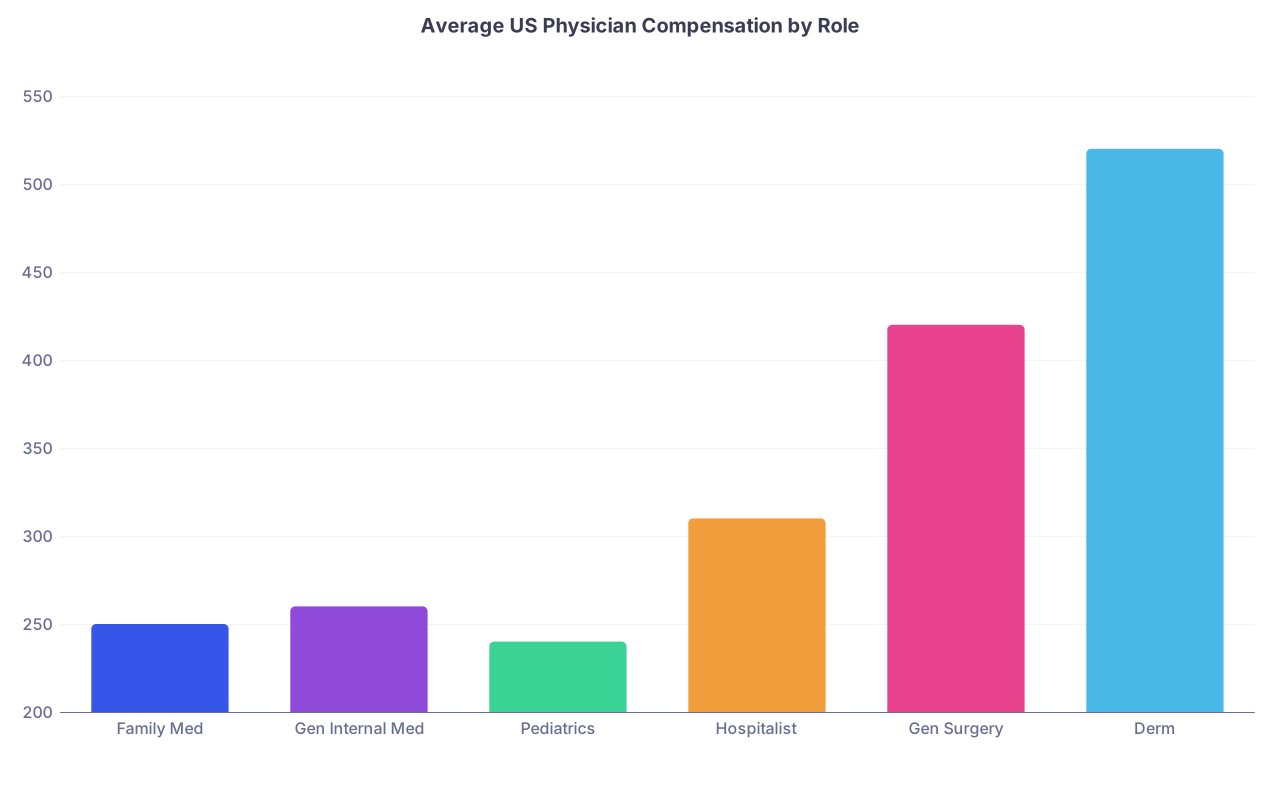
| Category | Value |
|---|---|
| Family Med | 250 |
| Gen Internal Med | 260 |
| Pediatrics | 240 |
| Hospitalist | 310 |
| Gen Surgery | 420 |
| Derm | 520 |
These are broad ballparks (2024-ish, US, before taxes, highly variable), but the pattern is real: outpatient primary care = bottom of the pay list.
Burnout? Multiple surveys have primary care, especially family med and outpatient IM, near the top in emotional exhaustion and feeling undervalued.
So if your gut is saying: “Wait, why would I sign up for the lowest pay and some of the highest burnout?”
That’s not you being dramatic. That’s just you reading the room correctly.
But here’s the twist: that’s not the whole story, and it’s not evenly distributed. Some primary care jobs are actual dumpster fires. Some are shockingly good.
The problem isn’t “primary care.”
The problem is bad practice models.
What Actually Burns People Out (It’s Not Just Salary)
You know what doesn’t burn people out?
“Caring about patients.” That’s not the issue.
The soul-crushers in primary care usually look more like this:
You’re in a big corporate system. Panel of 2500 patients.
Scheduled 20–24 patients a day. Double-booked sometimes.
Everyone wants chronic disease management, forms, refills, disability paperwork.
15 minutes per visit, but more like 7 or 8 once the MA is done, the patient is roomed, and you’ve fought with the EMR.
You finally get home. Charting isn’t done. You open your laptop. It’s 9 p.m.
Your in-basket is full of patient messages, refill requests, and “just a quick question” portal messages the system expects you to handle for free.
That is how burnout happens.
Notice what’s missing:
Nobody said “this person hates primary care.”
They hate the conditions: visit volume, admin overload, lack of support, and feeling like a revenue unit.
I’ve seen people warn students off primary care because their job is awful. Then they move to a smaller practice with 14–16 patients a day, actual support staff, and protected admin time—and suddenly they’re like, “Wait. I actually like my job.”
So if you’re going to be scared of something, be scared of the wrong job, in the wrong system, with zero boundaries, not the whole field.
Money: Are You Dooming Yourself Financially?
Here’s the financial anxiety in your head:
- “$230–270k sounds fine now, but with loans, kids, house… is it actually?”
- “What if I regret not going into anesthesia/rads/surg for the money?”
- “Will I be stuck working until I’m 75 because I chose family med?”
Let me be blunt: if you’re aiming for maximum income, primary care is not the winner. You already know that.
But the better question is:
“Is primary care financially viable and compatible with a reasonable life?”
Usually? Yes. With some conditions:
You can’t pretend $250k is $600k.
Live like a doctor, sure, but not like the highest-paid doctor in your friend group. The people who say primary care is “impossible” financially often also have huge houses, private school tuition, two luxury cars, and expensive city lifestyles. That’s not an income problem. That’s a lifestyle problem.Geography is a cheat code.
Primary care in NYC or SF on an employed salary with insane cost of living? Pain.
Primary care in a mid-size or smaller city or semi-rural area? Suddenly $260–300k goes a whole lot further. Some rural jobs, FQHCs, and underserved areas throw in loan repayment on top.You have levers you can pull.
Urgent care shifts. Telehealth one evening a week. Direct primary care with membership fees. Teaching stipends. Medical director roles. Primary care isn’t capped exactly where your base salary starts.
Here’s the uncomfortable truth:
You can do just fine financially in primary care, but not if you mix it with denial (about loans, about spending, about cost of living) and then blame the specialty.
Is the Burnout “I Hate Medicine” or “I Hate This Job”?
A lot of the horror stories you’re seeing are from people in specific setups:
- Large hospital systems or corporate chains with RVU pressure
- 20–24 patients per day, 5 days a week
- No control over scheduling, no say in workflows
- EMRs from hell and understaffed support
You absolutely can end up there if you sign the first job that offers a signing bonus and a vaguely decent salary.
But there are other versions of primary care:
- Smaller independent practices where the doc is a part-owner and sets visit length
- Direct primary care models with 8–12 patients per day, membership-based
- Hybrid clinic + telehealth jobs where you do 3 days in-person, 1–2 days remote
- Academic primary care with 50% clinic, 50% teaching/admin
I’ve watched residents panic their PGY-3 year thinking, “Primary care = death” because of their continuity clinic set in a broken system. Then they spend one afternoon visiting a well-run clinic where the doc has 30-minute slots and an RN who handles 80% of the inbox, and their whole view shifts.
So when you ask “Is primary care still worth it?” the answer depends heavily on:
- How much control you’re willing to demand over your future job
- Whether you’re willing to say no to toxic offers, even if they pay a little more
- Whether you’re okay not chasing the highest possible income ceiling
Comparing Primary Care to Other “Low-Pay” Fields
You’re in the “lowest paid specialties” category mentally: primary care, peds, psych (sometimes), maybe hospitalist work.
Let’s put some structure around it.
| Specialty | Typical Range (US) | Lifestyle Risk | Burnout Risk |
|---|---|---|---|
| Family Med | 230–280k | Variable | High |
| Outpt. IM | 240–290k | Variable | High |
| Pediatrics | 220–260k | Often good | Moderate |
| Psych (outpt) | 260–320k | Can be good | Moderate |
| Hospitalist | 280–340k | Shift-based | Moderate |
These numbers wobble by region, setting, bonus structure, etc., but the pattern stands: primary care is near the bottom of pay, not alone, but definitely not competing with derm/ortho/rads.
Lifestyle and burnout are messy. You’ll find FM docs who love their 4-day weeks and have hobbies, and FM docs who are dead inside at 32. You’ll find hospitalists who love 7-on/7-off and others who are fried.
The point: none of these specialties guarantees safety from burnout or struggle. You can absolutely burn out as a radiologist or an anesthesiologist too—it just manifests differently.
How To Tell If You’re Actually a Primary Care Person… or Just Afraid of It
Sometimes the fear of low pay and burnout is masking a different problem:
You might actually like primary care, but you’re scared of “wasting” your potential.
Ask yourself:
Do you actually enjoy longitudinal relationships?
Do you like being the first call when a patient’s life falls apart?
Do you get satisfaction out of being the person who knows the whole story—not just one organ?
Or do you mostly feel guilty that you’re “not aiming higher” because people around you are chasing more competitive specialties?
If talking about preventive care, chronic disease management, and “family doctor who knows three generations” secretly warms your soul a bit, that’s not nothing. Pay attention to that.
If, on the other hand, you light up doing procedures, or reading imaging, or being in the OR, and primary care only feels safer because it’s “less competitive,” then your fear isn’t about burnout or pay. It’s about disappointing yourself or failing to match the thing you actually want.
Primary care isn’t the “safe” choice if you’ll resent it for 30 years.
Can You Protect Yourself From the Worst-Case Scenarios?
Let’s talk about the big what-ifs in your head and how much control you realistically have.
“What if I match FM/IM, then hate outpatient life?”
You’re not locked in forever. Internal medicine still has hospitalist, subspecialty fellowships, even palliative, ID, cards, GI, etc. Family med has sports med, addiction, urgent care, hospitalist FM in some places, academic tracks.
Do some of those paths pay less than procedural subspecialties? Sure. But it’s not like you’re trapped in a single version of primary care for life.
“What if I burn out in my first job?”
Then you leave. Quickly. The trap is staying 5–10 years in a bad job and thinking that means the specialty is the problem.
I’ve seen people change their entire outlook on medicine by:
- Going from 5 days a week to 4
- Moving from corporate clinic to FQHC with sane volume + loan repayment
- Joining a direct primary care practice
- Moving to a smaller city where cost of living is lower and panels are manageable
You absolutely have to be willing to walk away from toxic setups. If you’re a chronic people-pleaser who can’t say no, primary care will chew you up unless you learn that skill.
“What if I can’t support a family on primary care pay?”
You can. Plenty of people do. But if your mental picture of “supporting a family” is ultra-high-cost city, fancy private schools, and massive house, then yeah, it’s going to feel tight.
Primary care is totally compatible with:
- Middle to upper-middle-class life
- Reasonable house, decent area, vacations, kids’ activities
- Stable retirement if you’re not reckless with money
It is not compatible with living like a tech CEO on day one.
How To Think About This Without Losing Your Mind
Here’s what I’d do if I were you and full of anxiety about this:
Stop thinking in specialties. Start thinking in jobs.
Imagine an actual day: how many patients, what pace, what kinds of problems, how much charting, commute, call, colleagues. You’re not choosing an abstract; you’re choosing to train for a set of possible future daily lives.Go find one primary care doc who actually likes their job.
Not the one who corners med students and vents for 40 minutes. Someone who’s been out 5+ years and isn’t dead inside. Ask them specific questions: visit length, panel size, admin load, how many evenings a week they’re charting.Be honest about your values.
If the idea of making “only” $250k honestly fills you with dread or resentment, that’s not going to magically disappear later. It’s okay to admit you want more money. Just don’t lie to yourself and then call it “burnout” later.Remember: every specialty has tradeoffs.
Surgery = more money, also more call, OR delays, complications, higher stress.
EM = shift work, lifestyle… plus night shifts forever and job market worries.
Rads = high pay, more sitting/screen time, pressure for speed.
You’re not choosing “easy perfect” vs “hard and miserable.” You’re choosing which problems you want.

| Step | Description |
|---|---|
| Step 1 | Interested in Longitudinal Care |
| Step 2 | Consider higher paying fields |
| Step 3 | Explore Primary Care Paths |
| Step 4 | Primary Care Remains On Table |
| Step 5 | Money Priority High |
| Step 6 | Can Accept 230-300k Range |

So… Is Primary Care Still Worth It?
If your metric is: “Will this make me rich and impress everyone at cocktail parties?”
No. Primary care will not win that game.
If your metric is: “Can I have a financially stable life, decent hours, meaningful relationships with patients, and some control over my schedule?”
Then yes, primary care can 100% be worth it—if you’re deliberate about where and how you practice.
Here’s the part nobody tells you during med school:
A well-structured primary care job can be more sustainable and emotionally satisfying than a high-paying procedural job that you dread going to every day.
But a bad primary care job?
It’s exactly the nightmare you’re imagining. Late-night charting, low pay relative to workload, constant pressure, feeling like a cog. You should be scared of that. And determined to avoid it.
You’re not crazy for worrying about burnout and money. You’re just seeing the tradeoffs clearly. The real question isn’t “Is primary care good or bad?” It’s:
“Am I willing to shape my career aggressively enough to make a low-paid specialty work for my life?”
If the answer is yes, then primary care is still very much on the table.


