

The fantasy that you’ll magically love your specialty forever is dangerous.
If you’re matching into a low-paying specialty and already wondering, “What if my interests change?” — you’re not being dramatic. You’re being realistic. Because interests do change. People do regret. And yes, money starts to matter more when the loans come due and your classmates are posting their anesthesiology paychecks on Reddit.
Let’s walk straight into the thing you’re afraid of instead of pretending it doesn’t happen.
The Fear You’re Too Afraid To Say Out Loud
You’re probably spinning through some version of this:
- “What if I match into pediatrics/family/psych and then realize I actually want ortho or derm?”
- “What if I wake up PGY-3 and hate my life and I’m making half of what my classmates are?”
- “What if I trap myself in a low-paying, burnout-heavy field and I can’t get out?”
- “What if I’m already making a mistake and the Match just locks it in?”
You’re not crazy for thinking this. I’ve watched:
- A pediatrics PGY-2 secretly studying for Step 3 while telling everyone she was “just tired,” when really she was trying to switch to anesthesia.
- A family med resident in a community program who realized after intern year he actually loved inpatient medicine and wanted hospitalist life + cards fellowship.
- A psychiatry PGY-4 with 350k in loans saying, “I feel like I picked the ‘meaningful’ field and now I’m financially screwed forever.”
So yes. This happens. More than anyone admits publicly.
But here’s the part your anxiety is skipping: there are more exits, side doors, and creative pivots than your brain is currently allowing.
Reality Check: How Locked-In Are You Really?
Let’s be blunt.
The Match is binding for that year. It’s not binding for your entire life.
You are committing to start a residency. You are not swearing a blood oath to one specialty and one salary forever. People:
- Switch specialties after 1–2 years
- Do extra fellowships that change their day-to-day and income
- Add side gigs and niches that completely transform their financial picture
- Transition out of clinical full-time altogether
Still, your brain is whispering, “Okay, but what if I hate my low-paying specialty and can’t switch and I stay stuck and broke and burned out?”
So let’s hit the actual mechanisms and worst cases.
| Scenario | How Trapped Are You? |
|---|---|
| PGY-1 in low-paying specialty | Not very |
| PGY-3+ with family/roots in city | Moderately |
| Boarded attending, 5+ years in | Emotionally more than logistically |
| Heavy loans, single-income family | Financially constrained |
Your flexibility shrinks over time. But it doesn’t vanish.
Worst-Case Scenario: You Change Your Mind After Matching Low-Paying
Let’s play out the nightmare you’re replaying in your head.
You match into a lower-paying field — let’s say:
- Pediatrics
- Family Medicine
- Psychiatry
- Internal Medicine (but you don’t match a high-paying fellowship)
- OB/GYN in a saturated area
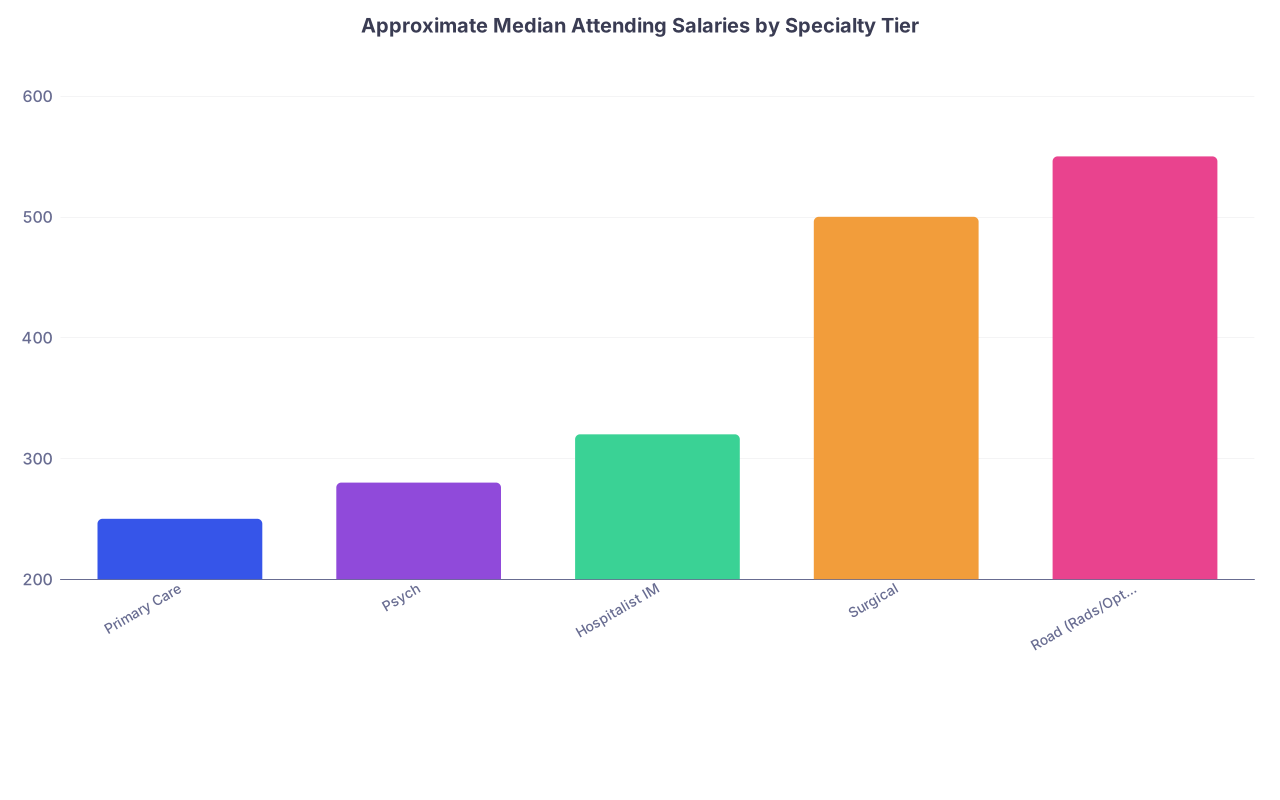
| Category | Value |
|---|---|
| Primary Care | 250 |
| Psych | 280 |
| Hospitalist IM | 320 |
| Surgical | 500 |
| Road (Rads/Optho/Anesthesia/Derm) | 550 |
You finish intern year and suddenly:
- You’re exhausted
- You don’t love clinic or the patient population the way you thought
- You see how much documentation/admin nonsense this specialty requires
- You meet residents from another specialty and think, “Oh. That. I want that.”
Your brain jumps straight to:
- “It’s too late.”
- “Programs won’t take me.”
- “I’ll have to redo intern year and they’ll judge me.”
- “I’ll look flaky and unemployable forever.”
Here’s what actually tends to happen in real life:
1. Switching specialties during residency is hard — but not impossible
Is it easy? No. Is it done every single year? Yes.
People switch from:
- Family → Anesthesia, PM&R, EM, IM
- Peds → Anesthesia, EM, psych, even radiology
- Psych → Neuro, IM, anesthesia
- IM → Cards, GI, or just a different type of IM
The key things programs care about:
- Are you running from something or running toward something?
- Do you have any evidence you understand the new specialty (electives, LORs, research, shadowing)?
- Are you clinically solid in your current role, or are you a problem child they’re trying to avoid inheriting?
So if your fear is, “If my interests change, there will be literally no way to pivot,” that’s just not true.
2. You can finish the residency and then pivot through fellowship or niche
This is the under-discussed path.
Different low-paying specialties have very different expansion options. A few examples:
- Pediatrics → PICU, NICU, peds EM, heme/onc, cardiology, hospitalist medicine, industry roles (vaccine/drug trials), medical education.
- Family Medicine → Sports med, sleep, palliative, addiction, urgent care, hospitalist with extra training, admin/leadership, direct primary care (DPC).
- Psychiatry → Interventional psych (ketamine, TMS, ECT), forensics, consult-liaison, telepsych, private practice, partial clinical + half-industry (pharma, digital mental health companies).
- Internal Medicine (without big fellowship) → Hospitalist with nocturnist premiums, leadership roles, QI roles, med ed, early pharma/biotech work.
No, these won’t all magically make you a neurosurgery-level earner. But the income ceiling in “low-paying” fields is way more variable than med school rumor suggests.
Money Panic: What If I End Up Poor Compared to Everyone Else?
You’re looking at salary numbers and thinking:
“I’m going to lock into pediatrics at 230–260k while my ortho friends are making 700k+ post-fellowship. Did I just screw myself and my future family?”
The brutal truth: the gap is real. But your brain is catastrophizing the practical impact.
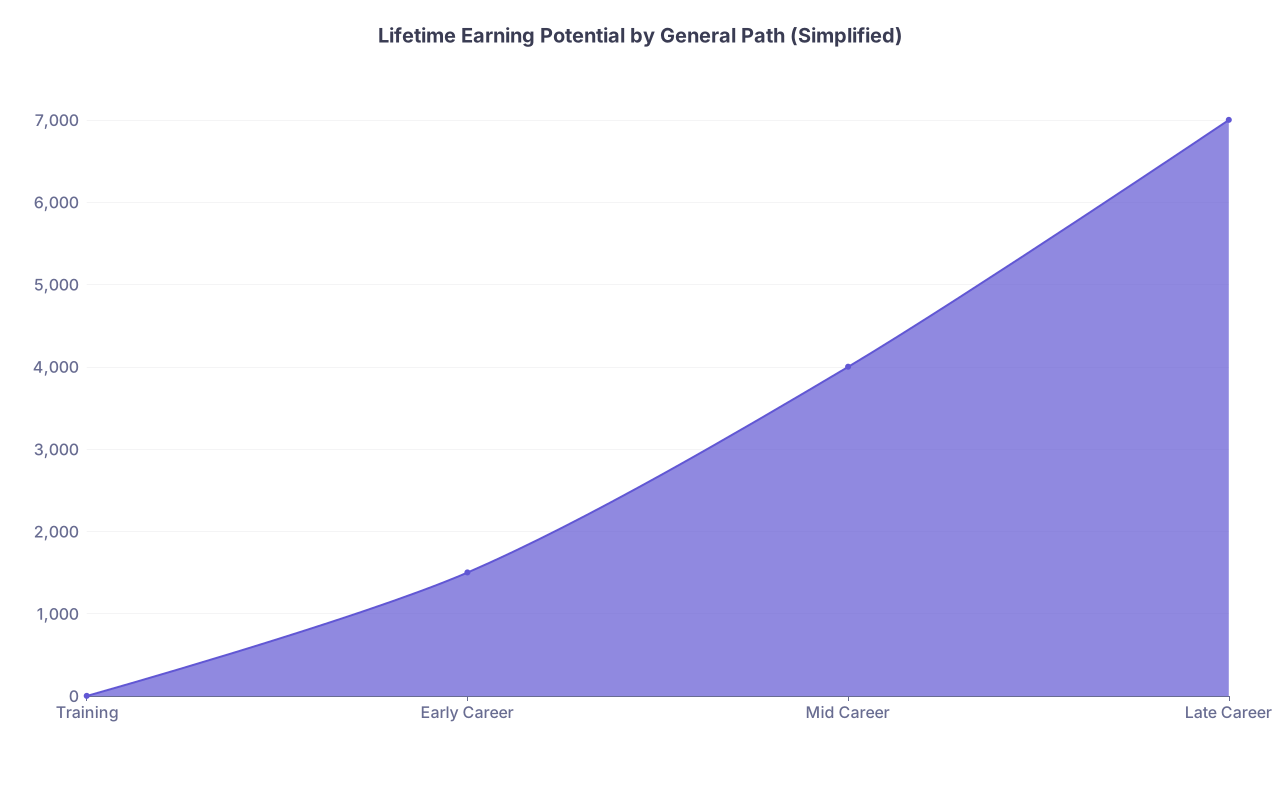
| Category | Value |
|---|---|
| Training | 0 |
| Early Career | 1500 |
| Mid Career | 4000 |
| Late Career | 7000 |
(Think of those values as “thousands” of dollars of cumulative earnings: low-paying vs high-paying specialty curves.)
What actually determines whether you feel “broke” as a low-paid specialist:
- Your cost of living (HCOL vs LCOL)
- How aggressively you manage debt in the first 5–10 years
- Whether you build any side income, leadership, or niche work
- How much lifestyle creep you allow once you finally start making money
I’ve watched a peds hospitalist clear her loans in under 7 years and hit a net worth her surgery friends would kill for — because she lived like a resident for several years and did extra shifts. I’ve also watched a high-earning anesthesiologist drowning in payments because they bought the house, the car, the private school, everything, instantly.
Is the money gap fake? No. But it’s not the sole determinant of whether your future self is miserable.
The Emotional Trap: “If My Interests Change, It Means I Failed”
This one hurts.
You’re telling yourself that if your interests change:
- It means you chose wrong
- It means you didn’t “know yourself” well enough
- It means you wasted years of training
- It means you’re behind everyone forever
I want you to hear this very clearly: medicine is one of the only professions that expects 22–24 year olds to predict who they’ll be at 45 and then shame them when they evolve.
People:
- Change careers in tech every 3–5 years
- Pivot in business from operations to product to leadership
- Go from bedside nursing to informatics to education
Medicine is weirdly rigid, but you don’t have to internalize that rigidity as personal failure.
If your interests change, it means you grew with more information. That’s it.
Concrete Ways To Protect Your Future Self (Even If You Do Change Interests)
You want something you can actually control. So here:
1. Match strategy: build optionality now
If you’re still in the application or early Match phase, there are ways to pick programs that leave more doors open, even within low-paying specialties:
- Favor university-affiliated programs with more subspecialty exposure
- Pick programs that have clear pathways to fellowships or niche roles
- Look for places where residents have successfully gone into nontraditional jobs (industry, admin, etc.)
| Specialty | Flexibility Potential |
|---|---|
| Internal Med | Very high |
| Psych | High |
| Family Med | High |
| Pediatrics | Moderate–High |
| OB/GYN | Moderate |
If you’re already matched, skip this. Don’t torture yourself. Focus on what you can still change.
2. During residency: quietly test your “what ifs”
You’re worried your interests could change? Then start gathering data early instead of sitting in dread.
- Take electives in specialties you’re curious about (even if you feel guilty for “cheating” on your field)
- Volunteer for QI, admin, or research projects that get you face time with other departments
- Talk to upper-levels and attendings who left or almost left your specialty — they’ll tell you what’s actually possible
This does two things:
- Confirms whether your fantasy specialty is really a fit, or just a grass-is-greener escape fantasy.
- Builds relationships you’ll need if you ever decide to pivot.
3. Work on financial flexibility from day one
If you’re in a low-paying specialty and you’re scared of being stuck, your best weapon is future leverage, which usually means:
- Minimizing lifestyle creep after residency
- Refinancing/optimizing loans once you’re out of the training fog
- Being strategic about geography (LCOL areas often pay more, ironically)
- Considering part-time telehealth / moonlighting / urgent care once you’re stable
This is how you protect the “option” to leave a toxic job, reduce FTE, or take a fellowship later without feeling like you’re going to go bankrupt.
If Your Interests Change After You’ve Already Started: What Then?
Let’s say the worst has already happened. You’re in training and thinking, “I chose wrong.”
Here’s the rough decision tree you’re facing:

| Step | Description |
|---|---|
| Step 1 | Realize you dislike current specialty |
| Step 2 | Finish residency |
| Step 3 | Explore switch |
| Step 4 | Fellowship or niche |
| Step 5 | Optimize job and schedule |
| Step 6 | Talk to PD and mentors |
| Step 7 | Apply to new specialty |
| Step 8 | Switch if accepted |
| Step 9 | Finish current program if not |
| Step 10 | How bad is it? |
| Step 11 | Want to change focus? |
A few ugly but honest truths:
- Switching is easier early (PGY-1/PGY-2) than PGY-3+
- Some credits/years may not transfer — you might “lose” time
- Program politics matter; some PDs are supportive, some take it personally
But also:
- Plenty of people quietly hate intern year and then end up liking life as a senior and loving attending life.
- Some people are miserable in general and think switching specialties will fix it — but their issue is deeper (burnout, depression, life stress, lack of boundaries).
- Even if you never switch, you can drastically change your day-to-day within a “low-paying” field.
The Truth You Don’t Want But Need: You Can’t Eliminate All Risk
You want some guarantee that if your interests change, there’ll always be a perfect, high-paying, zero-regret escape hatch.
There won’t be.
There will be tradeoffs. Time, money, location, pride. Switching specialties might mean:
- Extra years of training
- Moving cities
- Starting at the bottom again
- Awkward conversations with colleagues
Staying might mean:
- Less money than you wanted
- Chronic frustration with certain aspects of your field
- Periodic “what if” thoughts about the road not taken
But that doesn’t mean you’re doomed either way. It just means you’re human in a system that’s very rigid and expects impossible certainty from very young people.
The win isn’t “never regretting anything.” It’s building enough flexibility — mentally, financially, logistically — that you have options if your future self wants something different.
What You Can Do Today (Not In Six Months, Not “Someday”)
You’re probably doomscrolling right now, half-numb with anxiety about all this. So here’s something specific and small:
Open a blank page and write down:
- The specialty you’re matched to or aiming for.
- Three things you think you’ll like about it.
- Three things that genuinely scare you about it (including money, lifestyle, content).
- One related specialty or niche that might interest you if things change.
That list becomes your starting map.
Then pick one concrete action this week:
- Email a resident in that specialty and ask blunt questions about regret.
- Look up fellowship options for your field and read what they actually do and earn.
- If you’re already in residency, schedule an elective or shadow day that tests your “what if” field.
Do that, not another two hours of reading horrifying threads about “I chose the wrong specialty” on SDN.
You can’t make future uncertainty disappear. But you can stop being completely at its mercy.


