
The clock after a near-miss or adverse event matters more than the event itself. What you do in the next 7 days can decide whether this becomes a learning moment—or a malpractice claim that haunts you for years.
I’ve watched good clinicians turn a contained situation into a legal disaster simply by documenting poorly, talking loosely, or delaying the right notifications. Not because they were bad doctors. Because they were bad at timelines.
You need a playbook. Hour by hour, day by day.
Below is a 7-day risk and documentation timeline—what to do, what not to do, and when to do it—specifically focused on malpractice exposure, documentation, and insurance implications.
Before Day 1: The First 0–2 Hours (Immediate Response Window)
At this point you are still in the event. Emotions high. Risk also high.
Your priorities are:
- Patient safety
- Honest, factual documentation
- Early protection of your legal and insurance position
In the first 0–30 minutes
Focus: Stabilize and document the basics.
- Stabilize the patient or ensure the team is doing so.
- Communicate clearly with the team: no blame, no speculation.
- Make a brief, factual note in the record:
- What happened
- Your assessment
- Your immediate actions and orders
- Do not document:
- “Error,” “mistake,” “malpractice,” “negligence”
- Blame statements about colleagues or systems
- Your emotions or opinions about liability
You’re documenting clinical facts, not writing a confession.
By 2 hours
At this point you should:
- Notify your supervising physician or department lead (if you’re not the attending).
- Make sure your initial note is complete and time-stamped.
- If your institution has an occurrence-reporting or incident-reporting system:
- File the internal incident report separate from the medical record.
- Keep it factual and concise; these are usually quality-improvement tools, not discoverable clinical notes, but assume anything might someday be seen.
And crucially:
- Call your malpractice carrier’s risk or claims hotline if:
- There was serious harm or death.
- The family is angry, threatening, or asking about legal action.
- There’s a clear deviation from usual practice or a “never event” (wrong site, wrong patient, retained foreign body, etc.).
- You received any written complaint.
Even if you’re “not sure it’s that bad,” early calls are almost always better.

| Step | Description |
|---|---|
| Step 1 | Adverse or near-miss event |
| Step 2 | Stabilize patient |
| Step 3 | Document facts in chart |
| Step 4 | Notify supervisor |
| Step 5 | Call malpractice carrier |
| Step 6 | File internal incident report |
| Step 7 | Serious harm or concern? |
Day 1: Risk Triage, Documentation Cleanup, and Early Communication
Day 1 is about cleaning up the record, controlling your communication, and setting up the right protections.
Morning (0–12 hours after event)
At this point you should:
Re-read your initial note with a cooler head:
- Add an addendum if needed to clarify facts or sequence.
- Correct any obvious omissions:
- Time of recognition
- Vital signs
- Orders placed
- Consults requested
- If you add an addendum, label it clearly as such, with date/time.
Do not:
- Alter or delete prior entries.
- Backdate anything.
- Copy/paste whole chunks of text to “pad” the record.
That kind of thing gets destroyed in discovery.
Family / patient discussion
If you’re the attending or responsible clinician, by Day 1 you should have:
- A clinical disclosure conversation:
- Focus on:
- What happened
- Current status
- Next steps
- Use plain language, not defensive jargon.
- Focus on:
- Follow institutional policy on disclosure and apology:
- Many states have apology laws that protect expressions of sympathy.
- But they may not protect explicit admissions of fault (“This was my mistake”).
Smart approach:
- Express empathy:
- “I’m very sorry this happened and that you’re going through this.”
- Avoid legal conclusions:
- Don’t say “This was negligence” or “We violated standards.”
If risk management or your malpractice carrier offers to sit in or coach this, take it.
Administrative and insurance steps by end of Day 1
By the end of Day 1, you should have:
- Contacted:
- Your malpractice carrier if there’s any credible risk of a claim.
- Your institution’s risk management (often mandatory).
- Documented in the chart:
- That you discussed the situation with the patient/family.
- The clinical content of that discussion (no need to mention “legal” anything).
- Not documented in the chart:
- “Called malpractice carrier.”
- “Spoke to hospital legal about liability.”
Keep legal/insurance communications outside the medical record.

Day 2: Legal Positioning and Detailed Review
At this point the dust has settled clinically. Now you’re shifting into structured risk management.
Morning of Day 2
You should:
- Do a detailed chart review:
- Your notes
- Nursing notes
- Orders and MAR (medication administration record)
- Lab/imaging timestamps
- Build a private timeline for yourself (not in the chart):
- Key events with exact times
- Who was involved
- What was communicated and when
This private timeline is for your memory and for consultation with risk/defense—not for the medical record.
Contact with your malpractice carrier
If you haven’t contacted them yet and there was any significant harm, Day 2 is the last day to be “early.”
Here’s what usually happens when you call:
- You’re assigned:
- A claims rep or risk consultant.
- Sometimes early access to panel defense counsel for advice.
- They’ll ask:
- What happened (briefly).
- Current patient status.
- Whether any complaint, grievance, or legal document has been received.
- Whether media, administration, or licensing bodies are involved.
Be factual, not self-flagellating. This is not therapy.
What to organize for the insurer or counsel
By the end of Day 2, you should have ready (for them, not to upload into the EMR):
- Your personal event timeline
- Copies or access info for:
- Relevant notes
- Orders
- Lab/imaging reports
- Names and roles of all involved clinicians
- Any emails, messages, or written complaints from family or staff
And you should have clear guidance from the carrier on:
- What to say or not say going forward
- Whether they recommend:
- Proactive outreach
- Waiting for future developments
- How to handle any media or external inquiry (usually: do not respond directly).
Day 3: Documentation Refinement and System-Level Reporting
By Day 3, risk and legal exposure are now tied to the record and the system response.
Documentation refinement (without rewriting history)
If you realize more detail is needed:
- Use addenda, not hidden edits.
- Focus on:
- Clarifying clinical reasoning.
- Making decision points explicit:
- Why you chose X vs Y.
- What information you had at the time.
- Documenting clarifying conversations with consultants:
- “Discussed case with cardiology, Dr. Smith, at 14:35; recommendation was…”
Do not:
- Add defensive narratives (“I did nothing wrong”)
- Insert obvious “CYA” phrases that read like legal spin.
Good documentation looks like good medicine, not courtroom theater.
Internal reports and quality reviews
By Day 3 you should:
- Have completed any required institutional reports:
- Incident/occurrence report
- Safety/quality reporting tool (e.g., RL6, RiskMan)
- Know whether a:
- Morbidity and mortality (M&M) review
- Root cause analysis (RCA)
- Peer review
is being initiated.
Clarify with risk or leadership:
- Which documents and discussions are protected under peer review privilege in your state.
- Where to send or store analysis so that it’s within protected channels.
| Type of Document | Location | Typically Discoverable? |
|---|---|---|
| Progress note in EMR | Medical record | Yes |
| Addendum in EMR | Medical record | Yes |
| Incident report | Risk/quality system | Often No (varies) |
| Personal timeline notes | Private, for counsel | Possibly |
| Peer review/M&M documents | Protected committee | Usually No (varies) |
Day 4: Financial and Coverage Reality Check
This is the day you actually look at your malpractice policy and the money side. Most clinicians wait until they’re already sued. That’s late.
By Day 4 you should know:
- What type of policy you have:
- Your limits:
- Per-claim and aggregate (e.g., $1M/$3M).
- Who is covered:
- You only?
- Your PA/NP?
- Trainees under you?
- Your reporting obligations:
- Timeframe to report incidents or potential claims.
- Method (hotline, portal, through institution).
Pull the actual policy documents or summary. Don’t guess.
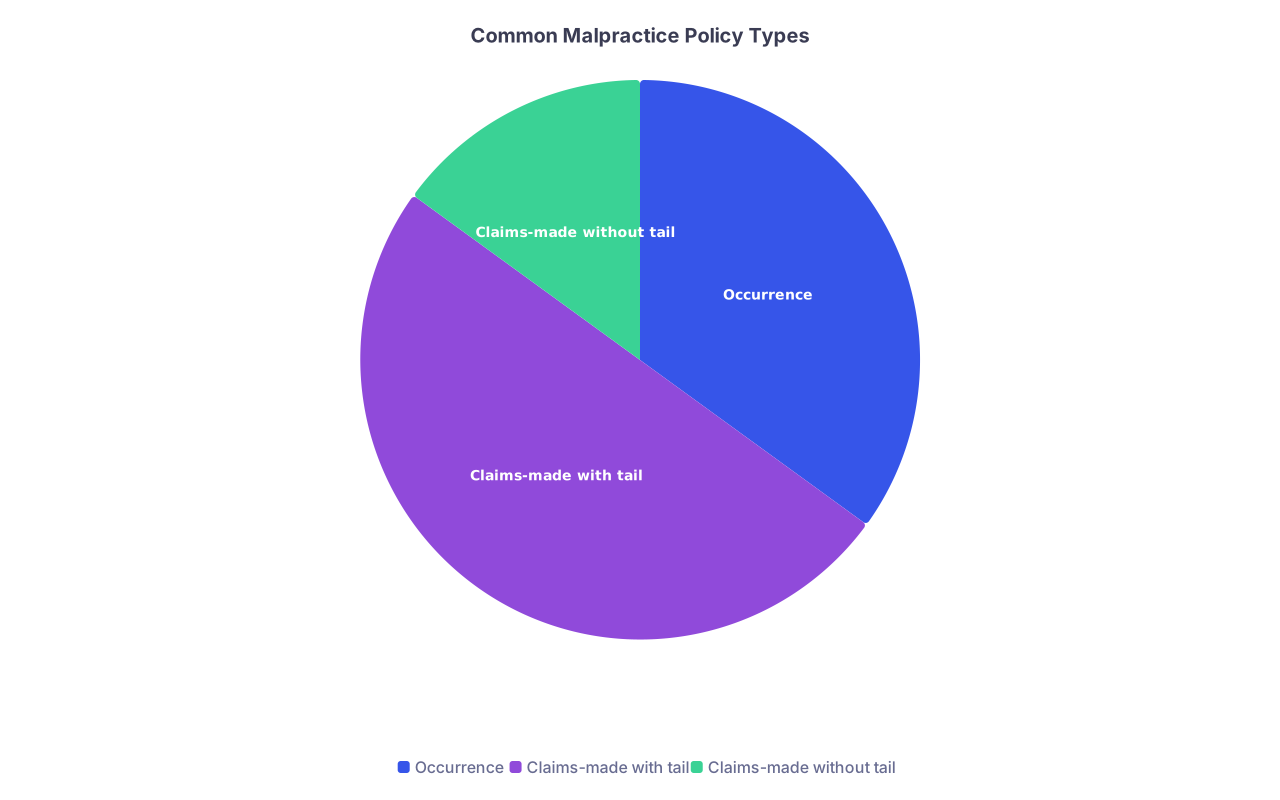
| Category | Value |
|---|---|
| Occurrence | 35 |
| Claims-made with tail | 50 |
| Claims-made without tail | 15 |
Talk to the right people
By the end of Day 4 you should have:
- Clarified with:
- Your group or employer who owns the policy and pays premiums.
- Your carrier whether:
- This event has been logged as a “notice only” or an open claim.
- There’s any immediate premium impact (often no, until actual claim).
- Asked about:
- Whether this event (if it becomes a claim) will:
- Be reportable to the National Practitioner Data Bank (NPDB).
- Affect credentialing or privileges.
- Whether this event (if it becomes a claim) will:
Most adverse events never become actual claims. But the ones that do can follow you across states and employers via NPDB.
Day 5: Communication Discipline and Reputation Protection
By Day 5, gossip, email chains, and hallway commentary start to build. That’s where a lot of damage happens.
At this point you should:
Lock down your communication habits:
- No case details:
- Over text
- On social media
- In non-secure email
- No casual case discussions:
- With colleagues not involved in care unless in formal peer review or QA context.
- No venting with specifics:
- To friends, partners, or family that could later be subpoenaed.
If you need support, talk in generalities or use confidential physician wellness or counseling services.
Internal narrative control
Whether you like it or not, people are forming a story about what happened.
By Day 5 you should:
- Ensure:
- Your leadership and risk team know the accurate clinical narrative from your perspective.
- Avoid:
- Throwing colleagues under the bus in informal conversations.
- Saying, “If X had just done their job, this wouldn’t have happened.”
Those comments often show up in depositions years later, usually twisted and out of context.
Instead, if asked informally:
- “It was a complex situation, and it’s going through the proper review process right now.”
Day 6: Preparing for External Fallout (Licensing, Credentialing, and Claims)
Most events never reach this stage. But planning for it early keeps you ahead, not scrambling.
By Day 6 you should:
Map out likely scenarios:
No formal action
- Patient recovers
- No complaint filed
- Internal learning, case closed
Complaint without lawsuit
- Patient/family files:
- Hospital grievance
- Complaint to state board
- Insurer and risk handle response
- Patient/family files:
Pre-suit activity
- Letter from attorney
- Request for records
- Intent-to-sue notice (in some states)
For each scenario, clarify with your carrier and risk:
- Who responds to:
- Patient letters
- Attorney letters
- Licensing board inquiries
- How you’ll be supported for:
- Board complaints (sometimes separate coverage from malpractice).
- Credentialing questions about this event later.
If you’re in training or early practice, Day 6 is when you think ahead: “How do I explain this on future credentialing forms if it escalates?”
Day 7: Consolidation, Learning, and Long-Game Risk Reduction
At this point, the acute phase is over. You’re into the chronic phase: what this means for your practice, risk profile, and finances going forward.
End-of-week checklist
By Day 7, you should be able to say “yes” to these:
Clinical and chart:
- The medical record is complete, factual, and time-accurate.
- Any necessary addenda are entered correctly, not hidden.
- Patient/family discussions are clearly documented.
Legal and insurance:
- The event has been reported to the malpractice carrier if indicated.
- You know your policy type, limits, and reporting obligations.
- You’ve followed risk/insurer advice about what to say and not say.
Institutional:
- Incident/occurrence reports are filed.
- You know whether there will be M&M, peer review, or RCA.
- You understand the confidentiality boundaries of those processes.
Personal:
- You’ve avoided careless written or verbal statements.
- You’ve sought emotional support in appropriate, confidential ways.
- You’ve started thinking about any practice changes (checklists, protocols, second-checks) to lower recurrence risk.
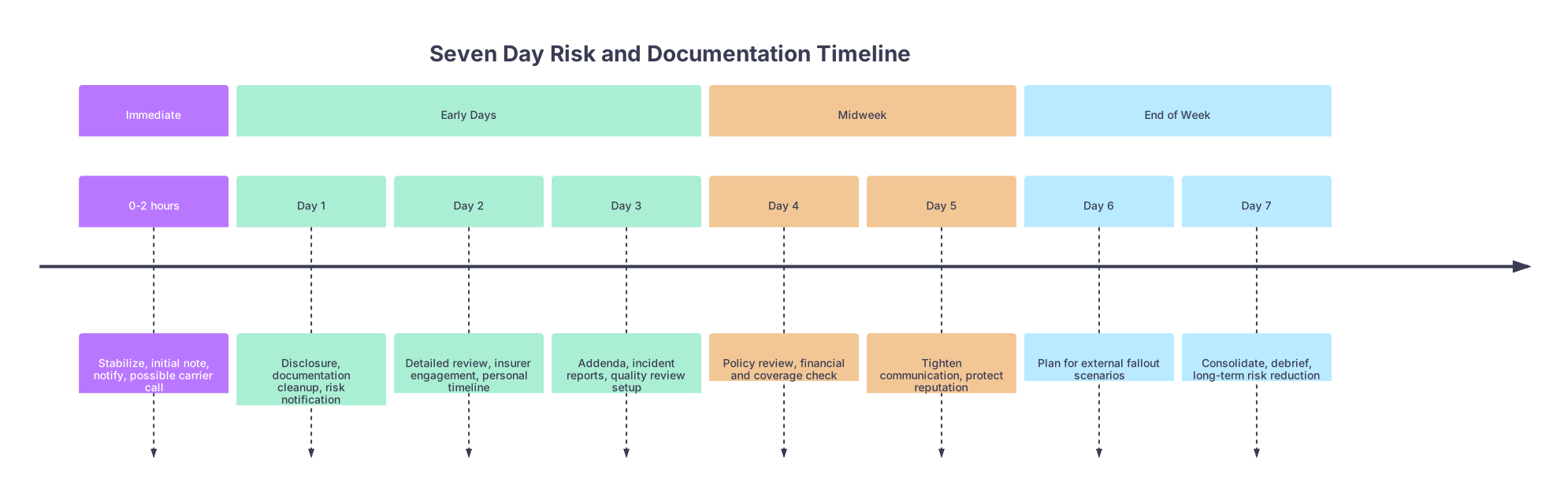
| Period | Event |
|---|---|
| Immediate - 0-2 hours | Stabilize, initial note, notify, possible carrier call |
| Early Days - Day 1 | Disclosure, documentation cleanup, risk notification |
| Early Days - Day 2 | Detailed review, insurer engagement, personal timeline |
| Early Days - Day 3 | Addenda, incident reports, quality review setup |
| Midweek - Day 4 | Policy review, financial and coverage check |
| Midweek - Day 5 | Tighten communication, protect reputation |
| End of Week - Day 6 | Plan for external fallout scenarios |
| End of Week - Day 7 | Consolidate, debrief, long-term risk reduction |
Putting It All Together: Your 7-Day Rhythm
You’re not trying to be perfect. You’re trying to be structured.
Here’s the high-level pattern:
| Day | Primary Focus | Key Actions |
|---|---|---|
| 0–1 | Safety + facts | Stabilize, document, notify, disclose |
| 2 | Legal positioning | Detailed review, insurer engagement |
| 3 | System + documentation refinement | Addenda, incident reporting, QA setup |
| 4 | Financial and coverage clarity | Review policy, confirm coverage details |
| 5 | Communication discipline | Control narrative, avoid loose talk |
| 6 | Scenario planning | Prepare for complaints/claims/boards |
| 7 | Consolidation and learning | Checklist review, long-term changes |

Today—not when something goes wrong—set up your first line of defense:
Pull out your malpractice declaration page and your policy summary. Read the section on “notice of circumstances” or “reporting potential claims.” Highlight the exact language that describes when you must call your carrier. If you cannot find it in under five minutes, email your broker or carrier right now and ask them to send you that section clearly marked.