
You’re staring at your renewal notice. Premiums just jumped again. You’re exhausted, margins are thin, maybe you’re locums, maybe you’re moonlighting, maybe you’re doing some low-risk concierge work. And the thought crosses your mind—maybe for the first time, maybe not:
“Do I really need malpractice insurance for this? Could I just… go bare?”
Let me answer the core question clearly before anything else:
If you are a practicing physician in the U.S., you almost never have a smart, defensible reason to go without malpractice insurance. Going bare is a high-risk, usually bad financial and legal decision.
But there are nuances, and you probably want to know: how bad, why exactly, who actually goes bare, and are there any exceptions where it might make sense?
That is what we’ll walk through.
The Short Answer: Almost Always No
Here’s the blunt version:
- Going without malpractice insurance does not make you “judgment proof” unless you truly have nothing and expect to keep it that way.
- Plaintiffs’ attorneys can and will come after uninsured doctors—especially if they suspect you have assets or income.
- One big claim can wreck decades of savings, future earnings, and your sanity.
- Malpractice insurance, while annoying and sometimes expensive, is almost always cheap compared with the downside risk.
So if you’re looking for permission or some secret hack where you safely practice without coverage, you will not get that here. It’s almost always a bad idea.
What we can do is walk through the rare edge cases, the myths, and the alternatives that actually make sense.
What “Going Bare” Really Means (Financially and Legally)
Going bare is not just “I don’t pay premiums.” It has concrete implications.
When you go uninsured:
- You personally become the insurer for any claim.
- Your house, savings, brokerage accounts, and sometimes future wages become the “policy limits.”
- You pay for your own defense lawyer—hundreds of dollars per hour—for years, if needed.
- Any settlement or judgment comes out of your pocket.

Most physicians massively underestimate the cost structure of a real malpractice case:
- Defense costs alone can easily hit $75,000–$200,000.
- A serious claim with permanent injury or death routinely settles or is judged in the high six to seven figures, sometimes more.
If you’re insured, your carrier pays:
- The defense lawyers
- The experts
- The settlement/judgment (up to your limits)
If you’re bare, that’s all on you.
Who Even Considers Going Without Malpractice Insurance?
There are a few common scenarios where doctors think about going bare:
Late-career physicians in “retirement mode”
They own their home outright, have a paid-off practice building, and do a tiny amount of low-risk care (e.g., concierge, telemedicine triage).Physicians in very plaintiff-hostile premium markets
Think certain OB/GYNs, neurosurgeons, general surgeons in high-risk states where premiums are brutal.Locums or side-gig work where coverage is fuzzy
Someone offers you a “moonlighting opportunity” and says, “It’s simple stuff. You don’t really need coverage…”Physicians who misunderstand sovereign immunity or employer coverage
For example, VA doctors, FQHC physicians, or academic docs who think they’re fully protected personally in all scenarios.Doctors in states that do not legally require malpractice insurance
They hear: “It’s not mandated by law,” and interpret that as “It’s safe to skip it.”
Here’s reality: in most of these scenarios, going bare is still a bad choice, just for different reasons.
Key Myth: “If I Have No Insurance, Lawyers Won’t Bother Suing Me”
Wrong. This belief is common and dangerously naive.
Plaintiffs’ attorneys do basic asset checks:
- Property records
- Business ownership records
- Lifestyle hints (where you live, what you drive, your online footprint)
If they think you have:
- A house
- Retirement accounts
- Ongoing income
- Practice equity
They’ll sue. And if they get a judgment, they can:
- Put liens on real property
- Garnish certain types of income (depending on state law)
- Disrupt your ability to borrow or refinance
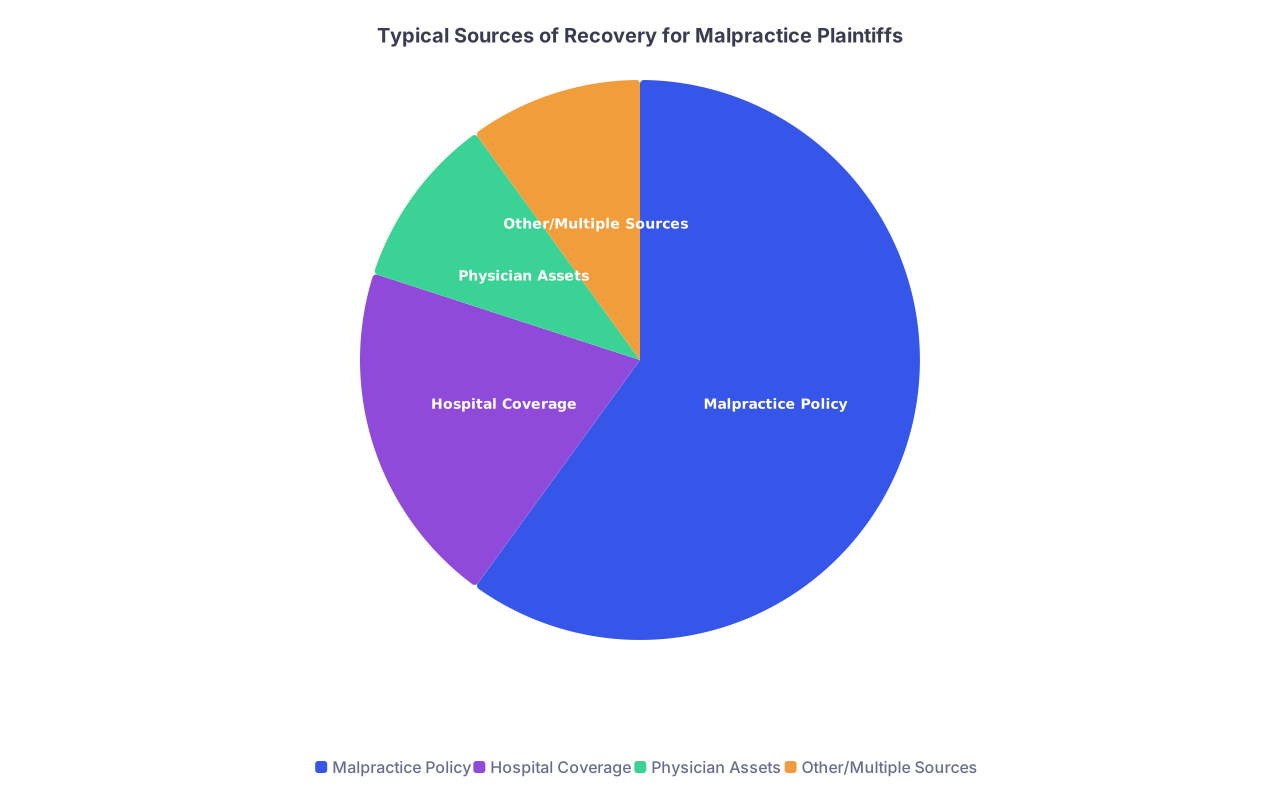
| Category | Value |
|---|---|
| Malpractice Policy | 60 |
| Hospital Coverage | 20 |
| Physician Assets | 10 |
| Other/Multiple Sources | 10 |
That 10% slice—physician assets—is you if you go bare.
When You Might Consider Going Bare (Very Narrow Cases)
There are some narrow situations where a doctor might reasonably choose to go without individual malpractice coverage. This is not an endorsement. It’s an honest list of edge cases.
1. Fully Employed, Fully Covered, No Side Work
Example: You’re a VA physician or a full-time employed hospitalist with:
- No 1099 work, no moonlighting, no telemedicine on the side
- Written confirmation that all clinical services are covered by employer or federal protections
- No independent billing or private practice entity
In that narrow case, separate individual coverage may be optional because you:
- Are already defended and indemnified by the feds or large institution.
- Do not do any work outside that umbrella.
Even here, I’d want that in writing from risk management.
2. Truly Asset-Poor, End-of-Career, Minimal Practice
Example:
- Solo doc in a state with some personal asset protections
- No significant non-protected assets
- Very low revenue, minimal clinical work
- High premiums that would eat most or all net income
This is the “judgment-proof or nearly judgment-proof” strategy. It’s brutal but sometimes rational for a doctor with:
- No dependents relying on future earnings
- Zero desire to protect estate value
- A very small, tightly controlled practice pattern
Be clear: this is extreme. And it relies on staying poor in a legal sense.
3. Coverage Is Truly Unavailable
Occasionally, a physician with prior license problems, multiple claims, or certain unusual practice models simply cannot buy a policy at any sane price, or at all.
Then the decision is:
- Change or stop practicing
- Or practice bare
At that point, this is no longer a normal financial decision. It’s a last-resort, career-survival calculation.
In all three scenarios, any doctor who chooses to go bare should be sitting down with:
- A healthcare attorney
- An asset protection/estate attorney
- A competent insurance broker
If you don’t have these professionals involved, you are not “strategically going bare.” You’re gambling blindly.
Why Going Bare is Usually a Financially Dumb Strategy
Think of malpractice insurance as catastrophic risk transfer. You’re not trying to buy perfection; you’re trying to avoid ruin.
Let’s put numbers on it.
Say your annual premium is $18,000. Over 10 years, that’s $180,000.
Annoying? Absolutely.
But:
- A single moderate claim with settlement + defense could easily be $500,000–$1,000,000.
- A severe permanent injury case can go north of $2M–$5M depending on state caps.
| Scenario | Typical Annual Premium | Typical Claim Exposure |
|---|---|---|
| Outpatient IM/FP in low-risk state | $6,000–$12,000 | $250k–$1M+ |
| OB/GYN in high-risk state | $60,000–$150,000+ | $1M–$5M+ |
| Hospitalist employed (covered) | $0 individually | $250k–$1M+ |
| Telemed urgent care (panel policy) | $3,000–$8,000 | $100k–$750k+ |
You’re not buying insurance for the “likely outcome.” You’re buying it because the worst-case outcome is life-changing and permanent.
Most physicians are financially literate enough to understand:
- You don’t self-insure your house against full destruction unless you have obscene wealth.
- Malpractice risk is similar—low frequency, high severity.
Practical Alternatives to Going Bare
If the real issue is “my premiums are killing me,” there are smarter paths than dropping coverage.
Here are tools I’ve seen used effectively:
Talk to a specialized malpractice broker
Not a random general agent. A broker who does physician malpractice all day. They can:- Shop multiple carriers
- Adjust limits
- Change occurrence vs claims-made (with proper tail planning)
- Bundle or join risk pools
Adjust policy structure
Options might include:- Moving to lower but still reasonable limits (e.g., $1M/$3M to $500k/$1.5M in some markets if allowed)
- Higher deductibles or self-insured retention for small amounts
- Joining a group policy or cooperative
Modify practice risk profile
Reduce or eliminate:- High-risk procedures
- Obstetrics or certain surgeries
- High-risk patient populations (e.g., certain trauma roles)
Then ask your insurer if they’ll re-rate your risk, and get that explicitly documented.
Consider part-time or tail + nonclinical work
Sometimes the right move is:- Buy tail on your existing policy
- Stop high-risk or any clinical work
- Shift to consulting, admin, expert witness work, or pharma/industry roles that carry different or no malpractice needs
Employer-based arrangements
Moving from:- Solo or small private practice
- To employed hospital/health system/FQHC positions
can move the malpractice cost and complexity off your plate.
Legal and Licensing Landmines
Another misconception: “If it’s not mandated by state law, I’m fine.”
Not quite.
Even if your state doesn’t require malpractice insurance, other entities might:
- Hospitals or surgery centers (medical staff bylaws)
- Health plans and payers (contract requirements)
- Credentialing bodies
- Some telemedicine platforms
If you go bare and:
- You lie on credentialing paperwork
- Or you fail to meet contractual insurance requirements
You can face:
- Loss of privileges
- Contract termination
- Possible board trouble for misrepresentation
So the “no law against it” argument is shallow. Your practical ability to practice often requires proof of coverage.
Asset Protection Is Not a Magic Shield
I’ve seen docs say: “I’ll just put everything in my spouse’s name or a trust and go bare.”
Reality check:
- Some states do protect certain assets robustly (e.g., homestead, retirement accounts).
- Others are far weaker; plaintiffs’ attorneys in those states know how to pierce sloppy or fraudulent “asset protection” attempts.
If you’re going to build any asset protection structure, do it:
- Early (before any known claim)
- With an attorney who lives and breathes this area
- With a realistic understanding that some assets are still reachable
And even then, you still have the emotional and time cost of defending yourself in court. Insurance isn’t just money—it buys you a professional defense team.
Decision Framework: How To Think About This Like a Grown-Up
If you’re seriously considering going without malpractice insurance, run your situation through this mental checklist:

| Step | Description |
|---|---|
| Step 1 | Practicing Clinically? |
| Step 2 | No personal policy needed |
| Step 3 | Covered by Employer or Federal? |
| Step 4 | Buy Individual Coverage |
| Step 5 | Doing Any Side Work? |
| Step 6 | Get Separate Policy for Side Work |
| Step 7 | Review Written Proof of Coverage |
| Step 8 | Sign Off With Attorney and Broker |
And if you’re still thinking of going bare, ask yourself:
- If I were sued for $1M tomorrow, exactly what would happen—to my house, savings, and career?
- Am I comfortable explaining this decision to my spouse or partner, with numbers?
- Have I had a healthcare attorney review my risk and coverage options in writing?
- Am I willing to stop clinical work entirely if premiums are truly unaffordable?
If the honest answers make your stomach drop, that’s your signal.
Bottom Line
You should almost never voluntarily go without malpractice insurance as a physician. The rare exceptions are:
- Fully covered, no-side-work, institutionally or federally protected docs, with clear written confirmation.
- Truly judgment-proof, end-of-career, minimal-practice physicians who are consciously accepting the risk.
- Physicians unable to obtain coverage at all, making last-ditch career decisions.
Everyone else? You need coverage. The downside is too big, the upside too small.
If your premiums feel unbearable, the smart move is not to drop insurance—it’s to change either:
- How you’re insured, or
- How and where you practice.
Don’t confuse “not required by statute” with “safe to skip.”
FAQ: Malpractice Insurance and Going Bare
1. Is it ever illegal to practice without malpractice insurance?
Yes, in some states and in certain settings. A few states require minimum malpractice coverage to practice or to have hospital privileges. Even where the state doesn’t mandate it, hospitals, payers, or employers often do. Practicing without required coverage can cost you privileges or contracts, and lying about it on forms can get you into serious trouble.
2. If I fully retire from clinical practice, do I still need malpractice coverage?
You do not need new coverage for new patients if you’re no longer seeing any. But you often need tail coverage for your prior claims-made policy, because claims can arise years after the care occurred. If you’re retiring, your top priority is securing tail (or an extended reporting endorsement) to cover your past work. Once that’s in place and you’ve truly stopped all clinical care, you typically don’t need ongoing malpractice insurance.
3. I’m doing just telemedicine from home – can I safely go without coverage?
No. Telemedicine does not magically eliminate malpractice risk. You can misdiagnose, miss red flags, or be accused of delayed care just as easily by video. You also cross state lines, which complicates jurisdiction. Many telemed companies provide coverage, but you must confirm the scope, limits, and whether you’re named or just “under their umbrella.” If it’s your own telemed practice, you absolutely need your own policy.
4. Can I rely on my corporation or LLC to protect me from personal malpractice liability?
No. Corporate structures (PC, PLLC, LLC) can protect you from business liabilities—like debts or landlord disputes—but they do not shield you from your own professional negligence. If you are the one who provided the care, you can be personally named and personally liable in a malpractice suit, regardless of your entity structure. An entity may help in other ways, but it’s not a substitute for malpractice insurance.
5. What’s the single most important step if I’m even thinking about going bare?
Pull your current policy, your employment contract, and any medical staff or telemedicine agreements, and schedule an hour with a healthcare attorney or a malpractice-focused insurance broker. Today. Ask them to map out what is and isn’t covered, and what realistically happens if you drop or change coverage. Do not make this decision based on rumors, online forums, or what “one guy in my group” is doing.
Open your latest malpractice policy or renewal notice right now. Look at the limits, the type (claims-made vs occurrence), and who is actually listed as the insured. Then decide: do you need to renegotiate, shop, or get legal eyes on it—before you ever entertain the idea of going bare.