It is Match Day afternoon. Your phone has finally stopped buzzing. Group chats are full of screenshots of “Matched – [your dream specialty] at [big-name program].” Your email says you matched. But not into the specialty you spent the last four years building toward.
Your stomach drops every time someone says “Congratulations!” because it feels like they are talking to somebody else.
Here is what you are actually thinking:
- “Did I just blow my entire career?”
- “Can I still end up in my original specialty?”
- “Do I try to pivot back later, or commit to this new path now?”
- “What concrete moves do I make in the next 30, 60, 365 days?”
This is where you are. The Match is over. But your career is not. You need a pivot strategy that is realistic, not fantasy. One that respects your financial, mental, and professional limits.
Let us build that.
Step 1: Get Oriented – What Kind of Pivot Are You Actually Considering?
First decision: what “pivot” actually means for you. There are only a few real options. Everything else is noise.
You fall into one of these buckets:
Matched into a different categorical specialty
Example: You wanted Dermatology, matched Internal Medicine.Matched a preliminary or transitional year, but not advanced spot
Example: Prelim surgery or TY, no anesthesia/rads/derm spot.Did not match at all (SOAP or unmatched)
You scrambled into something less ideal, or you are taking a gap year.Matched your “backup” specialty, but strongly considering reapplying
Example: EM was backup to Ortho, but you cannot let Ortho go.
Your pivot strategy depends on two axes:
- How far is your current training from your target specialty?
- How much risk are you realistically willing to take?
Here is the blunt reality:
- Some pivots are common and feasible (IM → Cards, Pulm/CC; TY → Anesthesia; Gen Surg → PRS via fellowship, etc.).
- Some are long-shot but possible (IM → Radiology, FM → Anesthesia, EM → Anesthesia).
- Some are borderline fantasy unless you are an all-star (low-tier IM → Derm/Rad Onc/Neurosurg).
Your first task: name your situation and your realistic ceiling.
Step 2: Decide Your Time Horizon – One-Year Pivot vs Long-Game
You cannot plan a pivot without a timeline. Too many residents drift, hoping something will “open up,” and then wake up PGY-3 with no leverage.
You have three realistic time frames:
Short-term pivot (within 1 year)
- Reapplying in the next Match cycle
- Spotting PGY-2 openings, transfers, or off-cycle positions
Medium-term pivot (2–3 years)
- Completing part of a residency, then switching
- Positioning for competitive fellowships to get closer to your target field
Long-game pivot (3–7+ years)
- Build a niche/fellowship path that gives you the practice you want, even if not the label you once imagined (e.g., intensivist vs anesthesiologist; hospitalist with procedures vs interventional subspecialist)
You need to pick a default plan and a backup:
- “Primary plan: reapply next cycle.”
- “If that fails: commit to current specialty and maximize X/Y fellowships to approximate my target career.”
Put that in writing. Not because it is pretty, but because you need a decision anchor when you are tired and emotional.
Step 3: Do a Ruthless Post-Match Autopsy
If you are even thinking about pivoting back into your original top specialty, you must understand why you did not match it.
No sugarcoating. You are collecting data, not protecting feelings.
| Issue Category | What It Usually Signals |
|---|---|
| USMLE/COMLEX scores | Below typical range for target specialty |
| Limited interviews | Weak app or poor program list strategy |
| Many interviews, no match | Interviewing or fit issues |
| Weak letters | Lack of strong sponsor in field |
| Late application | Missed wave of earlier invites |
How to do the autopsy, quickly and honestly
List your concrete data:
- Step 1/2/3 or Level 1/2 scores
- Number of interviews in the desired specialty
- Tier of programs where you interviewed
- Any failed/low grades, repeats, professionalism concerns
Ask 2–3 brutally honest people in the target field:
- A faculty mentor who writes lots of letters
- A PD or APD (even at another institution)
- A senior resident who has seen multiple match cycles
Ask these questions explicitly:
- “If you saw my application again for [specialty], would you rank me?”
- “What would I need to change over the next 12 months to be competitive?”
- “Am I a realistic candidate, or should I fully commit to my matched specialty?”
If three honest people say some version of, “Your odds are extremely low no matter what you do,” you pivot your plan now. Not in two years.
Step 4: Choose a Pivot Path That Actually Exists
Let us get specific. Ideas like “I will just switch to Plastics later” are not strategies. They are wishful thinking.
Here are the major pivot archetypes and what they look like in practice.
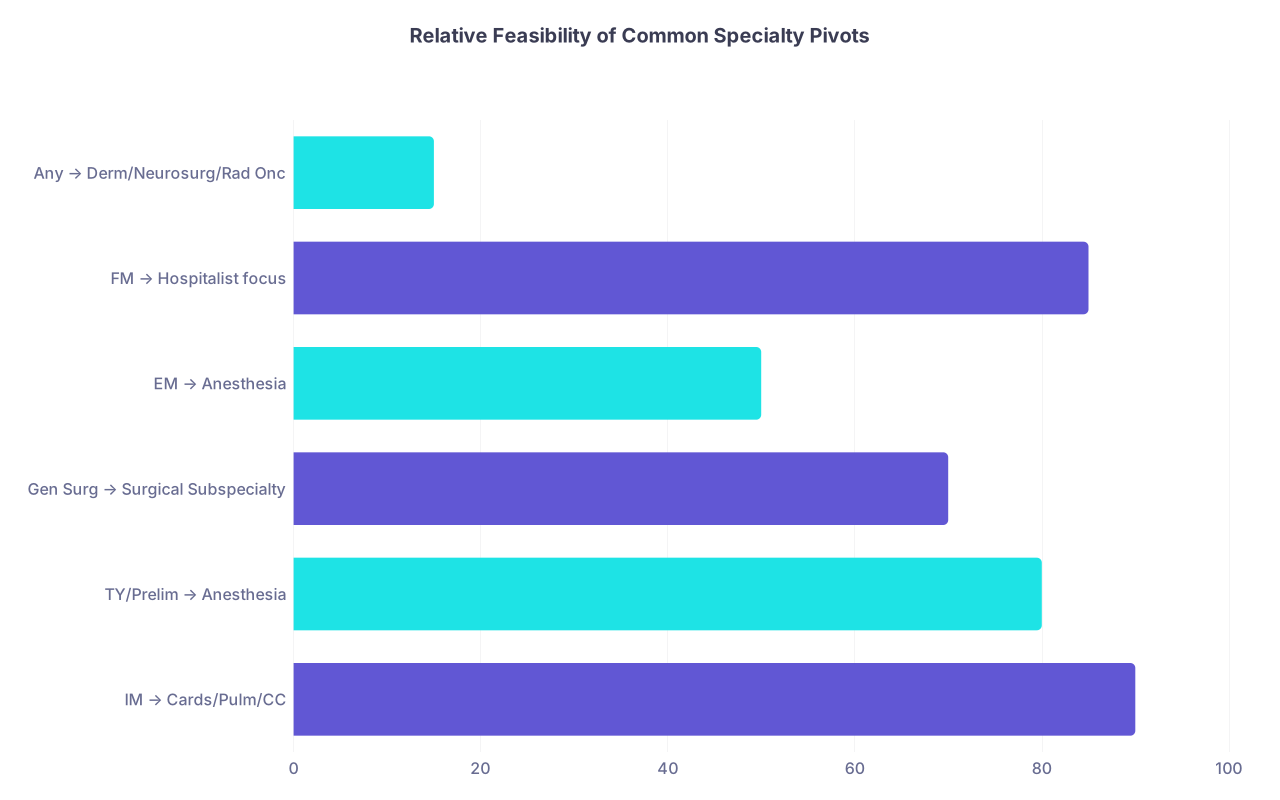
| Category | Value |
|---|---|
| IM → Cards/Pulm/CC | 90 |
| TY/Prelim → Anesthesia | 80 |
| Gen Surg → Surgical Subspecialty | 70 |
| EM → Anesthesia | 50 |
| FM → Hospitalist focus | 85 |
| Any → Derm/Neurosurg/Rad Onc | 15 |
1. Pivot Within Your Matched Specialty Via Fellowship
This is the most common and highest-yield pivot.
Examples:
You wanted Cardiology → matched Internal Medicine
- Strategy: Crush IM residency, get Cards-level research, find a cards mentor, aim for strong fellowship.
You wanted PICU/Neonatology → matched Pediatrics
- Strategy: Early PICU/NICU mentorship, QI projects, strong letters, no weak rotations in core Peds.
You wanted Critical Care/anesthesia-type work → matched Internal Medicine or EM
- Strategy: Pivot hard to Pulm/CC or EM/CC, get ICU exposure, look like an intensivist early.
When this is your path, your job is clear:
- Be a top-third resident where you are
- Attach yourself to the subspecialty people who do the work you want
- Build a CV that looks like “this person is already functioning like a future [X] fellow”
This is not settling. This is the grown-up version of career design.
2. Pivot to a Related Residency After Starting Another
This is the “switch residency” play. It exists. I have seen it. But it is work.
Typical realistic switches:
- Prelim/TY → Anesthesia, Radiology, Neurology, PM&R
- Gen Surg categorical → Anesthesia, Radiology, EM, FM
- IM categorical → Neurology, Radiology, Anesthesia (less common but possible)
Less realistic, high-risk, but seen in strong candidates:
- EM → Anesthesia
- FM → Anesthesia or Radiology (hard, needs strong research/board scores)
Your move set if you want this:
Tell your PD early that a switch is possible.
Not week one. But not end of PGY-1 either. Sooner they know, the better they can help (or at least not sabotage).Start collecting receipts:
- Strong early performance reviews
- Great multi-specialty evaluations, especially in your target area
- At least one faculty in the destination specialty willing to say,
“If this person applied here, I would take them.”
Scan for real openings:
- FREIDA
- Specialty listservs
- NRMP off-cycle / mid-year openings
- Whisper network via mentors
Be willing to move.
Geographically. Institutionally. You cannot be picky and switch at the same time.
3. Reapply Next Cycle While in a Prelim/TY or Gap Year
This is the classic “did not match derm/rads/ortho/anesthesia, doing prelim or research year, will reapply” path.
Here is the cold truth:
- If your original application was far below typical metrics, one year will not fix that.
- If you were near the threshold and missing one or two key elements (research, letters, timing), a focused year can materially change your odds.
Reapply only if you can:
Significantly upgrade:
- Multiple publications or meaningful ongoing research
- New, heavyweight letters from specialty leaders
- Strong performance in a related clinical year
- A cleaner narrative (“I used this year to prove I belong in this field”)
Live with the outcome if you fail again:
- Do you have a just-as-clear plan B if reapplication fails?
- Are you okay eating another year of reduced income and increased loans?
If not, you are better off committing to your matched or SOAPed specialty and building a future within it.
Step 5: Build a 12-Month Pivot Plan – Month by Month
You do not need a five-year manifesto. You need a one-year operational plan that pushes you toward a defined fork in the road.
Use this for any pivot direction. Adjust details to your situation.
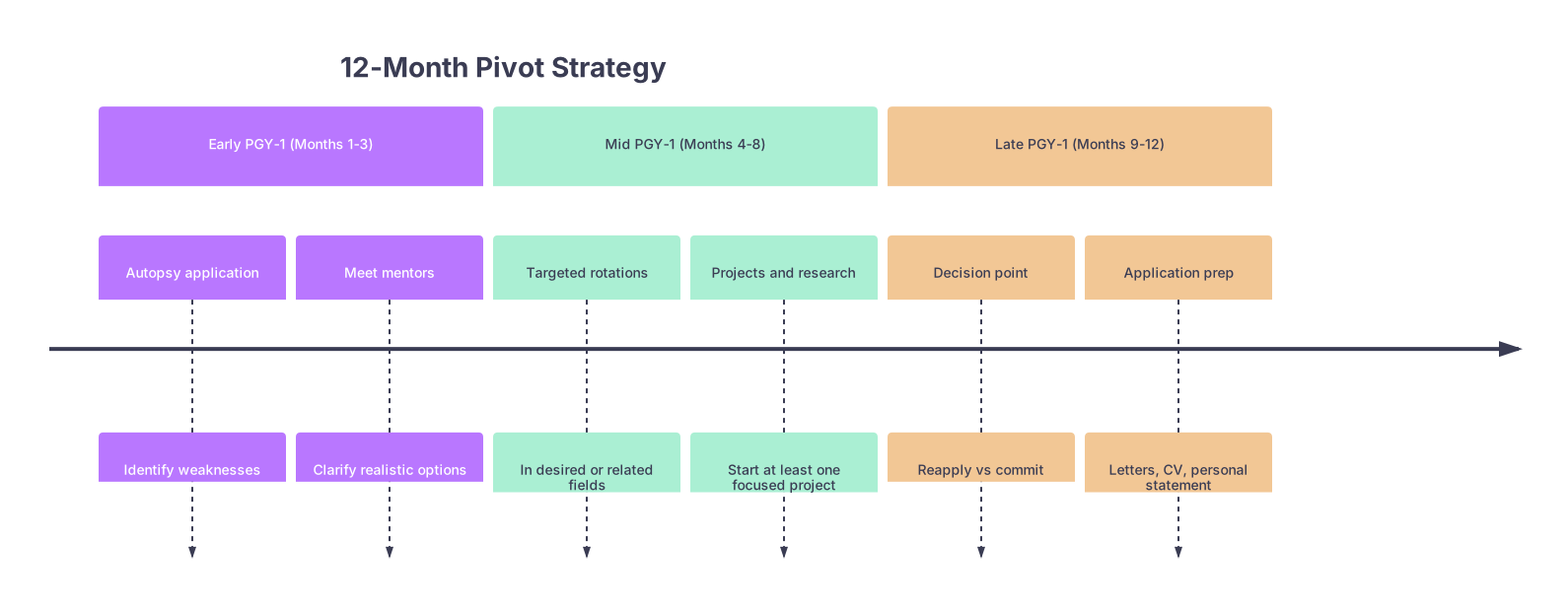
| Period | Event |
|---|---|
| Early PGY-1 (Months 1-3) - Autopsy application | Identify weaknesses |
| Early PGY-1 (Months 1-3) - Meet mentors | Clarify realistic options |
| Mid PGY-1 (Months 4-8) - Targeted rotations | In desired or related fields |
| Mid PGY-1 (Months 4-8) - Projects and research | Start at least one focused project |
| Late PGY-1 (Months 9-12) - Decision point | Reapply vs commit |
| Late PGY-1 (Months 9-12) - Application prep | Letters, CV, personal statement |
Months 1–3: Information and Alignment
- Get your application autopsy done.
- Meet with:
- Your current PD or APD
- A faculty mentor in your “dream” field
- Someone who matched your target specialty recently (for current realities)
Deliverables by end of Month 3:
- Written list: reasons you did not match
- Written list: realistic pivot paths, ranked
- Decision: are you planning to reapply or committing to your current specialty and using fellowships/skills to pivot internally?
Months 4–8: Evidence Gathering
This is the grind phase. You generate proof of concept.
If reapplying:
Schedule or swap into rotations linked to your target specialty
- Example: For Anesthesia → ICU, OR, PACU, anesthesia elective if possible
- For Derm → Rheum, immunology, complex med-derm, or direct derm electives
Start or join at least one substantial project:
- Clinical research
- QI project with publication/poster potential
- Educational project with concrete outputs (curriculum, workshop, etc.)
Build relationships with new potential letter writers:
- Ask directly: “If I perform well, would you be open to writing a strong letter of recommendation?”
If not reapplying and pivoting inside current specialty:
- Identify 1–2 fellowships or practice patterns that approximate your dream job
- Line up early rotations and mentors in those areas
- Make yourself the person they think of when they need a resident for X-type project
Months 9–12: Decision and Execution
By now you should have:
- Real clinical evaluations
- At least one active academic project
- Clear sense of whether your stock has actually improved
Now you choose:
Option A: Reapply.
- Update ERAS aggressively.
- Rewrite personal statement explaining your trajectory without sounding flaky.
- Have honest conversations with your PD about supporting your reapplication.
Option B: Fully commit to current specialty.
- Shift mental energy from “escape plan” to “how do I become top 10% in this field and carve a niche?”
- Double down on the skills and subspecialties you like.
What you cannot do: stay half-in, half-out, for years. That ruins both paths.
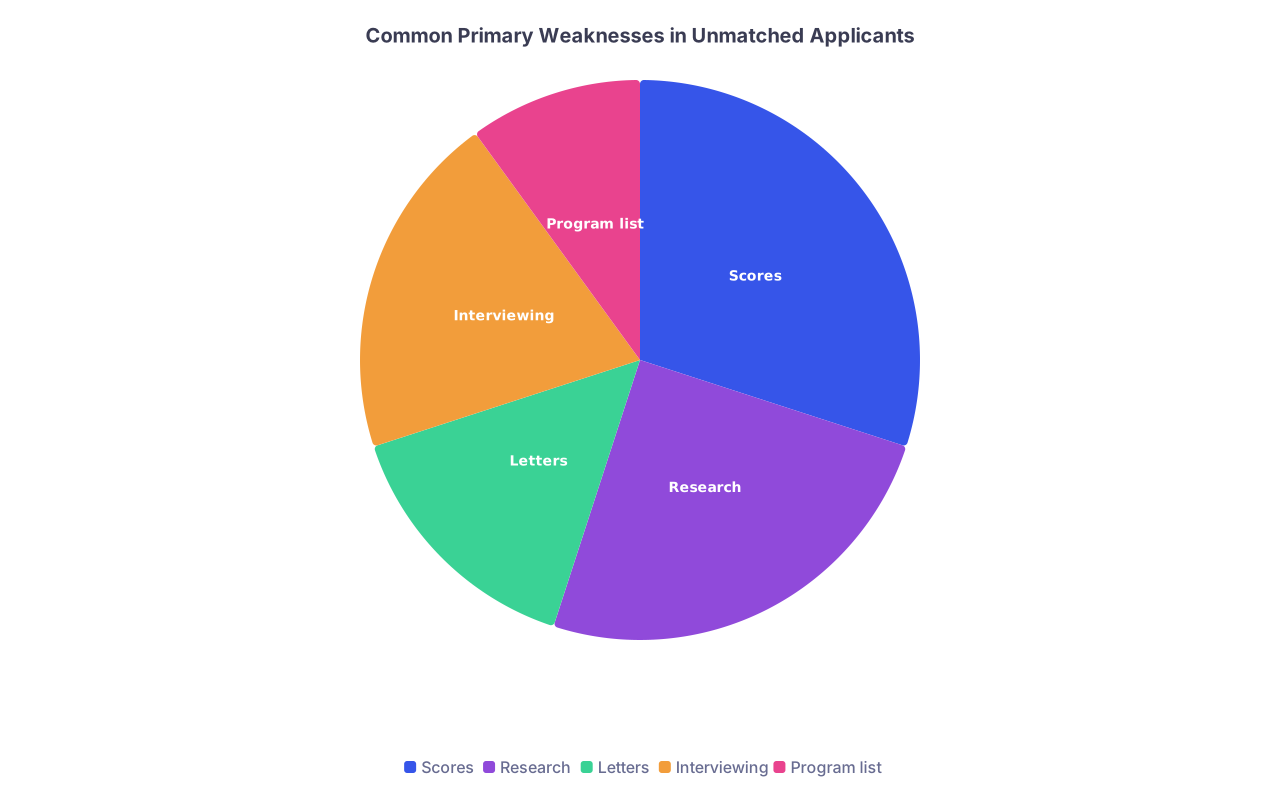
Step 6: Fix Your Weakest Link (Not Everything)
People who did not match often make the same mistake: they try to improve everything at once. That dilutes your efforts.
You need to find the critical constraint in your application.
| Category | Value |
|---|---|
| Scores | 30 |
| Research | 25 |
| Letters | 15 |
| Interviewing | 20 |
| Program list | 10 |
If your weakness was scores
You cannot change past board scores. You can:
- Absolutely crush any future exams (Step 3, in-training)
- Show strong performance in a tough clinical year
- Pick a pivot path that is less score-obsessed and more “whole person” based
Reality: If you were under the 10th percentile for your dream ultra-competitive specialty, reapplying is often a poor bet unless you have compensatory radiance (major research, elite mentorship, etc.).
If your weakness was research
For research-heavy fields (Derm, Rad Onc, Ortho, PRS, some IM subspecialties), you need output:
- Aim for several concrete deliverables:
- Submitted or accepted manuscripts
- Posters at national meetings
- Named role in a project (not just data monkey)
Do not collect 10 half-finished projects. Aim for 2–3 that actually cross the finish line.
If your weakness was letters and sponsorship
This is huge and often underrated.
You need at least one letter writer who:
- Works in the target specialty
- Is known and respected
- Is willing to go beyond “hard-working and pleasant”
This means:
- Deliberately choosing rotations with people who write high-yield letters
- Doing the unsexy things well: show up on time, know your patients cold, follow through, be useful
If your weakness was interviewing or “fit”
You fix this with reps and honesty.
- Mock interviews with faculty who are not afraid to hurt your feelings
- Direct questions:
- “Did I come off as arrogant, unsure, scattered, vague, too casual?”
- Tighten your story:
- One clear narrative about who you are, what you want, and how you have demonstrated it.
Step 7: Manage the Politics – PDs, Colleagues, and Reputation
You are not moving chess pieces in a vacuum. You are working inside a small, very talkative ecosystem.

How to talk to your current PD
Your PD is not your enemy. But they are also not your therapist.
Your script should be something like:
“I am grateful to be here and I want to do excellent work for this program. I also want to be transparent that I still have interest in [specialty X]. Over the next year, I want to explore whether reapplying or pivoting through fellowship makes sense. I will not let this interfere with my performance here, and I would appreciate your guidance on what is realistic.”
This communicates:
- Loyalty now
- Honesty about your goals
- Respect for their perspective
Do not spring your pivot plans on them two weeks before applications go in. That burns bridges fast.
How to talk to mentors in the target specialty
Be direct but grounded:
“I applied in [X], did not match, and matched into [Y]. I am considering [reapplying / switching / building a fellowship path]. Based on my file and what you see in applicants, is this realistic? What would you need to see from me over the next year to support me strongly?”
Then listen. Do not argue.
Step 8: Protect Your Sanity and Your Finances
If you ignore this part, the rest collapses.
Financial reality
- Extra years of training = lost attending income
- Potential relocation costs
- Conference and exam fees, especially if reapplying
Run a back-of-the-envelope calculation:
- How much debt do you have?
- How many extra years of trainee salary can you tolerate?
- Is the financial difference between paths actually huge, or just internet-forum huge?
For many, the gap between, say, a procedural IM subspecialty and a surgical field is not as life-and-death as it feels emotionally.
Mental health reality
You just got hit with a major identity blow. You are at higher risk for burnout and depression this year. That is not melodrama. That is pattern.
You need:
- 1–2 people you can be fully honest with (no façade)
- A low-friction way to get mental health support (resident wellness program, therapy, peer support)
- Boundaries on doom-scrolling SDN/Reddit and comparing your path to strangers
Your pivot strategy is worthless if you break down halfway through PGY-1 and start functioning at 50%.
Step 9: Make Peace With Multiple Good Outcomes
Here is the part most people resist: a successful pivot strategy does not require your original specialty “dream” to come true.
It requires that:
- You end up in a job whose day-to-day reality you can respect and enjoy.
- You maintain enough optionality early on to not trap yourself for no reason.
- You stop letting your 24-year-old fantasy dictate your 40-year-old life.
I have seen:
- A “failed” ortho applicant become a procedural IM doc doing interventional pulmonary and loving it
- A would-be dermatologist become an allergist-immunologist with a cush clinic schedule and deep immunology work
- An unmatched anesthesia applicant become an EM/CC intensivist who spends most of their life in the ICU
They stopped chasing the brand. They designed the work.
FAQs
1. Is it worth doing a research year just to reapply to my original top specialty?
Only if at least two things are true:
- You were already near competitive (not way below) for that field in scores and core metrics, and
- You have guaranteed, structured research with strong mentors who routinely help people match in that specialty.
If you cannot point to specific likely outputs (papers, major posters, strong new letters), a generic “research year” is usually a very poor trade.
2. How soon should I tell my program director that I might want to switch specialties?
Once you have:
- Completed your application autopsy,
- Talked with at least one mentor in the target field, and
- Decided you are at least 30–40% serious about reapplying or transferring.
Too early (week 1) makes you look impulsive. Too late (right before applications) makes you look dishonest and ties your PD’s hands in helping you. A reasonable window is months 2–5 of PGY-1.
3. Did matching into a different specialty permanently close the door on my original dream specialty?
For some ultra-competitive, low-volume fields (Derm, Neurosurg, Rad Onc), yes, in practice the door is almost closed unless you are an exceptional candidate who makes huge targeted gains. For others, the door is more of a revolving one: you may not get the residency label, but you can get very close to the actual work via fellowships and niche practice.
The key is to stop thinking in labels only and start architecting the clinical life you want: procedures vs clinic vs ICU vs OR vs longitudinal continuity. From there, there are often multiple viable routes.
Key points to walk away with:
- Do a cold, honest autopsy of why you missed your top specialty and decide on a 12‑month pivot plan, not a vague “someday.”
- Choose a real path that exists—switch residencies, reapply with major upgrades, or pivot inside your matched specialty via fellowships and niche skills.
- Protect your reputation, finances, and mental health as aggressively as you chase any pivot. A sustainable, well-designed career beats a brittle “dream” that never quite materializes.