
The panic you feel after matching late in SOAP is justified—but completely fixable if you move fast and move smart.
You are not behind because you are less capable. You are behind because the clock just got shortened. Other incoming interns have had months; you may have weeks. So you cannot afford vague advice like “relax and enjoy this moment.” You need a concrete, ruthless, time-based plan.
I have seen late-SOAP interns walk in on July 1 completely overwhelmed… and I have seen others look like they had been planning this for a year. The difference was not brilliance. It was structure.
Here is the structure.
1. First 24–48 Hours: Stabilize the Chaos
Your first move is not to buy books or “start reading.” Your first move is to lock down logistics and expectations. Without that, everything else is noise.
1.1 Mission for Day 1–2
You have five critical objectives:
- Confirm the position and paperwork.
- Get your start date and orientation schedule.
- Clarify licensing and credentialing steps.
- Lock in housing and basic life support (literally and figuratively).
- Start a communication channel with your new program.
Step-by-step protocol
Reply to the offer email immediately.
Confirm in writing:- You accept the position.
- You are available for a July 1 start.
- You are ready to complete all onboarding tasks as soon as they are sent.
Call the program coordinator. Not just email. Call.
Script (rough, but it works):“Hi, this is [Name], I matched into [Specialty, PGY-1] through SOAP. I want to make sure I complete everything on time. Can you walk me through the most urgent onboarding and licensure steps and when you need them done by?”
Ask specifically:
- Exact orientation dates and required sessions.
- Any conditional items: pending background check, drug screen, immunizations, ECFMG documentation, etc.
- Whether they require Step 2 CS-equivalent, USMLE transcript update, or anything unique.
- Whether you need a training license or full license for this state and who initiates it.
Start your licensing / training permit process the same day.
Go to the state’s medical board website:- Search “[State] resident training license” or “limited license.”
- Identify:
- Required forms (often program + you).
- Required documents: diplomas, transcripts, USMLE scores, ECFMG, etc.
- Fees and approximate processing time.
Then email the coordinator:
“I reviewed [State] training license requirements. I see they require [list]. Do you prefer that I start this now or wait for an institutional packet? I want to avoid any delay in my start date.”
Lock in temporary housing.
Do not waste a week hunting for the perfect apartment. You need safe and functional, not dreamy.- Ask the program: “Do you have recommendations for short-term housing or previous residents who sublet to incoming interns?”
- Use:
- Hospital-affiliated housing (often cheaper, closer).
- Short-term (month-to-month) leases near major hospitals.
- Platforms like Furnished Finder or short-term Airbnb / extended-stay hotels for the first 4–8 weeks. Target:
- < 30 minutes from hospital.
- Parking or easy transit.
- Private space + quiet enough to sleep post-call.
Handle basic life admin in parallel. In the first 48 hours, open a running checklist for:
- Driver’s license / state ID (if moving states).
- Bank account with local branch (optional but handy).
- Phone plan coverage in new area.
- Health insurance timing (school vs employer start date).
- Car registration and insurance if relocating with a vehicle.
You will feel overwhelmed. That is normal. The rule: No decision has to be perfect. It just has to be done on time.
2. Week 1–2: Build a Compressed Onboarding System
Once basic logistics are in motion, your job is to build a pre-intern boot camp for yourself. Fast. Focused. Ruthless about priorities.
2.1 Clarify what actually matters clinically
Your goal is not to become a subspecialty expert before July 1. Your goal is to function safely as an intern on day one. That means:
- Recognizing a crashing patient.
- Writing reasonable notes and orders.
- Communicating clearly with seniors and consultants.
- Not missing landmines (e.g., anticoagulation, electrolytes, sepsis, chest pain, stroke).
Ask your program (email chief residents if possible):
“I matched recently through SOAP and want to hit the ground running. Are there 3–5 key topics or resources you recommend all new interns review before July 1?”
Most respond with something like:
- Hospital handbook.
- Top 5 emergency protocols.
- Some reading (e.g., Pocket Medicine, a specific handbook like UCSF Hospitalist Handbook).
2.2 Build your “two-week boot camp” schedule
You are not doing full-time study; you are doing targeted preparation.
Use a simple daily structure:
| Time Block | Focus Area |
|---|---|
| 1–2 hours/day | Core clinical topics |
| 30–45 min/day | EMR / hospital systems |
| 30 min/day | Procedures & orders |
| 20–30 min/day | Communication scripts |
| 15–20 min/day | Physical + mental setup |
Concrete content plan
A. Core clinical topics (1–2 hr/day)
Choose your specialty, then prioritize:
- Internal Medicine / Transitional Year / Prelim:
- Approach to chest pain, dyspnea, sepsis, GI bleed, AKI, DKA, stroke, delirium, fever in hospitalized patient.
- Daily management: CHF, COPD, pneumonia, cirrhosis, alcohol withdrawal, diabetes, anticoagulation.
- Surgery / Surgical Prelim:
- Post-op fever, pain control, fluid/electrolyte management, ileus, wound infections, DVT prophylaxis, immediate post-op complications.
- Pre-op clearance basics, common surgical floor calls (low urine output, tachycardia, pain).
- Peds / OB / Psych / Others:
Same concept: common admissions + common emergencies in that field.
Pick one solid reference, not five:
- IM: UCSF Hospitalist Handbook, Pocket Medicine, Hospitalist Handbook app, or similar.
- Surgery: Surgical ICU Rounds basics, Surgical Recall chapters on common issues.
- Peds: The Harriet Lane Handbook.
- OB: A basic OB call handbook from your program or Johns Hopkins OB/GYN Handbook.
- Psych: Inpatient psych guide, suicide risk assessment frameworks, med side effects.
B. EMR and order entry (30–45 min/day)
You cannot practice the hospital’s exact EMR from home. But you can:
- Watch generic Epic/Cerner training videos online.
- Review sample admission orders for:
- Pneumonia.
- CHF exacerbation.
- Sepsis.
- Post-op day 1.
- Build templates (in a document) for:
- H&P.
- Daily progress note.
- Discharge summary.
Day 1 is far less terrifying when you already have a mental template for what your notes look like.
C. Procedures and orders (30 min/day)
Watch short videos / high-yield guides on:
- Code status discussions.
- Basic airway steps (not that you will intubate day 1, but know the language).
- Central lines, arterial lines, lumbar puncture—focus on indications, contraindications, and what can go wrong, not just technique.
D. Communication scripts (20–30 min/day)
This is the difference between flailing and looking organized.
Write and rehearse scripts for:
- “Calling my senior at 2 am.”
- “Presenting a new admission briefly.”
- “Paging a consultant.”
- “Calling a rapid response.”
Example pattern for rapid response:
- Who you are: “Hi, this is Dr. [Name], the intern on [floor].”
- Who the patient is: “[Age]-year-old [sex], admitted for [reason].”
- What changed: “Now has [vitals], [symptoms], concerning for [x].”
- What you did: “I placed the patient on oxygen, checked a fingerstick, got stat labs and EKG.”
- What you need: “I am concerned the patient is acutely unstable and need immediate help at bedside.”
E. Physical + mental setup (15–20 min/day)
We will come back to this, but start a small routine now:
- 10–15 pushups, squats, or a short walk daily.
- 5–10 minutes of mindfulness, prayer, or quiet—even if you hate that word, you need some decompression.
3. Get Your Life Operational Before Day 1
You will not have time to “settle in” once residency starts. If you show up with life chaos, it bleeds into every call night.
3.1 Housing, transportation, and food
By the end of week 1 after matching, aim to have:
Housing contract or short-term arrangement signed.
- Confirm:
- Move-in date.
- Utilities.
- Internet.
- Parking.
- Confirm:
Transportation plan tested.
- Drive the route (or simulate with Maps) for:
- Typical weekday 6–7 am.
- Night shift.
- Ask current residents:
- “Is parking hell here?”
- “How much extra time do you usually give yourself?”
- Drive the route (or simulate with Maps) for:
Food system in place, not just groceries.
Not “I will cook.” An actual system.- Pick 3–4 simple meals you can batch cook weekly (chili, stir fry, pasta, sheet-pan chicken and vegetables).
- Pre-identify:
- 2–3 hospital cafeteria options that are tolerable.
- 1–2 healthier fast-casual places within 10–15 minutes.
- Buy:
- Reusable containers.
- Water bottle.
- Coffee solution (home or to-go).
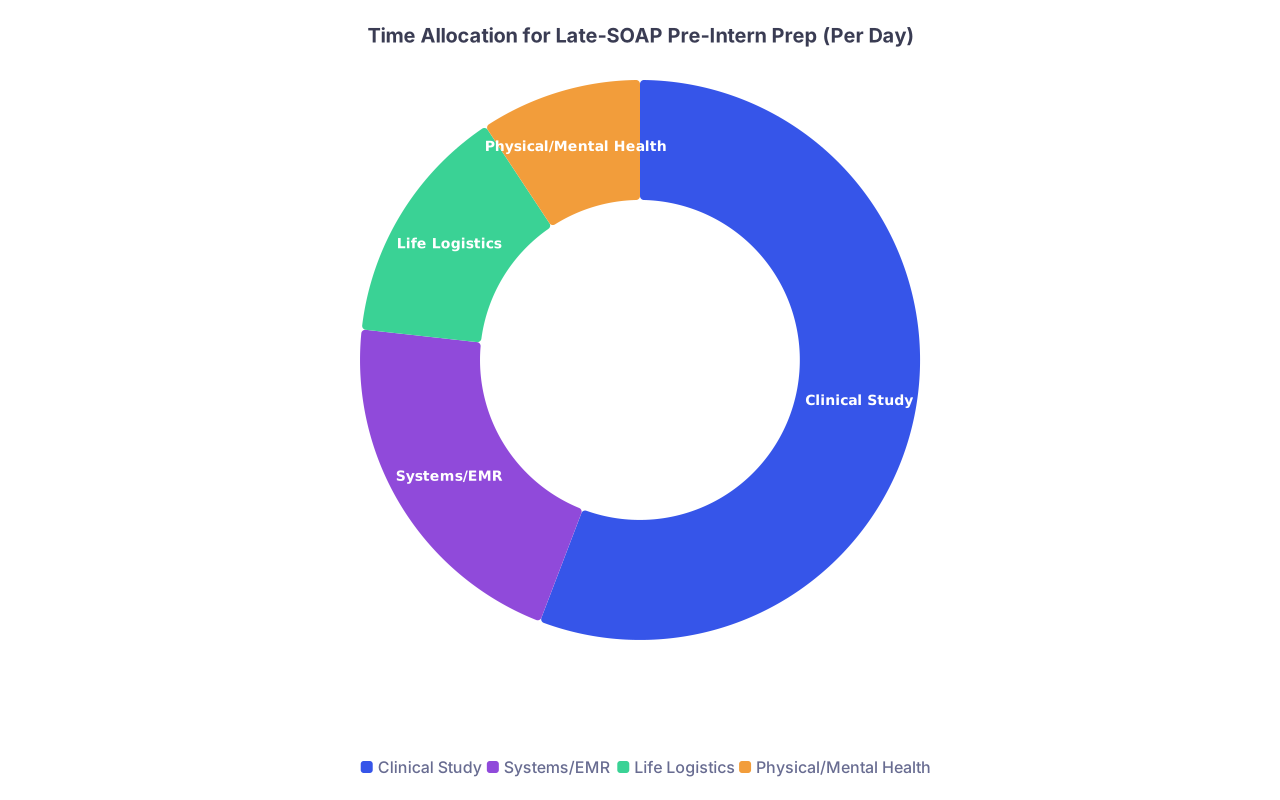
| Category | Value |
|---|---|
| Clinical Study | 120 |
| Systems/EMR | 45 |
| Life Logistics | 30 |
| Physical/Mental Health | 20 |
3.2 Finances and paperwork
You are about to start earning a salary, but there is a lag before your first check. Plan for a 4–6 week financial buffer if you can.
Checklist:
- Estimate moving costs:
- Travel.
- Deposit + first month’s rent.
- Furniture essentials (mattress, desk, chair, lamp).
- Clarify first paycheck date with HR.
- Ask about:
- Resident union (if present).
- Meal stipends.
- Parking costs.
- Set up auto-pay for:
- Rent.
- Student loan minimums (or forbearance arrangements if needed).
For international grads (IMGs) or visa-dependent residents:
- Confirm visa type (J-1 vs H-1B) and exact steps.
- Ask GME office:
- “What are the critical dates and documents you need from me for visa processing?”
- Do not assume your school or ECFMG is auto-forwarding everything on time. Follow up.
4. Surviving Orientation and Your First 2 Weeks
Orientation is not just mandatory meetings. For late-SOAP residents, it is where you close the gap.
4.1 How to use orientation strategically
Most people treat orientation as:
- “Sit. Sign forms. Complain about boring slides.”
You will treat orientation as:
- “This is my one protected period to map the system.”
Your tasks during orientation:
- Find your people.
- Identify 2–3 co-interns who seem organized and sane.
- Identify 1–2 seniors who are clearly decent teachers.
- Get contact info. Start a small “Intern Survival” group chat if one does not exist.
- Locate everything:
- Main workrooms, call rooms, ICU.
- Pharmacy window.
- Blood bank.
- Radiology reading rooms.
- Where to get scrubs, ID fixes, computer help.
- Clarify “how things actually get done”:
Ask seniors:
- “How do you realistically manage pre-rounds here?”
- “What time do most people show up for day shifts?”
- “What is the fastest way to get an urgent CT read?”
- “Any unwritten rules about consults in this place?”
The goal is to learn the culture and work-arounds, not just official policy.
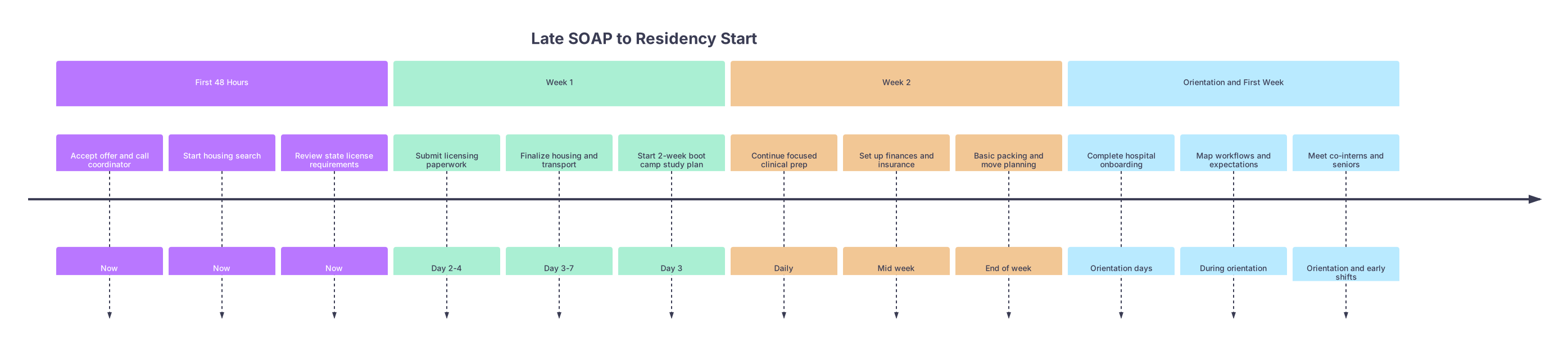
| Period | Event |
|---|---|
| First 48 Hours - Accept offer and call coordinator | Now |
| First 48 Hours - Start housing search | Now |
| First 48 Hours - Review state license requirements | Now |
| Week 1 - Submit licensing paperwork | Day 2-4 |
| Week 1 - Finalize housing and transport | Day 3-7 |
| Week 1 - Start 2-week boot camp study plan | Day 3 |
| Week 2 - Continue focused clinical prep | Daily |
| Week 2 - Set up finances and insurance | Mid week |
| Week 2 - Basic packing and move planning | End of week |
| Orientation and First Week - Complete hospital onboarding | Orientation days |
| Orientation and First Week - Map workflows and expectations | During orientation |
| Orientation and First Week - Meet co-interns and seniors | Orientation and early shifts |
4.2 How to not drown your first week on service
Let’s be blunt. Your first week will feel like drinking from a firehose. That is fine. Your mission is not perfection. It is not making dangerous mistakes and building a system fast.
I tell new interns to follow a simple protocol:
The “3 lists” system (start on day 1)
Carry a small notebook or use a dedicated app (not buried in your general notes).
Make three separate sections:
“Don’t Miss” List
- Things that, if forgotten, hurt patients or get you yelled at:
- DVT prophylaxis.
- Vitals frequency.
- Follow-up of critical labs.
- Daily weight in CHF patients.
- Any time a senior says, “Never forget to do X,” add it here.
- Things that, if forgotten, hurt patients or get you yelled at:
“Ask Senior” List
- Questions you cannot solve in < 5 minutes:
- “When do we anticoagulate in new-onset AF here?”
- “Do we usually bridge patients off DOACs for minor procedures?”
- Batch these and ask your senior once or twice per day, not every 5 minutes.
- Questions you cannot solve in < 5 minutes:
“Look Up Tonight” List
- Things that are not urgent but you need to learn:
- “Workup for hyponatremia.”
- “Management of hospital-acquired pneumonia.”
- Look up 1–3 items each evening. Not 20. You will be exhausted.
- Things that are not urgent but you need to learn:
This system turns chaos into a learnable loop.
Use your senior properly
Bad intern move:
- Silent, scared, tries to guess, makes dangerous mistakes, and then apologizes.
Good intern move:
- Early page: “I am not sure. Here is what I am thinking. Can you guide me?”
Template:
“I am with [patient name], [age] with [brief reason for admission]. New issue is [x]. I am considering [A vs B], leaning toward [x] because [y]. I am not fully confident and want your input before placing orders.”
You are allowed to be inexperienced. You are not allowed to be careless.
5. Managing the Emotional Fallout of a Late SOAP Match
Let us address the part no one likes to talk about.
You matched late in SOAP. You may feel:
- Embarrassed.
- Inferior to classmates.
- Resentful you did not match your dream specialty or location.
These feelings do not magically disappear because someone hands you an ID badge.
Here is the hard truth: if you cling to that resentment into July, it will affect:
- How willing you are to engage.
- How you see feedback.
- How hard you fight to learn.
You do not need fake positivity. You need functional acceptance.
5.1 A simple mental reset framework
Name it plainly.
- “I am disappointed I did not match [X].”
- “I am angry I am moving to [City I did not want].”
Set a time box for grieving.
- Give yourself 1–2 weeks where it is ok to be upset, vent to trusted friends, write it out.
- After that, you shift from “why did this happen to me” to “what can I build from here.”
Define a 1-year win that is fully under your control. Examples:
- “By the end of intern year, I will be the intern whom nurses trust to respond effectively to urgent issues.”
- “I will learn inpatient medicine so well that my daily notes and plans are clean and respected.”
- “I will position myself for a categorical spot or reapplication with strong letters.”
Stop rehearsing your SOAP story as a failure narrative.
Practice a neutral, confident version:“I matched later in the cycle through SOAP into [specialty] at [institution]. It ended up being a good fit for me clinically, and I have been focusing on becoming strong in [specific skills].”
That is it. You do not owe anyone your emotional backstory.

6. If You Matched into a Different Specialty Than Planned
SOAP often means compromise. Prelim instead of categorical. A field you did not plan to enter. A location far from support.
You have two parallel jobs:
- Be excellent where you are.
- Keep optionality alive if you want to re-apply or pivot.
6.1 How to set this up from day 1
Clarify the program’s expectations and opportunities. Ask your PD (not day 1, but within the first month):
- “For residents who are strong performers, what opportunities exist here—research, teaching, leadership?”
- “If I am interested in transitioning to a categorical position here if one opens, what would you want to see from me this year?”
Document your work.
- Keep track of:
- Evaluations.
- Notable positive feedback emails or comments.
- Any QI, research, or teaching roles you take on.
- Keep track of:
Treat this year as a professional audition, not a holding pattern.
Every rotation is a chance to generate:- Strong letters of recommendation.
- Evidence that you can thrive in high-acuity, high-responsibility settings.
Ironically, some of the best residents I have seen were people who SOAPed into positions they never planned on, then decided to own it fully.
7. Concrete Packing and Gear Checklist
You cannot show up on July 1 with a backpack and vibes.
Bare-minimum gear:
- 2–3 pairs of scrubs (if not fully hospital-provided).
- White coat(s), cleaned and with sewn badge if required.
- Comfortable, closed-toe, supportive shoes (this matters more than you think).
- Compression socks.
- Small pocket notebook or index cards.
- Pens that actually work.
- A small penlight.
- Stethoscope you like using.
- Phone charger and portable battery.
- Lightweight backpack or work bag.
For home:
- Blackout curtains or eye mask if you may work nights.
- Simple bedding that is easy to wash.
- Alarm clock that is not just your phone (back-up).
This seems basic. Interns who skip it pay later.
FAQ (Exactly 3 Questions)
1. I matched so late that my state license might not be ready by July 1. What can I do?
Contact your program coordinator and GME office immediately and explain the situation. Ask directly whether the institution allows you to start under a temporary or pending status while the license processes. Some hospitals can credential you under a trainee category while the state license finalizes, as long as paperwork is filed. You should:
- Submit every form and payment to the state board as soon as possible.
- Keep PDF copies of all confirmations and receipts.
- Update your coordinator with each step completed.
Do not “wait and see.” The earlier they know, the more levers they can pull on their side.
2. I have only 2–3 weeks before July 1. Is it even worth doing a study plan, or should I just handle moving?
Yes, it is worth it. You are not doing a six-hour-per-day intensive course. Even 60–90 minutes daily of smart, targeted review on core inpatient problems pays off massively your first month. The key is prioritization:
- Move and housing logistics get handled first each day.
- Then a short, structured clinical review focused on emergencies and top diagnoses in your specialty.
- No endless random reading. One main resource. A short daily list of “look this up tonight” from your day’s questions once you start.
3. I feel ashamed that I matched through SOAP and worry my co-interns will judge me. How do I handle this?
Most people are far too busy worrying about themselves to dissect your match history. What they will actually notice about you is:
- Whether you show up prepared.
- Whether you are reliable.
- Whether you own your mistakes and improve.
If someone asks about your match, keep it brief and neutral:“I ended up matching through SOAP to this program. I am glad it worked out; I like the team here and I am focused on learning as much as I can this year.”
Then shift to the present: ask them about the program, their expectations, tips. Intern year reputations usually form based on behavior from July to September—not on where you matched on Monday of Match Week.
Key points:
- Use the first 48 hours to lock down logistics, licensing, and contact with your coordinator—speed beats perfection.
- Run a lean, focused 1–2 week boot camp on core inpatient problems, EMR basics, and communication scripts so you walk in functional, not flailing.
- Treat your late-SOAP match as a starting line, not a verdict—stabilize your life, show up prepared, and your performance from July onward will matter far more than the timing of your offer.