
The Match does not care about your relationship. You have to.
If you matched and your partner did not—different city, different state, or they are reapplying—it feels like life just split in two. One path got a clean, institution-approved plan. The other is a question mark. That asymmetry is brutal. It breeds resentment fast if you let it.
You fix this with structure, not vibes. You need a plan for:
- The relationship
- The logistics
- The money
- The reapplication or career plan for your partner
- Your own mental bandwidth as an intern
I will walk you through concrete steps I have seen work—for couples who actually survived this, not hypothetical Hallmark scenarios.
Step 1: Call the Situation What It Is
Do not soften it. Do not pretend this is “just temporary” without defining temporary.
You are dealing with:
- A long-distance relationship during the most time-starved years of your life.
- One partner with institutional structure and income (you).
- One partner with uncertainty and often identity injury (your partner).
Name the facts in plain English, together:
- “We will be living in different cities starting [date].”
- “My schedule will be unpredictable and heavy, especially PGY-1.”
- “You did not match / your job plan changed, and we need a concrete next step for you.”
- “We want to stay together—unless one of us feels otherwise.”
You cannot build a plan on half-truths.
Do this in a single, focused conversation, not dragged out over weeks. Sit down, no phones, and answer three core questions together:
- Are we committed to staying together through at least intern year?
- Are we willing to do long distance if co-location is not possible in the short term?
- Are we both willing to change plans (jobs, cities, spending, free time) to protect this relationship?
If either of you cannot answer “yes” to at least the first two, your problem is not distance. It is commitment. Different article.
Assuming you both say yes, you move to structure.
Step 2: Build a 12-Month Relationship Plan (Not a Fantasy)
Intern year destroys relationships that rely on “we’ll talk when we can.” You need explicit systems.
2.1 Decide Your Primary Communication Channels
Pick:
- One daily low-friction channel
- One weekly high-quality channel
For example:
- Daily: Short check-ins via text or voice note (2–5 minutes).
- Weekly: 45–60 minute video call on a consistent day.
Then make rules:
- Daily messages do not require immediate reply.
- Weekly call is sacred—treated like a scheduled conference or clinic.
You are not trying to be in constant contact. You are trying to be reliably reachable.
2.2 Schedule the Relationship Like a Rotation
Intern year is scheduled to the hour. Treat the relationship with equal seriousness.
Use your first rotation schedule and map this out:
Identify relatively lighter days
- Outpatient vs ICU
- Golden weekends vs q4 call
Block:
- One weekly video call (same day/time when possible)
- One “date” activity every 2–3 weeks:
- Watching the same movie together + FaceTime
- Cooking the same meal
- Online game night
- Walking outside while on call together (if safe and allowed)
Plan in advance for heavy blocks
- Off-service surgery month? Tell your partner: “For these 4 weeks, expect shorter calls. Let us pre-plan a weekend visit or special thing afterward.”
Your partner will handle uncertainty better if they understand the pattern.
Step 3: Create a Concrete Visit Schedule Before PGY-1 Starts
“Let’s visit when we can” leads to disappointment and fights. You need real dates.
Before residency starts, sit with a calendar and:
List your known major obligations:
- Orientation
- In-Training Exam
- Vacation blocks (you will know or at least have a sense by July/August)
- Interview season (if you are prelim or switching specialties later)
Identify 3–6 tentative visit windows across the next 12 months.
Decide for each:
- Who travels to whom
- Travel budget cap per visit
- Approximate length (e.g., 2–3 days, long weekend)
You will adjust as schedules become clearer, but you start with a skeleton.
Now you align this with money.
Step 4: Build a “Distance Budget” So You Do Not Fight About Money
Travel plus two housing setups is expensive, especially if your partner is job-hunting or reapplying.
You need:
- A clear picture of your combined income and fixed expenses
- A specific line item for:
- Travel
- Phone / internet upgrades (if needed)
- Occasional “relationship splurges” (nice dinner when together, shared subscription, etc.)
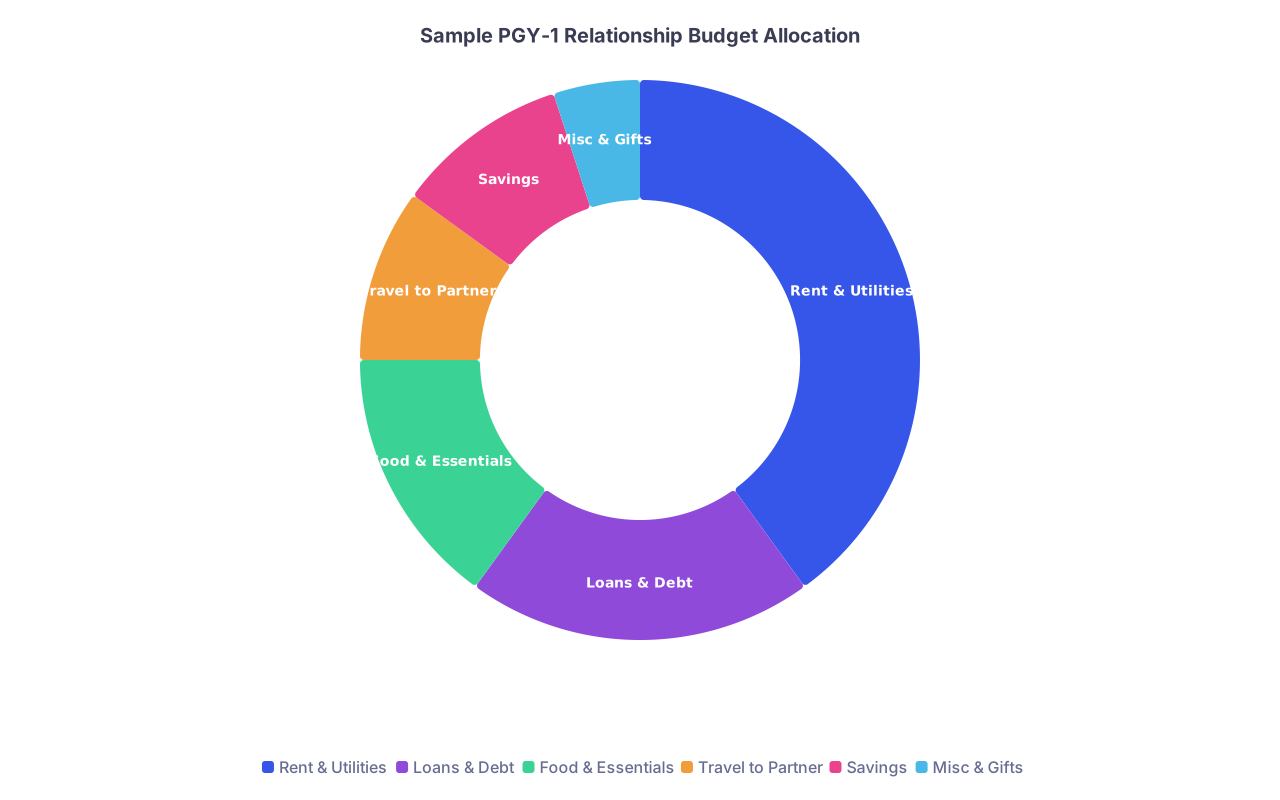
| Category | Value |
|---|---|
| Rent & Utilities | 40 |
| Loans & Debt | 20 |
| Food & Essentials | 15 |
| Travel to Partner | 10 |
| Savings | 10 |
| Misc & Gifts | 5 |
4.1 Decide Travel Priorities
Be ruthless. You cannot go to every friend’s wedding, every conference, and see your partner monthly if the money is not there.
Options:
- Commit to quarterly in-person visits and fewer social trips elsewhere.
- Or, if cities are closer, more frequent but shorter visits with cheaper transport (buses, driving, red-eyes).
Agree on:
- Maximum you will spend monthly on travel, combined.
- What gets cut first when money is tight (e.g., fewer restaurant meals vs. fewer visits).
Write the numbers down. Shared Google Sheet. Not a vibe-based “we’ll figure it out.”
Step 5: Address Your Partner’s Career and Emotional Fallout Head-On
If your partner did not match, there is often quiet shame. Especially when you are suddenly the “successful one” in matching.
You must do two things:
Acknowledge the power imbalance.
You have a badge, an ID, a schedule, a clear stepwise path. They may have:- A generic “reapplicant” label
- A temp job or no job
- Loans with no clear repayment plan
Separate your roles.
- As partner: You are supportive, validating.
- As planner/problem-solver: You help with practical steps.
Ask which role they want in each conversation.
5.1 For Unmatched Med Grads Reapplying
If your partner is reapplying, help them structure this year like a job, not a failure.
Concrete action list (that works):
Within 2 weeks of Match results:
- Analyze their ERAS from last cycle:
- Scores
- Number and type of programs
- Personal statement quality
- Letters quality and variety
- Identify 2–3 weaknesses that actually matter (e.g., late Step 2, no US clinical experience, weak LORs), not vague “I guess I am just not competitive.”
- Analyze their ERAS from last cycle:
By 1 month:
- Secure at least one of:
- Research position (clinical, outcomes, QI)
- Clinical job (scribe, MA, clinical research coordinator)
- Additional rotations / observerships (for IMGs)
- Plan Step 3 timing if relevant for their specialty.
- Secure at least one of:
By 3–4 months:
- New letter writers identified and engaged.
- Draft of new personal statement.
- Rationalized program list: more realistic range, DO vs MD balance if applicable, community vs academic mix.
Your role:
Not to micromanage. But to be the accountability partner:
- “Do you want me to help you set deadlines?”
- “Want me to read that email before you send it to the PD?”
- “We said you’d contact 5 programs this week—how did that go?”
If they are not reapplying to medicine, same idea:
- Commit to one clear job search track at a time.
- Set weekly application minimums.
- Track progress.
You are trying to prevent the “lost year” where resentment festers, they stagnate, and you move forward.
Step 6: Set Explicit Rules for Conflict, Jealousy, and Resentment
Distance does not create insecurities; it exposes them. Add the career gap between you and your partner and you get a volatile mix.
You neutralize some of this with rules you both agree to before residency starts.
6.1 Jealousy and Opposite-Sex (or Same-Sex) Friends
Decide together:
- What counts as crossing a line?
- Late-night texts with co-interns?
- One-on-one dinners with co-residents?
- Emotional venting about your partner to someone you could be attracted to?
You do not need perfectly aligned rules with other couples. You need a shared standard between you two.
Put it in one page of bullet points. Seriously. Call it “Relationship Norms While Long-Distance.” Revisit every few months.
6.2 How You Will Argue
You will fight. Often at horrible times. Like post-call, or during your partner’s worst job search week.
Set these rules:
No major fights by text.
If something big comes up:- Send, “This is important and I do not want to fight by text. Can we talk on video / phone tonight or tomorrow?”
No breakup threats unless you mean it.
Using “maybe we should just break up” as a weapon destroys safety.Time-out rule.
Either of you can say: “I am too flooded to keep talking. Let us pause and come back in 24 hours.”
Then you actually come back. You do not ghost.No scorekeeping about who is more tired / stressed.
You are both exhausted, in different ways.
Banned phrases:- “You think you are stressed? At least you…”
- “You have no idea how hard my day was compared to yours.”
You are trying to keep your fights about issues, not about who “deserves” more sympathy.
Step 7: Choose Transparency Over “Protecting” Each Other
Common mistake: The resident hides just how bad intern year is to avoid worrying the unmatched partner. The unmatched partner hides how awful job search or reapplication feels to avoid “dragging down” the resident.
Result: Distance, not protection.
A better model:
- 80% filtered reality, 20% raw.
Meaning:- You do not bleed every single tiny frustration on them while they are already overwhelmed.
- But you also do not pretend everything is great.
Practical system:
- During weekly calls, each of you answers:
- “Best thing this week.”
- “Hardest thing this week.”
- “One thing I need from you this coming week.”
Short. Structured. Human.
Step 8: Use Technology Intentionally, Not Randomly
There is a difference between being constantly connected and staying emotionally connected.
Good uses:
- Shared photo albums of your week.
- “Open when” emails or letters scheduled on rough rotations.
- Watching a show together (synchronized start) + text commentary.
- Shared to-do list or Notion board for:
- Next visit plans
- Gift ideas
- Things you want to talk about when you actually have time
Bad uses:
- Frantic texting during rounds, then snapping at each other because you are rushed.
- Passive-aggressive “seen” or ignoring messages to punish each other.
If your partner is sensitive to delayed replies, be explicit:
- “On this rotation, I may not reply for 6–8 hours. If I have not answered, assume I am scrubbed in, driving, or asleep, not ignoring you.”
Spells it out. Reduces drama.
Step 9: Control What You Can About Co-Location (Without Fantasy Thinking)
People love to say, “Maybe you can transfer later.” Maybe. Maybe not.
Here is how to handle the “Can we end up in the same city?” problem like an adult.
| Option | Realistic Timing | Control Level |
|---|---|---|
| Residency transfer same PGY | Very low | Low |
| Transfer after PGY-1 | Low–moderate | Low–moderate |
| Partner job change to your city | Moderate (3–12 months) | Moderate–high |
| Your fellowship in their city | High (years later) | High |
9.1 What You Actually Do Now
- Talk to your PD only when you have a real reason.
Not “my partner lives elsewhere and I am sad,” but:- Spouse with stable job in X city
- Dependent family there
- Serious, long-term partner with clear job prospects there
Real transfers require:
- Open spots
- No red flags in your performance
- Departmental politics lining up
So you:
- Perform well PGY-1.
- Keep your eyes open for programs in your partner’s city.
- If a realistic spot opens and your PD is supportive, you explore.
Meanwhile, your partner:
- Looks for work/study in your city concurrently, not sequentially.
You both pursue co-location from both ends. Whichever wins, you take.
The key: Do not hang the survival of your relationship on a transfer that may never happen. Plan to function in long distance for the full length of residency. If you beat that timeline, you celebrate.
Step 10: Protect Your Own Mental Health Without Making Your Partner Your Only Outlet
If you make your partner your only emotional outlet, you are setting both of you up to fail. They will already be stretched by their own career issues.
You need a support graph, not a support line.

What you do in practice:
- Identify 1–2 co-residents you can be honest with.
- Identify 1 mentor (senior resident or attending) who “gets” relationship strain and burnout.
- If your program offers therapy or counseling, use it before you are in crisis, not after.
- Keep at least one non-medical friend on your radar, even if you only talk monthly.
This takes weight off your partner and reduces the pressure on each call to handle everything.
Step 11: Have a Six-Month and Twelve-Month Relationship “Check-In”
Do not wait until everything is on fire to review whether this is working.
Schedule two big check-ins:
- Around 6 months into PGY-1
- Around 12 months
During these, you explicitly discuss:
- Are we both still in?
- How has the last period felt for each of us (1–10 scale for connection, stress, satisfaction)?
- What needs to change:
- More or fewer visits?
- Different communication style?
- Adjusted boundaries?
Be honest about:
- Resentment about career differences
- Fear one of you is “outgrowing” the other
- Your actual vision for the next 2–5 years
Sometimes this conversation leads to a breakup. That is not failure. That is two adults acknowledging reality instead of dragging things out for years.
Step 12: Stop Comparing Your Relationship to Everyone Else’s
On social media, you will see:
- Couples who matched together, smugly posting their joint Match Day photos.
- Residents whose partners dropped everything and moved immediately.
- People claiming “we did long distance all of residency and it was easy.”
Ignore the PR.
You and your partner need to solve your puzzle with:
- Your specialty
- Your call schedule
- Your cities
- Your finances
- Your actual emotional capacities
If that means:
- Less frequent travel than others
- More therapy than others
- Different boundaries than your friends
so be it.
The only metrics that matter:
- Are both of you feeling fundamentally respected?
- Are both of you still choosing this, not just drifting along?
- Does your plan line up with your stated values, not just external expectations?
A Quick Reality Check: What Fails, What Survives
Patterns I have seen repeatedly:
Relationships that tend to fail:
- No real plan, just “we love each other, we will make it work.”
- One partner secretly resents the other’s career success but never says it.
- Fights handled primarily by text, at 2 a.m., on call.
- No scheduled visits, reactive planning based on moods.
Relationships that tend to survive:
- Explicit timelines and expectations (12-month plan, check-ins).
- Both partners are moving forward in something: career, study, therapy, new skills.
- Clear, written norms about communication and boundaries.
- Both are willing to make actual sacrifices (money, trips, social life) to prioritize the relationship.
You cannot guarantee survival. You can make survival a lot more probable.
Put It All Together: One-Page Distance Blueprint
Before PGY-1 starts, sit down and create a 1-page “Distance Blueprint” that includes:
Communication
- Daily: texts / voice notes
- Weekly: video call on [day/time]
Visits
- Tentative visit dates / months
- Who travels where and approximate lengths
Money
- Monthly travel budget: $____
- Agreed cutbacks: ______
Career Plan for Partner
- Next 3–6 month goals (reapp, job, study)
- Milestones and dates
Relationship Rules
- Conflict rules (no text wars, time-out rule)
- Jealousy / boundary norms
- How to raise concerns without blowing up
Review Points
- 6-month check-in date
- 12-month check-in date
Print it or keep it in a shared folder. This is your operating manual, not a romantic manifesto.
Do This Today
Open your calendar and block a 90-minute meeting with your partner—virtual or in person—within the next 7 days. Title it: “Our Distance Plan.” During that meeting, draft your one-page Distance Blueprint together. No phones, no TV, just the two of you being brutally honest and specific.