Did you really just ruin your career because you matched at your 8th choice instead of your 2nd?
Let me be direct: that story lives loudly in student gossip and quietly in the actual data. Almost everything you’ve been taught to believe about “where you matched on your list” is emotionally compelling and statistically garbage.
The Myth: “Low Match = Lower-Tier Career”
You know the script.
Your group chat blows up:
- “OMG I got my #1!!”
- “Matched to my #2—stoked.”
- Silence from the person who landed at #9.
- Someone whispers, “Tough. That’s gonna limit them later.”
This idea is everywhere:
If you matched low on your rank list, then:
- You’re behind your peers
- Your fellowship chances are worse
- Academic jobs will be out of reach
- You’ve signaled to the universe that you’re “less competitive”
Here’s what the data and lived reality actually say: for the overwhelming majority of physicians, where you matched on your list has almost no predictive power for long-term success.
Not “somewhat little.” Almost none.
The details matter, so let’s pull the myth apart.
What Your Rank Position Actually Measures (And What It Doesn’t)
First problem: people treat “I matched at #8” like it’s a meaningful metric. It isn’t. It’s a relative position inside a self-curated list with massive noise.
You didn’t rank programs like this:
- Objective superior training
- Slightly less superior training
- Measurably worse training…
You ranked them based on a messy mix of:
- One resident who was nice to you on a tour
- How awkward your interview felt after a 5 a.m. flight
- Whether you liked the city food scene
- Hype from older students (“Everyone wants Program X”)
- Where your partner could realistically live
- Call schedule, vibe, commute, cost of living
I’ve seen students rank a program #12 because the chairs in the conference room “felt weird” and another rank that same program #1 because “the PD laughed at my joke.”
So when people say:
“I only got my 7th choice…”
They’re acting like their rank list is some absolute quality scale. It isn’t. It’s a personal preference list distorted by limited information and a 30–60 minute interview snapshot.
Your #1 might have:
- A toxic call culture you never saw
- Faculty turnover you didn’t hear about
- Weak mentorship in your eventual subspecialty
Your #8 might quietly have:
- One of the best fellowship mentors in the country
- Solid clinical autonomy
- A culture that actually lets you grow instead of burn out
But nobody puts that nuance in the group chat. They just flex the single digit.
What The Data Actually Shows About “Prestige,” Rank, and Outcomes
We don’t have a dataset labeled “rank position vs success” because NRMP does not release that granularity of individual match data. But we do have adjacent data and career outcome studies that hit this question from the side.
Here’s what repeatedly shows up:
Within a specialty, residency “tier” has modest and uneven impact
- For extremely competitive fellowships (derm Mohs, certain surgical subspecialties, top 5-10 GI/cardiology programs), program reputation can help.
- But the effect is mostly about being at a strong program, not whether it was your #1 vs #7.
- Within the same general tier, there’s no magic line between “top of my list” and “middle of my list.”
Individual performance beats program name over time
Studies on academic promotions, publication output, leadership roles: the consistent predictors are:- Personal productivity (papers, projects, QI)
- Ongoing mentorship
- Networking and collaboration
- Sometimes fellowship pedigree
Very rarely: what exact rank you placed a program on an ERAS list five years earlier.
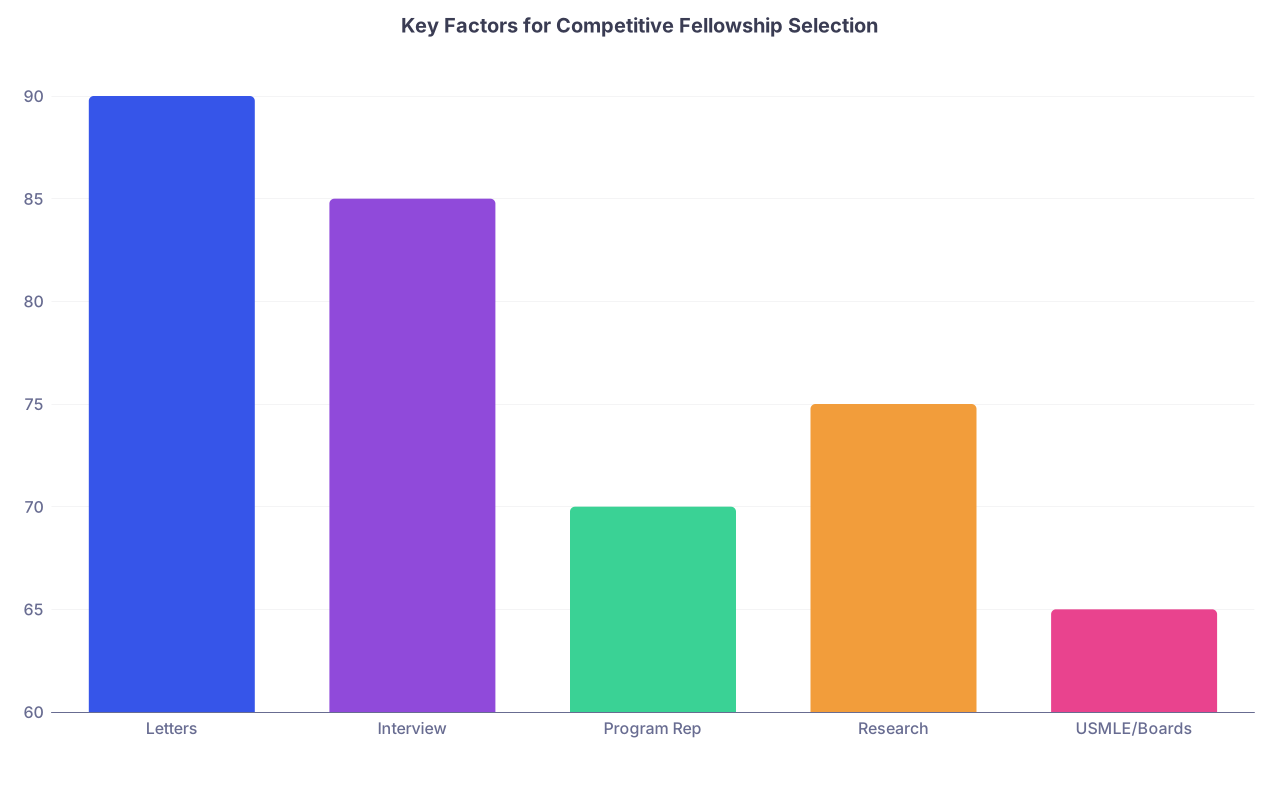
Fellowship directors care about concrete output, not your ROL from med school
When they evaluate you, they see:- Where you actually trained
- Your letters of recommendation
- Your research / scholarly work
- How your PD describes you
They have zero clue that this program was your 4th vs 10th choice. It isn’t in any file. It never will be.
| Category | Value |
|---|---|
| Letters | 90 |
| Interview | 85 |
| Program Rep | 70 |
| Research | 75 |
| USMLE/Boards | 65 |
Surveys of fellowship PDs in internal medicine subspecialties, surgery, and anesthesia essentially line up like this: letters, interview performance, and perceived fit dominate. The name-brand effect of your residency is real but not the main driver—and again, nothing to do with ROL position.
The Quiet Reality: Match Position Predicts Feelings, Not Fate
Matching at your #1 feels fantastic. Dopamine fireworks.
Matching at your #8 feels like a loss. That feeling is real. But it’s psychological, not predictive.
Here’s what actually happens after July 1st:
- You’re on call. No one cares what number your program was on your rank list.
- You’re in morning report. Nobody asks, “So where did this program fall on your preferences?”
- You meet co-residents who didn’t rank this program #1 either. You all still have the same badges.
- Attendings evaluate your work ethic, judgment, and growth. Not your ROL.
Within 3–6 months, most residents stop talking about “I only got my #X” and start talking about:
- Which attendings will actually teach
- Which rotations are brutal
- Where they can realistically get research support
- How to survive nights without imploding
I’ve watched residents who were devastated on Match Day turn into the strongest people in their class, matching competitive fellowships and taking academic jobs. Their eventual success had nothing to do with where their program sat on a spreadsheet in February.
Where Matching Low Can Matter (And How Much)
Let’s distinguish between two different things people conflate badly:
- You matched at your #10 program
- You matched at a genuinely weaker program (less volume, weaker mentorship, low fellowship placement, disorganized leadership)
Those are not automatically the same.
Sometimes you matched low because:
- You ranked geography or lifestyle high
- Your partner’s job limited locations
- You over-ranked a few “prestige” programs that weren’t actually better for training
- You submitted a long list that included many good-but-similar options
Other times, yes, your low-ranked program is weaker. That can create friction later—but again, that’s about program characteristics, not the ROL position.
Here’s the more honest framework:
| Factor | Long-Term Impact |
|---|---|
| Personal performance in residency | Very High |
| Quality of mentorship | Very High |
| Fellowship training site | High |
| Residency program reputation | Moderate |
| City / lifestyle fit | Indirect |
| ROL position (1st vs 8th) | Negligible |
See that last row? That’s the myth.
The real danger isn’t “I matched at #8.” The real danger is: “I’m at a place with no mentorship in what I care about and I’m not proactive about fixing that.”
Which brings us to the part few people want to hear.
The Uncomfortable Truth: Your Effort Now Outweighs Your Match Story
You can’t control your ROL anymore. You can absolutely control what you do once you arrive.
I’ve seen two interns start at the same “mid-tier” program:
- One matched there at #2 and coasted
- One matched there at #9 and arrived with a chip on their shoulder
Three years later, guess who had stronger letters, more projects, and better fellowship options? The one who decided that the ranking narrative was over and the performance narrative had begun.
Your trajectory over the next 3–7 years will hinge on things like:
- Do you actively find mentors early or passively hope they discover you?
- Do you show up prepared, interested, and coachable, or do you carry resentment about not being “where you deserved”?
- Do you look for research and QI opportunities that align with your interests, or just do the minimum?
- Do you protect yourself from burnout well enough to stay consistently good, not just sporadically excellent?
Residency is long enough that early advantages get diluted and early disappointments get washed out. Sustained behavior wins.

But What About Ultra-Competitive Fellowships and Academia?
Here’s where people push back: “Fine, but for super competitive fellowships, doesn’t the program name matter a ton?”
Yes. Program reputation can matter. But again, two key clarifications:
- Program reputation, not “was it your #1 vs #7.”
- Within the set of reasonably strong programs, your track record dominates.
Fellowship directors aren’t blind to prestige. But they are very aware of:
- The best person in a mid-tier program can absolutely outperform the 10th-best resident at a name-brand shop
- Residents from supposedly “lesser” programs often show more grit, autonomy, and practical skill
- A glowing letter from someone known and trusted beats a lukewarm letter from a famous logo
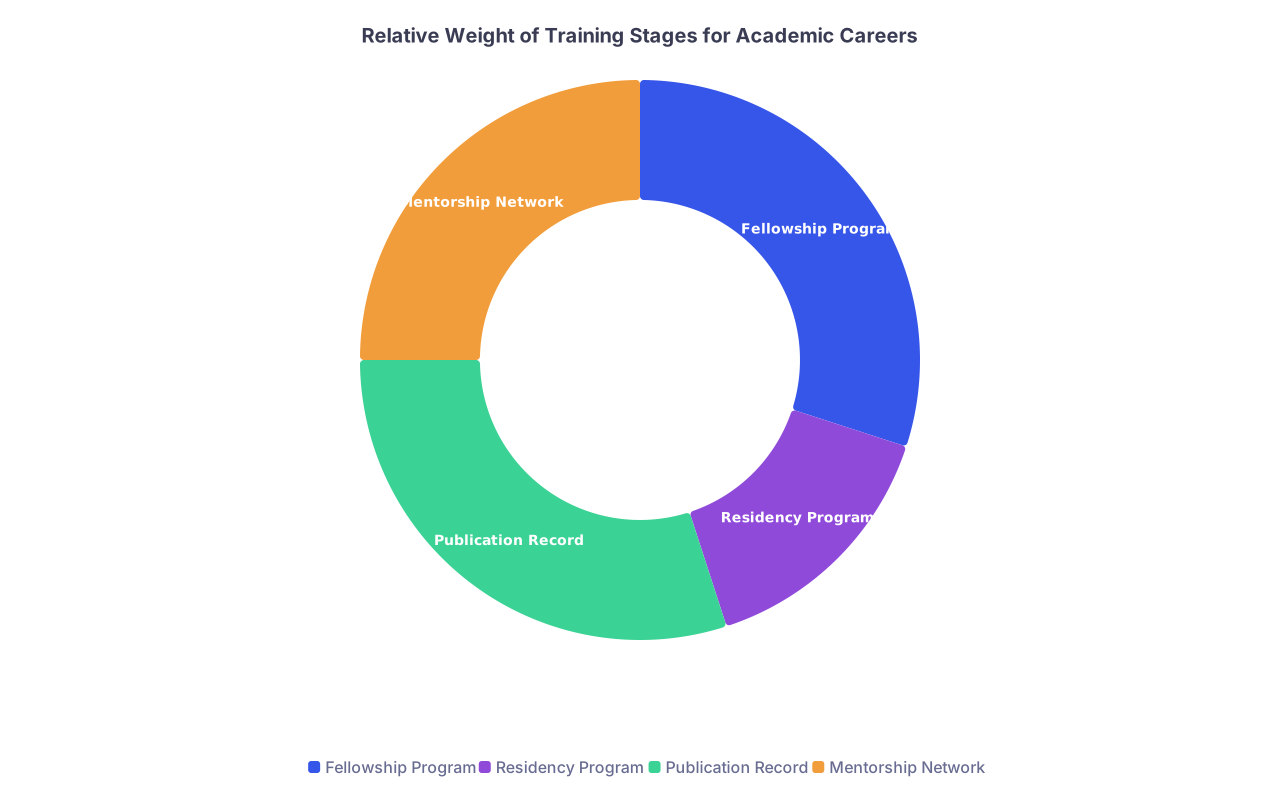
For academic careers:
- Your fellowship institution and what you accomplish there frequently matter more than your residency name, especially outside the most elite academic bubbles.
- Your publication record, grant history, and collaborations will, over time, outweigh where you trained as an intern.
| Category | Value |
|---|---|
| Fellowship Program | 30 |
| Residency Program | 15 |
| Publication Record | 30 |
| Mentorship Network | 25 |
Again, notice what never appears: “Original ROL position on ERAS.”
Emotional Reality vs Statistical Reality
You might be thinking, “Data aside, I still feel like I lost.”
That’s honest. Match Day is a spectacle built to amplify that feeling. Giant envelope. Crowd. Screaming. Posters on Instagram. It’s engineered contrast.
You open your envelope, see your #9, and your brain translates it as:
“I wasn’t good enough for #1-8.”
That’s not what happened. The algorithm:
- Tried to satisfy your preferences
- Tried to satisfy programs’ preferences
- Operated in a market with way too many moving parts for your ego to explain
You might have been ranked high at your top programs—but they filled with people who just happened to rank them even higher. That’s it. There’s no cosmic judgment attached.
The evidence we do have—from countless careers, not just one dataset—shows something very unsexy:
Most physicians’ satisfaction and success correlate far more with:
- Fit with colleagues
- Supportive culture
- Adequate volume and responsibility
- Outside-of-work life being at least somewhat functional
…than with, “Did I match where my 4th year brain thought I wanted to be?”

So What Do You Do If You Matched Low?
Not “think positive.” Not “everything happens for a reason.” Let’s be practical.
Drop the ranking narrative fast
After a week, stop saying “I only got my #X.” It keeps your brain anchored in loss instead of opportunity. You matched. You’re a doctor in training. Start acting like it.Do reconnaissance early
Before you even start, find current residents who are honest. Ask them:- Who are the real mentors here?
- Which rotations give the best learning?
- How do people successfully get X (fellowship, research, etc.) from this program?
Build your micro-environment
Your day-to-day is mostly: your team, your mentors, your co-residents. If those are strong, you can thrive almost anywhere. Be intentional about who you attach yourself to.If you truly landed somewhere dysfunctional
Sometimes the program actually is toxic or incapable of supporting your goals. That’s not a “low on my list” problem; that’s a “bad fit” problem. Residents transfer programs every year. It’s not easy, but it’s real. Your ROL has nothing to do with your right to seek a better environment.

| Step | Description |
|---|---|
| Step 1 | Match Low on List |
| Step 2 | Shift Focus to Mentors and Performance |
| Step 3 | Document Issues and Seek Support |
| Step 4 | Build Research and Network |
| Step 5 | Strong Fellowships and Jobs |
| Step 6 | Discuss Options with PD or DIO |
| Step 7 | Explore Transfer or Exit Plans |
| Step 8 | Program Functional? |
| Step 9 | Improves? |
Your influence over your career doesn’t end at Match. It mostly starts there.
The Long View You Don’t Have Yet
Ask attendings 10–20 years out where they matched on their list. Many don’t even remember the exact number. They remember:
- The attending who believed in them
- The co-residents who had their back on brutal nights
- The fellowship mentor who opened a door
- The one major fork in the road where they took a chance
Match position fades quickly in the rearview mirror because it’s a noisy, emotionally charged, and ultimately shallow metric.
You want something that predicts career success? Try these instead:
- Do you consistently show up prepared and engaged?
- Do you recover from setbacks without imploding?
- Do you stay curious instead of cynical over time?
- Do you build and maintain relationships with people who are better than you at what you want to do?
Those variables have teeth. Your #8 vs #2 does not.

Years from now, you won’t be replaying the half-second when you read the line on your Match Day envelope. You’ll be living the consequences of how you responded to it. That’s the part that actually predicts who you become.