
The worst thing you can do after Match Day is disappear and hope your program assumes everything is fine. They do not. They assume something is wrong.
You’re about to see why that “I’ll just stay quiet and not bother them” approach is exactly what spikes your program’s anxiety—and sometimes puts a target on your back before you even show up.
The Reality: Programs Notice When You Go Silent
Let me be blunt: residency programs track engagement after Match.
Not with some fancy CRM dashboard (usually), but with group texts, email threads, and hallway conversations that sound like:
- “Has anyone heard from the new interns yet?”
- “Did that prelim actually respond to the welcome email?”
- “Why is this one not answering anything—visa issue? Cold feet? Problem?”
If you think you’re “just busy” or “not really an email person,” here’s how the silence reads on their side:
- Possible no‑show risk
- Possible professionalism issue
- Possible communication problem
- Possible visa / credentialing / background-check problem
- Possible burnout risk before day one
None of those are labels you want attached to your name before orientation.
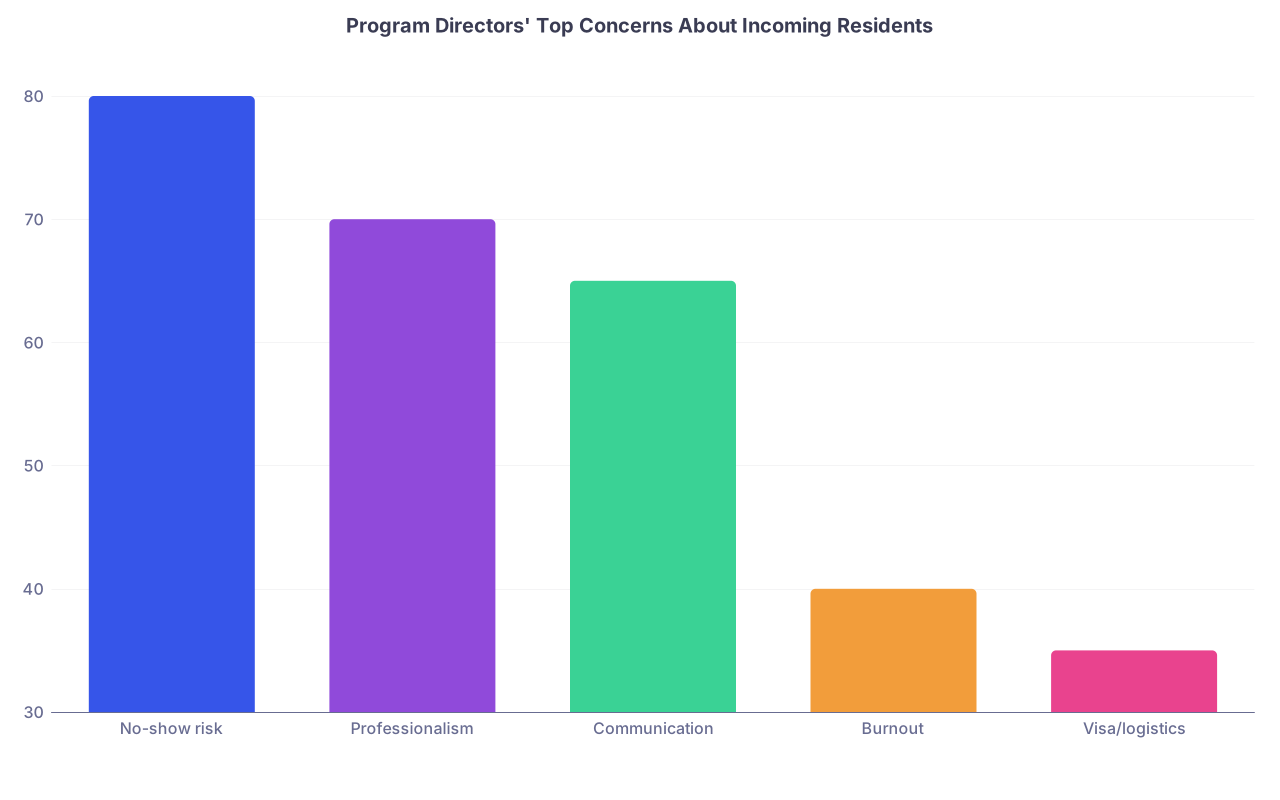
| Category | Value |
|---|---|
| No-show risk | 80 |
| Professionalism | 70 |
| Communication | 65 |
| Burnout | 40 |
| Visa/logistics | 35 |
Those numbers aren’t real survey data, but the ranking is. I’ve sat in meetings where PDs and coordinators bring up specific names based almost entirely on post-match behavior.
You don’t need to be the superstar. But you cannot be the ghost.
What “Post-Match Silence” Actually Looks Like
Most people think “going dark” means ignoring everything completely. It doesn’t have to be that extreme to get noticed.
Programs see “silence” in a bunch of specific ways:
- Ignoring the initial “Welcome to our program!” email
- Taking weeks to sign and return onboarding paperwork
- Not filling out credentialing or hospital privileging forms on time
- Not joining or responding in the group chat they set up
- Not replying to PD or APD outreach (even if it’s a short, casual note)
- Failing to answer simple logistical questions (move-in date, start date confirmations, etc.)
- Ignoring deadlines from GME/HR that everyone else has met
Here’s the dangerous assumption:
“I matched. I’m in. I’ll handle all this later.”
Programs hear a different message:
“This person does not prioritize communication or deadlines. That’s going to be a problem when a lab is critical or a patient is crashing.”
They extrapolate. A lot.
Why Silence Freaks Out Your Program
You might be thinking, “Why are they so paranoid? I signed the contract.”
Because programs have been burned before. Repeatedly.
I’ve seen every single one of these scenarios play out:
- A matched intern never answers, then emails in June: “I’ve decided to pursue a different specialty.”
- A visa-dependent resident ghosts because the visa fell through and they were embarrassed to say so.
- Someone fails a licensing exam, panics, and just stops responding while “figuring it out,” leaving the program in limbo.
- A trainee with major professionalism issues pre-residency continues the same pattern post-match.
So programs learn to see patterns. And post-match silence is a huge red flag. Not because they hate you—but because they have to protect their service coverage, their patients, and their accreditation.

| Step | Description |
|---|---|
| Step 1 | No response after Match |
| Step 2 | Concern escalates |
| Step 3 | Gentle reminder |
| Step 4 | Minor concern only |
| Step 5 | High risk label |
| Step 6 | Flag to PD and Chief |
| Step 7 | Pattern? |
| Step 8 | Responds now? |
By the time you finally reply with “Hey, so sorry, been super busy with moving,” they may have already had three conversations about you.
Preventable conversations.
The Biggest Mistakes People Make After Matching
Let’s walk through the classic errors that trigger the “post-match silence trap” and how to avoid each one.
1. Treating Every Email as Optional
Common phrases I hear from interns later:
- “I thought that was just an FYI email.”
- “It didn’t sound urgent.”
- “I figured I’d deal with it closer to June.”
This is how you earn the label “doesn’t read emails.”
The worst offenders:
- IT sign-up links (hospital email, EMR access, pager setup)
- Occupational health requests (vaccines, TB test, titers, drug screen)
- Licensing / training permit paperwork
- Onboarding checklists from GME or HR
- PD welcome messages asking for simple details
If you’re not sure whether something is optional, assume it’s mandatory until told otherwise. Replying with:
“Received, working on this this week—will confirm once submitted.”
takes 10 seconds and instantly reassures them.
2. Not Saying Anything Until There’s a Crisis
Another common pattern: silence, silence, silence… then a panicked email 10 days before start date.
- “I’m still waiting on my visa.”
- “I haven’t gotten my license yet.”
- “I didn’t realize I had to finish X before orientation.”
Here’s the mistake: waiting until it’s a near-emergency before looping in the program.
From their side, this looks like:
- Poor judgment
- Poor planning
- Poor communication skills
Three qualities no residency wants in an intern.
You’ll get far more grace if you flag an issue early:
“Just wanted to keep you updated: my Step 3 score is still pending, and state board timelines look a bit slow. I’m working on it daily and will send updates every 1–2 weeks.”
Silence until crisis? That’s how programs lose trust fast.
The Visa and Exam Score Black Hole
If you’re visa-dependent or sitting on high-stakes exam results (Step 3, for example), you’re at special risk of falling into this trap.
The instinct is to wait silently “until I know for sure.”
That’s exactly the wrong instinct.

Visa issues
What you think:
“I’ll wait to email them until I know if the visa is denied or approved. No point worrying them.”
What they think during your silence:
- “Has this person even started their visa process?”
- “Are we going to be short an intern?”
- “Do we need to start contingency planning?”
Even if you do everything right, without updates you look like the problem.
You should be doing both:
- Working aggressively on the visa
- Sending calm, periodic updates (“I submitted X on [date]. Y is pending. Here’s the expected timeline.”)
Exam score issues
Same trap with licensing exams:
You’re afraid of being judged if you fail or cut it close, so you go quiet. Program hears: “unreliable, evasive, potentially dishonest.”
You must not hide:
- Delayed exam date
- Postponement
- Attempt failures
- Concern about meeting start-date requirements
Bring them in early. Programs hate surprises more than they hate delayed scores.
The Social Silence: Group Chats, Retreats, and “Optional” Events
Now to the softer stuff that still matters.
Your program sets up:
- A group chat with current residents and incoming interns
- A welcome dinner or informal social
- A “get to know you” Zoom session
- A pre-orientation retreat
You think, “Optional. I’m introverted. I’ll pass.”
One event skipped? Fine. A pattern of total absence? Not fine.
What people actually say in resident rooms:
- “Is that new person coming to anything?”
- “Do they even want to be here?”
- “Watch, they’re going to be the one that never answers when we need coverage.”
If social events are truly impossible (travel, finances, family emergencies, time zones), you avoid the trap with one short message:
“Thanks so much for the invite! I won’t be able to attend because of [brief reason], but I’m really looking forward to starting and meeting everyone soon.”
That’s it. You’ve shown:
- You’re alive
- You care
- You respect the invite
Silent non-participation reads like disinterest at best, disdain at worst.
How Silence Hurts You Before Day One
Post-match silence doesn’t just make them nervous. It changes how they treat you when you arrive.
Here’s how it plays out in real life:
| Program Perception | Likely Impact on You |
|---|---|
| “Risk for no-show” | Less trust, more micromanagement |
| “Poor communicator” | Less autonomy early, more skepticism |
| “Not engaged with team” | Fewer social supports, weaker peer network |
| “Disorganized/unreliable” | Less likely to be offered early opportunities |
| “High-maintenance unknown” | Chiefs mentally brace for problems |
You might feel like, “That’s unfair, they don’t know me yet.”
Correct. They don’t. So they use what they do know: your responsiveness, your follow-through, your tone.
And no, they won’t tell you to your face that you came in with a red mark. You’ll just notice:
- You’re not the one getting volunteered for early teaching or research chances.
- Chiefs “double check” your work more than others.
- PD holds back on trusting you with stretch opportunities.
You don’t need that handicap. Especially when it’s entirely avoidable.
The Simple Fix: Controlled, Professional Visibility
The goal isn’t to become the over-eager intern emailing every 12 hours. That’s its own problem.
You want controlled visibility: enough presence that no one worries about you, but not so much that they roll their eyes when your name shows up.
Here’s the bare minimum to avoid the silence trap:
Respond to every program email within 48 hours
Even if it’s just: “Received, I’ll complete this by [date]. Thank you.”Acknowledge every major request
If they send forms, checklists, or deadlines, reply once, track it, and confirm when done.Send proactive updates about anything time-sensitive
Visas, exams, moving delays, serious family issues—brief updates every 1–2 weeks if unresolved.Show your face at least once pre-start
Zoom session, welcome dinner, group chat introductions—pick something and show up.Answer PD / APD / chief messages promptly
These are not the people you leave on read for a week.
This is not people-pleasing. It’s baseline professional behavior in a high-stakes field.
Scripts You Can Steal (So You Don’t Overthink It)
If you freeze every time you need to “sound professional,” steal these and tweak as needed.
When you receive onboarding forms
“Dear [Coordinator Name],
Thank you for sending these documents. I’ve received everything and will complete and return the required forms by [specific date].
Best,
[Your Name]”
When you’re behind but not catastrophically late
“Hi [Name],
I wanted to update you that I’m still working through the onboarding items. I’ve completed [A, B] and am currently working on [C]. I expect to have everything submitted by [date].
Thank you for your patience,
[Your Name]”
When you’re facing a real delay (visa, license, exam)
“Dear Dr. [PD Last Name] and [Coordinator Name],
I wanted to keep you updated about my [visa/state license/Step exam].
- Current status: [brief, clear one-line summary]
- Actions taken so far: [1–2 short bullets]
- Next expected step and timeline: [specific if possible]
I’ll send another update by [date] or sooner if there’s a major change. Please let me know if there’s anything else I should be doing on my end.
Best regards,
[Your Name]”
When you can’t attend a social/welcome event
“Hi everyone,
Thank you for organizing this! I won’t be able to attend because of [pre-existing travel/family commitment], but I’m really looking forward to meeting you all when the year starts.
Best,
[Your Name]”
None of this is fancy. It just breaks the silence and signals: “You don’t have to worry about me.”
What To Do If You’ve Already Gone Too Quiet
Maybe you matched weeks ago, haven’t replied to half your emails, and are reading this with that sinking feeling.
Fine. Don’t spiral. Fix it.
Here’s your damage-control plan:
Go through your email and messages from the program. Make a list:
- Overdue forms or tasks
- Unanswered emails from PD, APDs, coordinator, chiefs
- Missed invites / events
Triage:
- Handle anything you can complete in under 30 minutes today.
- For bigger items, set specific dates this week to finish.
Send one “reset” email to the coordinator (and CC PD if appropriate):
“Dear [Name],
I wanted to apologize for my delayed responses over the past few weeks. I’ve gone back through my email and am working to complete remaining onboarding items. So far I have completed: [list what’s done].
I’m planning to finish [remaining items] by [clear date]. If there’s anything I’ve missed or anything urgent I should prioritize, please let me know.
I’m very grateful for the opportunity to join the program and want to make sure I start on the right foot.
Best regards,
[Your Name]”
- Then do what you said you’d do. On time.
You won’t erase the past silence entirely, but you’ll change the story from “unreliable ghost” to “had a rough start but took responsibility and corrected it.” Programs respect that more than you think.
FAQ (4 Questions)
1. Do I really have to respond to every single email from the program?
You don’t need a flowery reply to every announcement, but anything that:
- Mentions you by name,
- Requests information,
- Contains forms, links, or deadlines,
deserves a brief acknowledgment and follow-through. If you’re ever unsure, err on the side of replying.
2. What if I’m genuinely overwhelmed finishing med school and moving?
Then say exactly that—briefly. Programs understand busy seasons. They do not understand silence. A simple, “I’m in the middle of finals and moving prep, but I’ll complete this by [date],” goes a long way and buys you grace.
3. Will being more responsive make me look desperate or like a suck-up?
No. Prompt, clear replies are standard professional behavior. The suck-up line is crossed when you send unnecessary, overly long messages or constantly seek reassurance. Efficient, on-time responses don’t read as desperate—they read as competent.
4. How often should I send updates about visa or licensing issues?
If something is unresolved and could affect your start date, aim for every 1–2 weeks, or whenever there’s a meaningful change. Always include: current status, what you’ve done, and what’s coming next. Keep it short, factual, and calm.
Two things to remember:
- Silence after Match does not read as “chill” or “independent.” It reads as “problem incoming.”
- You don’t need to be perfect—you just need to be reachable, predictable, and honest.
Break the post-match silence before it breaks your reputation.