
The usual MCAT advice ignores one brutal truth: cramming “full-time MCAT prep” into a summer while you’re also working or taking classes is where smart students crash and burn.
You do not have time to waste a single week.
This 8-week summer MCAT timeline is built for full-time students—people taking 2–3 summer classes, doing research, or working ~30–40 hours—but who still need a serious score (think 510+). I’m going to walk you week by week, then day by day, with concrete targets. At each point you’ll know exactly what you should be doing, how many questions to hit, and what to absolutely skip.
Assumptions:
- You’ve taken (or are taking) the core prereqs: gen chem, orgo, bio, physics, psych/soc.
- You have ~20–25 hours/week for MCAT. Not ideal, but common.
- Test date is at the end of Week 8.
If your schedule is uglier than that, you’ll have to trim hours, not goals. The bar doesn’t move because you’re busy.
Big-Picture 8-Week Structure
Here’s the spine of your summer:
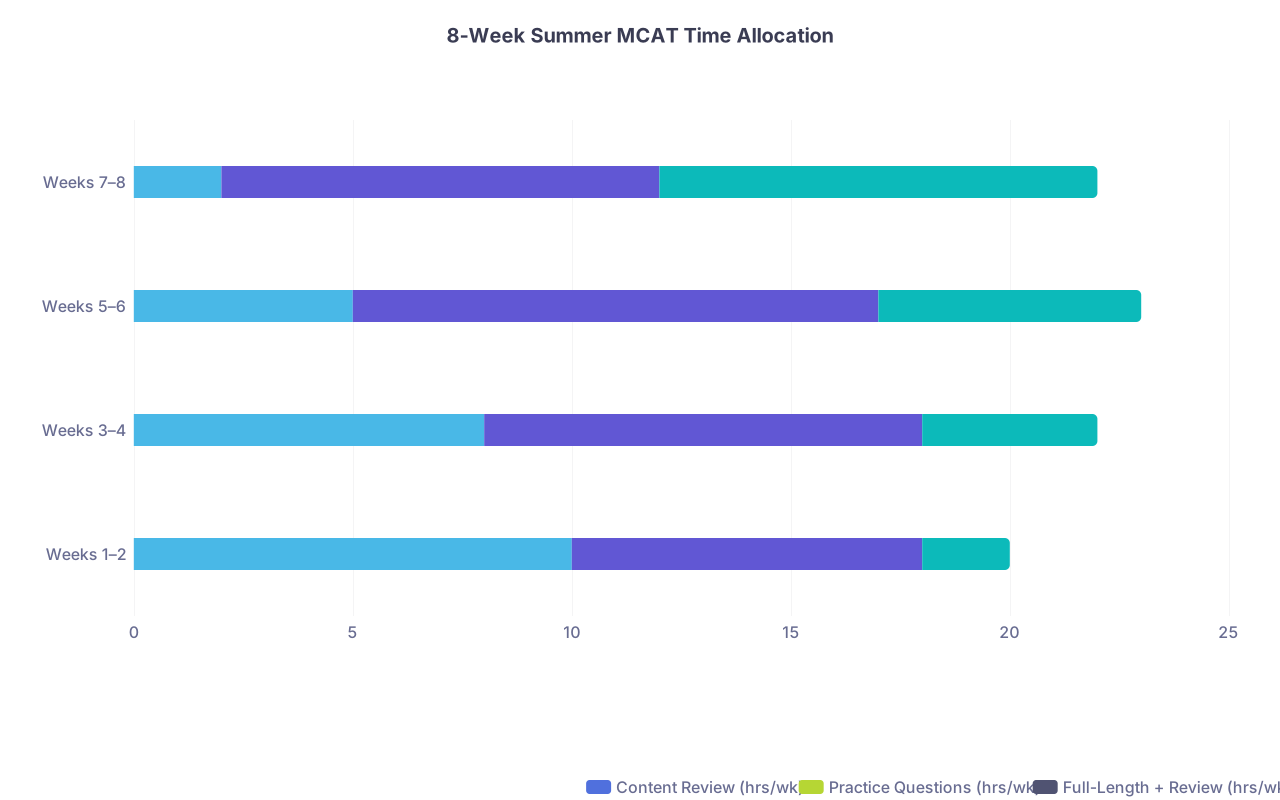
| Category | Content Review (hrs/wk) | Practice Questions (hrs/wk) | Full-Length + Review (hrs/wk) |
|---|---|---|---|
| Weeks 1–2 | 10 | 8 | 2 |
| Weeks 3–4 | 8 | 10 | 4 |
| Weeks 5–6 | 5 | 12 | 6 |
| Weeks 7–8 | 2 | 10 | 10 |
- Weeks 1–2: Foundation + Baseline
- Fast but focused content review
- Build habits, take a diagnostic, start question-based learning
- Weeks 3–4: Heavy Question Phase
- Content review continues but shrinks
- Daily MCAT-style practice, start full-lengths
- Weeks 5–6: Full-Length & Weakness Attack
- Weekly full-lengths, aggressive review
- Content only where it’s actually hurting your score
- Weeks 7–8: Simulation & Refinement
- 2 full-lengths/week
- Timing, stamina, and targeted clean-up
Your job: stick to the calendar like you would to an exam schedule. Because this is one.
Week 1: Baseline and Build the Machine
Goal: Set realistic targets, build your study infrastructure, and get your baseline score.
At the start of Week 1 (Day 1–2)
You should:
Choose your test date and register.
- Put it in your calendar as a non-negotiable. No “I’ll see how it goes.”
Set score targets by section. Don’t aim for “510+.” Break it down:
Example Section Score Targets Section Baseline Likely Target Score Chem/Phys 123–125 128–129 CARS 123–125 127–128 Bio/Biochem 124–126 128–130 Psych/Soc 125–127 129–130 Pick resources. Commit.
- 1 primary content set (Kaplan, TBR, Blueprint, or Khan Academy + Anki).
- 1 question bank (UWorld, Kaplan QBank, etc.).
- AAMC materials reserved for later (FLs, Section Banks, Question Packs).
If you’re trying to juggle three different book sets, stop. That’s how you waste half the summer “choosing” instead of improving.
Mid-Week 1 (Day 3–4): Take Your Diagnostic
You should:
- Take a full-length diagnostic (preferably a 3rd-party FL, not AAMC yet).
- Timed conditions.
- One sitting with minimal breaks, like test day.
- Same start time as your real MCAT (if you’re scheduled for 8 AM, start at 8).
That score, however painful, is now your starting line. I’ve seen students go from 496 to 510 in 8 weeks with discipline. I’ve also seen 505 plateau at 507 because they never fixed their process.
End of Week 1 (Day 5–7): Start Structured Content + Light Questions
Daily targets (5 MCAT days this week, 2 lighter or off):
- 2–3 hours content review
- Focus: Chem/Phys + Bio/Biochem
- Strategy: Read a chunk → write a 5–10 line summary from memory → make/review 20–30 Anki cards.
- 60–90 minutes of practice questions
- 20–30 untimed, but with focus.
- Review each question thoroughly:
- Why was the right answer right?
- Why were the wrong choices tempting or bad?
- What rule or concept did this question test?
By the end of Week 1, you should have:
- Diagnostic score + notes on weakest areas.
- A clear, repeatable daily routine.
- A written list of your top 3 weakest content domains.
Week 2: Finish the “First Pass” and Build Question Momentum
Goal: Finish a quick-and-dirty first pass of most content and increase daily question volume.
You’re still in class or working, so your MCAT days must be carved out.
Week 2 Structure
Aim for 5 MCAT days, 2 flexible. Example:
- 4 weekdays: 2.5–3 hours/day
- 1 weekend day: 4–5 hours focused block
At this point each MCAT day should look like:
1.5–2 hours content
- Finish:
- General chemistry main topics (acids/bases, equilibrium, electrochem).
- Core physics: kinematics, forces, energy, fluids.
- High-yield bio: cell bio, enzymes, metabolism basics.
- Light pass on Psych/Soc: skim 1–2 chapters, start vocab Anki.
- Finish:
1.5–2 hours questions
- 30–40 questions/day (section-mixed or topic-based).
- Still can be partially untimed, but start tracking:
- Time spent per passage.
- Where you freeze or reread excessively.
By end of Week 2, you should:
- Have touched every major content area at least once.
- Be doing ~30 questions on most active days.
- Have a running “error log” (spreadsheet or notebook) with:
- Concept
- Question ID/source
- Why you missed it
- Fix (specific rule, equation, or strategy)
Week 3: Shift to Question-First Mode
Goal: Transition from “let me finish content” to “questions drive what I review.”
This is where many students mess up. They keep reading. Reading feels safe. It also doesn’t reliably raise your score without questions to anchor it.
Start of Week 3 (Day 1–2)
You should:
- Plan your first AAMC full-length for the end of Week 3.
- Tighten your weekday routine into this:
On 3–4 weekdays:
- 45–60 minutes: CARS practice
- 3–4 passages, timed.
- Review every passage: highlight where your reasoning went off.
- 60–90 minutes: Science questions (Chem/Phys or Bio/Biochem focus)
- 2–3 passages + 10–15 discretes.
- 60–90 minutes: Targeted content review based on missed problems.
Weekend (one long day):
- 3–4 hours total:
- 2–3 CARS passages
- 4–6 science passages
- Content patching on your worst topics from the week
End of Week 3: FL #1 (Ideally AAMC FL1)
- Take your first AAMC full-length.
- Treat it like a dress rehearsal:
- Same timing, breaks, snacks, water.
- No phone, no pausing “just this once.”
Score doesn’t matter emotionally; it matters diagnostically. By this point you should be within ~5–8 points of your target if you started reasonably close. If you’re 12–15 points away, you’ll need to be ruthless for the next 5 weeks.
Week 4: Cement Habits, Add Stamina
Goal: Turn question review into your primary learning engine and build test-day endurance.
At this point, content-only days are over. They do not exist.
Week 4 Routine
Aim for another full-length at the end of Week 4, so we’re moving toward weekly exams.
On 3–4 weekdays:
CARS (45–60 minutes)
- 3–5 passages, timed.
- Track:
- Passages where you finish too early (rushing).
- Passages you constantly reread.
Science blocks (90 minutes)
- 3–4 passages in one section (e.g., just Chem/Phys).
- Timed to match MCAT pace: ~8–9 minutes/passage.
- Immediately after, 45–60 minutes of deep review.
Targeted content (30–45 minutes)
- Only from your error log:
- If you missed 5 questions involving electrochemistry: review Nernst, galvanic vs electrolytic, sign conventions.
- If you keep blowing endocrine questions: review major hormones, glands, feedback loops.
- Only from your error log:
Weekend: Full-Length #2 (3rd-party or AAMC depending on what you have)
- Same drill: test + 1–2 days of serious review.
- During review, you should:
- Label each missed question:
- Content gap
- Misread question
- Reasoning error
- Time pressure
- This breakdown tells you what to attack in Weeks 5–6.
- Label each missed question:
By the end of Week 4, you should:
- Be 2 full-lengths in.
- Have a stable routine that fits around your full-time obligations.
- Know your top 5 recurring error types.
Week 5: Full-Length Every Week, Weakness Assault
Goal: One FL per week + aggressive, focused repair.
You’re halfway. This is where people either make a jump… or flatline.
Start of Week 5
You should schedule:
- FL #3 early in the week (Day 1–2).
- A fixed block for review on the following 1–2 days.
Post-FL Review (1–2 days)
On these days:
- 3–4 hours of review, broken into blocks:
- CARS: Identify question stem types you miss (inference, main idea, tone).
- Chem/Phys & Bio/Biochem: Group missed questions by topic and formula.
- Psych/Soc: Flag vocab and terminology you did not fully know.
Turn this into specific to-dos:
- “Review optics: lenses, mirrors, sign conventions, thin lens equation.”
- “Anki 30 new psych terms I missed: conformity, obedience, groupthink, etc.”
Mid-to-End Week 5 (Remaining days)
Daily structure:
- CARS (45–60 min): 3–4 passages.
- Science set (60–90 min): 3–4 passages from your weakest section (e.g., Chem/Phys).
- Targeted drilling (60 min):
- 15–20 Psych/Soc discretes if that section is weaker.
- Otherwise, science discretes on key formulas and concepts.
- Short content review (30 min):
- Only high-yield + your missed items.
By end of Week 5:
- You should see at least some move in your FL scores, even 2–4 points.
- Stamina should feel better—mental crash around Bio/Biochem should start to recede.
Week 6: Increase Pressure, Mimic Real Test Conditions
Goal: Keep 1 FL per week, but tighten timing and test-day realism.
Early Week 6: FL #4
At this point, use AAMC full-lengths if you haven’t been already. They’re the closest to the real exam.
You should:
- Run this FL at the same time of day and same breakfast routine as the real thing.
- Seriously. If you’re testing at 7:30 AM, don’t start this practice at noon.
FL #4 Review (1–2 days)
Now you should be extra critical:
- Look for question types you always miss:
- For CARS: detail vs inference vs main idea.
- For Chem/Phys: conceptual vs calculation-heavy.
- Tighten timing:
- If you’re always rushing the last 3–5 questions, your pacing in the first half is off.
Your study blocks for the rest of the week should be:
- 1 hour CARS (4–5 passages).
- 90 minutes science:
- 2 hard passages in your weakest section.
- 2 moderate passages in second weakest.
- 45–60 minutes Psych/Soc:
- Rotate: question blocks + Anki/vocab.
By end of Week 6:
- Your scores should be within ~3–5 points of target if everything is on track.
- If not, you don’t quit. You cut distractions and double down.
Week 7: Two Full-Lengths, Fine-Tuning, No New Major Content
Goal: Push stamina and consistency. No more trying to “learn everything from scratch.”
Week 7 Plan
You should schedule:
- FL #5 on Day 1–2.
- FL #6 on Day 5–6.
That’s two full-lengths this week. Perfect simulation training.
Between them:
After FL #5 (Day 2–3):
- Half day: thorough review of the worst section.
- Half day: lighter review of other sections + targeted drills.
Mid-week short days (Day 3–4):
- 2–3 hours total:
- 3 CARS passages
- 2–3 science passages
- Quick Psych/Soc vocab refresh
After FL #6:
- Same deep review, but now you are looking for:
- Patterns in silly mistakes.
- Timing habits that bleed points.
- End-of-test fatigue (Psych/Soc performance collapse).
By the end of Week 7, you should:
- Have 6 full-lengths under your belt.
- Know exactly:
- Your predicted score range.
- What not to do on test day (e.g., changing answers impulsively, overthinking easy discretes).
Week 8: Taper, Protect Your Brain, Final Reps
Goal: Arrive on test day sharp, not exhausted.
This week is about control, not heroics.
Early Week 8 (Day 1–3): Last Full-Length (Optional)
If you’re not burned out and your scores have been stable, you can do:
- FL #7 on Day 1 (ideally AAMC if you have one left).
- Day 2–3: Light, focused review. No marathon days.
If you’re mentally fried, skip this and use shorter section drills instead.
Mid-Week 8 (Day 3–5): Light Tuning
Each day:
- 30–45 minutes CARS (2–3 passages).
- 60 minutes science:
- 2–3 passages in historically weak areas.
- 30–45 minutes Psych/Soc:
- Vocab, key theories, practice discretes.
- 15–30 minutes formula and concept sheet review:
- Kinematics, circuits, optics, thermodynamics.
- Amino acids: structures, properties, pKa logic.
- Enzyme kinetics basics, hormonal axes, major psych/soc theories.
No new resources. No new books. Just sharpening what you already know.
Day Before the Exam
Do not study more than 2–3 light hours. Many ignore this and walk in fried.
What you should do:
- 1–2 CARS passages (max).
- Quick scan of your personal formula sheet and most-missed concepts.
- Pack:
- Snacks
- Water
- Layers of clothing
- IDs
- Visit or at least map the test center in advance.
Sleep is more valuable than 50 extra Anki cards at this point.
Typical Weekday Template for Full-Time Students
You’re juggling classes, research, or work. Here’s how a realistic weekday might look.
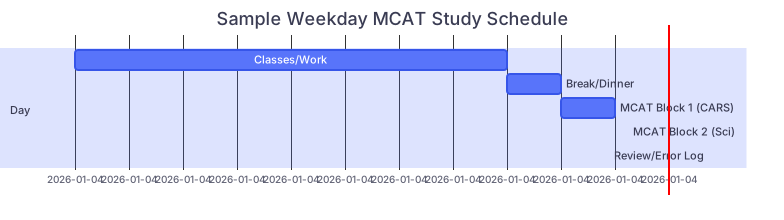
| Task | Details |
|---|---|
| dateFormat HH | mm |
| Day: Classes/Work | a1, 08:00, 8h |
| Day: Break/Dinner | a2, 16:00, 1h |
| Day: MCAT Block 1 (CARS) | a3, 17:00, 1h |
| Day: MCAT Block 2 (Sci) | a4, 18:15, 1h30m |
| Day: Review/Error Log | a5, 19:45, 0h45m |
Notice:
- You won’t feel like doing that evening block.
- That’s the difference between a 502 and a 510+.
Quick Reality Check: Are You On Track?
By the end of each milestone, you should roughly be here:
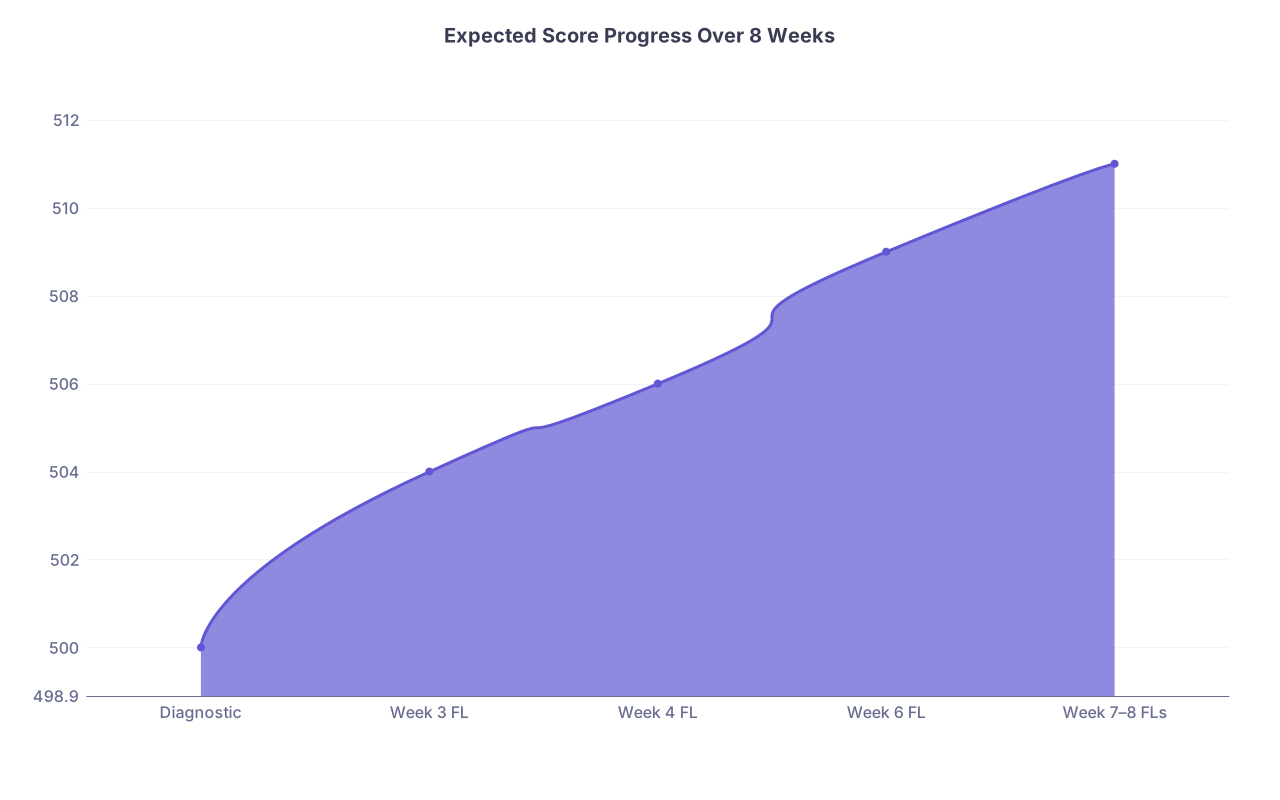
| Category | Value |
|---|---|
| Diagnostic | 500 |
| Week 3 FL | 504 |
| Week 4 FL | 506 |
| Week 6 FL | 509 |
| Week 7–8 FLs | 511 |
This is just an example curve, but the pattern matters:
- Early modest gains.
- Bigger gains in the middle as practice compounds.
- Smaller refinements at the end.
If your line is totally flat after multiple FLs, your process—not your intelligence—is broken. You’re either:
- Not reviewing deeply enough.
- Avoiding your weaknesses.
- Or not doing enough timed practice.
Your Next Action Today
Take out a calendar—paper, Google, doesn’t matter—and block off your next 8 weeks exactly as I laid it out. Write in:
- Which days you’ll take each full-length.
- Which 3–4 days per week are non-negotiable MCAT days.
- Your daily study blocks around classes or work.
If you don’t schedule those full-lengths and blocks right now, this entire plan turns into wishful thinking.