You're finally ready to apply. Personal statement polished. Activity descriptions done. Letters are in. You open your school list, glance at your old MCAT date, and then it hits you:
Wait. Is this score still valid?
I've seen this derail applications at the worst possible moment. Someone assumes their score will "probably count," submits anyway, and then finds out three of their top schools won't accept it because the test date is too old for that cycle. That's not a minor mistake. That's wasted money, wasted time, and sometimes a wasted year.
Here's the rule you need to keep straight: a score can appear on your application and still not be accepted by a school. Those are not the same thing.
Medical schools care about score recency because they want evidence of current readiness. Fair or not, that's the logic. A strong MCAT from several years ago may still exist in the system, but a school can decide it no longer reflects your present academic ability. And schools absolutely do enforce that.
So if your MCAT is anywhere near the edge of a school's policy window, don't guess. Don't rely on a Reddit thread from two cycles ago. Don't assume AMCAS or AACOMAS listing your score means every school on your list will honor it. It won't.
The good news? This is fixable. Usually in a few minutes per school. You just need a clean way to check your date against each program's actual rule and make a decision before you hit submit.
Why MCAT Score Validity Matters Before You Apply
The trap here is simple: applicants confuse visibility with validity.
If your MCAT score is on your AMCAS or AACOMAS application, schools can usually see it. That doesn't mean they'll use it. Admissions offices often have their own cutoff rules based on the year, the exact test date, or the matriculation cycle. That's why an "old but reported" score can still be useless for a specific school.
Why do schools care so much? Because they want recent evidence that you can handle the science load now. Not four years ago. Not before a career change, a master's program, or a long break. Current readiness matters. They're building a class that can survive the curriculum, and the MCAT is one of the ways they screen for that.
This gets especially messy when you apply broadly. One school may accept a January 2022 test date for the current cycle. Another may require January 2023 or newer. Same application. Same score report. Different outcome.
That's why checking this early is not optional. It belongs on the same pre-submission checklist as transcript receipt, letters, and school prerequisites. Ignore it and you risk building a school list around programs that were never really available to you.
The Basic Rule: How Long MCAT Scores Usually Stay Valid
Here's the short answer: most medical schools accept MCAT scores that are about 2 to 3 years old. That's the common window for both MD and DO programs.
But "usually" is doing a lot of work there.
Some schools count backward from:
- your application submission date
- the start of the application cycle
- the expected matriculation year
- a specific month or calendar date listed in admissions requirements
That's where people get burned. They hear "MCAT scores are good for three years" and stop reading. Bad move. Schools don't all define those three years the same way.
For example:
- One school might say your oldest accepted MCAT must be from January 2022 or later
- Another might say scores are valid if taken within three years of anticipated matriculation
- Another might use a stricter two-year limit
And yes, MD and DO schools can differ, though the variation is often school-specific rather than degree-specific.
The biggest misconception? Thinking AAMC or AACOMAS sets one universal expiration rule. They don't. They report scores through the application services, but the admissions policy belongs to the school. Period.
So use this as your default assumption:
- 2 to 3 years is common
- individual schools may be stricter
- the school's own admissions page is the final authority
That last point matters more than anything else. If a school website says your score is too old, it's too old. Doesn't matter what a forum says. Doesn't matter what another school does. Doesn't matter that your friend got in somewhere else with an older score.
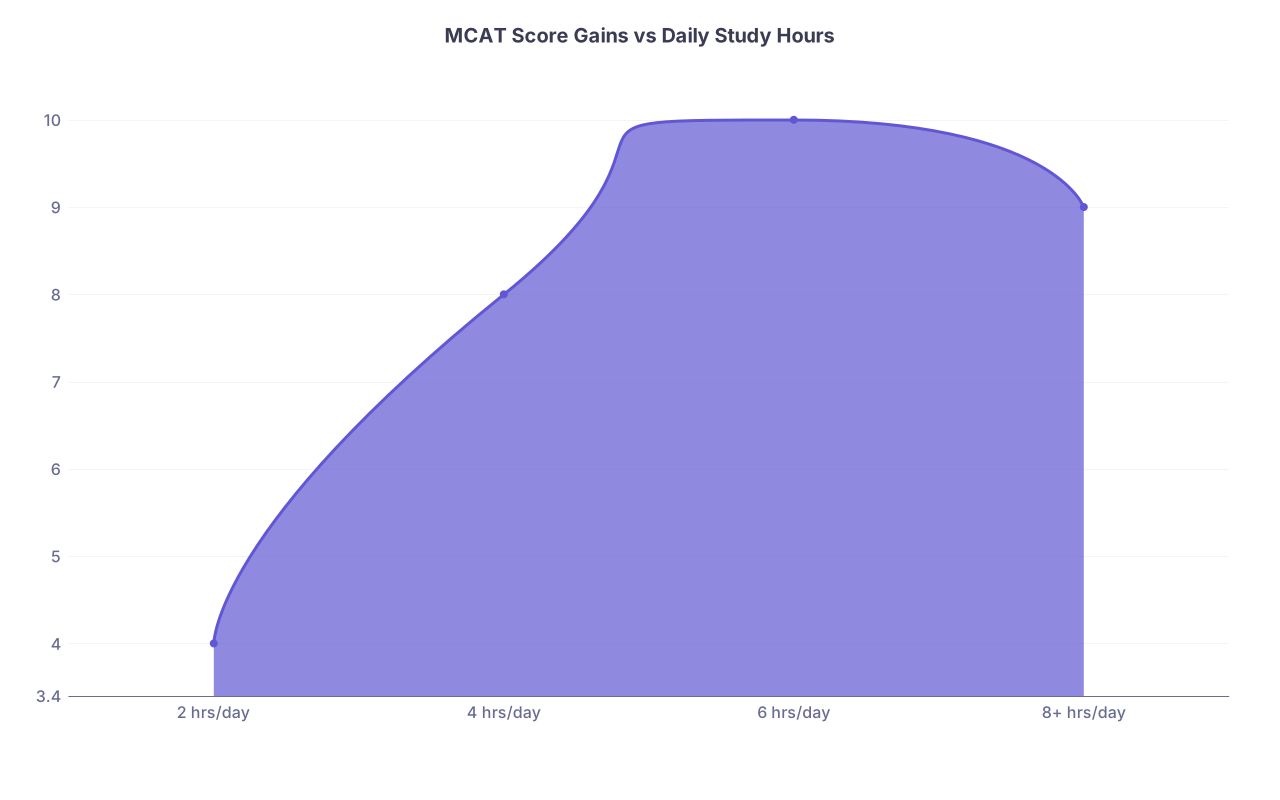
The chart isn't a rulebook. It's a reality check. There's a common pattern, but you still have to verify every school on your list.
How to Check Whether Your Score Is Still Valid for Your Target Schools
Here's the cleanest way to do it.
Step 1: Find your exact MCAT test date
Not your score release date. Not the year you "took the MCAT." The exact test date.
Write it down once at the top of a spreadsheet or notes page.
Step 2: Go to each school's admissions website
Look for pages titled:
- Admissions Requirements
- Application Process
- FAQ
- MCAT Requirements
- Class Profile or Eligibility
You're looking for the oldest accepted MCAT date for that cycle.
Step 3: Match the school's wording to your date
Schools phrase this differently. Common versions include:
- "We accept MCAT scores from the last three years."
- "Applicants for the 2026 entering class must have taken the MCAT no earlier than January 2023."
- "MCAT scores must be valid through matriculation."
Those are not interchangeable. Read carefully.
Step 4: Use AMCAS or AACOMAS resources as a starting point, not the final answer
Application service directories can help you locate requirements faster. Good. Use them.
But don't stop there. Their summaries may lag behind website updates, or they may not capture the nuance of a school's cycle-based cutoff. School-specific policy wins every time.
Step 5: If the wording is unclear, email admissions
Do this when:
- the cutoff language is vague
- your test date is right on the edge
- the site uses old cycle language
- AMCAS/AACOMAS and the school site don't match
Keep the email short:
- state your exact MCAT test date
- state the cycle you're applying for
- ask whether that score meets the school's current MCAT date policy
Get the answer in writing. Not because admissions is trying to trap you, but because details get messy fast.
A simple decision framework: Safe, borderline, or expired
Use this for every school.
Safe
- Your MCAT date is clearly inside the school's accepted range
- The policy language is current and unambiguous
- No follow-up needed
Borderline
- Your date falls close to the cutoff
- The school uses unclear cycle wording
- Different sources say different things
- You need written confirmation before treating the school as a real option
Expired
- Your date is older than the school's stated limit
- The admissions office confirms it won't be accepted
- Take the school off your list or plan a retake
That's it. Don't overcomplicate it.
One more thing. If half your school list is "borderline," that's not a stable plan. That's gambling with an expensive cycle.
What to Do If Your MCAT Is Expiring Soon or Already Expired
You really have three options.
1. Retake the MCAT
This is the cleanest fix if a lot of your target schools won't take your old score.
- your preferred schools mostly require a newer test date
- your current score limits your list too much
- you'd rather apply once with a stronger, cleaner application than force a shaky cycle now
What doesn't make sense? Panic-booking a test date and throwing together a rushed application at the same time. That's how people end up with a mediocre retake and a late submission. Worst of both worlds.
2. Narrow your school list
If enough schools still accept your score, you may not need a retake.
This works best when:
- your score is still valid at a solid number of schools
- those schools genuinely fit your GPA, mission, geography, and experiences
- you're not cutting your list down to fantasy options and one random backup
Be honest here. If your "revised list" is tiny or weak, you're forcing it.
3. Delay your application
Not glamorous. Often smart.
If your MCAT is expired or nearly expired for many programs, and you don't have time to retake properly, waiting a cycle may be the best move. A delayed application with a valid, well-prepared MCAT is usually much better than an on-time application that's dead on arrival at half your schools.
And no, don't assume schools will "make an exception." They usually won't. If a policy exception exists, it will be stated clearly or confirmed directly by admissions. Wishful thinking is not strategy.

MD vs DO: Important Differences That Can Change Your Plan
Here's the practical truth: MD and DO schools often look similar on MCAT validity at first glance, but the details can diverge fast.
Many MD programs publish very specific cutoff language tied to matriculation year or cycle year. Many DO programs do too, but the formatting and visibility can vary. Sometimes the policy is obvious on the admissions page. Sometimes it's buried in an FAQ. Sometimes you have to email. Annoying, yes. Still your job.
Also, AMCAS and AACOMAS are just application services. They are not the final decision-makers on score age. A school participating in AMCAS can still reject an older MCAT that appears on your application. Same for AACOMAS-participating DO programs.
So build your school list around confirmed validity, not assumptions about MD versus DO as categories.
Good approach:
- verify each MD school individually
- verify each DO school individually
- label schools safe, borderline, or expired
- build your final list from the safe group first
Bad approach:
- "DO schools are probably more flexible"
- "AMCAS let me submit it, so it should be fine"
- "I'll deal with it after secondaries"
No. That's lazy planning, and it costs people cycles.
Bottom-Line Checklist Before You Submit
Before you send a single application, check these four things:
- Your exact MCAT test date
- Each school's oldest accepted MCAT date or validity window
- How that school defines the cycle cutoff
- Your backup plan if the score is borderline or expired
Use this go/no-go framework:
Go now if:
- your MCAT is clearly valid for most or all of your target schools
- your school list is built around confirmed policies
- you don't need a rushed retake
Wait if:
- your score is expired at many target schools
- too many schools are borderline
- your only solution is guessing and hoping
This check doesn't take long. Really. A few minutes per school can save you hundreds or thousands in wasted applications and a lot of unnecessary frustration. Verify first. Then apply with confidence.