
The way most juniors “prepare” for the MCAT is backwards. They cram for 8–10 weeks, panic over practice scores, then try to retrofit their semester around a bad timeline.
You are going to do the opposite: build your junior year around a semester‑by‑semester MCAT strategy.
Below is a concrete, chronological guide—fall junior year through the summer after junior year—so you know exactly what you should be doing each month and each week.
Big‑Picture Timeline: Junior Year MCAT Strategy
At this point you should have a rough sense of when you want to take the MCAT. If you are aiming for:
- Traditional timeline (apply after junior year): MCAT between January–April of junior spring.
- Gap year (apply after senior year): MCAT between May–August after junior year or early senior fall.
Here is the year laid out:
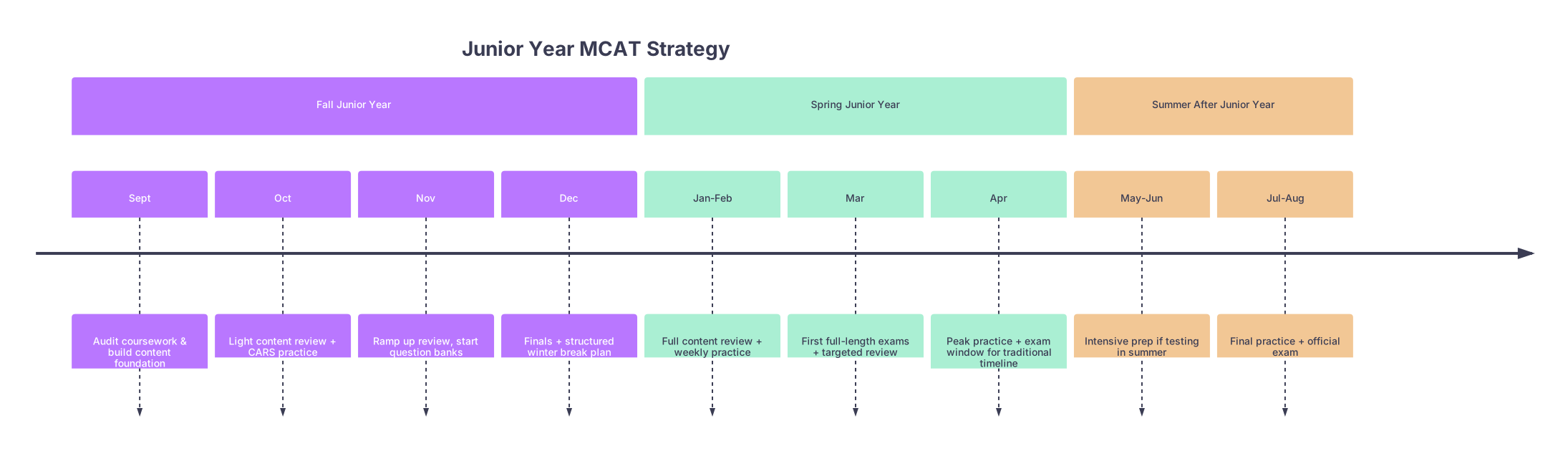
| Period | Event |
|---|---|
| Fall Junior Year - Sept | Audit coursework & build content foundation |
| Fall Junior Year - Oct | Light content review + CARS practice |
| Fall Junior Year - Nov | Ramp up review, start question banks |
| Fall Junior Year - Dec | Finals + structured winter break plan |
| Spring Junior Year - Jan-Feb | Full content review + weekly practice |
| Spring Junior Year - Mar | First full-length exams + targeted review |
| Spring Junior Year - Apr | Peak practice + exam window for traditional timeline |
| Summer After Junior Year - May-Jun | Intensive prep if testing in summer |
| Summer After Junior Year - Jul-Aug | Final practice + official exam |
Now let us break this into semester‑by‑semester and then month‑by‑month.
Fall Junior Year: Set the Foundation (September–December)
Goal of fall: Finish core prereqs, identify your weaknesses, and quietly lay down a solid content and CARS base—without tanking your GPA.
September: Audit and Align
At this point you should:
- Know your tentative MCAT test month.
- Know which pre‑reqs are complete and which are in progress.
Week 1–2 of the semester:
Audit your coursework vs. MCAT content
- List the MCAT sections:
- Chem/Phys
- CARS
- Bio/Biochem
- Psych/Soc
- Under each, list what you have already completed:
- General Chemistry I & II
- Organic Chemistry I (II in progress?)
- Physics I & II
- Intro Biology I & II
- Biochemistry
- Intro Psychology, Intro Sociology
- List the MCAT sections:
Identify content gaps
- No biochemistry yet? That is a major red flag if you plan to test before or during junior spring.
- No Physics II until spring? Plan extra self‑study time for missing topics (fluids, circuits, optics, etc.).
Choose a test window
- If you want to apply directly after junior year: January, March, or April test dates. April is the last sane date.
- If you want a gap year: May–June after junior year is ideal.
By the end of September you should have decided:
- Target test month
- Primary prep resources (e.g., AAMC materials + one commercial company’s books or videos)
- Whether you need to self‑study any missing course content
October: Start Light Review and CARS
This month, the priority is still your GPA. MCAT prep is background noise, not the main act.
At this point you should:
- Be doing 2–3 hours per week of low‑intensity MCAT work.
Weeks 1–4:
CARS:
- 3–4 passages per week (20–30 minutes, 3x/week).
- Use Examkrackers CARS, Jack Westin, or similar.
- Do untimed first, focusing on comprehension and question patterns.
Content “micro‑review”:
- 2 short sessions per week (30–45 min).
- Rotate topics based on current classes:
- Taking Biochem now? Reinforce it with MCAT‑style notes.
- In Physics? Summarize formulae and conceptual explanations in an MCAT notebook.
This is the month where the disciplined students quietly pull ahead. Not by doing “grind” hours. By building habits.
November: Structured Base‑Building
At this point you should increase MCAT time to 3–5 hours per week, still secondary to your courses.
Weeks 1–3:
Start light question practice:
- Pick one section (often Bio/Biochem or Chem/Phys).
- Do 10–15 discrete practice questions twice a week.
- Focus on why answers are right or wrong rather than speed.
Content mapping:
- Build a 1–2 page outline for each section:
- Chem/Phys: kinematics, forces, work/energy, fluids, circuits, acid/base, equilibrium, electrochem.
- Bio/Biochem: cell biology, genetics, metabolism, molecular biology, organ systems.
- Psych/Soc: major theories, key researchers, classic experiments, high‑yield terms.
- Build a 1–2 page outline for each section:
Week 4 (right before Thanksgiving):
- Create a Winter Break MCAT Plan:
- How many days per week you will study.
- Which chapters or video modules you will cover.
- Which AAMC materials you will not touch yet (save most for spring).
December: Finals First, Then a Targeted Winter Break
Early December (through finals):
At this point you should:
- Cut MCAT to maintenance only: CARS 2–3 passages, 2x/week max.
- Protect your GPA. A lower GPA is harder to fix than a delayed MCAT.
Post‑finals through New Year (2–3 weeks):
Now you shift gears.
- Aim for 2–3 hours per day, 5–6 days per week.
- Focus: content review, not full‑lengths.
A sample Winter Break weekly structure:
- 3 days/week:
- 2 x 45–60 min blocks of content (e.g., Bio/Biochem in the morning, Chem/Phys in the afternoon).
- 2 days/week:
- 1 x 45–60 min Psych/Soc
- 30 min CARS (3–4 passages)
You are not “intensively studying” yet. You are front‑loading the most painful part: relearning old content so spring is not a disaster.
Spring Junior Year: Primary MCAT Push (January–April)
Now the stakes are higher. At this point you should have:
- A test date on the calendar (or at least a target month).
- A baseline grasp of major content areas.
- A rough idea of your weaker sections.
This semester you will gradually move from content‑heavy to practice‑heavy work.
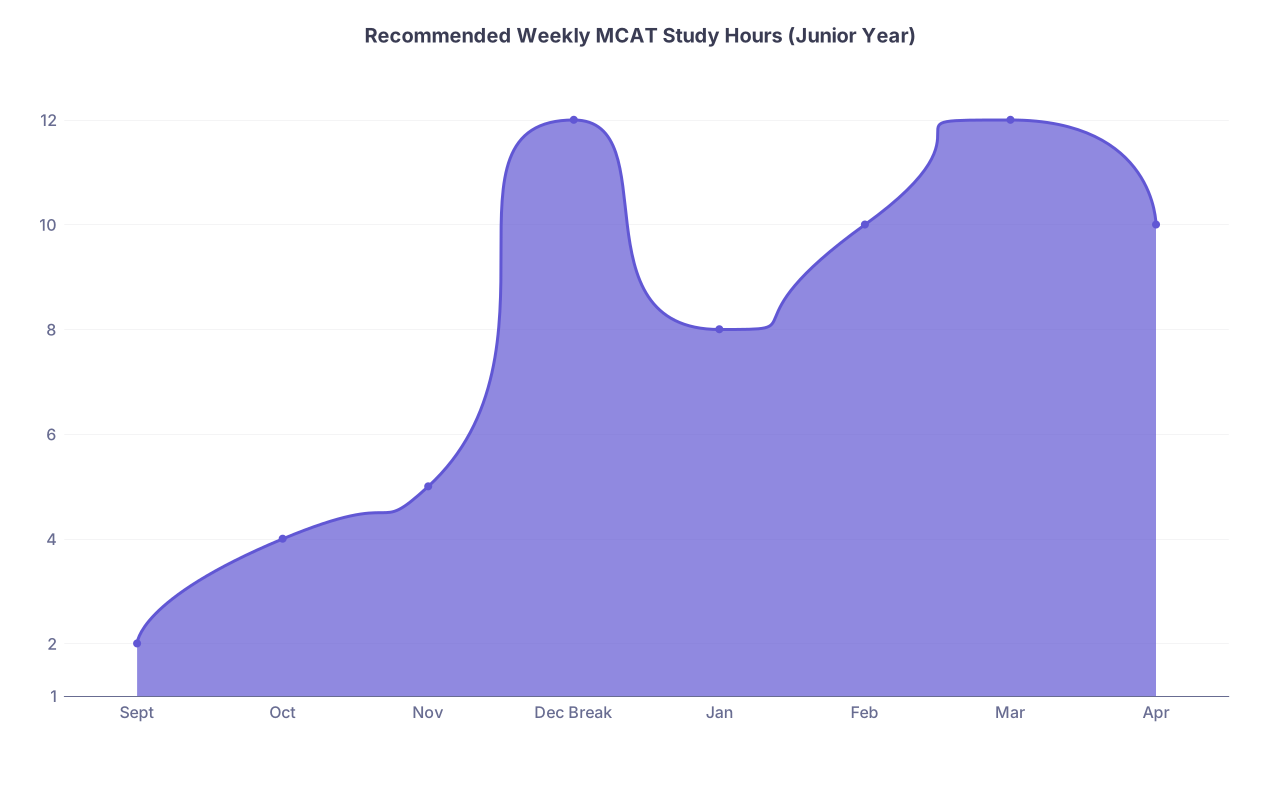
| Category | Value |
|---|---|
| Sept | 2 |
| Oct | 4 |
| Nov | 5 |
| Dec Break | 12 |
| Jan | 8 |
| Feb | 10 |
| Mar | 12 |
| Apr | 10 |
January: Commit and Organize
Weeks 1–2:
At this point you should:
- Finalize your exam date (if you have not already).
- Set a weekly hour target: usually 8–10 hours per week during the semester.
Build a repeatable weekly template. For example:
- 2 evenings/week: 1.5 hrs content review
- 1 evening/week: 1 hr CARS + 0.5 hr review
- 1 weekend day: 3 hrs mixed content + questions
Weeks 3–4:
- Start timed practice sets:
- 20–30 minute sets of 10–15 questions in one section.
- Review in detail (takes as long as the set itself).
Do not take a full‑length exam in January if your content is weak. You will just terrify yourself with a low score that is mostly noise.
February: Finish Content, Increase Practice
This is the “no more pretending” month. MCAT time bumps up to 10–12 hours per week, but still with GPA protection.
Early February (Weeks 1–2):
- Aim to have 80–90 percent of content reviewed by mid‑month.
- Start using:
- AAMC Question Packs (especially for CARS, Bio, Chem).
- One commercial Qbank for extra volume.
At this point you should:
- Track your performance:
- Not just % correct, but types of mistakes:
- Misreading the question stem?
- Weak in particular content (e.g., electrochem, endocrine system)?
- Running out of time?
- Not just % correct, but types of mistakes:
Mid to Late February (Weeks 3–4):
- Take your first full‑length (FL) exam.
- If content is still patchy, you can use a non‑AAMC FL as a “sacrificial” baseline.
- Simulate real conditions: one sitting, timed, minimal breaks.
Your reaction will likely be: “That was worse than expected.” Good. Now you have data.
March: Full‑Length Focus and Targeted Repair
At this point you should be one month out if testing in April, or about 2–3 months out if testing in May/June.
Goal of March: transition from mostly content to mostly practice and refinement.
Early March: FL #2 and Weakness Inventory
Week 1:
- Take AAMC FL 1 (if you did a non‑AAMC FL earlier) or your second available FL.
- Same rules: realistic timing, quiet environment, no phone, no pausing.
Week 2:
- Deep review of FL:
- Make an error log spreadsheet or notebook.
- For each missed or guessed question:
- Classify the error: content gap, reasoning error, timing, careless.
- Write a 1–2 line “lesson” (e.g., “Re‑read last sentence of passage before answering,” “Review glycolysis regulation”).
At this point you should have:
- A clear list of 3–5 highest‑yield weaknesses per section.
- A plan to hit those topics over the next 3–4 weeks.
Mid–Late March: FL #3 and Section Work
Weeks 3–4:
- Take another FL (AAMC or high‑quality third‑party) about 10–14 days after the last one.
- In between FLs:
- 1 day: FL test
- 2 days: FL review (2–3 hours each)
- Remaining days: targeted content + shorter timed sets
Your weekly breakdown if testing in April should look roughly like:
- 1 FL every 1.5–2 weeks
- 2–3 CARS sessions (3–5 passages)
- 3–4 sessions of mixed science practice (30–40 questions each)
- Ongoing focused review of Psych/Soc terms and theories
April: Peak and Exam (Traditional Timeline)
If your MCAT is in April, this is peak intensity. If you are testing later (May–June), you can stretch this pattern out.
At this point you should:
- Be averaging 10–12+ hours per week of study if in‑semester.
- Have finished almost all new “content learning.” You are now:
- Applying
- Reviewing
- Polishing
First Half of April (3–4 Weeks Out)
- Take AAMC FL 2 and FL 3 (spaced 7–10 days apart).
- Treat these like dress rehearsals:
- Same start time as your real exam.
- Same breakfast, same water/coffee routine.
- Same break behavior.
Your review is where the gains happen. You should be:
- Re‑doing difficult questions without answer choices.
- Teaching tricky concepts out loud or in writing.
- Building rapid‑review sheets:
- Hormones and their sources/actions
- Key physics formulas and units
- High‑yield psych/soc definitions
Final Week Before Exam
If your test is in late April:
- 7 days out: Final full‑length (often AAMC FL 4).
- 5–6 days out: Intensive review of that FL.
- 3–4 days out: Only light practice sets and content flashcards.
- 1–2 days out: Stop heavy studying. Sleep, routine, logistics.
At this point you should not be trying to “learn” new material. You are sharpening and protecting mental stamina.
Alternate Path: Testing in Summer After Junior Year
If your MCAT is in May–August after junior year, your junior spring still matters, but the curve shifts.
Here is the general shape:
| Period | In-Semester Focus | Post-Semester Focus |
|---|---|---|
| Jan–Feb | Heavy content review | N/A |
| Mar–Apr | Mix of content + light FLs | N/A |
| May–Jun | N/A | Intensive content + frequent FLs |
| Jul–Aug | N/A | Practice-heavy, polishing, exam |
Junior Spring (with Summer Test)
At this point you should:
- Still aim for 6–8 hours/week of MCAT during the semester.
- Emphasize:
- Solid content review across all sections.
- Regular CARS practice.
- 1–2 full‑lengths by the end of April for baseline.
The difference: you are not trying to peak in April. You are building a launchpad for May.
May–June: Intensive Prep Block
Once finals end:
- Shift to 25–35 hours per week if you are treating MCAT as your main job.
- Typical week:
- 2 full‑lengths every 2 weeks.
- 1–2 days focused on deep FL review.
- Remaining days split between:
- Targeted content repair.
- Section‑specific timed sets.
- Daily CARS (3–6 passages).
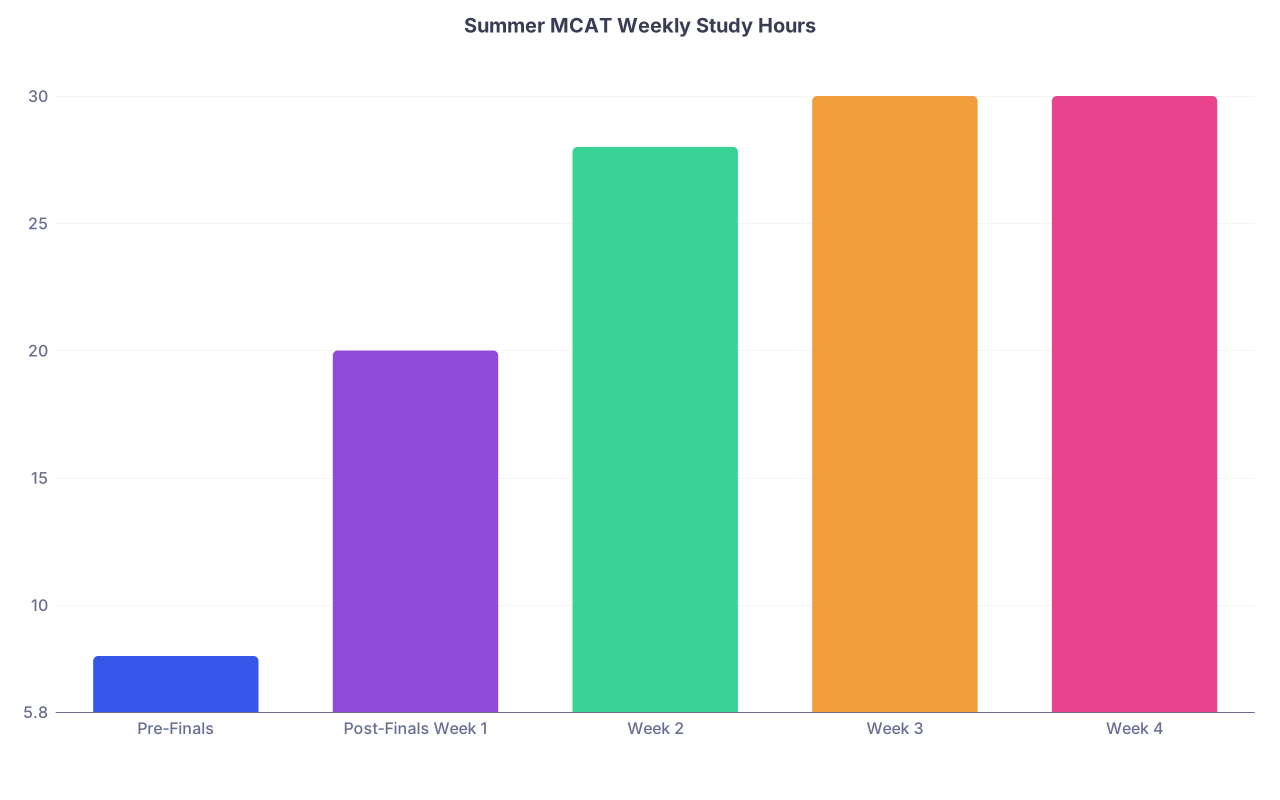
| Category | Value |
|---|---|
| Pre-Finals | 8 |
| Post-Finals Week 1 | 20 |
| Week 2 | 28 |
| Week 3 | 30 |
| Week 4 | 30 |
Test in late June or July and you still stay in a strong position for a gap‑year application or early senior application cycle.
Week‑by‑Week Structure Template (During a Busy Semester)
You do not need a unique plan every week. You need a repeatable structure that flexes around exams and deadlines.
Here is a realistic in‑semester template for ~10 hours/week:
Example Week (February or March)
Monday
- Evening (1.5 hrs): Bio/Biochem content review + 10 practice questions
Tuesday
- Short block (45 min): CARS – 3 passages timed + brief review
Wednesday
- Evening (1.5 hrs): Chem/Phys content + 10–15 questions
Thursday
- Rest from MCAT or just flashcards (if you have a heavy course day)
Friday
- Afternoon (1 hr): Psych/Soc terms + 10–15 questions
Saturday
- Morning (2.5 hrs):
- 1.5 hrs timed practice set (mixed sciences, 30–40 Q)
- 1 hr review of those questions
- Morning (2.5 hrs):
Sunday
- Flexible (1–2 hrs):
- Review error log
- Update weak topic list
- Light CARS or flashcards
- Flexible (1–2 hrs):
You adjust for exam weeks by cutting back on MCAT hours and front‑loading or back‑loading around big midterms.
Common Junior Year Mistakes and How the Timeline Fixes Them
I have watched smart students blow a good application year because they did not respect the timeline. Three patterns show up every cycle.
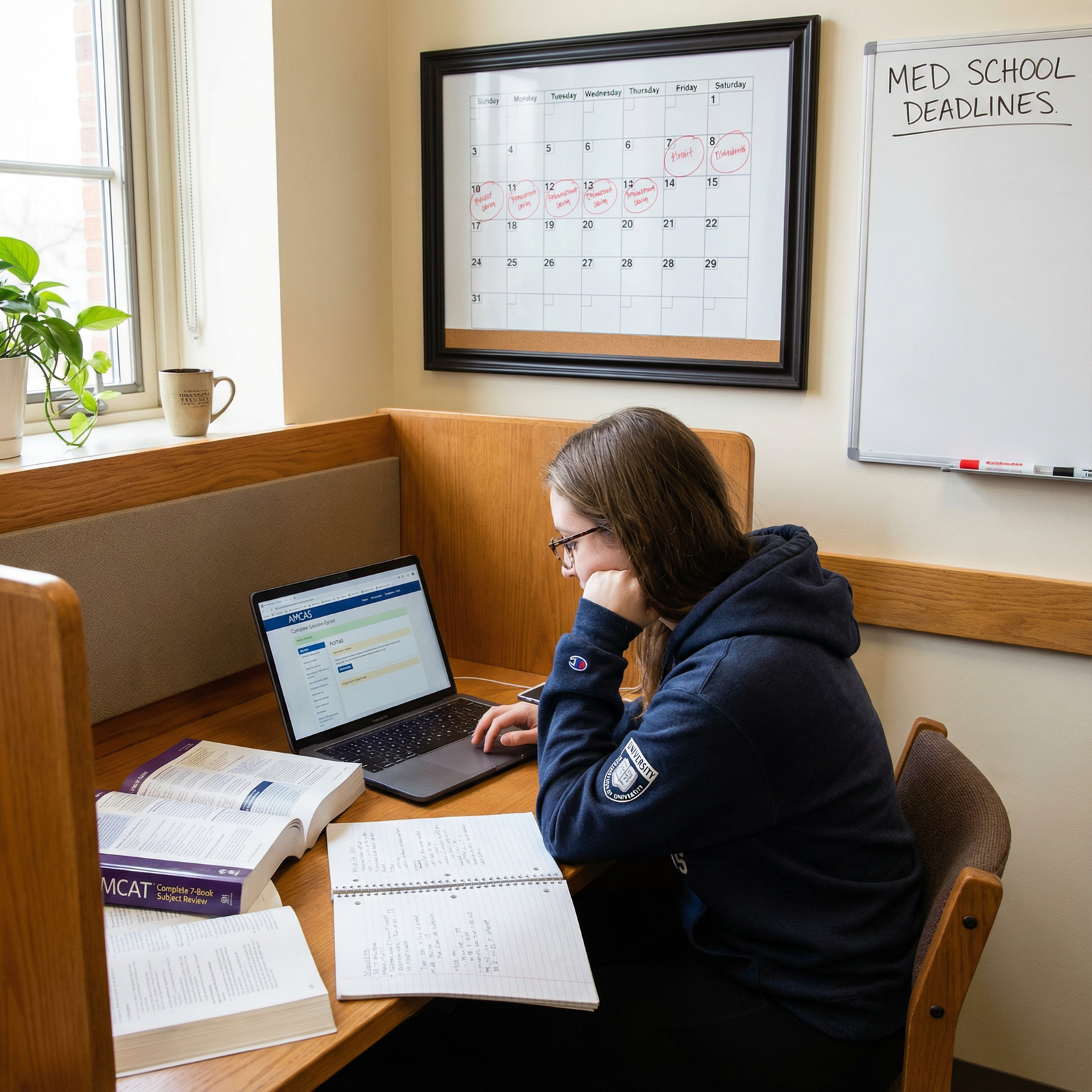
Mistake 1: “I’ll Start After Finals”
Translation: “I am going to try to relearn two years of science in six weeks.”
The fix in this guide:
- Light, disciplined fall base‑building
- Structured winter break work
- Solid spring rhythm before any “intensive” period
Mistake 2: Endless Content, No Practice
Students feel productive highlighting books. Their scores do not move.
The fix in this guide:
- Introduce questions by November.
- First full‑length by late February to early March.
- FL‑driven targeting from March onward.
Mistake 3: Letting MCAT Wreck the GPA
MCAT is not an excuse to tank organic chem or biochem.
The fix in this guide:
- Clear priorities during December finals and midterms.
- Reasonable weekly hour caps so you can sustain both.
Final Checkpoints: Are You on Track?
Use these quick “at this point you should…” checks.
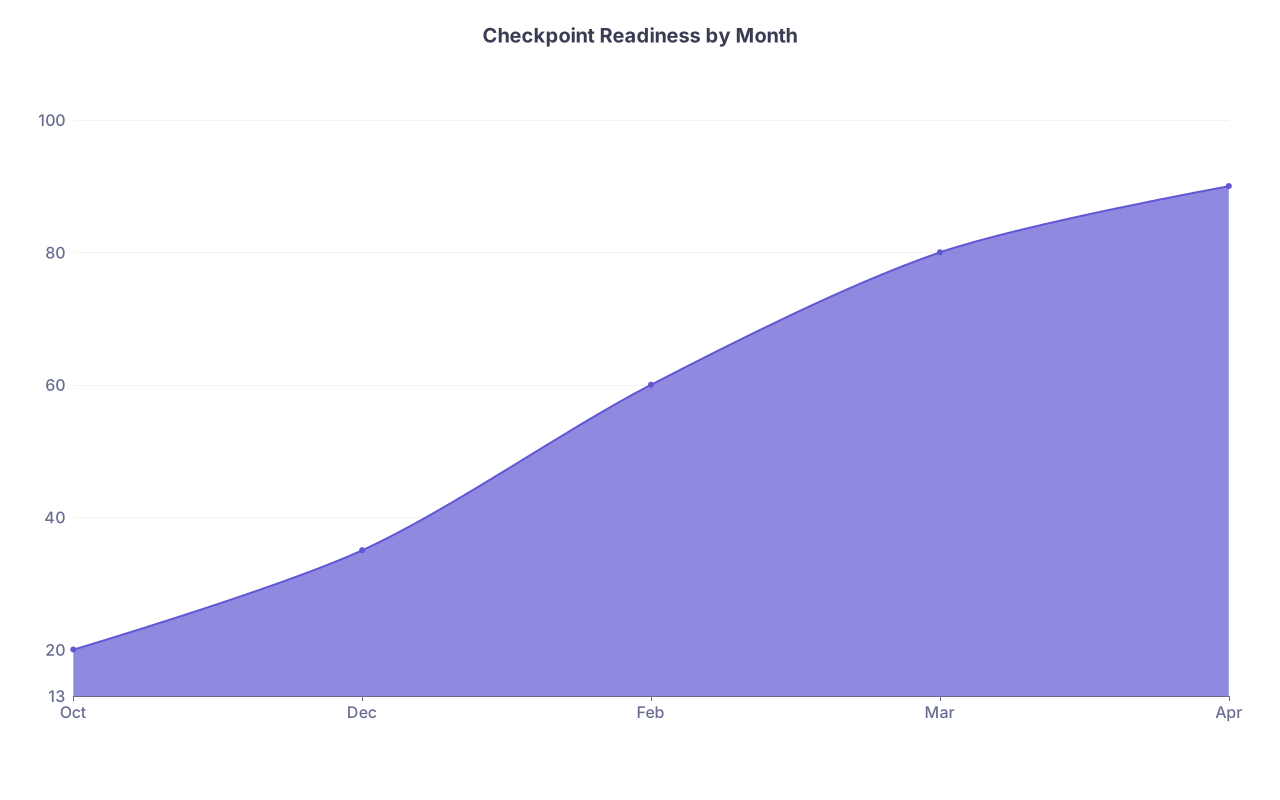
| Category | Value |
|---|---|
| Oct | 20 |
| Dec | 35 |
| Feb | 60 |
| Mar | 80 |
| Apr | 90 |
End of Fall (December):
- At this point you should have:
- Chosen a test window.
- Completed a first pass of at least 1–2 sections’ content.
- Consistent CARS habit (2–3x/week).
- At this point you should have:
End of February:
- At this point you should have:
- 80–90 percent of content reviewed.
- At least 1 full‑length completed and reviewed.
- A written list of weaknesses guiding your study.
- At this point you should have:
End of March (for April test):
- At this point you should have:
- 3 full‑lengths done, all reviewed deeply.
- Weekly practice in all four sections.
- No major untouched topic areas.
- At this point you should have:
Key Takeaways
- Junior year MCAT prep only works if you build the year around the exam, not the other way around—light foundation in fall, structured push in spring, and, if needed, intensive summer.
- At each stage you should know your primary objective: fall = foundation, winter = organized content review, early spring = finish content and start FLs, late spring/summer = FL‑driven refinement and stamina.
- The students who score well are not the ones who “worked hardest” in one panicked month; they are the ones who committed to a steady, time‑specific plan all year and actually stuck to it.