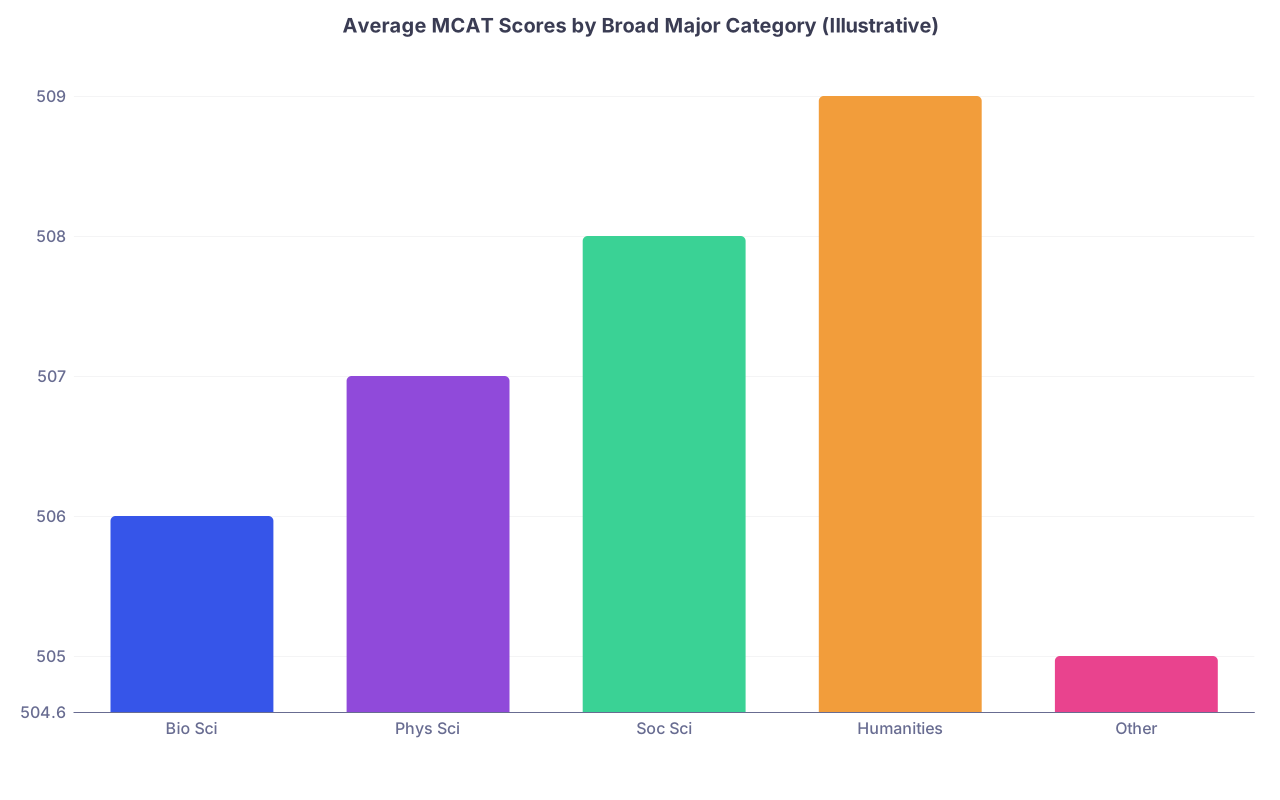
| Category | Value |
|---|---|
| Bio Sci | 506 |
| Phys Sci | 507 |
| Soc Sci | 508 |
| Humanities | 509 |
| Other | 505 |
The ‘Premed Major Advantage’ Myth: MCAT Results by Major
The belief that one premed major gives you a big MCAT advantage is fantasy. A comforting one. But still fantasy.
Every year I hear the same lines:
“Major in biochemistry, it’s basically MCAT built-in.”
“Engineering majors crush the MCAT.”
“Humanities majors have an edge because of CARS.”
No. They don’t. At least not in the way people think.
Let me be blunt: there is no magic “MCAT major.” The data we actually have show small differences between majors—so small they’re irrelevant compared to how you study, when you study, and how disciplined you are. People cling to major myths because it’s easier than admitting the truth: your habits matter more than your transcript.
Let’s walk through what the numbers actually say, how to read them without self-deception, and what this means for your premed strategy.
What the Data Actually Show About MCAT by Major
We’re not guessing here. The AAMC publishes aggregated performance data by undergraduate major category. It’s not perfect, but it’s the best large-scale dataset we’ve got.
They break majors into broad groups: biological sciences, physical sciences, social sciences, humanities, “other,” and “multiple majors.” Across these, the average MCAT score differences are typically in the range of a couple of points.
Here’s an illustrative summary (not exact current-cycle numbers, but the pattern is faithful to the actual reports):
| Major Category | Approx. Avg MCAT |
|---|---|
| Biological Sci | 505–506 |
| Physical Sci | 506–507 |
| Social Sci | 507–508 |
| Humanities | 508–509 |
| Multiple Majors | 508–509 |
The key word there: approximate. But that’s enough to see what’s going on.
Humanities and “multiple majors” often sit at the top by a couple points. Biological sciences hang a bit lower. Social and physical sciences hover in between.
And here’s the piece everyone conveniently ignores: a 2–3 point difference in group averages does not mean the major is causing the score difference. It just means that the group of people who chose that major happen to, on average, score a bit higher or lower.
Correlation. Not causation. Yes, that cliché again. Because premeds keep ignoring it.
Why Those Differences Exist (And Why They Don’t Mean What You Think)
Let’s break the fantasy: if you switch from biology to philosophy, your MCAT score doesn’t magically jump 3 points.
Those small differences between majors are driven by at least four confounding factors.
1. Self-selection of students
The kind of student who chooses a humanities major and decides to do premed is usually not random.
I’ve seen this pattern more times than I can count:
The philosophy + premed student is often unusually driven, strategic, and not afraid to be the “odd one out.” They decide early: “If I’m going to split my time, I’d better crush the MCAT.” They’re often strong readers and writers, and they know they have to prove themselves quantitatively, so they overcompensate on science rigor and MCAT prep.
Compare that to the default biology major. It’s the path of least resistance for a lot of uncertain premeds and “maybe med school” students. That group includes everyone from hyper-focused gunners to people just floating along taking “premed requirements just in case.” That widens the performance range and drags the average down a bit.
The major didn’t do that. The type of people who pick the major did.
2. Different comfort zones vs. MCAT sections
Look at the MCAT sections: Chem/Phys, CARS, Bio/Biochem, Psych/Soc.
A biology major has more built-in exposure to Bio/Biochem. A psychology or sociology major is naturally more prepared for Psych/Soc. A humanities major walks into CARS with a lot more practice reading dense, abstract writing at speed.
Does that give each group an advantage? Slightly. But “slightly” is the operative word.
The problem is this: MCAT doesn’t reward raw content memorization; it rewards reasoning with that content in passage format. So your year-long biochem course? Great foundation. But if you never practiced applying that knowledge under MCAT-style constraints, you’re not ahead. You’re just familiar.
I’ve watched biochem majors bomb Bio/Biochem because they assumed “I’ve taken all this, I’m fine” and skipped serious passage-based practice. Meanwhile, a non-traditional English major methodically drilled UWorld and AAMC materials and walked out with a 130+ in the same section. Content background helped one. Discipline and strategy helped the other. Guess which one mattered more.
3. Study behavior, not transcript lines
There’s an ugly truth here: a depressing number of premeds use their major as an excuse to shortchange MCAT prep.
You hear things like:
- “I’m a biochem major so I’m basically already studying for the MCAT.”
- “I’m an engineer; I’m used to hard tests. I’ll just do a 4-week cram.”
- “Psych is half the MCAT now, I’m covered on that section.”
Then test day hits, and they realize the exam isn’t checking whether you’ve seen the topics before. It’s checking whether you can think under tight time pressure, in someone else’s structure, with questions designed to trick you into oversimplifying.
The premeds who do well—across any major—are the ones who treat the MCAT as its own beast. They plan months of focused, passage-based, exam-specific practice. They diagnose weak sections and fix them. They don’t hide behind “my major is close to the MCAT” as a study plan.
4. The ceiling effect and applicant filtering
Another thing the raw averages hide: who is even making it to test day.
In some groups, weaker students self-select out earlier. The humanities or social science premed who struggles badly in organic chemistry often leaves the premed track entirely. The biology major with the same performance might hang on longer because they feel “at least I like the material.”
So you end up with a somewhat more filtered group in some majors by the time you’re looking at MCAT data. Of course their average score is a bit higher. It’s not that the major boosts scores; it’s that the major environment pushes out certain students earlier.
Again: not magic. Just selection.
The One Real “Advantage”: How Majors Shape Your Weaknesses
There is one way your major really matters for the MCAT. Not as a secret advantage, but as a predictable pattern of vulnerabilities.
Here’s the game: be honest about what your major probably didn’t train you to do well.
- Biology majors usually need more help on CARS and experimental design reasoning than they’d like to admit. They’ve seen the content, but they’re used to memorizing and regurgitating, not dissecting arguments under time pressure.
- Engineering and physical science majors often underestimate the memorization and pattern-recognition needed for Psych/Soc and the nuance in Bio/Biochem. They lean on math-brain and get blindsided by vague, social-science-style passages.
- Humanities and social science majors typically need a serious, structured grind through Chem/Phys and Bio/Biochem content. But they can absolutely outperform if they respect the science content and don’t lean solely on “I’m good at reading.”
This is where the data by section would be more useful than by overall score. And guess what: internally, MCAT prep companies track exactly this. I’ve seen enough score breakdowns by major to know the pattern is real—but also completely fixable with targeted prep.
So if you want to use your major strategically, do this: assume you’re not special and that your weaknesses follow the usual pattern. Then overcorrect them early.
The Biochem-Is-Best Myth (And Its Cousins)
Let’s tackle the loudest misconception head-on: “Biochemistry is the best premed major for the MCAT.”
On paper, this sounds reasonable. MCAT has a whole Bio/Biochem section. Biochem is tested across multiple sections. Therefore, being a biochem major must be a cheat code. Right?
Wrong.
Here’s what actually happens in the real world.
A typical biochem major:
- Spends years in detail-heavy courses at a depth the MCAT does not require.
- Learns specific mechanisms and niche pathways that never show up on the exam.
- Gets used to exams that reward exact recall of tiny details.
Then the MCAT shows up and says:
“Here’s an unfamiliar passage with an odd enzyme you’ve never seen. Use basic principles, interpret this graph, and ignore the weird details.”
Biochem majors often struggle to let go of over-specific thinking. They second-guess simple reasoning because they’ve been trained to assume there’s a hidden trick buried in the tiny footnote of the figure. Their background gives them a higher ceiling—but only if they retrain themselves to think like a standardized test-taker, not a pre-thesis PhD student.
I’ve seen plenty of non-biochem majors outscore their biochem friends on Bio/Biochem for one reason: they practiced MCAT-style thinking more, instead of leaning on “I’ve taken the right classes.”
The same thing happens with:
- Engineering majors who assume their math skills will carry Chem/Phys and then get wrecked by conceptual questions and low-yield curves they never practiced.
- Psychology majors who think Psych/Soc will save their composite and then find out that vague recall without test-style practice gets you stuck at 125–126.
Your major isn’t your edge. Your training in how to think on that exam is.
The Hard Truth: You Can’t Major Your Way Out of MCAT Prep
Here’s what the “premed major advantage” myth really is: an avoidance strategy.
If you can convince yourself that picking the right major does 30–40% of the MCAT work for you, then you don’t have to face the actual demands of scoring high:
- Long, structured, boring practice with passages you don’t care about.
- Reviewing wrong answers ruthlessly instead of just doing more questions.
- Admitting that your reading speed, focus, or reasoning might not be as strong as your GPA suggests.
So people project success outward:
“It’s because they were a physics major.”
“It’s because they did neuroscience.”
“It’s because they did philosophy and CARS loves them.”
No. It’s because they did the grind in a focused, intelligent way.
There’s a reason prep companies don’t offer “MCAT for biology majors” vs “MCAT for humanities majors” as fundamentally different products. The core blueprint is the same: diagnose, content review where needed, then relentless passage-based practice.
Major affects where you start. It doesn’t change where you can finish.
So How Should You Choose a Premed Major?
Pick the major that:
- You’re actually interested in enough to not burn out halfway.
- You can do well in while still leaving time and energy for MCAT prep.
- Covers (or is easily paired with) the prerequisite science courses.
That’s it. The rest is noise.
If that’s biology, fine. If that’s philosophy with a robust side of chem and bio labs, also fine. If that’s mechanical engineering and you’re willing to accept a brutal workload and still carve time for dedicated MCAT prep, also possible.
Just don’t pretend it’s a scoring hack.
And if you want to be slightly strategic, use your major to build non-MCAT advantages: research exposure, strong faculty relationships, better writing skills, statistical literacy. Those help you far beyond test day.
To visualize what actually matters over time, think less about “which major” and more about “when did I start real MCAT prep?”
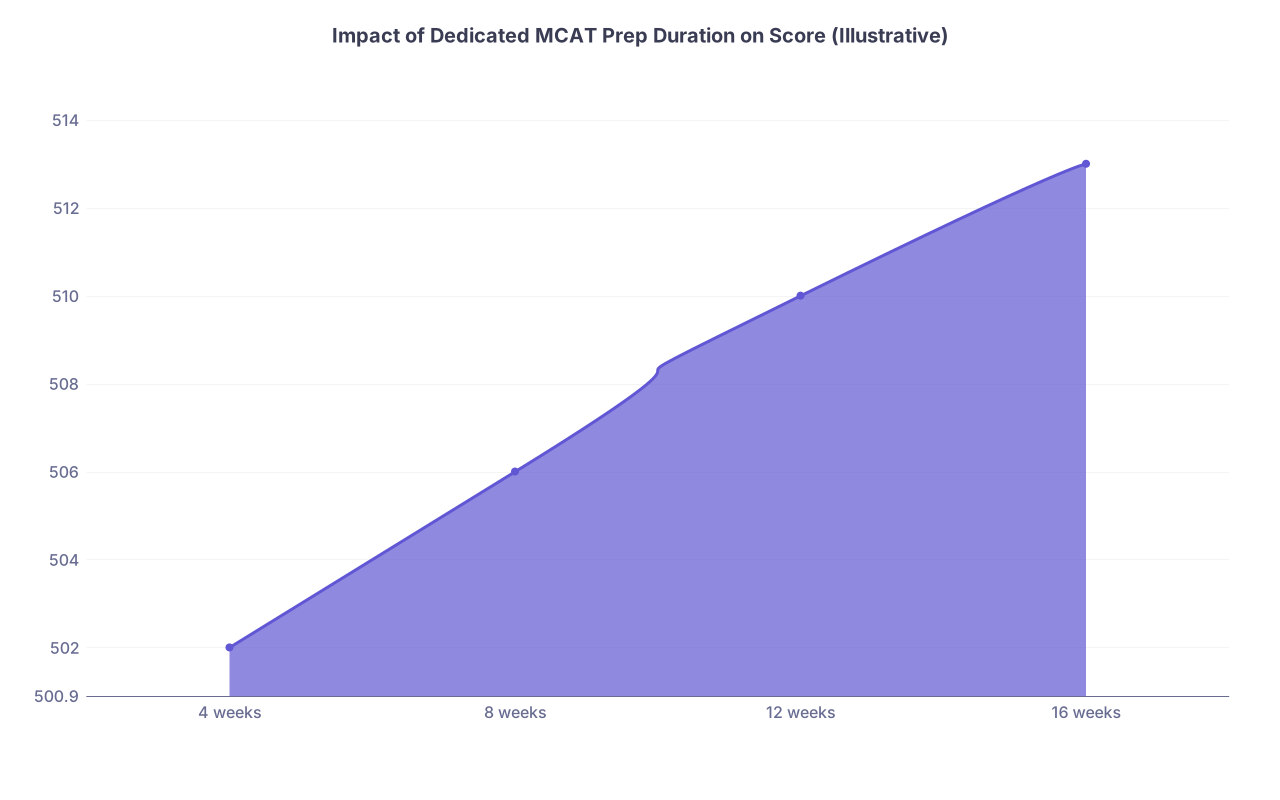
| Category | Value |
|---|---|
| 4 weeks | 502 |
| 8 weeks | 506 |
| 12 weeks | 510 |
| 16 weeks | 513 |
Notice what isn’t on that chart: your major.
Turning Your Major into a Real Advantage
If you insist on squeezing advantage from your major, do it deliberately.
If you’re a:
- Biology/biochem major: Start CARS early. Daily. No excuses. Think of it as your “new language.” And treat experimental passages as their own skill—practice them, don’t just hope your lab classes translate.
- Engineering/physics major: Humble yourself on content. Don’t assume your math skills automatically handle conceptual physics or chemistry. Build a focused framework for bio/biochem and Psych/Soc; stop dismissing them as “memorization only.”
- Humanities/social science major: Front-load your science content. Take biochem if at all possible. Don’t skip orgo-level depth in your review just because you don’t love molecules. Your reading edge is only useful if you understand what you’re reading.
And for everyone: dedicate serious, protected time for MCAT prep separate from just “doing well in my major courses.”
The Bottom Line
Here’s the reality, stripped of wishful thinking:
- Average MCAT scores by major differ only slightly, and those differences are mostly selection effects, not magic content alignment.
- Your major predicts your likely weak spots, not your final score. Fixing those weak spots with disciplined, exam-specific prep matters far more than what’s printed on your diploma.
- The only “advantageous” major is the one you can excel in academically while giving yourself the time, energy, and structure to train properly for the MCAT.
Everything else is noise that people use to avoid the real work. Don’t fall for it.