
The worst MCAT retake plans are the ones made in panic after a bad score.
You do not fix that at the last minute. You fix it now—by building a two-MCAT-cycle plan from day one.
If there is any real chance you might need a retake (and for most students there is), you should structure your entire year around two potential test dates, not one. That does not mean you are “planning to fail.” It means you are refusing to let one score date control your entire application cycle.
I will walk you through exactly what that looks like: month-by-month, then week-by-week between tests, and even day-by-day in the critical gap. By the end, you will know:
- When to take MCAT #1
- When to release scores and decide on MCAT #2
- How to overlap MCAT prep with your AMCAS / AACOMAS application timeline
- How to avoid the common disaster: a late retake that wrecks your cycle
Big Picture: The Two-MCCT (Two‑MCAT‑Cycle) Framework
At this point you should accept one fact: a single perfect MCAT date is a fantasy. Life happens. Exams misfire. The smart move is to build a “primary + backup” cycle from the start.
Here is the core structure.
| Item | MCAT #1 | MCAT #2 (Backup) |
|---|---|---|
| Ideal test window | Jan–Apr | Late May–July |
| [Score release](https://residencyadvisor.com/resources/mcat-prep/mcat-registration-to-score-release-what-to-do-each-phase) | Feb–May | Jun–Aug |
| Application status | Pre-submission / early | Primaries submitted, secondaries starting |
| Goal | Benchmark + apply if strong | Repair score without losing cycle |
You plan around:
MCAT #1 early enough that:
- You get scores back before you submit or shortly after
- You have time to pivot to a retake without destroying your application timing
MCAT #2 reserved far enough out that:
- You can meaningfully improve (6–10 weeks of focused work)
- Scores still arrive early enough to matter for this cycle
You will not actually take both automatically. You will only move to MCAT #2 if:
- Your first score is clearly below your target range and
- Your practice data suggests you can realistically improve
But the key is this: you register, block the dates, and structure your year as if both will happen.
12-Month Timeline: From First Content Review to Potential Retake
Assume you plan to apply in June of Year X for matriculation Year X+1. I will give one clean version of the schedule, then adapt it.
Months −12 to −9: Baseline & Light Build (the “I might need a retake” mindset starts here)
At this point you should:
Pick your intended application year and back-calculate.
Target: MCAT #1 between January and April of your application year.Get a baseline (one of the early AAMC exams or a decent third-party full length).
Not to predict your final score. To identify:- Weakest content domains
- Timing issues
- CARS reality (not your fantasy)
Set a realistic score range, not a magic single number.
Example:- Competitive MD target: 512–515
- Backup DO target: 505–508
Now you construct the Two-MCCT frame:
- Choose a MCAT #1 target month (Jan–Apr).
- Choose a MCAT #2 backup month 6–10 weeks later (May–Jul) and register, even if you think you “probably will not need it.”
If fees bother you, consider this: losing a full application cycle because you waited to sign up for a backup exam is far more expensive.
Months −9 to −6: Structured Content Review
At this point you should be in systematic content review 10–15 hours per week if you are in school, 20–25 if you are on a lighter schedule or gap year.
Block:
- 2–3 hours / weekday
- 4–6 hours / weekend day
Focus on:
- Finishing one full pass of physics, gen chem, orgo, bio, biochem, psych/soc
- Doing passage-based practice from the beginning, not just flashcards and notes
Start a mistake log:
- Concepts you repeatedly miss
- Question patterns that trick you (especially in CARS)
The “might need a retake” mindset here means: you track everything. You want clear data later if MCAT #1 goes sideways.
Months −6 to −3: Transition to Application Year – Lock in Your First Test Date
Now you are roughly 3–6 months from MCAT #1.
At this point you should:
- Lock MCAT #1 date if you have not already.
- Confirm MCAT #2 as backup, far enough out for a 6–8 week rebuild.
Example schedule for a June application:
- MCAT #1: Late March or early April
- MCAT #2 (backup): Late May or late June
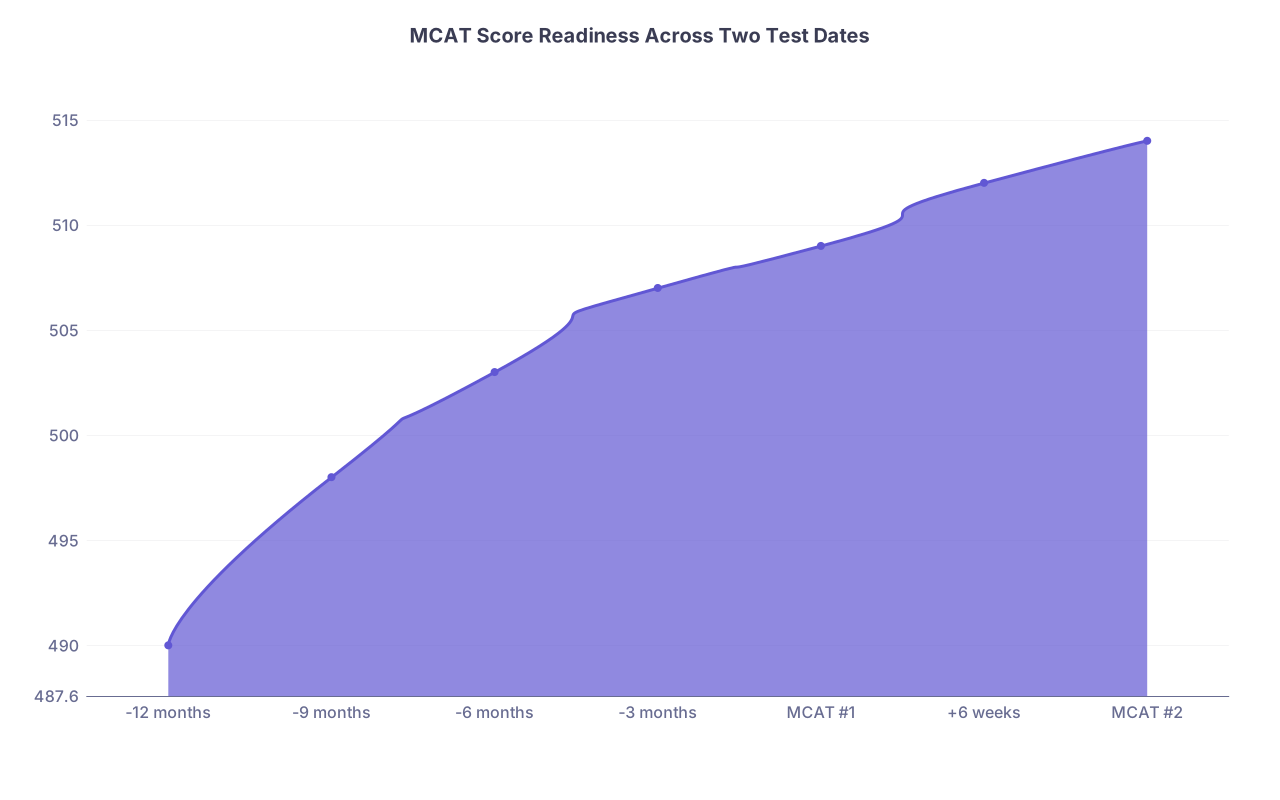
| Category | Value |
|---|---|
| -12 months | 490 |
| -9 months | 498 |
| -6 months | 503 |
| -3 months | 507 |
| MCAT #1 | 509 |
| +6 weeks | 512 |
| MCAT #2 | 514 |
In this window you:
- Increase to 3–4 full-length exams per month
- Use non-AAMC exams first, saving AAMC exams mainly for the last 6–8 weeks before MCAT #1
- Start simulating test conditions:
- Same start time as your actual exam
- Minimal breaks
- Full review within 48 hours
By the end of this phase (about 4–6 weeks before MCAT #1), you want:
- Practice full-lengths clustering near or above your target range
- Stable timing: no sections where you consistently guess on the last 5–7 questions
If your full-lengths are wildly inconsistent (say, 501, 508, 503, 510), keep the retake backup date. You are the exact person this two-cycle plan protects.
MCAT #1: Final 4 Weeks, Test Day, and Immediate Aftermath
Final 4 Weeks Before MCAT #1
At this point you should be in full “exam rehearsal” mode.
Weekly structure:
- 1–2 full-length exams per week
- 2–3 heavy review days
- Light content brushing, not full re-learning
Checklist:
- Take all AAMC full-lengths before MCAT #1. Keep them close to realistic conditions.
- Track:
- Composite score trend
- Section-by-section consistency
- Identify your “floor” score: the lowest score you have hit in the last 3–4 practice tests.
If your floor is way below your target (e.g., aiming for 512 but still hitting 503 on a bad day), do not cancel MCAT #1. Take it anyway. You need real data. Your second cycle will be much sharper with that information.
Test Week
At this point you should:
- Stop full-lengths 4–5 days before test day
- Focus on:
- Light passage practice
- Formula sheets
- High-yield psych/soc terms
Sleep is now more important than one more question set.
Test Day → 48 Hours After
You will walk out of MCAT #1 with an emotional, often pessimistic guess of your score. Ignore it.
What you should do in the first 48 hours:
- Write down a debrief while it is fresh:
- Sections that felt hardest
- Question types that surprised you
- Any timing disasters
- Do not immediately void your score unless something catastrophic happened (you were physically ill, had to leave mid-test, genuine emergency). Most students underestimate how they did.
You now wait about a month for scores. This is where most people waste time. You will not.
The Score Gap: 4–5 Weeks Between MCAT #1 and Scores
At this point you should assume MCAT #2 might still happen. You prepare at low-to-moderate intensity while keeping your primary application on track.
Your priorities in this 4–5 week gap:
Build your application core.
- Personal statement draft
- Activity descriptions
- School list rough draft
Maintain MCAT warm-up work without burning out.
- 3–4 days per week
- 60–90 minutes per day
- Focus on:
- CARS passage sets
- P/S terminology and passage practice
- Weakest science area from your debrief
Protect your backup test date.
- Keep the registration.
- Start mentally planning your 6–8 week rebuild if needed.
You are not intensively studying like before MCAT #1. But you are not dropping everything, either. You are staging.
Decision Point: MCAT #1 Score Drops – What Happens Next
Scores arrive. This is the critical fork.
At this point you should compare three numbers:
- Your MCAT #1 actual score
- Your AAMC practice test average from the last 3–4 exams
- Your target range for the schools you care about
Then decide which path you are on.
| Scenario | What You See | Action on MCAT #2 |
|---|---|---|
| Above Target | Score ≥ top of your target range | Cancel backup, proceed with apps |
| Within Range | Score in target but not stellar | Keep backup only if practice was much higher |
| Below Target but Reachable | Score ~2–5 points below realistic practice | Keep MCAT #2 and commit to retake |
| Far Below Target | Score >6–7 points below practice | Retake, but reassess timeline or even cycle |
The key thing I have seen over and over: do not retake based on ego. Retake because:
- Your practice data says you can realistically improve 3–5+ points, and
- The new score will arrive early enough to meaningfully help this cycle
If you decide no retake:
- Cancel MCAT #2 and fully pivot to the application grind: secondaries and interview prep.
If you decide yes retake:
You now enter the Two-MCCT retake phase.
Retake Phase: 6–10 Weeks Between MCAT #1 and MCAT #2
Assume you took MCAT #1 in early April, got scores in early May, and you are retaking late June.
At this point you should be executing on two rails simultaneously:
- Your retake study plan
- Your application submission plan
Here is what that looks like, week-by-week.
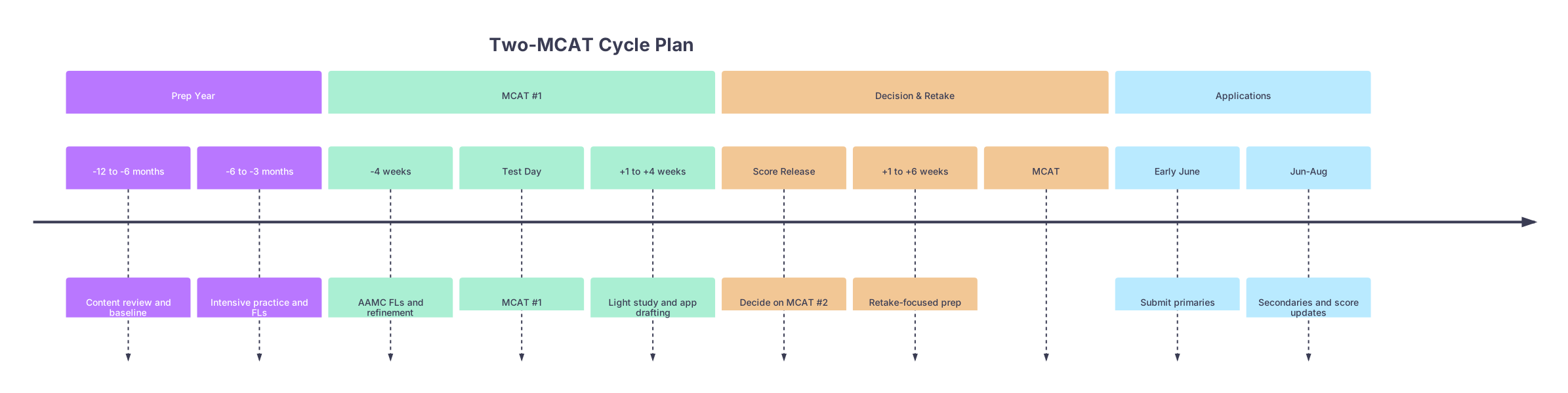
| Period | Event |
|---|---|
| Prep Year - -12 to -6 months | Content review and baseline |
| Prep Year - -6 to -3 months | Intensive practice and FLs |
| MCAT #1 - -4 weeks | AAMC FLs and refinement |
| MCAT #1 - Test Day | MCAT #1 |
| MCAT #1 - +1 to +4 weeks | Light study and app drafting |
| Decision & Retake - Score Release | Decide on MCAT #2 |
| Decision & Retake - +1 to +6 weeks | Retake-focused prep |
| Decision & Retake - MCAT #2 | Backup exam |
| Applications - Early June | Submit primaries |
| Applications - Jun-Aug | Secondaries and score updates |
Week 0 (Score Release Week)
At this point you should:
Make the retake decision within 48 hours of seeing your score.
Dragging this out eats into your most valuable study weeks.If retaking:
- Keep your MCAT #2 date
- Sketch a 6–8 week micro-plan:
- Weeks 1–2: Post-mortem and targeted content patching
- Weeks 3–5: Heavy passage-based drilling
- Weeks 6–7: Full-length focus and stamina
- Week 8: Taper + test
Weeks 1–2 After Score Release: Post-Mortem and Rebuild
Now you diagnose why MCAT #1 underperformed.
At this point you should:
- Compare:
- Section scores vs last 3–4 AAMC practice tests
- Timing notes from your debrief
- Identify 2–3 root causes, not 20:
- CARS timing and endurance
- Content gaps in biochem pathways
- Failure to adapt to experimental passages in C/P
- Psychological meltdown on test day
Your study now becomes surgical:
- 60–90 minutes of focused content review daily on your worst topics
- 2–3 passages per section per week under timed conditions
- Start one new full-length (non-AAMC) to re-check stamina
Meanwhile, for applications:
- If you have not yet submitted your primary, do it.
You can submit with your existing MCAT score and let schools see the new one later, or indicate a future test date.
Weeks 3–5: High-Intensity Practice Around Apps
This is the hardest period. You are juggling:
- MCAT retake prep
- Early secondaries arriving (if you submitted primaries in June)
At this point you should:
- Dedicate 4–5 days/week to MCAT, 2–3 hours per day
- Take 1 full-length per week, ideally AAMC if you still have them
- Spend the rest of your time on:
- Passage sets in your weakest sections
- Timed CARS blocks
- Thorough review of every missed question
On the application side:
- Triage secondaries:
- Top priority: Schools where your current MCAT is in range or just slightly below
- Lower priority / delay a bit: Reach schools that might look much better after a retake score posts
Do not let MCAT #2 destroy your application work. I have watched students ace a retake but send half their secondaries in September. That is not a win.
Weeks 6–7: Final Push Before MCAT #2
At this point you should be in very similar shape to your first test, but smarter.
Weekly plan:
- 1–2 full-lengths, all AAMC if any remain
- 2–3 heavy review days
- 1 lighter day focused on CARS and P/S
Your metrics now:
Are your recent AAMC full-length scores:
- Higher than pre–MCAT #1?
- Consistent (within 2–3 points)?
Are your weak sections improved:
- Fewer timing issues
- Improved accuracy in practice passages
If the answer is no—if you are not clearly outperforming your pre–MCAT #1 numbers—you may need to re-evaluate. Sometimes the best move is to push MCAT #2 into a later window and adjust your application strategy (or even cycle). I have seen students who gain 1 point at massive cost and regret the rushed decision.
Week 8: Taper and Test
Same as first time:
- Stop full-lengths 4–5 days out
- Light review only
- Prioritize sleep and mental calm
You walk into MCAT #2 not as “redemption day” but as “data-backed version 2.0.”
After MCAT #2: How It Fits the Application Cycle
Assume you took MCAT #2 in late June or July.
At this point you should:
- Keep grinding secondaries steadily; do not pause waiting for scores
- When scores release (July–August):
- Update schools automatically through AMCAS/AACOMAS
- Consider sending targeted update letters to key programs if the jump is large (e.g., 505 → 513)
If MCAT #2 is:
Significantly improved and in-range:
You will still be in the running at many schools, especially DO and mid-tier MDs, assuming your application was not catastrophically late.Minimal improvement:
You treat this cycle as practice. You choose a smarter full-cycle plan for the next year instead of trying to brute-force more MCAT attempts.
Alternative Scenarios: Winter Testers and Non-Traditional Paths
Not everyone fits the “April + June” pattern. Here is how the Two-MCCT plan flexes.
Winter MCAT #1 (January/February)
This is actually excellent for a two-cycle plan.
At this point you should:
- Take MCAT #1: January or February
- Get scores: February or March
- If retake needed:
- MCAT #2: April or May
- Application: Submit primaries first week of June, with retake score arriving early in the season
This version gives you the cleanest overlap: you finish nearly all MCAT work before secondaries flood you.
Late Spring MCAT #1 (May)
This is where most people get in trouble.
May test → June score → backup date in July or August.
Technically it can work, but:
- Your retake score may not post until August or even September
- Many MD schools will already be reviewing a huge chunk of their class
If you must do a May MCAT #1:
- At this point you should be brutally honest with yourself. If your May practice exams are not already near target, you risk being forced into a late retake and a weaker cycle.
What You Should Do Today
You do not build a strong retake safety net in June. You build it a year earlier.
Today, you should:
- Open a calendar and place two MCAT dates: your ideal first test and a realistic backup 6–10 weeks later.
- Then write one question at the top of that calendar:
“If MCAT #1 misses, do I still control my cycle?”
If the honest answer is no, adjust the dates until it becomes yes.