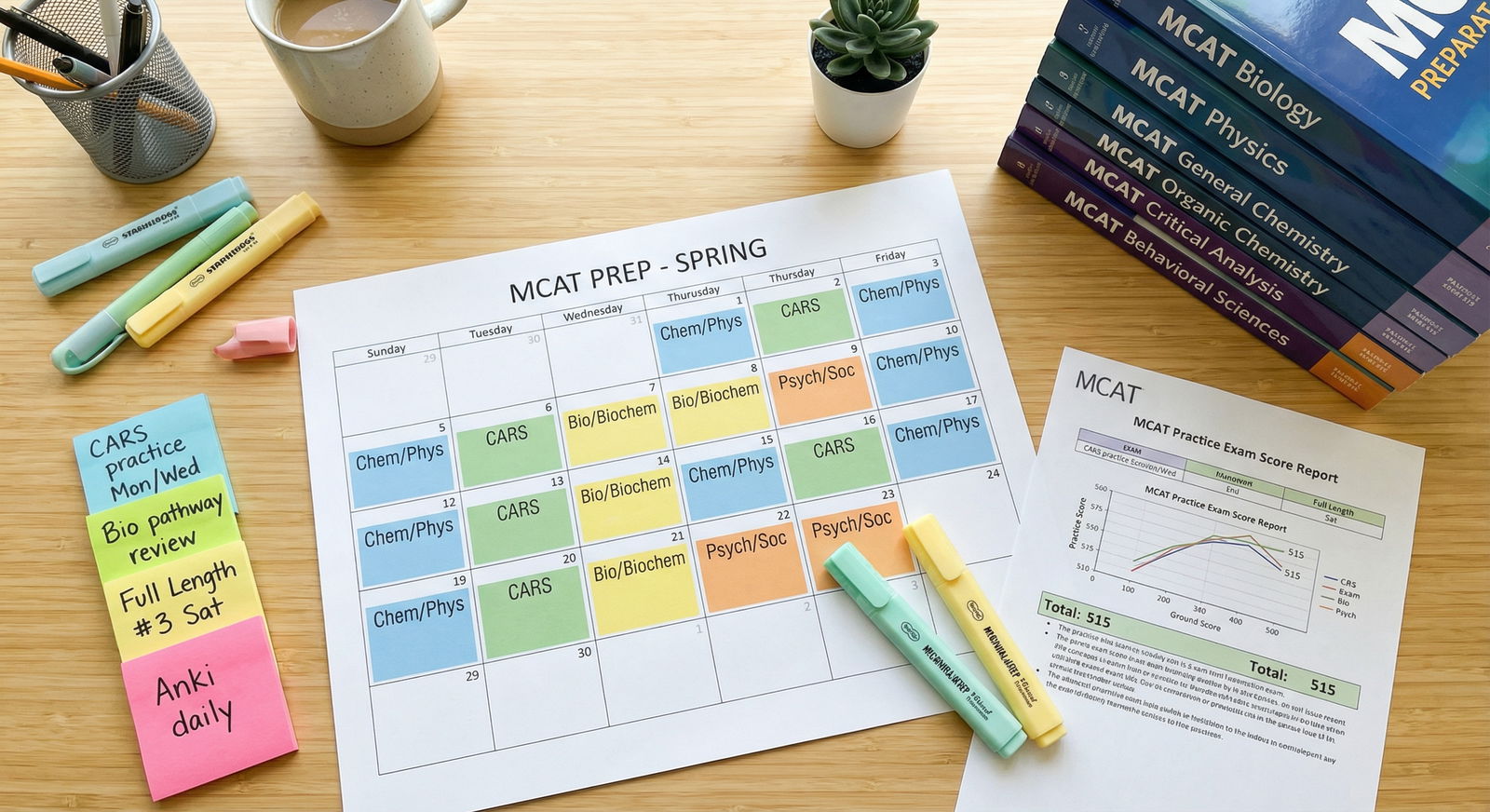
The worst MCAT study plans pretend you have no job, no life, and infinite energy. You do not. So your calendar cannot look like a full‑time grind schedule.
You are working part-time. You have a hard ceiling on hours and mental bandwidth. That changes everything.
Here is a 16‑week, realistic MCAT calendar built for busy premeds working about 15–25 hours per week. Chronological. Concrete. “At this point you should…” instead of vague “study a lot” nonsense.
Assumptions I am making about you:
- You can study 15–20 hours/week on average.
- You have at least one mostly free day each week.
- You can carve out 3–4 shorter study blocks on work days.
- You are aiming for 510+, not just “I hope I pass.”
If that is roughly true, this will fit you.
Big Picture: 16 Weeks in Four Phases
At this point—before you touch a single Anki deck—you should understand the overall arc.
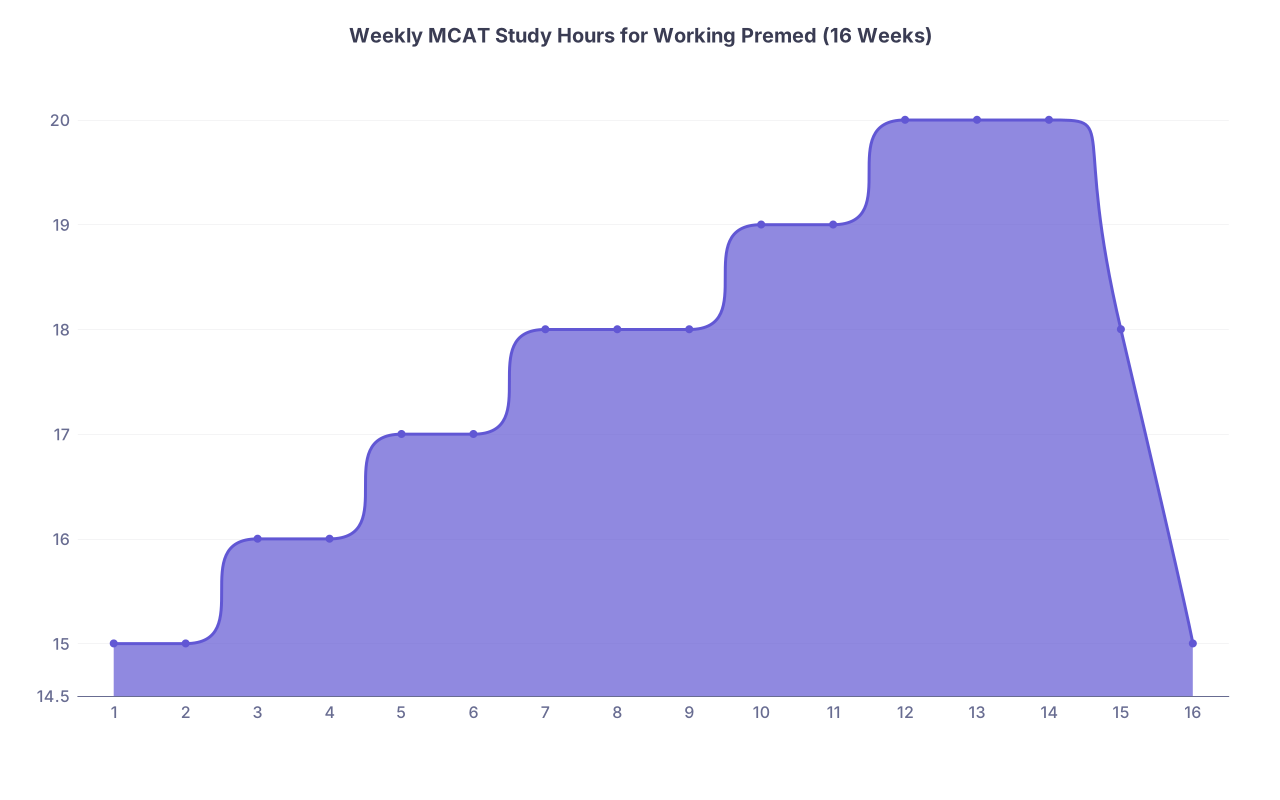
| Category | Value |
|---|---|
| 1 | 15 |
| 2 | 15 |
| 3 | 16 |
| 4 | 16 |
| 5 | 17 |
| 6 | 17 |
| 7 | 18 |
| 8 | 18 |
| 9 | 18 |
| 10 | 19 |
| 11 | 19 |
| 12 | 20 |
| 13 | 20 |
| 14 | 20 |
| 15 | 18 |
| 16 | 15 |
Phase breakdown:
Weeks 1–4 – Foundation & Systems
- Light content review
- Build study habits around your work schedule
- Start low‑stakes practice (discretes, short passages)
Weeks 5–8 – Heavy Practice & Targeted Content
- Content gaps plugged aggressively
- More passages, more sections, early full‑length
- Work on timing and endurance
Weeks 9–12 – Full‑Length Pipeline
- Weekly full‑length exams
- Systematic review becomes your “main job”
- Fine‑tune strategy per section
Weeks 13–16 – Taper, Polish, Protect Score
- Refine weak areas
- Gradual taper to stay fresh
- No last‑minute panic cramming
You will not “finish content” and then “start practice.” That sequence is fantasy for anyone working part‑time. You will mix content and practice from week 1, but shift the ratio over time.
Before Week 1: Non‑Negotiables (3–5 Days)
At this point you have not officially started the 16‑week clock. Good. Do these first.
1. Take a baseline exam (1 day)
- Use:
- AAMC Sample Test or
- A free Next Step / Blueprint / Kaplan full‑length
- Mode: Standard time, regular conditions.
- Do not pause for meals beyond what you will do on test day.
- Do not “review as you go.” Just experience the test.
That score will probably hurt. That is fine. You need a reference point.
2. Build your fixed weekly skeleton (1–2 days)
You cannot out‑organize a random work schedule. So lock down recurring blocks:
Example if you work 4–5 hour shifts on weekdays:
Work days (4x/week)
- 1 block of 60–90 minutes before or after work
- 1 mini block of 20–30 minutes (flashcards, discrete questions)
One “long” day (1x/week)
- 2 blocks of 2–3 hours separated by a real break
One flex / rest day (1x/week)
- Optional 60 minutes of light review
- Otherwise, off. You need a life and a brain that recovers.
Write this into a real calendar. Treat these blocks like shifts.
3. Choose your resources (1 day)
At this point you should commit. Jumping between 7 different platforms is how people waste months.
Choose:
- One content set:
- Kaplan books, Princeton Review, or Khan Academy (yes, still good for content).
- One main Qbank:
- UWorld for MCAT or Blueprint Qbank.
- AAMC package (required, not optional):
- Question Packs (QPs)
- Section Bank (SB)
- Practice Exams (FL 1–4)
- Sample Test
Weeks 1–4: Foundation While Working
Goal: By the end of week 4, you should:
- Have touched all major content areas at least once.
- Be doing timed practice sets 3–4 days/week.
- Know your rough strengths and weaknesses by section.
Weekly Structure Template (Weeks 1–4)
On average per week:
- Content review: 7–8 hours
- Practice questions: 5–6 hours
- Review of mistakes: 3–4 hours
Week 1: Orient and Stabilize
At this point you should not be sprinting. You are building the machine.
Focus:
- Learn MCAT format cold.
- Build study routines around your work.
Tasks:
- Read / watch high‑yield overview of each section:
- 1 day C/P overview
- 1 day Bio/Biochem overview
- 1 day Psych/Soc overview
- 1 day CARS overview and strategy
- Start Anki (or similar) for:
- Biochem terms
- Psych/Soc vocab
Practice:
- 3 days of light practice:
- 2–3 CARS passages per day (untimed or lightly timed)
- 10–15 discrete questions from any science section
End of Week 1 check:
- You should have:
- A functioning flashcard routine
- A written list of “early pain points” (e.g., fluids, amino acids, conditioning)
Week 2: Systems-Based Content + CARS Habit
At this point you should be building a CARS daily habit. No exceptions.
Content focus:
- Physics + General Chem basics (units, forces, energy, stoich, solutions)
- Bio: Cell structure, enzymes, DNA/RNA basics
Plan:
- 4 content blocks (60–90 minutes each) across the week.
- In each block:
- 40–50 minutes new content
- 20–30 minutes of related discretes / short passages
CARS:
- 4–5 days this week:
- 3 passages/day, timed (10 minutes per passage)
- Brief review of 1–2 tricky passages
End of Week 2 check:
- You should have:
- ~12–15 CARS passages done
- 100–150 science questions attempted
- A short list of formulas and concepts for daily quick review
Week 3: Move Into Bio/Biochem and Psych/Soc
Content focus:
- Bio: Genetics, gene expression, cell cycle
- Biochem: Amino acids, protein structure, enzymes, metabolism overview
- Psych/Soc: Research methods, core vocab (this repeats a lot)
Plan:
- One “heavy” long study day:
- 2 hours: Bio/Biochem content
- 1 hour: Qbank questions (mixed)
- 30 minutes: Review + flashcards
- 3 smaller days:
- 45–60 minutes content
- 30 minutes questions
CARS:
- Keep 3 passages per day, 4–5 days/week.
- Begin to track average accuracy and timing.
Week 4: First Mini-Diagnostic & Adjustment
At this point you should start testing how content and strategy hold up in timed blocks.
Mid‑month mini‑diagnostic:
- 1 day: Do one full section of MCAT‑style questions:
- Either C/P or Bio/Biochem
- 59 questions, standard time
- Treat it like a mini exam:
- No phone, no interruptions
- Short break halfway if you need to simulate endurance
The rest of the week:
- 50/50 split content and practice.
- Prioritize:
- High‑yield Bio/Biochem topics (endocrine, nervous system, metabolism basics)
- High‑frequency Psych/Soc topics from Anki
End of Week 4 check:
- You should:
- Have completed at least 400–500 practice questions in total.
- Be doing CARS most days.
- Have a clear list of weakest topics per section.
Weeks 5–8: Shift Toward Practice and Strategy
From this point, content is secondary. Practice + review are primary.
Target mix:
- Practice questions: 8–10 hours/week
- Content review: 5–6 hours/week
- Review & error analysis: 3–4 hours/week
Week 5: Targeted Content Patching
At this point you should use your mistake log to drive content.
Plan:
- Choose 3–4 weakest topics (for example: fluids, electrochem, endocrine, experimental design).
- Structure the week:
- 4 days: 60 min targeted content + 40 min targeted Qbank sets
- 1 long day: mixed practice block (2–3 passages per section) + review
CARS:
- 4–5 days
- 4 passages/day, fully timed
- Track:
- Accuracy per passage
- Question types that keep burning you (main idea, inference, detail)
Week 6: First Full-Length Exam
At this point you should do your first deliberate MCAT full‑length since the baseline.
- Schedule:
- Take FL 1 (third‑party like Blueprint/Kaplan) on your long day.
- Use true test‑day timing.
- Next 1–2 days:
- Review only. No new content.
- For each missed question:
- Identify if you failed due to:
- Content
- Reasoning
- Rushing / timing
- Misreading
- Identify if you failed due to:
This review will feel slow. Good. That is where you actually improve.
Rest of Week 6:
- Shorter content blocks driven entirely by full‑length weaknesses.
- Qbank sets of 20–30 questions focused on those topics.
Week 7: AAMC Question Packs Start
At this point you should start getting closer to AAMC style.
- Begin:
- AAMC Question Packs for CARS and Bio
- Plan:
- 2 CARS Question Pack sessions this week (4–5 passages each)
- 2 Bio Question Pack sessions (2–3 passages each)
- Continue:
- 2–3 mixed Qbank sets of 25–30 questions each
- 2 focused content review sessions (based on recent misses)
CARS:
- At least 4 days this week; 4–5 passages/day.
Week 8: Second Full-Length + Reality Check
At this point you should see some progress from FL 1.
- Take FL 2 (another third‑party or AAMC Sample if you want early AAMC exposure).
- Again:
- 1 day to take it
- 1–2 days to review thoroughly
Compare to your first FL:
- Total score change
- Section‑by‑section change
- Timing:
- Which sections ended in panic mode?
If there is no improvement at all:
- You likely:
- Are not reviewing deeply enough
- Are still in “content comfort” mode instead of “test mode”
End of Week 8 check:
- You should have:
- 2 full‑lengths completed and reviewed
- Completed majority of at least one CARS Question Pack
- Clear sense of which section is currently weakest
Weeks 9–12: Full-Length Pipeline While Working
This is where a lot of working premeds either level up or crash. You cannot cram full‑lengths after long shifts without burning out. You need a predictable rhythm.
At this point you should commit to one full‑length per week for 4 weeks.
Ideal pattern each week:
- Day 1 – Full‑length exam (your longest free day)
- Day 2–3 – Review (2 shorter sessions or 1 long, 1 short)
- Day 4–6 – Targeted practice (AAMC SB, QP, Qbank)
- Day 7 – Light review / rest
Week 9: First AAMC Full-Length
- Use: AAMC FL 1.
- Treat this like a dress rehearsal:
- Same start time as real exam
- Same meal plan
- Same breaks
Review focus:
- For each section:
- Label questions as:
- “Guess but got right”
- “Knew and got right”
- “Knew but rushed / misread”
- “Had no clue”
- Label questions as:
- You want fewer “had no clue” and fewer “rushed” over time.
Practice later in the week:
- Start AAMC Section Bank (SB) for:
- Bio/Biochem and C/P: 1–2 sessions each (15–20 questions per session).
- Keep CARS going:
- 3–4 passages, 4 days this week.
Week 10: AAMC FL 2 + Section Bank Deep Dive
- Take AAMC FL 2.
- Use review to tell you:
- Which section currently limits your score the most.
The rest of the week:
- Target that limiting section aggressively:
- 2–3 SB sessions in that section.
- Focused content review of top 3 weak topics from that section.
- Other sections:
- Maintain with smaller sets (10–15 questions).
By now:
- Your total practice question count should be creeping past 1500–2000. That is the range where patterns start to stick.
Week 11: AAMC FL 3 + Fine-Tuning Strategy
At this point you should have a stable test‑day routine and rough score range.
- Take AAMC FL 3.
- During review, zoom in on:
- Stupid mistakes:
- Misreading “except”
- Ignoring graphs
- Missing units
- Timing breakdowns:
- Panicking and rapid guessing at the end of sections
- Stupid mistakes:
Adjust strategies:
- If CARS is weak:
- Shorter passage notes or no notes at all.
- Commit to simpler, literal interpretations.
- If C/P timing is bad:
- Do easier discretes first.
- Flag but move on from any question >1.5–2 min on first pass.
Week 12: AAMC FL 4 + Plateau or Progress?
- Take AAMC FL 4.
- Compare FL 1–4 trend:
- If you are within 2–3 points of your target, you are on track.
- If you are consistently 5+ points below target, you need a harder conversation:
- Are work shifts crushing you?
- Are you actually reviewing full‑lengths thoroughly?
- Are you sleeping less than 6–7 hours?
Late week 12:
- Keep practice light but sharp:
- 1–2 SB sessions in weakest science section
- 3–4 CARS passages every other day
End of Week 12 check:
- You should:
- Know your realistic score range.
- Have at least 4 AAMC full‑lengths plus 1–2 third‑party full‑lengths under your belt.
- Have a clear priority list for the final month.
Weeks 13–16: Taper, Consolidate, Protect
You are working part‑time. Your risk now is over‑extending and walking into test day burned out.
At this point you should gradually decrease volume but increase precision.
Week 13: Last Heavier Practice Week
Plan:
- One more full‑length (either:
- Retake an AAMC you did early
- Or a final third‑party).
- Review over 1–2 days.
Practice:
- 3–4 sessions of:
- 20–25 questions from your weakest science section
- 3–4 CARS passages
Content:
- Do not start entirely new topics.
- Only clarify:
- Concepts you keep missing across multiple tests.
Week 14: No More New Exams
No more full‑lengths after this week. People love to ignore this and fry their brains.
Focus:
- Short, sharp, section‑level work:
- 1 CARS set (3–4 passages) on 4 days
- 1 science set (20 questions) on 3–4 days
- Heavy emphasis on:
- Reviewing old mistakes
- Re‑doing missed AAMC questions if you have not already
Lower total hours slightly:
- Aim ~15–17 hours this week, not 20.
Week 15: Light, Confidence‑Building Work
At this point you should be in maintenance mode.
Plan:
- 2–3 days:
- 60–90 minutes focused practice (e.g., CARS + a small B/B or P/S set)
- 2–3 days:
- Only light review:
- Flashcards
- High‑yield formula sheets
- “Concept maps” for metabolism, endocrine, etc.
- Only light review:
No:
- Late‑night full sections
- New resources
- “Just one more test” impulses
Week 16: Test Week
Simplify. You are working part‑time, so the temptation to “use every spare minute” is strong. That is how you ruin 15 weeks of good work.
Ideal test‑week structure:
6–5 days before exam:
- 2 light sessions (60–75 min each) of:
- Mixed review questions (10–15) + flashcards
- Confirm logistics:
- Test center location
- Transportation
- ID, snacks, allowed items
- 2 light sessions (60–75 min each) of:
4–3 days before exam:
- Only:
- Flashcards
- Reading through your error log and high‑yield notes
- Cap total study at 2 hours/day.
- Only:
2 days before exam:
- One short session (60 minutes max):
- A few CARS passages and 10–15 mixed discretes.
- Then stop.
- One short session (60 minutes max):
Day before exam:
- No real studying.
- Gentle walk, decent meals, early bedtime.
- Pack everything.
Sample Weekly Template Around a Part-Time Job
To make this tangible, here is a simple structure if you work 5 days/week, 4–5 hour shifts:
| Day | Work? | Study Focus (Weeks 5–12) |
|---|---|---|
| Monday | Yes | 60–75 min practice + 20 min review |
| Tuesday | Yes | 45 min content + 30 min CARS |
| Wednesday | Yes | 60–75 min targeted Qbank |
| Thursday | Yes | 45 min CARS + 30 min flashcards |
| Friday | Yes | 60 min mixed practice + review |
| Saturday | No | 4–6 hours (full-length or long block) |
| Sunday | No | 2–3 hours review or light practice |
You adjust those blocks according to the current phase (more content early, more review late), but the skeleton remains stable.
Visualizing the 16-Week Flow
Here is the entire timeline laid out as a quick reference.
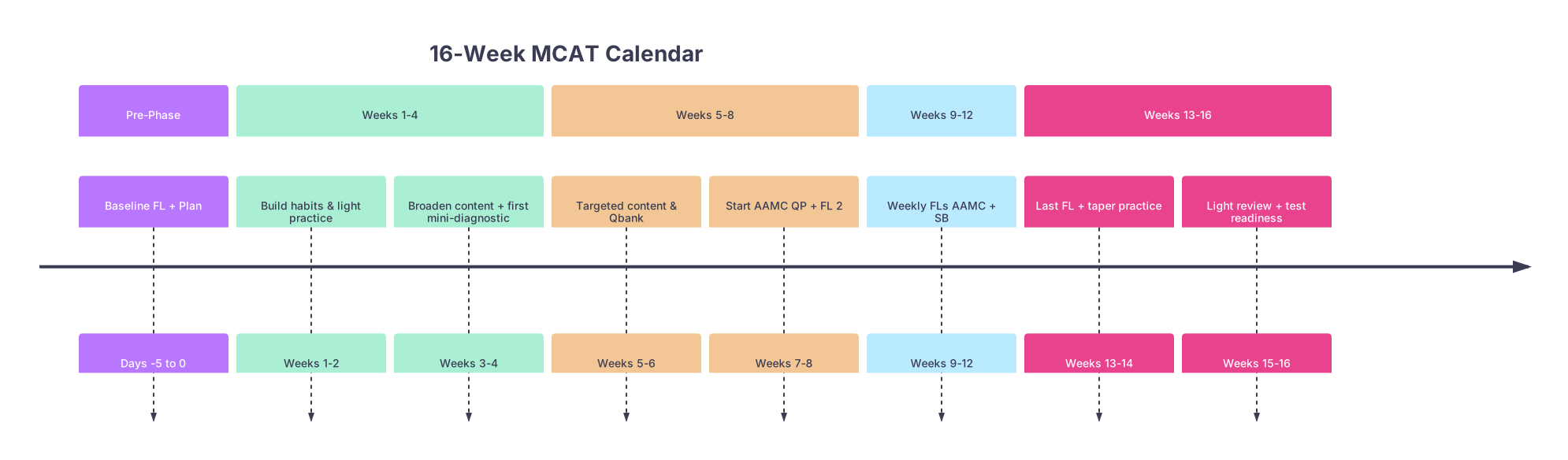
| Period | Event |
|---|---|
| Pre-Phase - Baseline FL + Plan | Days -5 to 0 |
| Weeks 1-4 - Build habits & light practice | Weeks 1-2 |
| Weeks 1-4 - Broaden content + first mini-diagnostic | Weeks 3-4 |
| Weeks 5-8 - Targeted content & Qbank | Weeks 5-6 |
| Weeks 5-8 - Start AAMC QP + FL 2 | Weeks 7-8 |
| Weeks 9-12 - Weekly FLs AAMC + SB | Weeks 9-12 |
| Weeks 13-16 - Last FL + taper practice | Weeks 13-14 |
| Weeks 13-16 - Light review + test readiness | Weeks 15-16 |
Part-Time Reality: Three Rules That Matter
Let me end bluntly. Working part‑time while prepping for the MCAT is absolutely doable. I have seen plenty of 510–520+ scores from people in your exact position. The ones who succeed follow three rules:
They protect fixed study blocks like shifts.
If you cancel on your calendar every time work is exhausting, you will not get there. Build small, sustainable daily blocks, then defend them.They treat full‑length review as the main event.
Not content. Not Anki streaks. Deep, painful review of every full‑length error. That is where the score moves.They taper instead of cramming.
You are not a full‑time student with endless reserves. Your brain is already working a job. Honor that. Taper in the last 2–3 weeks and walk in clear, not cooked.
Follow this 16‑week structure with discipline, adapt the hours to your real schedule, and you will not be guessing on test day. You will know roughly what score range is coming—and why.