

The biggest mistake first-gen applicants make in interviews is hiding the very thing that makes them unforgettable: their story.
You being first-gen is not a side note. It’s the frame. It explains your resilience, your resourcefulness, your perspective on patients and systems. If you treat it like a liability, you’ll sound generic. If you structure it well, it becomes a competitive advantage—especially in medical school and premed interviews where everyone has the same “I like science and helping people” script.
You’re first-gen. Here is exactly how to turn that into interview strength instead of quiet insecurity.
Step 1: Decide Why Your First-Gen Identity Actually Matters
Do not walk into an interview saying, “I’m first-generation, so I’ve overcome a lot.” That line is dead on arrival. Vague hardship doesn’t persuade anyone.
You need to answer a sharper question:
“What specifically did being first-gen force me to learn, do, or become that will make me a better medical student and future physician?”
Sit down and list real, concrete consequences of being first-gen. Things like:
- You explained FAFSA to your parents and half your cousins.
- You translated medical bills or clinic instructions for family.
- You worked 25–35 hours a week during school because there was no financial backstop.
- You had no roadmap for office hours, networking, shadowing, or research—so you built one yourself.
- You navigated immigration, housing instability, or inconsistent internet access while in school.
Now connect each consequence to a skill or trait schools care about. For example:
- Translating for family → communication with non-medical audiences, cultural humility.
- Working long hours while in school → time management, grit, discipline.
- No roadmap → self-direction, initiative, ability to figure things out without hand-holding.
- Navigating complex forms and bureaucracy → systems thinking, empathy for patients lost in the healthcare maze.
You’re looking for patterns. Usually there are 2–3 core themes that define you as a first-gen applicant. Common ones I see:
- Resourceful problem-solver
- Bridge-builder between communities
- Unusually high tolerance for uncertainty and pressure
Those themes are going to anchor how you answer “Tell me about yourself,” “Why medicine?” and “What challenges have you overcome?”
Step 2: Build a “First-Gen Story Spine” You Can Reuse
You don’t need 20 different first-gen stories. You need one or two strong “anchor stories” you can flex for multiple questions.
Use a simple spine:
- Context: the first-gen reality
- Challenge or tension
- What you did (not what happened to you)
- What changed in you
- How that shows up now as a future physician
Let me show you how this looks in practice.
Example spine (summarized):
- Context: “My parents finished school around 7th grade, and college was this vague idea, not a plan. When I started at State University, I didn’t know what ‘office hours’ were.”
- Challenge: “During my first semester, I failed my first chemistry midterm. I felt like I’d been dropped into a game where everyone else got the rulebook.”
- Action: “Instead of dropping the class, I found the TRIO office, met with a peer mentor, and started literally scheduling ‘how to college’ into my week: office hours, tutoring, emailing professors. By the next exam, I’d built a study routine I’d never seen at home.”
- Change: “I went from avoiding help because I didn’t want to look dumb to being the person who drags other students to office hours with me.”
- Medicine link: “That shift—a willingness to ask naive questions and then help other people do the same—is how I now approach patient communication in the clinic where I volunteer. I know what it’s like to nod along while secretly confused, so I’m very intentional about checking for understanding.”
You can turn that same spine into:
- “Tell me about yourself.”
- “What’s a challenge you’ve overcome?”
- “Describe a time you failed.”
- “How will your background influence you as a physician?”
You’re not memorizing a script. You’re memorizing the bones of the story so you can adapt it on the fly.
Step 3: Convert Common Interview Questions into First-Gen Opportunities
Here’s where people waste chances. They keep their first-gen identity in a single “diversity” answer and then answer everything else like a middle-class, hyper-coached applicant.
No. Thread it through.
Let’s hit some of the high-yield questions and how to leverage your story.
“Tell me about yourself.”
Wrong approach:
“I’m a senior at X University majoring in biology. I like science and working with people…”
Better first-gen-forward version:
“I'm a first-generation college student from a small town where most people go straight to work after high school. College—and especially medicine—weren’t on my radar until I started translating my grandfather’s clinic visits and realized my family understood almost nothing of what was being said. That pushed me to college, then into public health volunteering, and now into medicine, where I’m really focused on being a bridge between medical knowledge and families like mine.”
Structure:
Identity → first-gen context → formative experience → direction toward medicine.
“Why medicine?”
Here’s where your first-gen lens is gold. You’ve seen health, or the lack of it, from outside the system.
Weak:
“I want to help people and I like science.”
Stronger first-gen version:
“Growing up, my family avoided doctors unless something was an emergency. Not because they didn’t care about health, but because everything—from insurance forms to front-desk conversations—felt like a foreign language. As the first in my family to really understand the system, I saw how much suffering came from confusion, not just disease. Medicine, for me, is the way to do both: use science to treat disease and use my background to make the system less hostile for families like mine.”
Notice: you’re not asking for pity. You’re showing insight. Systems thinking. That’s attractive to interviewers.
“What’s a challenge you’ve overcome?” / “Tell me about adversity.”
Don’t just trauma-dump your life. Pick a situation where:
- You had limited support or knowledge
- You chose an active response
- You built a skill that’s relevant to training in medicine
Example sketch:
“In my second year, my dad lost his job. Overnight, my contribution went from ‘help with groceries’ to ‘pay rent or we move.’ I started working 30 hours a week as a CNA while carrying a full course load. I couldn’t study like my classmates, so I built a very tight schedule: 30-minute study blocks on breaks, recorded lectures on my commute, and a strict weekly review. It wasn’t glamorous, but it taught me how to perform academically under fatigue and emotional stress—conditions that feel a lot like what I’ll encounter in residency.”
Step 4: Anticipate the Landmines and Handle Them Cleanly
Being first-gen, you’re more likely to get certain follow-up questions, subtle or not. Some will be clumsy. Some will be biased. You need stock responses.
Landmine 1: “Do your parents support your decision to go into medicine?”
If your family is confused or worried, say so without sounding unstable or conflicted.
Example:
“My parents are proud but also nervous. Medicine is far outside their experience, and all they see are the years of training and the debt. I’ve tried to bring them into the process—sharing what I’m learning, explaining the path step by step. Their uncertainty has actually pushed me to be more intentional about why I’m doing this and how I’ll manage finances and support systems. I’m not doing this to prove something to them; I’m doing it because I’ve seen, through my own family, how powerful good medical care can be.”
Direct. Balanced. No drama.
Landmine 2: “How will you handle the academic rigor, given your background?”
Translation: “Are you actually prepared, or are you just a diversity admit?” Annoying, but it happens.
You address it head-on with evidence and growth.
“I stumbled my first year because I was learning college and chemistry at the same time. But you can see in my transcript that once I figured out how to study effectively and found mentorship, my grades trended up, even as I added research and work. I’m comfortable asking for help early, and I already use structured study systems—Anki, weekly review schedules, practice questions—which I know are similar to how students approach Step studying. I’m not guessing about what it takes anymore.”
You’re not defensive. You’re factual.
Landmine 3: “What do you do for fun?” when your life has mostly been work + school
You’re allowed to be human. But if your reality is “I work two jobs and send money home,” say it in a way that doesn’t make you sound one-dimensional or burnt out.
“I’ve had to be careful about time, so I don’t have ten hobbies. But I protect a few things: on Sundays I cook a big meal with my younger siblings—we’re working through my grandmother’s recipes—and during the week I run a few miles in the evenings when I can. Those small routines keep me grounded when everything else is busy.”
You’re signaling: I have coping strategies. I’m more than my struggle.
Step 5: Practice Owning Your Story Without Apology
First-gen students often talk like they’re sneaking in the back door. The energy is, “Thanks for letting me be here, I hope I’m enough.”
That leaks into your voice, posture, and word choice. Interviewers feel it.
You have to practice two things:
- Saying “first-generation” without shrinking your voice.
- Talking about hard things without chaos or oversharing.
Stand in front of a mirror and actually say:
- “I’m a first-generation college student.”
- “I worked 30 hours a week during undergrad to support my family.”
- “I failed my first chemistry exam, but my transcript now shows a strong upward trend.”
Out loud, until the words feel neutral. Not like confession. Just facts.
Then add the pivot line after each:
- “That forced me to learn how to ask for help early.”
- “That taught me to prioritize and protect my study time under pressure.”
- “That experience is why I now reach out to new first-gen students on campus.”
Every time you share something hard, you immediately shift to: here’s what I did with it; here’s how it shaped me as a future physician.
That’s the difference between an adversity story and a victim narrative. Interviewers are very sensitive to the difference.
Step 6: Build a Small, Sharp Story Bank (Not a Novel)
You don’t need to catalog your whole life. For interviews, you need about 6–8 stories you know cold, many of which come directly from your first-gen experience.
Use this framework:
| Story Type | Source Example |
|---|---|
| Academic setback / resilience | First failed exam / first-gen gap |
| Leadership / initiative | Starting a first-gen club or program |
| Ethical / difficult interaction | Translating in clinic or family care |
| Teamwork / conflict | Group project with clashing cultures |
| Service / impact | Work in free clinic or community org |
| Growth / self-awareness | Realizing you needed help, seeking it |
At least half of these can, and probably should, connect explicitly or implicitly to being first-gen.
Example: “Tell me about a time you showed leadership.”
“I helped start a first-gen in STEM group” is far more distinctive than “I was treasurer of the biology club.” As long as you can show real outcomes—more first-gen students using office hours, a mentorship program, resource guides—that’s serious leadership.
Step 7: Understand What Interviewers Are Actually Evaluating in Your Story
They’re not just thinking, “Wow, you worked hard, good for you.”
They’re silently scoring you on:
- Can you reflect, or do you just recite events?
- Do you know what you bring, or are you waiting for them to tell you?
- Will you crumble when coursework and life collide, or have you already been there?
- Are you going to contribute something unique to the class culture?
As a first-gen applicant, you have strong answers to all of these—if you articulate them.
For instance, when you talk about explaining medications to your grandparents, the smart thing to add is:
“That’s where I first learned that ‘Do you understand?’ is a useless question. My grandparents always said yes. Now, in the community clinic, I ask patients to walk me through how they’ll take a medication when they get home. It’s a simple change, but it reveals a lot of misunderstanding they’re too embarrassed to admit.”
That’s advanced communication insight. Only someone who’s lived close to the problem talks like that. And interviewers know it.
Step 8: Rehearse Under Real Conditions, Not Just in Your Head
Your brain will trick you. In your head, your story sounds smooth. In an actual interview, you might ramble, overshare, or freeze.
Do this instead:
Record yourself answering:
- “Tell me about yourself.”
- “Why medicine?”
- “What challenges have you faced?”
- “How will your background impact you as a physician?”
Watch the recording and check for:
- Do you actually say you’re first-gen? (Many people forget.)
- Do you clearly connect your story to skills/insights for medicine?
- Do you ramble past 2–3 minutes?
Trim. Tighten. Replace vague words like “stuff was hard” with one specific: “I was working night shifts as a CNA while taking organic chemistry.”
If possible, do a mock interview with someone not from your background—a professor, advisor, or mentor—and ask them one question:
“After hearing my responses, what do you think my first-gen experience adds to your class?”
If they can’t answer, you need to make the link clearer.
Step 9: Use Nonverbal Cues to Reinforce Confidence, Not Apology
You’re carrying years of feeling behind, out of place, or “lucky to be here.” That shows up physically. Interviewers read it even if they can’t name it.
Pay attention to:
- Eye contact: not a stare-down, but don’t look away every time you mention something difficult.
- Posture: sit like you belong in the chair, not like you’re hoping they don’t notice you.
- Voice: when you say “I’m a first-generation college student,” don’t trail off. Finish the sentence.
A quick hack: when you start an answer that includes your first-gen identity, imagine you’re explaining it to a younger student you’re mentoring, not asking for validation. That small mental shift often cleans up the apologetic tone.
Step 10: Tie Your First-Gen Story to Future Contribution
End at least one major answer (usually “Tell me about yourself” or “Is there anything else you’d like us to know?”) with how you’ll give back with this identity.
Concrete ways you might say this:
“On campus, I’ve been intentional about mentoring new first-gen students so they don’t waste a year figuring out what I had to learn the hard way. At your school, I’d like to be involved with [first-gen network / diversity office / pipeline programs] to support students and also to work on outreach to families who feel as out of place in clinics as mine did.”
“Being first-gen has made me very aware of who gets left out of complex systems. In medical school, I see myself gravitating toward work that improves communication for patients with low health literacy—through plain-language discharge instructions or community health education. I think that’s where my background can have outsized impact.”
You’re not just “overcoming” your story. You’re weaponizing it—in a good way—for your patients and your future peers.
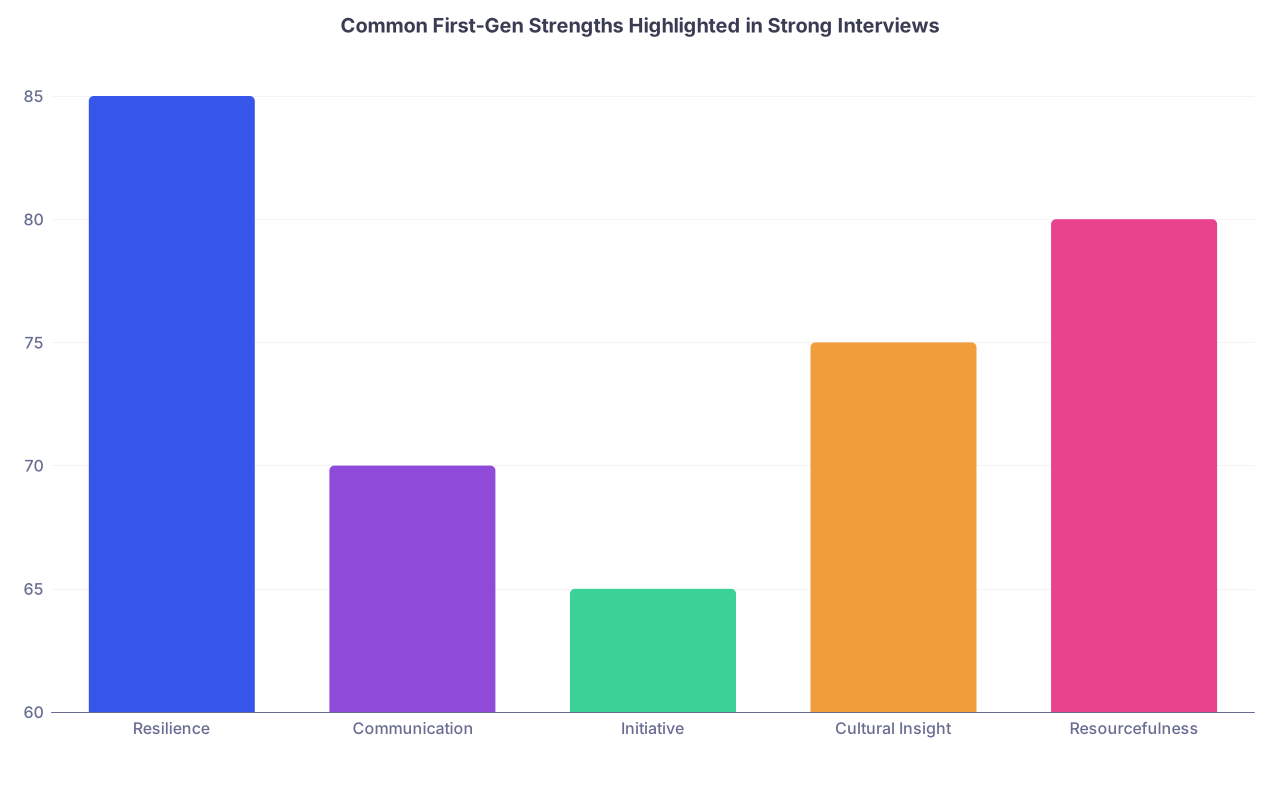
| Category | Value |
|---|---|
| Resilience | 85 |
| Communication | 70 |
| Initiative | 65 |
| Cultural Insight | 75 |
| Resourcefulness | 80 |
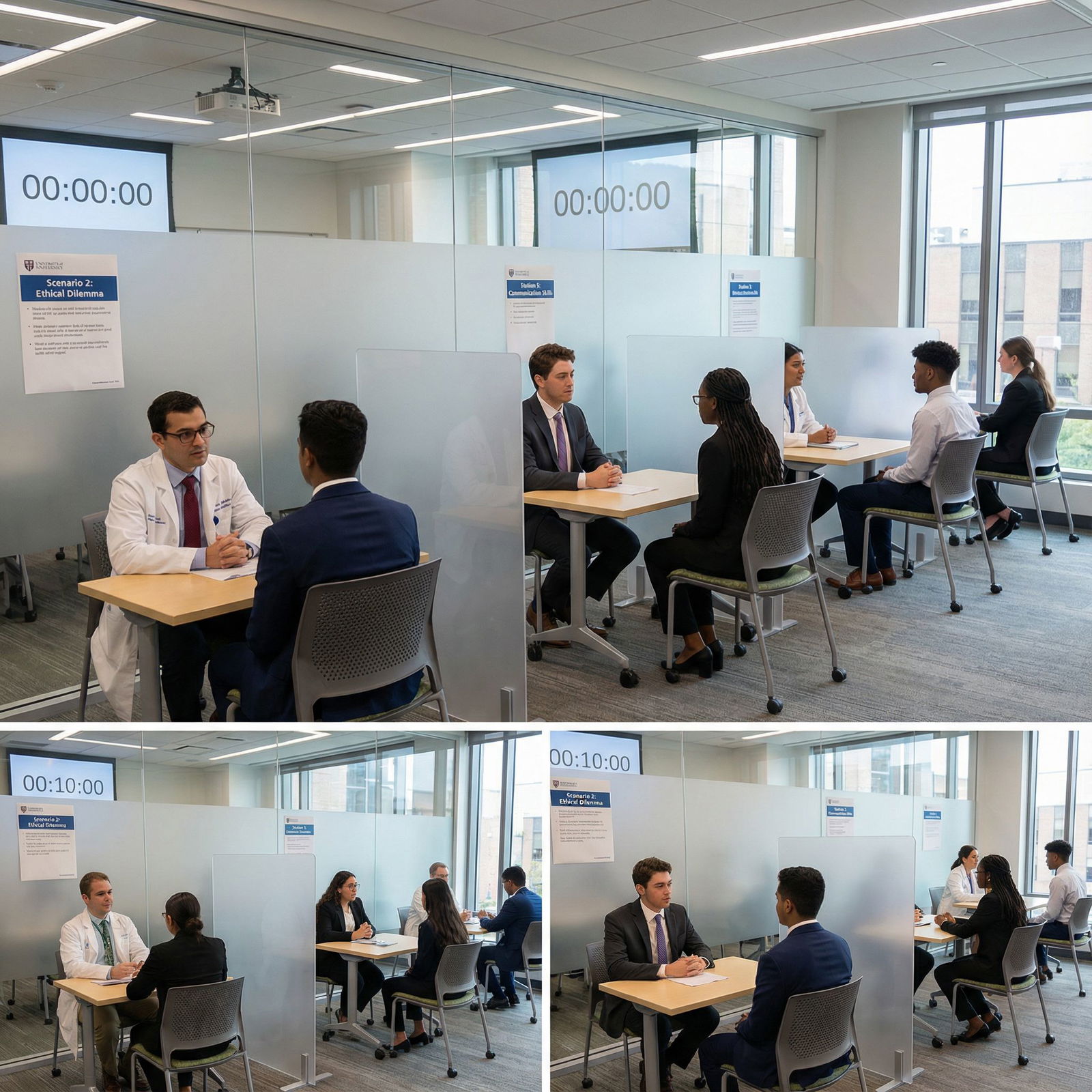
A Quick Scenario Walkthrough: OSCE-Style
Let’s run a realistic mini-simulation.
Interviewer: “Tell me about a challenge you’ve faced and how you handled it.”
You (weak): “Being first-gen was challenging. No one in my family went to college, so I had to figure out everything by myself, and it was very stressful. But I worked hard and made it.”
You (strong):
“I started college as a first-generation student with no idea how the academic system worked. That caught up to me when I failed my first general chemistry exam. I remember sitting outside the lecture hall thinking maybe I just wasn’t cut out for science.
Instead of dropping the class, I treated it as a problem to solve. I went to the tutoring center, met other first-gen students in TRIO, and asked an upperclassman who’d done well in the course to show me exactly how they studied. I stopped trying to memorize lecture slides the night before and built a schedule where I did 30 minutes of chem every day, plus weekly office hours.
By the final, I’d pulled my grade up to a B+, and you can see in my transcript that my science grades have been consistently strong since then. The bigger change, though, is that I now see confusion as a signal to reach out early, not as proof I don’t belong. That mindset is what I bring into patient interactions at the free clinic—I normalize questions and make it clear that not knowing something is the starting point, not a personal failing.”
That answer does multiple things:
- Names the first-gen context.
- Shows specific actions you took.
- Provides evidence (grade trend).
- Connects to how you interact with patients now.
You’d be surprised how many applicants never get to that last part. That’s where you stand out.

| Step | Description |
|---|---|
| Step 1 | Identify First-Gen Experiences |
| Step 2 | Extract Skills and Insights |
| Step 3 | Build 1-2 Anchor Stories |
| Step 4 | Map Stories to Common Questions |
| Step 5 | Practice Out Loud with Pivot Lines |
| Step 6 | Refine for Clarity and Confidence |
| Step 7 | Highlight Future Contributions |
FAQs
1. What if my first-gen story feels “small” compared to others’ hardships?
Do not play the trauma Olympics. Interviewers are not ranking whose life was worst. They’re assessing reflection, growth, and relevance to medicine. If your biggest first-gen struggle was quietly figuring out how to study without role models, that’s valid—if you show what you did and what you learned. Specific beats dramatic every time.
2. How do I avoid sounding like I’m asking for pity?
Focus on agency over suffering. Spend less time describing how bad it was, and more time on what actions you took, how you grew, and how that now benefits patients or peers. Watch your language: swap “I had no choice” with “I decided,” “I figured out,” “I built,” “I learned.” And always include that pivot line to the future: “Here’s how this shapes me as a future physician.”
3. Should I mention being first-gen even if they don’t ask about diversity?
Yes. If you leave it for a single “diversity” question, you’ve underused one of your biggest strengths. You can naturally weave it into “Tell me about yourself,” “Why medicine?” and relevant challenge/leadership stories. You’re not forcing it into every answer, but you’re not hiding it in a corner either.
4. What if talking about my family or background makes me emotional?
You don’t have to tell the hardest, rawest version of your story in an interview. Pick stories you can talk about with composure. If you do get emotional, keep breathing, pause, and ground yourself with a simple line: “This is important to me because…” Then continue with what you did and learned. Practicing out loud ahead of time will help you find the versions of your stories you can share steadily.

Open a blank document right now and write one story using the 5-part spine—context, challenge, what you did, what changed, and how it matters for medicine—centered on your first-gen experience. Then say it out loud, twice, like you’re already sitting across from an interviewer.


