

The loudest person in the room does not automatically win the interview.
That’s the lie a lot of us quietly believe while we’re sitting in our cars before an MMI, trying not to throw up. You look around at these ridiculously smooth, extroverted people, already bonding over gap year adventures and global health trips, and your brain goes: “I’m screwed. I can’t compete with this.”
Let me say it plainly: you absolutely can compete with charismatic interviewees. But you can’t do it by trying to become them. That’s where most introverts sabotage themselves.
You win by weaponizing the things that make you introverted in the first place: thoughtfulness, listening, depth, and calm. And by brutally preparing the parts that do put you at a disadvantage if you ignore them—energy management, concise storytelling, and the first 60 seconds of every interaction.
Let’s go through what really matters, what actually hurts you, and what you can fix way more than you think.
The Myth: Charisma = Acceptance
Here’s the fear in your head, translated:
- “They tell better stories.”
- “They’re faster on their feet.”
- “They fill silences. I create them.”
- “Faculty will remember them and forget me.”
- “In group MMIs, I’m going to be invisible.”
I’ve watched this play out on real interview days. There’s always that one person in the room holding court, telling wild stories about shadowing in some remote village, and everyone’s laughing. And you sit there thinking: I talked to like three patients in my entire clinical volunteering and I’m pretty sure one of them hated me.
Now here’s the part that doesn’t get said enough: admissions committees don’t trust “pure charisma” as much as you think. They’ve seen too many charming trainwrecks—students who shine in 20‑minute conversations and then blow up spectacularly on the wards. You know what’s harder to fake?
- Consistent listening.
- Coherent values.
- Humility that doesn’t feel performative.
- The ability to think before you speak.
Those are introvert strengths.
Charisma without substance is a red flag. Quiet + grounded + thoughtful? That reads as stable. coachable. safe to put in front of patients.
So no, the game is not “be the most entertaining person in the room.” The game is: be the most authentic, clear, and aligned version of yourself in 15–30 minutes.
Where Being an Introvert Actually Hurts (If You Ignore It)
Let’s be honest though. There are ways being introverted can screw you over if you just show up and “be yourself” with zero preparation. These are the landmines.
- Low energy = misinterpreted as low enthusiasm
You might feel incredibly motivated inside, but if your face and voice are at “half-asleep 8 a.m. Zoom lecture” level, they’ll assume you don’t really want to be there. Admissions can’t read your mind. They read your signal: tone, pace, body language, eye contact.
- Overthinking answers = rambling or freezing
Introverts like to think deeply. Interviews don’t give you deep-thinking time. If you’re crafting the perfect sentence in your head before speaking, you’ll either talk in giant confusing blocks or panic and stall out.
- Downplaying yourself = they never see your value
You’re used to not bragging. Except interviews are literally “structured bragging.” If you keep saying “I just helped a little,” your file will look weaker than your peers with the same experiences but clearer presentation.
- Group scenarios = you disappear
In MMI stations or group activities, you wait to speak until you have something “good” to say. The extroverts… do not wait. Result: you say two good things; they say ten okay things. Guess who feels more “engaged” to an observer?
Here’s the good news. All of this is fixable with specific, non-cringey strategies. You don’t have to rewire your personality. Just your approach.
Use the Introvert Superpowers You Already Have
Let’s flip this. You have several built‑in interview advantages that a lot of charismatic people don’t.
1. You actually listen
Extroverts sometimes answer the question they want to answer, not the one they were asked. You, on the other hand, are probably hyper‑aware of wording.
So you lean into that.
- In MMIs: “So if I’m hearing the scenario correctly, the core dilemma is X vs Y, is that right?”
- In traditional interviews: “You asked about a time I worked on a team under pressure. One example that comes to mind is…”
You show you’re engaged and accurate. Committees love that. On the wards, missing details hurts patients. Your default mode is safer.
2. You think in depth, not soundbites
Charismatic people love polished one‑liners. You’re more likely to say something like: “Honestly, I didn’t handle that perfectly. Here’s what I’d change now.”
That kind of nuance screams maturity. When you talk about:
- A mistake with a patient interaction
- A conflict in a volunteer group
- Struggling on an exam or with burnout
…you’re probably more real than the person who claims every experience was “amazing” and “transformative.” Interviewers can smell rehearsed nonsense.
3. You don’t over‑dominate social space
This matters more than you’d think. Medicine is full of big egos. An applicant who listens, shares space, and doesn’t bulldoze people? That’s gold. In MMI group tasks especially, evaluators want:
- Someone who contributes
- Someone who invites others in
- Someone who isn’t steamrolling
You’re naturally less likely to steamroll. We just need to raise your floor so you’re not silent.
Concrete Fixes: How to Compete Without Becoming Fake
You don’t need a new personality. You need a system that covers your weak spots. Here’s what that looks like.
Step 1: Script (and drill) your first 60 seconds
The first minute sets the tone. You know that sinking feeling when you stumble on your intro? It ruins your confidence for the rest of the station.
So you don’t leave that to chance.
Write and practice:
- A 20–30 second version of “Tell me about yourself.”
- A 10–15 second “why medicine” synopsis.
- A 10–15 second “why this school/program.”
Then you expand those when asked, but you always have a clean opening line ready.
Example “tell me about yourself” (introvert‑friendly, no fake hype):
“I grew up in a small town, and I’ve always been drawn to one‑on‑one interactions more than big groups. That’s partly why I ended up spending a lot of time in long‑term volunteer roles—like working with the same patients every week at the free clinic. Academically I’m strongest in [X], but what’s really pushed me toward medicine has been watching how consistent, quiet support from physicians changed how patients trusted the system.”
You don’t need to sound like a TED Talk. You do need to sound like you know who you are.
Step 2: Practice “energy dialing,” not personality changing
You’re not trying to be extroverted. You’re trying to show 5–10% more visible energy than your default. That’s it.
You can literally practice this:
- Record yourself answering a question at your natural level.
- Then again, slightly faster, with just a bit more variation in tone and more facial expression.
- Watch both. The second one will feel “too much” to you. It almost never is.
Target areas:
- A small smile at the start and end of answers.
- Slightly louder than your normal quiet voice.
- A bit more hand movement than you’d use in a library.
This is acting? Kind of. But it’s not faking your values. It’s adjusting the volume on your presence so people can hear you.
Answer Structure: Guardrails So You Don’t Ramble
Introverts overthink and then drown in their own thoughts. You need a simple template so your brain has a rail to follow.
For most behavioral/experience questions, use a stripped‑down version of STAR:
- Situation
- Task
- Action
- Result/Reflection
But keep it short. The trap is turning this into a 5‑minute monologue. Instead:
1–2 sentences: brief Situation + Task
2–3 sentences: what you did (Action)
1–2 sentences: what happened + what you learned (Result/Reflection)
Example:
Question: “Tell me about a time you worked with a difficult team member.”
You don’t say: “Well, I’ve had a lot of experiences with teams…”
You say:
“In my research lab, one of the newer students was missing meetings and delaying our data collection. I was responsible for keeping the project on timeline. I asked to talk with him one‑on‑one, and it turned out he was overwhelmed and didn’t fully understand the protocol. I broke the tasks into smaller parts, walked through them with him, and we adjusted the schedule. Our data collection got back on track, and I also learned that my first reaction—frustration—wasn’t helpful. Now I try to assume I’m missing information before I judge someone’s effort.”
Concise. Reflective. Not dramatic. Very introvert‑compatible.
Group MMIs and Multiple Mini Interviews: The Worst‑Case Scenario in Your Head
This is probably your nightmare: group MMI with some ultra‑charismatic applicant who jumps in immediately, talks confidently for 90% of the station, and you just… exist.
Here’s how you don’t get erased.
Before you speak, claim your space
Instead of waiting for a “perfect” thought:
- Set yourself a rule: you must speak in the first 30 seconds with something.
- Even if it’s simple: “Maybe we can start by listing the main issues we see, then pick one each?”
You’re not trying to be brilliant. You’re trying to signal: I am engaged, I am here, I will contribute.
Use your listening as a leadership tool
You don’t have to dominate. You can facilitate. That scores ridiculously well.
Phrase bank you can steal:
- “I like what you said about X. Can we connect that to Y?”
- “You brought up autonomy earlier—do you think that conflicts with what we’re suggesting now?”
- “We haven’t heard from everyone yet. Did you want to add anything?”
Observers love that. That’s quiet leadership. It also buys you time to think.
How Introverts Compare to Extroverts in Interviews (Reality Check)
| Aspect | Introvert Tendency | Extrovert Tendency |
|---|---|---|
| Listening | Strong | Variable |
| Talking time | Too little | Sometimes too much |
| Depth of reflection | High | Variable |
| Perceived enthusiasm | Understated | Overt |
| Group MMI presence | Risk of being overshadowed | Risk of dominating |
Neither side is “better.” Each has built‑in risks. You just have to manage yours.
Managing the Anxiety Itself (Because That’s Half The Battle)
Let’s not pretend this is just a skills problem. It’s also: “My heart rate is 160 and my brain has left the building.”
Introverts burn energy fast in high‑stimulus situations, especially social ones. So treat interview day like an endurance event, not a casual chat.
Concrete stuff that actually helps:
- Buffer time before the interview. Don’t show up 5 minutes before, heart racing, sprinting from the bus. Arrive early, find a quiet corner, and let your nervous system catch up.
- One-page “anchor sheet.” Not notes to read during the interview—just short bullets you glance at before going in:
- 3 key stories
- 3 reasons you want medicine
- 3 reasons you like this school
- 3 strengths, 3 weaknesses (framed honestly)
- Post‑station reset ritual (for MMI). 10–15 seconds:
- Exhale long and slow.
- Mentally say: “New room, new start.”
That’s it. Don’t replay what you just said. You will not fix it in the hallway.
And the hard truth: you need to practice being anxious and still talking. Not waiting until you “feel calm” (you won’t). Mock interviews where you intentionally go in slightly stressed will train your brain that you can still function at 7/10 anxiety.
How Much Practice Do You Actually Need?
You don’t need to rehearse to the point you sound robotic. But you do need enough reps that:
- You’ve heard yourself say your own stories out loud multiple times.
- You’ve answered “Why medicine?” so often it’s almost boring to you.
- You’ve survived someone interrupting you. Or challenging you. Or going off script.
If you want a rough guideline for introverts:
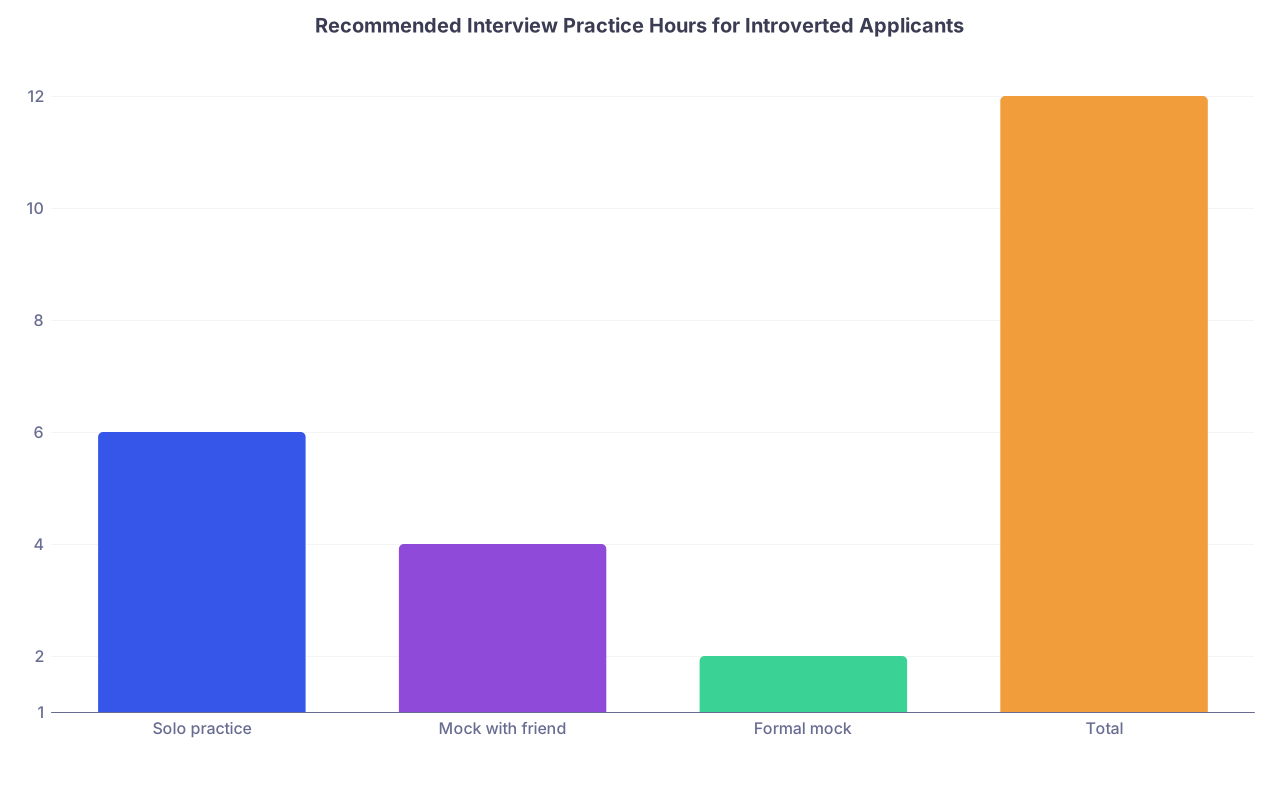
| Category | Value |
|---|---|
| Solo practice | 6 |
| Mock with friend | 4 |
| Formal mock | 2 |
| Total | 12 |
About 10–15 hours of targeted practice (not just “thinking about answers in the shower”) can transform you from “terrified and scattered” to “quiet but controlled.”
Break it up:
- 20–30 minutes a day for 2–3 weeks.
- Mix solo practice (recording yourself) with actual human feedback.
What If You’re Just… Not “Interesting Enough”?
This is the other introvert fear: “I didn’t start nonprofits, I didn’t work on a helicopter, I basically went to class, did research, volunteered, went home.”
Here’s the thing nobody tells you: your story is not judged on how flashy it is. It’s judged on:
- Can you explain why you did what you did?
- Can you show growth over time?
- Can you connect experiences to medicine in a non‑cliché way?
You can have what looks like a “boring” path and still stand out if you’re honest and specific.
Instead of: “I’ve always wanted to help people.”
Try:
“For a long time I thought ‘helping people’ meant getting perfect grades and being the one with answers. Working at the free clinic, I realized sometimes the best thing I did for a patient wasn’t solving anything—it was sitting with them while they processed a new diagnosis. That shifted my idea of what being useful actually looks like.”
That’s reflective. That’s compelling. No charisma required.
A Simple Pre‑Interview Checklist for Introverts
You don’t need 50 hacks. You need a short list you can actually remember.
Before your interviews, make sure you’ve:
- Written and practiced your 3 core intros:
- Tell me about yourself
- Why medicine
- Why this school
- Identified 5–7 key stories that can flex for multiple questions:
- Challenge/failure
- Team conflict
- Leadership
- Ethical situation
- Patient/volunteer experience that changed you
- Practiced out loud, on camera, at least 3 times.
- Done at least 1 mock with someone who won’t just say “That was good!” to everything.
- Chosen your “energy dial”—that 5–10% up version of your normal self.
- Planned how you’ll recharge before and after (music, walking, sitting alone, whatever works for you).
And on the actual day:

| Step | Description |
|---|---|
| Step 1 | Arrive 30-45 min early |
| Step 2 | Find quiet spot |
| Step 3 | Review 1-page anchor |
| Step 4 | 2-3 warmup answers out loud |
| Step 5 | Enter interview room |
| Step 6 | After: brief reset breath |
| Step 7 | Final debrief & decompress |
Nothing on that list changes who you are. It just stops your introversion from looking like disinterest or uncertainty.
Years from now, you won’t remember the one hyper‑charismatic applicant who intimidated you in the waiting room. You’ll remember whether you showed up as the clearest, most honest version of yourself—or whether you let the fear of not being “outgoing enough” mute you.
You’re not losing to charisma. You only lose if you never let them actually see you.


