

It’s 10:07 AM. You’re in a med school interview, sitting across from an attending who hasn’t cracked a smile once. You just tried a light joke to ease the tension. It landed like a brick. Their face didn’t move. You feel your stomach drop and your brain starts screaming:
“I blew it. They hate me. I’m not their ‘type’ of student. I’m done.”
Or maybe it’s the opposite. Your interviewer is bubbly and extra and laughs at everything, and you’re more reserved, serious, and… not about fake chuckles every five seconds. You’re answering thoughtfully, but you’re not matching their energy. And the panic starts:
“They think I’m boring. They’re going to say ‘no personality’ on the eval. I’m screwed.”
Let me say the scary part out loud: you will have interviewers you don’t click with. Different personalities. Different humor. Different vibes. It’s unavoidable.
Now the part your anxiety doesn’t want to believe: that mismatch almost never kills your entire application. And trying too hard to “fix it” can make things worse.
Let’s pull this apart properly.
The Myth of the “Perfect Vibe Match”
There’s this unspoken fantasy a lot of applicants have: that the “good” interview is when you and the interviewer instantly mesh. Same humor, same energy, same niche interests. They laugh, you laugh, it feels like a coffee chat instead of an assessment.
I’ve seen this play out. I’ve also seen those exact “we vibed so well” interviews still end in waitlists or rejections.
On the flip side, I’ve seen painfully dry interviews — interviewer stone-faced, rapid-fire questions, zero emotional warmth — end in strong acceptances.
You know why? Because:
- You’re not being scored on whether you could be best friends
- You’re being scored on whether you’re safe, reliable, teachable, and not a walking red flag
Most med schools and residency programs use some version of an evaluation form. Is it subjective? Sure. But it’s also structured. Personality “fit” is only one small slice, and “comedy compatibility” isn’t a category.
Here’s roughly how much weight personality fit usually holds compared to everything else:
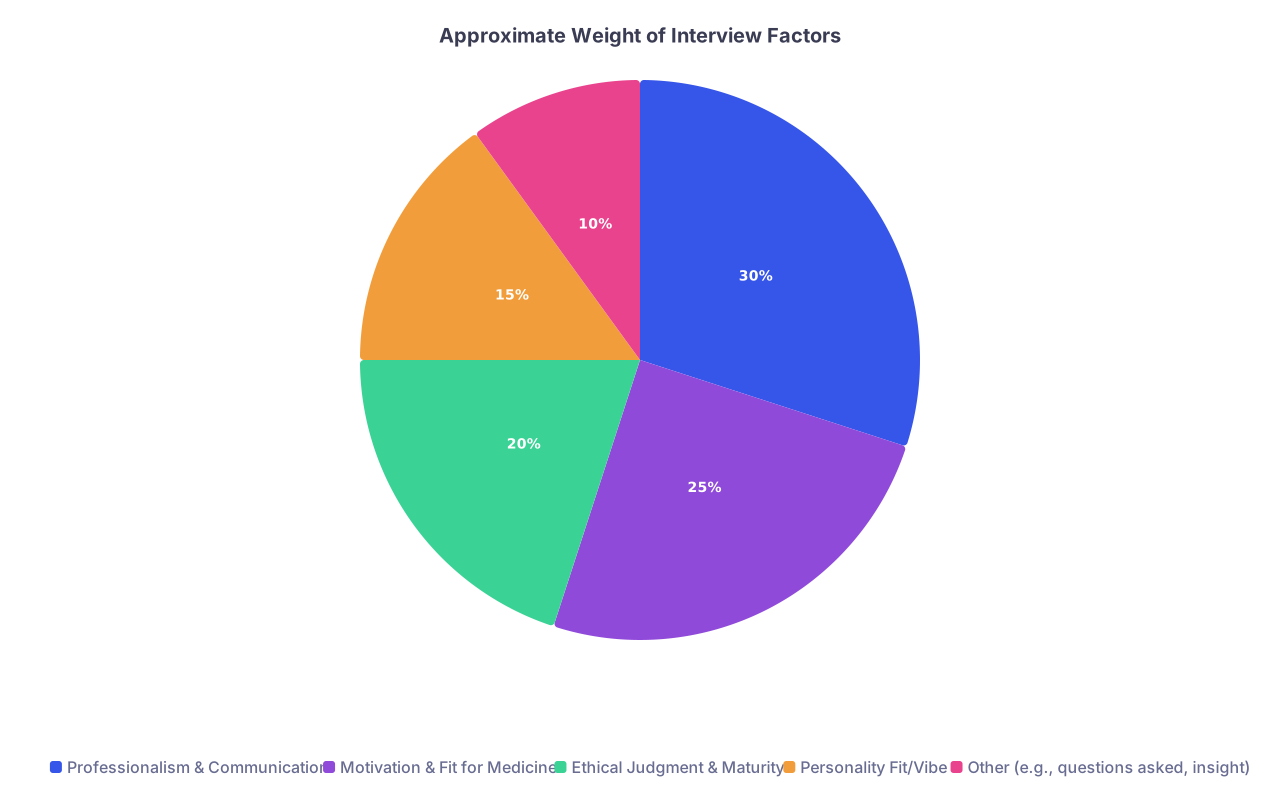
| Category | Value |
|---|---|
| Professionalism & Communication | 30 |
| Motivation & Fit for Medicine | 25 |
| Ethical Judgment & Maturity | 20 |
| Personality Fit/Vibe | 15 |
| Other (e.g., questions asked, insight) | 10 |
Is it perfect data? No. But that slice for “vibe” is smaller than your brain is making it.
Most interviewers aren’t thinking, “Do I want to be friends with this person?” They’re thinking, “Can I see this person managing a sick patient at 2 a.m. without imploding?”
Very different bar.
What “Not Matching” Actually Looks Like (And What It Doesn’t)
Your anxiety likes extreme scenarios, so let’s differentiate between:
- Normal personality mismatch
- Actual problem behavior
Normal mismatch looks like:
- They’re very serious and you’re more casual, so your jokes don’t land
- They’re super enthusiastic and you respond more calmly and measured
- They don't laugh, but they nod and move on
- You don’t share their hobbies/interests and the conversation feels flat
- There are occasional awkward silences you have to gently fill
Does this feel uncomfortable? Yes. Does this equal “automatic rejection”? No.
Actual problem behavior looks like:
- You keep doubling down on jokes after they clearly don’t respond
- You make sarcasm your main communication style in a serious question
- You dismiss something they care about (“Honestly, I think research is kind of pointless…”)
- You visibly shut down because they’re not your type, and you get short, cold, or defensive
- You try to “mirror” them so hard that you start sounding fake or pandering
That’s what can tank an interview. Not the mismatch itself. Your reaction to the mismatch.
The Sense of Humor Trap
You know that moment when you try to lighten the mood, and as you’re finishing the joke, you already regret it? Yeah.
Humor is one of the biggest anxiety magnets in interviews because it’s unpredictable. You don’t know their line. You don’t know their style. And if it backfires, you replay it in your head for the next six months.
Here’s the uncomfortable truth: you don’t need to be funny in an interview. At all.
You can be:
- Warm
- Pleasant
- Engaged
- Human
without being “the funny one.”
If your natural personality includes light humor, that’s fine. But the moment you sense it’s not connecting with this interviewer? Stop trying to force it. You’re not auditioning for stand-up. You’re auditioning to be allowed near sick people.
When the joke doesn’t land, you do this:
You keep your face relaxed, continue what you were saying, and let it die. No apologizing. No weird giggles. No “Wow, that sounded better in my head.” Just keep going. Like an attending who ignored your joke on rounds. Because that will happen.
The worst thing isn’t a dead joke. The worst thing is spiraling mid-interview and losing your train of thought.
What Interviewers Actually Care About When You Don’t “Click”
Here’s what runs through a seasoned interviewer’s head when they don’t naturally click with you:
“Okay, different style than me. Are they:
- Respectful?
- Thoughtful in their answers?
- Easy to follow?
- Open to feedback?
- Someone I’d trust around patients and colleagues?”
They do not need to see their own personality in you. In fact, many programs like variety. A team full of identical people is a walking disaster.
I’ve sat in debrief meetings where one faculty member said, “They were a little stiff.” And someone else said, “Yeah, but solid. I’d be fine working with them.” End of discussion. That’s it. Stiff doesn’t equal no.
Also — and this is the part applicants don’t believe — you’re not the only awkward one in that room. Some interviewers are just not good at interviews. They’re blunt, they’re tired, they’re thinking about the pager they muted before walking in. The flat affect? Might have nothing to do with you.
You’re internalizing their style as a judgment of your worth. That’s your anxiety talking, not data.
How to Survive a Personality Mismatch in Real Time
You’re in the interview. You feel the mismatch. Your stomach is in your shoes. Here’s what you actually do.
First: mentally label what’s happening.
“Okay, this is a personality mismatch, not a catastrophe.”
That one sentence keeps you grounded. You’re naming it, not drowning in it.
Then you shift from “impress mode” to “professional colleague mode.” That means:
- Speak clearly and slower than your panic wants you to
- Sit with small silences instead of panic-filling them with nervous chatter
- Answer the question directly first, then expand
- Keep your tone warm but not overly animated if they’re more flat
- Match pace, not personality — their tempo, not their entire identity
You’re basically saying: “We’re different, but I can function with you.”
If they don’t laugh at your comment, you move on. Not awkwardly, not with a self-own. Just… move on.
If they seem blunt or critical, you don’t get defensive. You say something like, “That’s a fair point. The way I think about it is…” and respond calmly.
You’re proving emotional regulation. That’s gold.
How Much Does a Single Personality-Mismatched Interview Matter?
Let’s zoom out. Especially for med school: you’re not usually being judged by one person in a vacuum.
There’s a file. Scores. Letters. Personal statement. Secondary essays. Sometimes multiple interviewers. Sometimes MMI stations. Sometimes a committee that literally sits around a table and says:
“So, what do we think about Applicant 184?”
One stiff or low-chemistry interview where you were still professional, coherent, and not weird? It’s rarely fatal. It might move you from “obvious yes” to “let’s discuss,” but it doesn’t yank you straight into the trash.
Here’s a brutally oversimplified view of how one awkward interview usually plays out against a strong application:
| Overall Application | Interview Quality | Likely Outcome Range |
|---|---|---|
| Very strong | Awkward vibe | Accept / Waitlist |
| Solid | Awkward vibe | Waitlist / Reject |
| Borderline | Awkward vibe | Usually Reject |
Notice what actually decides things: your file + your baseline performance, not whether your interviewer thought your joke was hilarious.
If your application is already shaky, yes, a bad interview hurts more. But if you’re reading this, you’re probably the type who’s been over-preparing for years. You’re not falling apart because someone didn’t think you were charming.
The Part That Hurts: You Won’t Be Everyone’s Favorite. That’s Okay.
You will have interviewers who think:
“Nice. Great fit.”
“Fine, nothing special.”
“Not really my person, but okay.”
That last one stings, but it’s survivable.
You’re not auditioning for a cult. You’re auditioning to join a community of very different people. Some attendings you’ll adore, some you’ll tolerate, some you’ll avoid. Same goes in reverse.
Trying to engineer being universally liked will only do one thing: make you come off as fake.
I’d rather see an applicant who’s a bit reserved but clearly authentic than someone who shape-shifts their personality depending on who’s in front of them. Interviewers pick up on that. Fast.
How to Prepare If You’re Already Panicking About This
Since your brain likes scripts and control, give it something concrete.
Here’s what I’d actually do over the next week if this is your fear:
Practice with “mismatched” people on purpose.
Find a classmate, advisor, or friend-of-a-friend who isn’t your usual vibe. Ask them to do a mock interview. Your goal isn’t to charm them. It’s to stay calm, clear, and structured even when the chemistry is meh.Record yourself answering 3 questions with a neutral face watching.
Literally put a neutral face image on your screen or imagine someone expressionless. Practice answering:- “Tell me about yourself.”
- “Why medicine?”
- “Tell me about a time you failed.”
Your brain needs reps of “I can keep going even when I get nothing back.”
Decide your humor line before the interview.
Something like: “I’ll allow myself light, situational humor, but if it doesn’t bounce back, I won’t keep using it.” Pre-deciding stops you from panic-freestyling.Build a post-interview rule for yourself.
“I’m allowed 20 minutes to spiral and then I have to write down 3 things I did well in that interview.” It’s harsh, but it keeps you from letting one vibe-y interview contaminate the rest.
Here’s the bigger mindset shift: your goal isn’t to be liked by everyone. Your goal is to consistently show up as a competent, kind, self-aware human — even when the room feels off.

| Step | Description |
|---|---|
| Step 1 | Notice mismatch |
| Step 2 | Stay professional & steady |
| Step 3 | Stay calm, protect boundaries |
| Step 4 | Answer clearly & concisely |
| Step 5 | Limit humor, focus on content |
| Step 6 | Finish strong, ask thoughtful questions |
| Step 7 | Post-interview: brief reflection, then move on |
| Step 8 | Are they disrespectful? |
FAQs – The Stuff You’re Probably Still Worried About
1. What if the interviewer flat-out doesn’t like me?
Then they don’t like you. It happens. The important question is: did you still act like someone an admissions committee can trust? If you stayed respectful, coherent, and not defensive, their personal dislike is much less powerful than you think. Most places know some interviewers are harsh or idiosyncratic; they don’t give every single opinion the same weight.
2. What if I accidentally make an off-color joke?
If it’s even possibly off-color, you shouldn’t be making it in an interview. But let’s say it happened. Don’t dig the hole deeper with nervous rambling. A simple, calm, “Sorry, that didn’t come out how I meant. Let me rephrase,” and then move on. If they keep the interview going, you focus on being solid the rest of the time. One misstep isn’t ideal, but owning it like an adult is salvageable.
3. Should I try to mirror my interviewer’s personality to build rapport?
Light calibration? Fine. Full personality cosplay? No. Matching tone and pace a bit can help communication, but don’t rewrite your entire personality on the spot. Interviewers are used to seeing lots of different types. They’re more put off by inauthenticity than by a quiet or serious applicant.
4. Can a single bad chemistry interview cancel out a strong application?
It can hurt, especially if you’re on the borderline already. But “bad chemistry” is not the same as “terrible performance.” If you answered questions well but just didn’t click, that’s not typically what sinks you. Truly disastrous interviews usually involve red flags: arrogance, lack of insight, ethical issues, clear unprofessionalism — not “we didn’t laugh together.”
5. How do I stop replaying an awkward interview in my head?
Give yourself a hard limit. Example: you’re allowed to obsess for the car ride home and that evening. After that, you write down:
- 3 things you did well
- 2 things you’d do differently next time
Then you move on to the next interview. Rumination doesn’t change that interview’s outcome; it only sabotages your performance in the upcoming ones.
6. Is it better to be “boring but safe” or take risks with personality?
In a high-stakes, professional gatekeeping setting like med school or residency interviews? Boring-but-safe beats edgy-but-unstable every time. You can show warmth, curiosity, and a hint of your personality without taking big risks. Save your spicier humor and hot takes for after you’ve matched and you’re grabbing coffee with co-residents, not when one stranger gets to write a paragraph that might end up in your file.
Do one thing today:
Write down your answer to, “Tell me about yourself,” and read it out loud in the flattest, least reactive voice you can manage — like you’re talking to a brick wall. Can you still sound clear, organized, and like you belong in this profession, even without any feedback?
If you can get through that, you can get through an interviewer who doesn’t laugh at your jokes. And that’s enough.


