
The problem isn’t your alarm clock. If you keep oversleeping and missing morning sessions in med school, your whole system is broken—and you need to treat it like an acute problem, not a personality flaw.
I’m going to walk you through a repair plan. Not vague “sleep hygiene” fluff. A concrete, week-by-week approach you can actually run in real life while exhausted, ashamed, and already behind.
This is for you if:
- You’ve missed 8 a.m. small groups, skills labs, or even exams.
- You keep promising yourself “tomorrow I’ll fix it,” and then you wake up at 10:40.
- You’re starting to feel like a failure and are quietly panicking about professionalism, dean’s letters, and remediation.
Let’s get specific and tactical.
Step 1: Stop the Bleeding This Week (Emergency Protocol)
Your first goal is not “perfect sleep.” It’s: make it physically hard to oversleep tomorrow and the next few days.
Think of this like stabilizing a crashing patient. You don’t start with long-term lifestyle advice. You stop the immediate damage.
A. Create a Morning “Hard Fail-Safe” System
You’re no longer relying on motivation or willpower. You’re building external scaffolding.
For the next 2–3 weeks, do this:
Three-alarm system (different devices)
- Phone alarm
- Cheap $10 alarm clock across the room
- Backup on another device (old phone, tablet, smartwatch)
Stagger them: e.g., 6:30, 6:35, 6:40. All on LOUD, annoying tones. No gentle piano nonsense.
Put at least one alarm in another room
This is not optional. Alarm should be far enough away that:- You must physically get out of bed.
- You can’t reach it by leaning or doing that half-sleep arm stretch.
Kitchen counter is good. Bathroom even better.
Use a “verification” alarm
Set one alarm 15–20 minutes after your planned wake-up:- Label: “Are you actually awake?”
If you’re still in bed when that goes off, you know your system failed and you need to get up immediately. No negotiation.
- Label: “Are you actually awake?”
External accountability human
For critical mornings (labs, exams, mandatory sessions), enlist:- Classmate on the same schedule
- Partner / roommate
- A reliable friend in another time zone (they text you early from their morning)
Concrete ask: “Can you call me at 6:40 for the next 10 weekdays and I’ll Venmo you $5 any day I don’t pick up by the third ring?”
Money helps. A small sting is motivating.

| Step | Description |
|---|---|
| Step 1 | Night Before |
| Step 2 | Set 3 Alarms |
| Step 3 | Place Device in Other Room |
| Step 4 | Text Accountability Partner |
| Step 5 | Morning Alarms Ring |
| Step 6 | Partner Calls if No Response |
| Step 7 | Start Quick Routine |
| Step 8 | Out of Bed? |
B. Minimal Viable Morning Routine
If your brain hears “wake up and be productive”, it shuts down. So for now, the bar is low:
Your only morning goal:
- Get out of bed.
- Get fully upright and lit.
- Get caffeine in.
- Get out the door.
Example 10-minute script:
- 0:00–1:00 – Stand up immediately, walk to alarm in other room, turn on brightest lights.
- 1:00–3:00 – Bathroom + splash cold water on face.
- 3:00–5:00 – Start coffee/tea/caffeine, no phone scrolling.
- 5:00–10:00 – Get dressed (decided night before), grab bag (packed night before), leave.
You’re not optimizing. You’re surviving.
Step 2: Do Damage Control with School Before It Blows Up
Oversleeping in med school stops being a “sleep problem” and starts being a professionalism problem very fast. You cannot pretend it’s not happening.
A. Know Where You Actually Stand
Look at:
- Attendance policy for pre-clinical / clerkships
- Number of unexcused absences allowed for:
- Small groups
- Labs
- Required lectures
- Past emails from course directors or student affairs about your attendance
If you’ve already had “the email” or “that meeting,” you’re not in hypothetical territory anymore. You’re on their radar.
B. Send the Grown-Up Email
Do this before they call you in again.
Template you can tweak:
Subject: Request for Support with Morning Attendance
Dear Dr. [Name],
I wanted to reach out proactively because I’ve had multiple late arrivals/absences for morning sessions in [course/block]. This pattern is not acceptable and doesn’t reflect my commitment to the program.
I’m struggling with significant difficulty waking up in the mornings, despite multiple alarms, and I’m concerned about the impact on my performance and professionalism. I’ve started implementing a more structured sleep/wake plan and accountability system, but I would appreciate guidance on any steps I should be taking, including whether I should connect with student wellness or disability services.
I value this course and want to address this problem before it escalates further. I’m happy to meet to discuss and to make up missed work as appropriate.
Sincerely,
[Name]
[Class year]
This does three things:
- Shows insight and ownership (admissions committees and deans care about this).
- Signals you’re already taking action.
- Opens the door for formal supports instead of quiet resentment from faculty.
C. Loop in Student Wellness / Counseling
Not “later when it’s really bad.” Now.
You say:
- “I’ve started missing morning sessions.”
- “It’s happening repeatedly.”
- “I’ve tried alarms and schedules; it’s not enough.”
Ask them directly:
- Could this be depression, burnout, ADHD, circadian rhythm disorder, or something medical?
- Should I get a sleep study?
- Should I be evaluated for accommodations (e.g., schedule adjustments)?
If you feel embarrassed, remember: they’ve seen worse. You’re not the first med student to sleep through a mandatory session. Or three.
Step 3: Figure Out What’s Actually Broken
People oversleep for different reasons. If you try to fix the wrong thing, you just add more alarms and more shame.
Here are the most common patterns I see:
| Pattern | Clues | Primary Fix Focus |
|---|---|---|
| Revenge bedtime procrastination | In bed with phone till 1–3 a.m., “need me-time” | Night routine + boundaries |
| Depression / burnout | Low mood, no motivation, sleep still unrefreshing | Mental health treatment |
| True circadian delay (night owl) | Naturally alert late, can’t fall asleep early even without screens | Light timing + gradual shift |
| Sleep debt from chaos schedule | Rotations, call, constant variability | Protected sleep windows |
A. Ask Yourself These Brutally Honest Questions
What time did you last touch your phone last night?
If it’s regularly after midnight, your problem is not 8 a.m. It’s 12–2 a.m.If there were no classes, what time would you naturally wake?
If it’s consistently 10–11 a.m., your circadian rhythm is shifted late.Do you feel exhausted even after 9–10 hours in bed?
That’s a red flag for depression, sleep apnea, meds side effect, or other medical issues.Do you hate your current course/rotation and dread going?
Sometimes your brain is “protecting” you from a day it really doesn’t want to face.
Your answers change the repair plan.
Step 4: Build a Night Routine That a Tired Human Can Actually Follow
Yes, everyone says “no screens before bed.” Very cute. Not happening for most med students overnight.
We’re going to do something more realistic: reduce the damage of your nights and make mornings less of a physics-defying act.
A. Decide Your “No More Decisions After X” Time
Pick a time where your brain is officially done making big choices. For most people: 10–10:30 p.m.
After that time, your only job:
- Execute a simple pre-written sequence.
- No complaining, no bargaining.
Example script (15–25 minutes max):
- Plug in phone in another room or at least across the room, alarms already set.
- Lay out clothes for tomorrow. Shoes visible near the door.
- Pack bag: laptop, notes, ID, stethoscope, snacks.
- Fill water bottle, prep coffee machine if you use one.
- Dim lights, get in bed with only 1–2 allowed low-stimulation activities (book, podcast, boring playlist).
If your phone must be by your bed (e.g., call, kids), use:
- Blue-light filter maxed out
- “Night mode” + Do Not Disturb with emergency bypass only
- Apps like Forest or Freedom to block social media after X p.m.
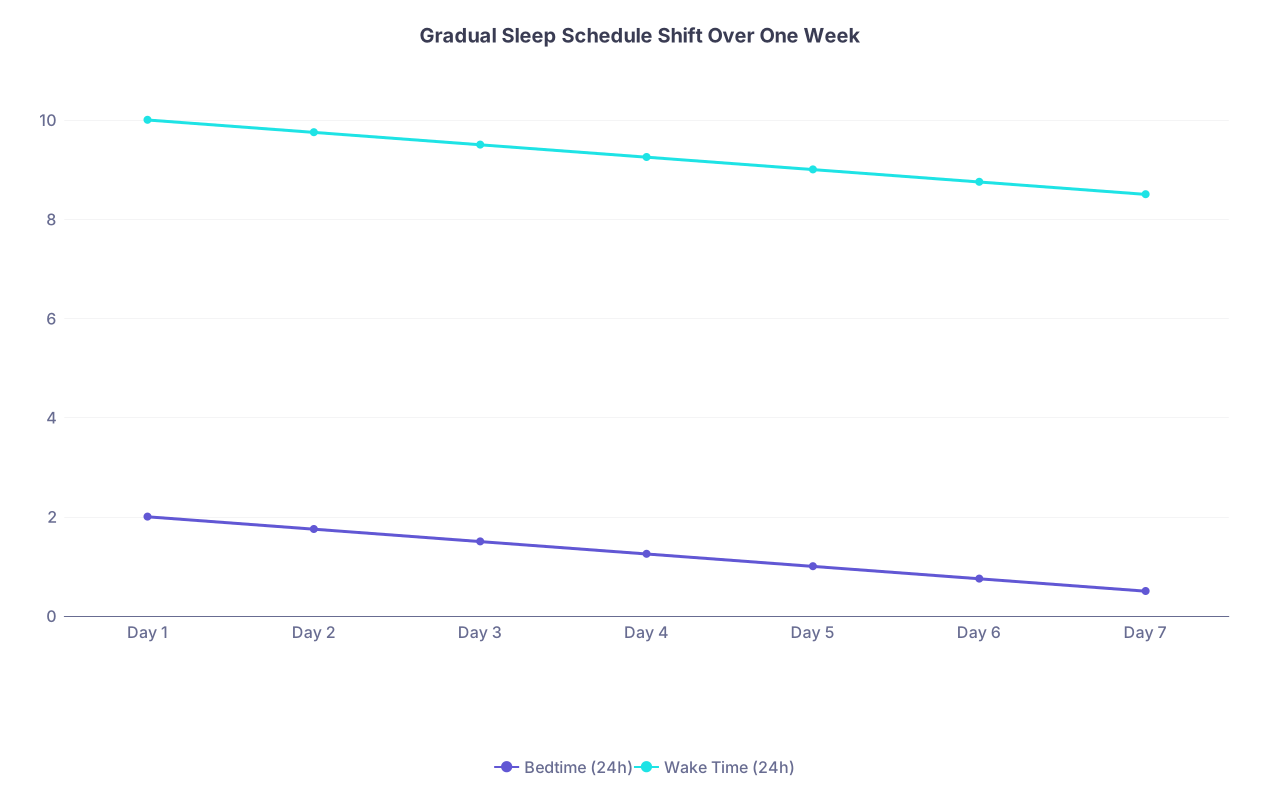
B. Shift Your Sleep Window Gradually (Not Heroically)
If you’re currently:
- Asleep ~1:30–2:00 a.m.
- Waking ~9:30–10:00 a.m.
And you suddenly demand 10:30 p.m.–6:00 a.m., you will fail. Guaranteed.
Do this instead for 1–2 weeks:
- Move bedtime 15–20 minutes earlier every 2–3 nights.
- Anchor wake-up at the desired time first, even if you’re sleepy.
Use bright light on waking (sunlight if possible, or very bright indoor lighting). Darkness + minimal screens in the hour before bed. This is physiology, not vibes.
| Category | Bedtime (24h) | Wake Time (24h) |
|---|---|---|
| Day 1 | 2 | 10 |
| Day 2 | 1.75 | 9.75 |
| Day 3 | 1.5 | 9.5 |
| Day 4 | 1.25 | 9.25 |
| Day 5 | 1 | 9 |
| Day 6 | 0.75 | 8.75 |
| Day 7 | 0.5 | 8.5 |
You’ll be groggy for a few days. That’s fine. Don’t “fix” it by oversleeping again.
Step 5: Use Behavior Tricks That Work on a Sleep-Deprived Brain
You’re not dealing with your best self at 6:30 a.m. You’re dealing with a half-conscious creature that only understands:
- Pain vs. comfort
- Immediate vs. later
- Easy vs. hard
So design around that.
A. Make Staying in Bed More Inconvenient Than Getting Out
Concrete tweaks:
- No charger within arm’s reach of the bed (phone slowly dying is a built-in motivator).
- Put your next-day clothes not on a chair you can reach from bed, but in another spot that requires standing.
- If you have a smart plug or lamp, set it to turn on at wake-up time. Bright room = harder to fall back asleep.
B. Pre-Commit Tiny Rewards
Set up small immediate rewards that you only get if you’re up on time.
Examples:
- You only buy that fancy coffee if you leave your apartment by 7:05. Miss it? Instant oatmeal at home.
- You only allow yourself your favorite podcast if you’re listening to it on the walk/commute to class, not in bed.
This sounds dumb. It works.
C. Track Like a Scientist for 2 Weeks
Don’t overdo this. Just a tiny daily log:
- Time you planned to sleep / wake
- Time you actually slept / woke
- Whether you made it to your morning obligation
- One line: “why I think today went this way”
Patterns appear quickly:
- “Every time I study in bed, I’m up till 2.”
- “Any night on call → next morning is a disaster.”
That’s actionable.
Step 6: Deal with the Mental Health Piece (Because It’s Probably There)
If you’re chronically oversleeping in med school, don’t assume it’s pure laziness. Often, under the surface:
- Depression: “What’s the point, I’m failing anyway.”
- Burnout: emotional exhaustion, cynicism, feeling detached.
- Anxiety: dread about going in, perfectionism, fear of being exposed as “behind.”
- ADHD: time blindness at night, poor transitions, impulsive “one more episode / one more reel.”
Signs this is more than a basic sleep issue:
- You wake up tired even after long sleep.
- You’ve lost interest in things you used to enjoy.
- Your appetite, concentration, or mood are off.
- You’re missing not just class, but also things you care about (gym, friends, hobbies).
What to do:
- Be blunt with counseling: “I’m not here for generic stress. I’m missing morning sessions and I need this to stop or I could fail.”
- Ask about whether meds, therapy, or both might be appropriate.
- If ADHD is on your radar (you were always the “last minute” person, time-blind, chronically late), say that out loud. Don’t dance around it.
Missing mornings might be the symptom that finally forces you to treat the underlying problem. That’s not a bad thing.
Step 7: Use Supports and Accommodations Without Shame
A lot of schools have more flexibility than they advertise. But they don’t offer it unless you ask.
Possible avenues:
Disability/Accessibility Services
If you have a documented condition (ADHD, depression, anxiety, sleep disorder), you may be eligible for:- Adjusted attendance expectations in certain courses
- Avoiding stacked super-early sessions
- Exam scheduling later in the morning
Course-Specific Fixes
- Make-up quizzes or labs
- Assigned alternative work for missed small group
- Being moved to a later section if multiple sections exist
Clerkship-Specific Tweaks
On some rotations, chiefs or coordinators are surprisingly flexible if you’re honest early:- “Can I take more late-shift coverage and fewer 5 a.m. pre-rounding days?”
- “I’m working with student affairs on a sleep/health plan; here’s my proposed schedule that still meets hours and responsibilities.”
What you do not do:
- Keep pretending it’s a one-off fluke.
- Start lying (“car trouble” every week, mythical doctor appointments).
- Ghost people. That’s how you get “professionalism concern” in your file.
Step 8: If You’ve Already Blown It – Repairing Trust
Let’s say you’ve:
- Missed multiple mandatory sessions.
- Gotten an official warning.
- Heard words like “ professionalism,” “pattern,” or “concerns going into clerkships.”
You can still repair this, but you have to be deliberate.
A. Script Your Next Conversation
You will probably sit down with a dean, course director, or advisor. You need three clear points:
Insight
“I recognize that this isn’t just about being late; it reflects on my professionalism and reliability.”Specifics (not excuses)
“What’s been happening is: I’ve been going to bed very late and then sleeping through alarms. I’d been telling myself I could handle it, but clearly I can’t.”Concrete plan
“Here is what I’m already doing:- Multiple alarms across rooms
- Set morning accountability with [person]
- Meeting with counseling on [date]
- Keeping a sleep log and aiming for midnight–7 a.m. consistent schedule
I’d appreciate your feedback on whether there’s anything else I should add.”
That’s how you look like a grown professional in training, not a drifting mess.
B. Accept Short-Term Consequences Without Drama
You might get:
- Required meeting with wellness
- Extra assignments
- A professionalism note (sometimes internal only)
- Attendance contract
Annoying? Yes. Fatal? Usually not.
What will hurt you long-term is arguing, minimizing, or making faculty chase you down repeatedly.
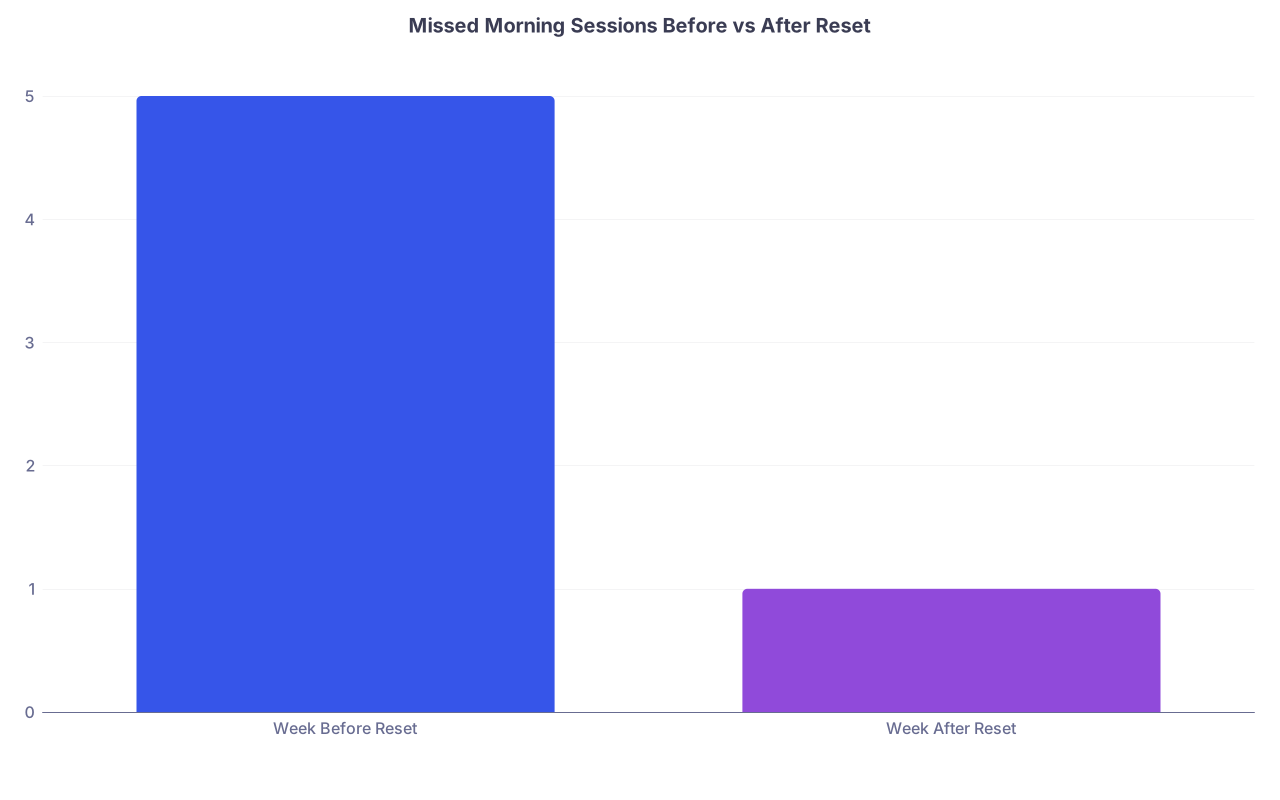
A One-Week “Reset” Plan You Can Start Tonight
Let me give you a simple, no-frills 7-day reset. Not perfection. Just getting from “I keep missing” to “I mostly show up.”
| Day | Night Focus | Morning Focus |
|---|---|---|
| 1–2 | Set alarms, pack bag, move phone | Just get out of bed + arrive on time |
| 3–4 | Bed 15–20 min earlier | Add quick breakfast/coffee routine |
| 5 | Review sleep log, adjust alarms | Aim to arrive 10–15 min early |
| 6 | Remove 1 late-night trigger (YouTube, TikTok) | Add one positive habit (walk, light) |
| 7 | Reflect: what actually helped? | Plan next week based on real data |
Stick to this like you would a patient care plan. You won’t fix everything in a week, but you’ll stop the free fall.
| Category | Value |
|---|---|
| Week Before Reset | 5 |
| Week After Reset | 1 |
When You Should Worry This Is Something Medical
Get a real medical workup (not just “I Googled it”) if:
- You snore loudly, gasp, or stop breathing at night (ask a roommate/partner).
- You wake up with headaches regularly.
- You can fall asleep almost anytime you sit down (lectures, bus, reading).
- Your legs feel creepy/crawly at night and you have to move them.
- Your sleep is extremely fragmented for no obvious reason.
Tell your PCP: “I am a med student, but I need you to treat me like a patient, not a colleague. I’m chronically oversleeping and missing professional obligations.”
If your school has a student health clinic, this is exactly what it’s for.

FAQ (Exactly 3 Questions)
1. What if I fix my schedule and still sleep through alarms?
Then you’re past “simple bad habits.” You need evaluation for:
- Sleep disorders (sleep apnea, narcolepsy, delayed sleep phase)
- Depression or other mood disorders
- Medication effects (sedating meds, antihistamines, etc.)
Bring a 1–2 week sleep log to student health or your PCP. Be explicit: “I’m missing required sessions; I need a clear diagnosis and plan, not just ‘try to sleep earlier.’”
2. Is it better to stay up all night before an early exam so I don’t oversleep?
No. That’s a panic move, not a strategy. One all-nighter compromises:
- Exam performance
- Emotional stability
- Your ability to safely get home afterward
Better approach before a big exam:
- Multiple redundant alarms + accountability person
- Sleeping at least 4–6 hours
- Napping afterward if needed, not before
You’re training for a career where you’ll be trusted with actual patients. “I didn’t sleep at all so I would show up” is not a sustainable professional pattern.
3. I’m terrified this will go in my dean’s letter. How much does this hurt residency applications?
A single rough block with some absences, honestly addressed and clearly improved, usually won’t doom you. What hurts you:
- Repeated patterns of unprofessional behavior over time
- Needing constant reminders or remediation
- Blaming others or making excuses
If you get in trouble once, fix it aggressively and document your change:
- Keep emails showing you sought help
- Maintain a simple log of attendance after the incident (to show consistent improvement)
- Talk with your dean early about how to frame this if it ever comes up
Residency directors care more about: did you learn from it, and can we trust you now? The repair work you do in the next few months answers that question.
Key points:
- Treat oversleeping like an acute, fixable systems problem, not a moral failure.
- Build hard external safeguards (alarms, people, routines) while you address the deeper causes (sleep, mental health, schedule).
- Communicate early and honestly with your school—own it, show a specific plan, and then execute.