
The story we tell about “resilient” med students is wrong. The data show most do not reach out when they need help; they reach out when they are already underwater.
What the Numbers Actually Say About Help-Seeking
Let me start with the blunt pattern that keeps repeating across studies: distress starts early, but help-seeking comes late.
Multiple large surveys from the U.S., Canada, and Europe converge on roughly the same signal:
- Around 25–35% of medical students meet criteria for depression at any given time.
- Roughly 45–55% report significant anxiety symptoms.
- Burnout levels often sit between 40–60%, depending on the year and the school.
- Actual formal help-seeking (counseling, mental health services, or physician consultation) for these problems? Usually 15–25%.
That gap—call it the “silent 20–30%”—is where the real risk lives. Students who are significantly unwell but are not in treatment.
More interesting than the simple gap, though, is when students finally decide to get help. The data are pretty consistent: help-seeking spikes at predictable pressure points in the training timeline, and not necessarily when symptoms first appear.
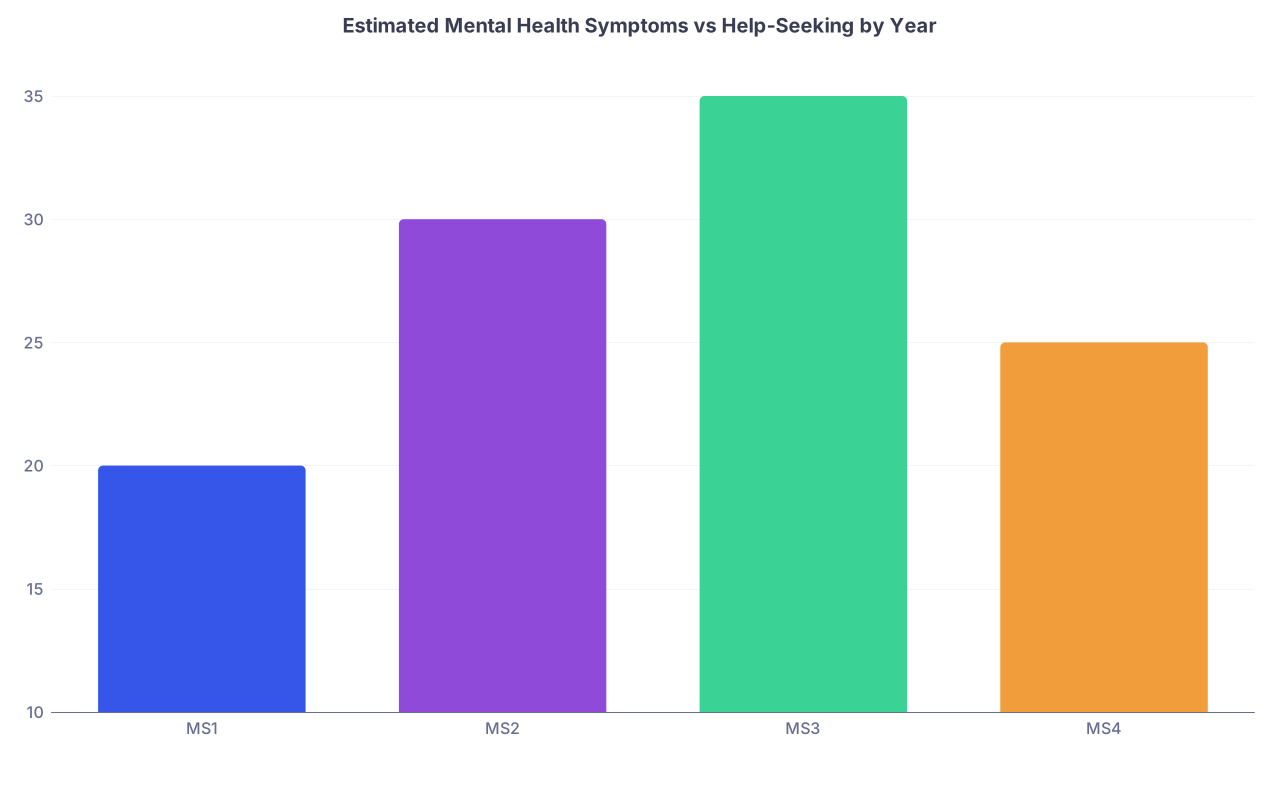
| Category | Value |
|---|---|
| MS1 | 20 |
| MS2 | 30 |
| MS3 | 35 |
| MS4 | 25 |
You can read that bar chart in a simple way: distress rises from MS1 to MS3 and slightly falls in MS4. Actual help-seeking tends to track lagged behind those symptom curves, with students often waiting months—or years—from onset to first contact.
Let’s break the patterns down more granularly.
Timepoints: When Students Actually Reach Out
If you map help-seeking behavior against the medical school calendar, you get clear peaks. I have seen this in campus counseling utilization data more times than I can count.
| Phase / Trigger Point | Relative Help-Seeking Level |
|---|---|
| First 2–3 months of MS1 | Moderate peak |
| 1–3 months before Step 1/Level 1 | High peak |
| Immediately after major board exam | Small secondary peak |
| First 2–3 months of third-year clerkships | Very high peak |
| Interview season / Match uncertainty | Moderate peak |
Early MS1: Identity Shock, Not Yet Burnout
The data show a noticeable rise in counseling utilization and peer-support usage in the first semester of MS1, usually between weeks 4 and 10.
What is driving it is not severe pathology yet. It is:
- Impostor feelings: “Everyone here is smarter than me.”
- Transition stress: new city, new role, new social group.
- Workload shock: going from undergrad control to firehose.
Surveys that ask why students reached out during MS1 generally find themes like anxiety and adjustment more than depression or suicidality. Severity scores (PHQ-9, GAD-7) are often in the mild-to-moderate range. The students who reach out here are disproportionately those who were already help-seekers before med school (prior therapy, prior diagnoses). They are “trained” to reach out.
Translation: early help-seeking is mostly done by students who already recognize mental health care as normal. The majority simply white-knuckle their way through and normalize chronic stress.
Pre-Board Exam Phase: Help-Seeking Under Duress
The run-up to Step 1 / Level 1 (or equivalent big exam) is the single clearest spike in distress metrics. You see:
- Sleep disturbance rates jump sharply.
- Self-reported anxiety often exceeds 60–70% in some surveys.
- Use of performance-enhancing substances (stimulants, energy drinks) climbs.
Yet, formal help-seeking only increases substantially when a threshold is crossed—usually when performance data show a real threat.
The typical pattern I have seen in utilization data:
First few months of board studying:
- Steady but not extreme counseling demand.
- Main themes: anxiety, perfectionism, inefficiency, procrastination.
4–8 weeks before the exam:
- Sharp spike in new intakes, often crisis-driven:
- Failing practice tests.
- Score plateau far below target.
- Panic attacks.
- Symptom severity: more moderate-to-severe depression and anxiety.
- Sharp spike in new intakes, often crisis-driven:
Most med students will not seek help when they start to struggle with content volume. They will seek help when an NBME score or QBank percentile gives them numerical proof of failure risk. Numbers move them more than feelings.
Quantitatively: if 30% of a class meets criteria for clinically significant anxiety before Step 1, only about 20% of those will have engaged with formal mental health care in the months leading up to dedicated study. A much larger portion will surface in the last 4–6 weeks in crisis mode.
It is reactive utilization, not preventive.
Immediately After Big Exams: The Crash
The week after a major exam shows a smaller, but very distinct, bump in help-seeking. Different driver: collapse after tension release.
Common features in student reports:
- “I held it together until the exam, then I fell apart.”
- Emotional numbing or derealization.
- Sleep pattern disruption when the rigid schedule evaporates.
- Emergence or worsening of depressive symptoms.
There is also the “delayed realization” phenomenon: students ignore how bad they feel because “I just have to make it to the test.” Once that anchor disappears, there is nothing holding the structure up.
This group is often undercounted because they sometimes do not label it as a mental health issue. They frame it as “motivation problems,” “exhaustion,” or “post-exam slump.”
But if you actually screen them with standardized instruments, many of them hit moderate depression or anxiety thresholds.
Beginning of Clerkships: The Steepest Spike
If I had to pick one phase where help-seeking jumps sharply and consistently, it is the first several months of third year.
Raw drivers:
- Role change: from classroom to clinical environment.
- Loss of control over schedule.
- Sleep deprivation and on-call stress.
- Evaluation anxiety: constant impression management.
In multiple institutional data sets:
- Overall counseling visits per month increase by 30–60% compared to late MS2.
- Proportion of students reporting burnout escalates rapidly.
- Students present with a mix of anxiety, demoralization, and early moral injury.
Here you see a different pattern in “when” they reach out. It is very tied to bad feedback:
- Negative comments on evaluations.
- Being directly or indirectly shamed by residents or attendings.
- Failing (or nearly failing) a shelf exam.
An anecdotal but consistent story: Students often tolerate extreme hours and emotional strain as long as they believe they are performing adequately. The moment evaluations suggest they are “behind,” many cross from internalizing the struggle to seeking help. Again: performance metrics act as a behavioral trigger.
Help-seeking here is less optional. Some students are referred by faculty or deans after repeated performance issues. In utilization logs, those referrals often correlate with more severe distress and impairment at first presentation.
Interview Season and Match Anxiety: Anticipatory Fear
Later in MS4, distress overall often declines compared to MS3. But there is a very focused bump around:
- The weeks between interview invites and actual visits.
- The 2–4 weeks before rank lists are due.
- The stretch between submitting ranks and Match Day.
The data: You see more situational anxiety, catastrophic thinking, and sleep disruption. Help-seeking here is more voluntary and less crisis-driven than pre-boards or early clerkships.
A meaningful fraction of students finally reach out in MS4 not because they are at their worst, but because they finally have enough breathing room to notice how long they have been operating in “barely coping” mode.
From a numbers vantage point, this is late but still useful. Students who get connected in MS4 have better odds of carrying healthy habits into residency. But again, this is post-hoc repair, not early prevention.
Why Students Wait: Barriers You Can Actually Quantify
You cannot talk about help-seeking patterns without mentioning the barrier data. Surveys of med students consistently show three or four dominant deterrents:
- Fear of impact on future licensing or credentialing (often overestimated).
- Concern about stigma from peers, faculty, or program leadership.
- Time constraints and logistical hassles.
- Belief that their symptoms are “not severe enough” or “just part of med school.”
What the data show quite clearly is that these barriers affect when students seek help almost as much as if they do.
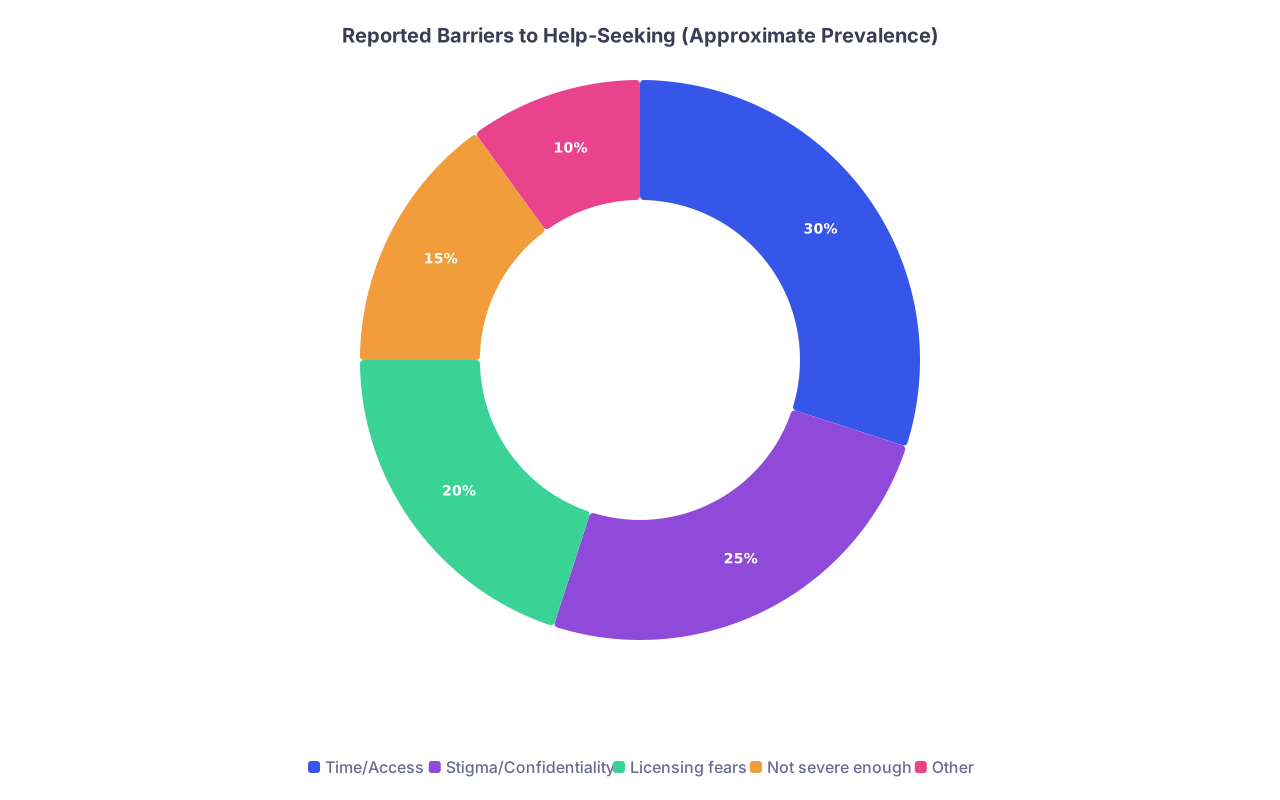
| Category | Value |
|---|---|
| Time/Access | 30 |
| Stigma/Confidentiality | 25 |
| Licensing fears | 20 |
| Not severe enough | 15 |
| Other | 10 |
Time and access constraints are obvious. The more locked down the clinical schedule, the less likely students are to attend regular therapy visits. You can see that statistically:
- Pre-clinical years: more flexibility → higher chance of scheduled weekly sessions.
- Clinical years: more irregular, crisis-style visits and single consults.
Licensing fears are more insidious. Many students delay help-seeking for years because they believe that disclosing treatment will harm them. The evidence that routine treatment for manageable conditions torpedoes a career is weak, but perception outruns reality. Behavior follows perception.
Then there is the “not severe enough” bias. If you ask students with PHQ-9 scores in the moderate range why they have not sought help, a large subset say some variant of: “Others have it worse,” or “This is just normal stress; I should handle it.”
The result: students do not treat rising symptom curves as signals. They wait for a dramatic crash—panic attack, failed exam, significant relationship breakdown—before accepting that it “counts” as a mental health problem.
Who Reaches Out (and Who Stays Silent)
Help-seeking is not evenly distributed. Certain subgroups of students are statistically more likely to reach out, and others underutilize services despite high distress.
Patterns seen across multiple data sets:
Students with prior mental health treatment:
Far more likely to engage again. Prior positive experiences reduce friction. They tend to present earlier in symptom progression.Women and non-binary students:
Consistently higher reported rates of both distress and help-seeking, compared to men. The gap is especially large for internalizing symptoms and formal counseling utilization.International or URM (underrepresented in medicine) students:
Complex picture. Often higher or similar distress, but mixed help-seeking. Stigma, cultural expectations, and distrust of institutional systems can all depress utilization, even when risk is high.“High-achiever perfectionists”:
High distress, often high functioning until they break; tends to be late help-seeking, triggered by a concrete failure. They frequently come in with language like “I have never failed at anything before; I do not know how to handle this.”
This creates a biased sample in student mental health services. You mainly see:
- Those comfortable with the idea of therapy.
- Those who have experienced enough performance or relational damage to override their avoidance.
The ones you worry about most—chronically distressed, overcompensating, afraid of any sign of “weakness”—are heavily underrepresented. On paper, they are at high risk for burnout, substance misuse, or leaving medicine entirely. In the clinic logs, they barely appear.
What the Patterns Mean for Interventions
If you treat help-seeking as a random, individual decision, you miss the point. The patterns are systematic and predictable. That is good news: it gives you leverage.
Here is the blunt way I interpret the data:
- Students do not seek help when they “should”; they seek help when pain crosses a personal or professional threshold.
- The thresholds are often defined more by performance fear (scores, evaluations, match prospects) than health awareness.
- The calendar drives behavior. You can anticipate when and how big the spikes will be.
That leads to some concrete strategic insights.
Intervention Windows Are Not Uniform
If you want to increase timely help-seeking, you do not push generic “mental health resources” messaging year-round and hope for the best. You align targeted offers with the moments students are closest to the tipping point.
Rational timing:
Orientation / early MS1:
Normalize help-seeking, especially by having upperclass students and faculty share specific, non-sanitized stories of using services. Get “prior treatment” from a stigma flag to a normal trait.3–4 months before boards:
Proactive outreach integrated into academic advising. Screen for distress and performance anxiety, not just raw scores. Offer low-friction consults with both learning specialists and mental health professionals.Onset of clerkships:
Build brief, embedded supports into rotation design—e.g., scheduled small-group debriefs, guaranteed access to confidential check-ins, clear reporting channels for mistreatment. Assume that a fraction of students will be near their breaking point.Pre-Match and mid-MS4:
Focus on anticipatory anxiety management and transition to residency. Help students set up continuity of care rather than waiting for them to fracture in PGY1.
Data-Driven Thresholds, Not Guesswork
You can use simple metrics to identify when to escalate outreach:
- Sudden drop in academic performance or practice scores.
- Uncharacteristic absenteeism or repeated professionalism concerns.
- Dramatic change in engagement patterns (e.g., previously active, now withdrawn).
These do not replace clinical evaluation, but they do signal that a student has probably already hit personal distress thresholds. Waiting for them to self-refer is, frankly, negligent.
Reduce the Transaction Cost of Asking for Help
The data show that even small logistical barriers suppress utilization. You increase help-seeking by:
- Offering protected time blocks (especially in MS3) for health appointments.
- Providing low-intensity, low-commitment entry points: 1–2 session consults, drop-in hours, online screening with immediate follow-up.
- Making confidentiality rules and licensing implications extremely clear, repeatedly, with concrete examples rather than vague reassurance.
Ideally, you want a student in crisis to go from “I should talk to someone” to actually having a scheduled contact in under 24–48 hours. Not “submit a web form and wait 3 weeks.”
If You Are a Med Student Reading This
I am not going to tell you to “ask for help early” as if that magically overrides the culture you are in. The data say you probably will not, unless:
- Something measurable (scores, evals) scares you badly, or
- Someone you trust models and validates help-seeking in a way that cracks your internal narrative.
What you can do, pragmatically:
- Treat sustained changes in sleep, mood, or function as data, not character flaws. If the “trend line” has been going in the wrong direction for 4–6 weeks, that is enough. You do not need to wait for a collapse.
- Notice when performance fear is the only thing stopping you. If the only reason you are avoiding care is “What will this look like later on my record?”, realize you are trading short-term image management for long-term risk.
- Use low-friction options first: a single consult, peer support, a brief screening. You do not have to sign up for weekly therapy forever to start.
Because the pattern in the aggregate is simple and brutal: most students wait too long. And by the time they finally walk into an office, the symptom severity graph is already near the top of the y-axis.
The Short Version: What the Data Really Show
Three points to carry out:
Help-seeking among med students is not random. It clusters tightly around high-stakes exams, evaluation shocks, and major transitions, and it usually lags months behind symptom onset.
Barriers—stigma, licensing fears, time constraints, and the belief that “this is just normal stress”—push students from early, preventive help into late, crisis-driven help. The most distressed are often the least likely to reach out.
If you align supports with predictable pressure points, reduce the friction of accessing care, and treat performance data as early warning signals, you can shift the pattern. From last-ditch rescue to timely intervention. That is the real leverage the numbers give you.