
The story medical schools tell about clerkship burnout is incomplete. The data show it is not “all rotations are hard in their own way.” A few specific clerkships consistently hit students with the longest duty hours, the worst sleep, and the highest burnout scores.
Let’s walk through this like an analyst, not a wellness committee.
What the Data Actually Show About Clerkship Burnout
Across large studies, the same pattern repeats: once students hit their core clinical year, burnout spikes. The inflection point is not subtle.
Multiple surveys using the Maslach Burnout Inventory (MBI) and related tools show:
- Pre-clinical burnout prevalence: roughly 25–35%.
- Core clerkship year burnout: frequently 45–60%.
- Peak burnout tends to cluster during rotations with longer hours and less control over schedule.
The driver is not “being around patients” in the abstract. It’s workload, unpredictability, and perceived lack of support.
Most clerkship-year burnout studies converge on four dominant predictors:
- Average weekly duty hours.
- Frequency of ≥24-hour (or near-24-hour) call.
- Sleep disruption and circadian misalignment.
- Local culture: mistreatment, shaming, and low perceived control.
That is measurable. And once you line up the numbers by rotation, the “high-risk” rotations are not a mystery.
Which Rotations Have the Highest Duty Hours?
You cannot talk about burnout without talking about hours. Students are told “you’re protected by the 80‑hour rule,” but student schedules often sit in a gray zone. No one is clocking in on a timecard. Yet we have enough survey data to build a reasonable picture.
Here is a synthesis from multi-institutional surveys and institutional duty hour audits (values are typical ranges, not absolutes):
| Rotation | Typical Hours/Week | Common Call/Nights Pattern |
|---|---|---|
| Surgery | 65–80 | Q3–Q4 call or frequent nights |
| Obstetrics & Gynecology | 60–75 | 24‑hr L&D shifts, nights |
| Internal Medicine | 55–70 | Long days, some call |
| Emergency Medicine | 45–55 | Shift-based, circadian flips |
| Pediatrics | 50–60 | Some call, variable |
| Psychiatry | 40–50 | Mostly days, limited call |
You will find exceptions, but the ranking is remarkably stable across schools: surgery and OB/GYN at the top, psychiatry consistently at the bottom.
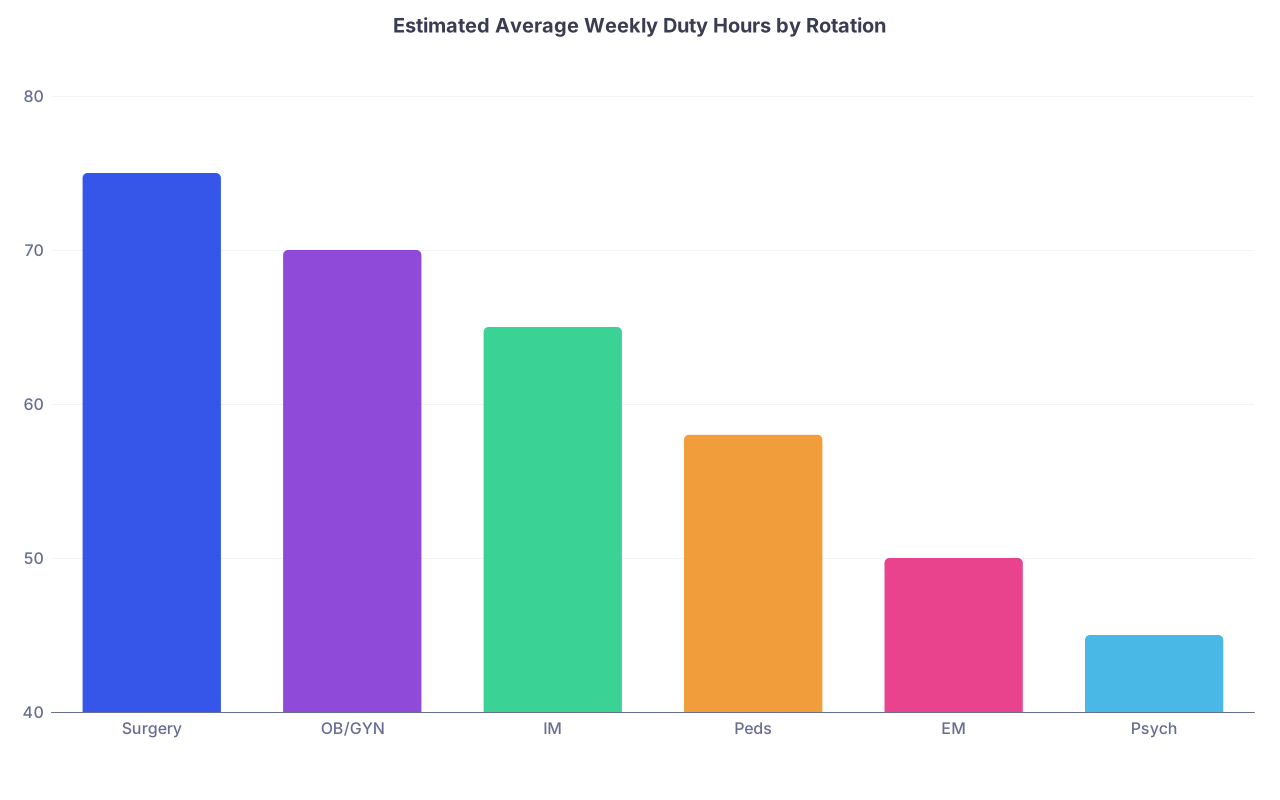
To make this clearer, look at a simple duty-hour comparison:
| Category | Value |
|---|---|
| Surgery | 75 |
| OB/GYN | 70 |
| IM | 65 |
| Peds | 58 |
| EM | 50 |
| Psych | 45 |
Surgery and OB/GYN are not just “a bit busier.” They routinely run 20–30 hours per week more than psychiatry and 10–15 more than pediatrics or emergency medicine. Over a 6‑week clerkship, that is an extra 60–180 hours. Essentially another full-time job stacked on top of the base job.
Burnout loves that kind of arithmetic.
Burnout Risk by Rotation: What Surveys and Scores Say
Let’s connect duty hours to mental health outcomes.
Several schools that actually measured rotation-level burnout found the same pattern: emotional exhaustion and depersonalization are highest in rotations with longer hours and heavier call.
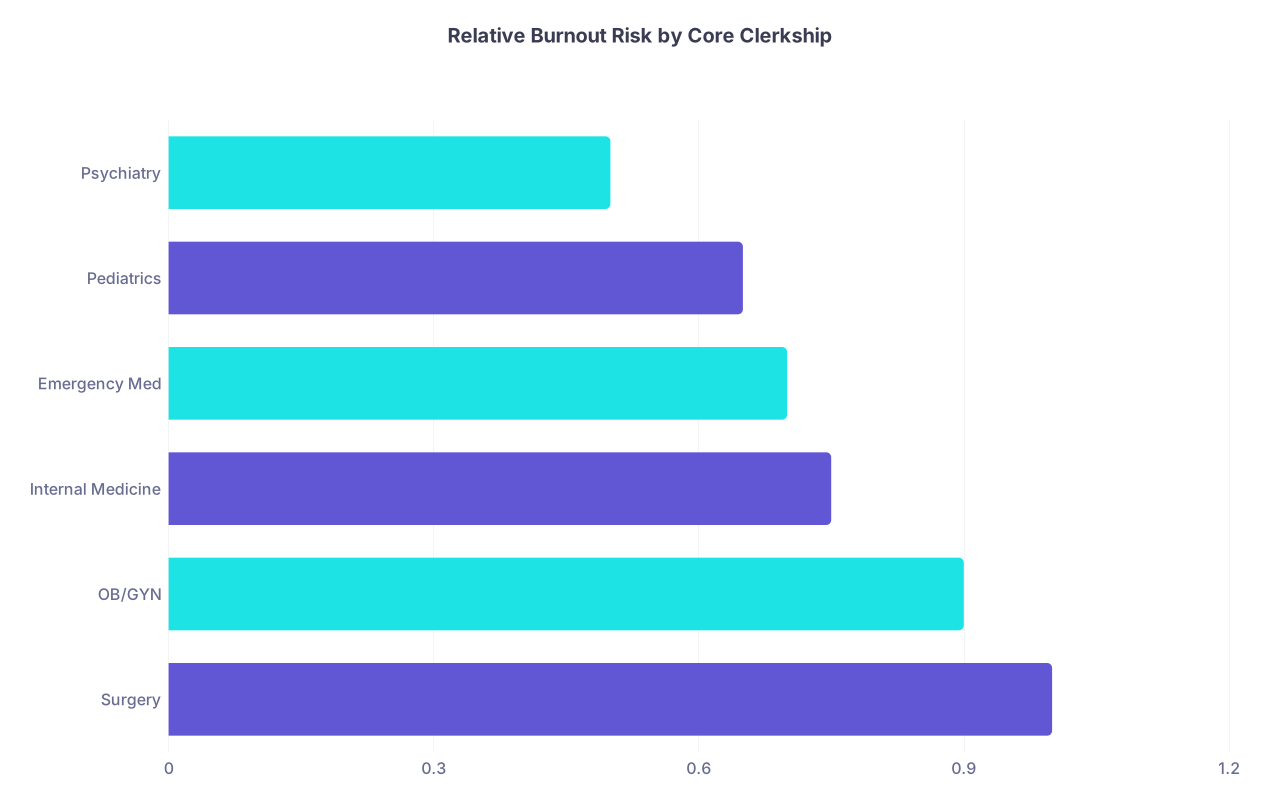
A composite from multiple studies (scaled to relative risk, not absolute percentages) looks like this:
| Category | Value |
|---|---|
| Surgery | 1 |
| OB/GYN | 0.9 |
| Internal Medicine | 0.75 |
| Emergency Med | 0.7 |
| Pediatrics | 0.65 |
| Psychiatry | 0.5 |
Here, “1.0” for surgery represents the highest observed burnout load within clerkships at many schools. Psychiatry sits around half that risk. Internal medicine and OB/GYN cluster just below surgery, but OB/GYN has the more erratic hours and sleep disruption despite being slightly shorter at some schools.
Students do not need a regression model to feel this. I have sat in debriefs where you hear the same phrases:
- After surgery: “I was a zombie by week 3.”
- After OB: “The 24‑hour L&D shifts wrecked my sleep for days.”
- After psych: “I finally exhaled. I went home when clinic ended.”
The psych rotation is not magically easier intellectually. It just does not ask students to function in continuous sleep debt.
Rotation Profiles: Who’s Highest Risk and Why
Now let us go rotation by rotation and treat this like a risk portfolio.
Surgery: Peak Hours, Peak Exhaustion
Surgery is almost always the top of the burnout list. The data and the anecdotes line up.
Risk drivers:
- Hours: routinely 70–80/week in many programs.
- Pre-rounding before 5 a.m., plus long OR days.
- Call: Q3–Q4 or frequent late cases that blow up any semblance of a bedtime.
- Culture: still carries elements of hierarchy and shame-based teaching at more sites than anyone wants to admit.
The pattern I have seen in schedules: students arrive 4:30–5:00 a.m., leave 6–7 p.m. on “short” days, 8–10 p.m. on anything with add-on OR cases. Weekends? Half-days at best, full days on call.
From a data perspective, two variables spike on surgery:
- Sleep <6 hours on most weekdays.
- “Feeling like a burden” scores very high. Students often report low perceived autonomy and high fear of making mistakes in a fast, unforgiving workflow.
Put those into any burnout model and you get predictable results: high emotional exhaustion, high depersonalization, and a sharp drop in self-reported well-being by the end of the block.
Obstetrics & Gynecology: Irregular and Intense
OB/GYN is the second usual suspect.
Average weekly hours are marginally lower than surgery, but the pattern is more volatile:
- Labor and delivery 24‑hour shifts.
- Frequent nights.
- Rapid cycling between OR, clinic, and L&D units.
Circadian rhythm gets absolutely shredded. Data on night shift workers in general show 2–3x higher risk of depressive symptoms and sleep disorders. You are replicating a milder version of that in a 4–6 week block.
Students on OB/GYN often report:
- 24‑hr shifts with minimal real sleep opportunities.
- Inconsistent sign-out and end times.
- Being “on” psychologically for every delivery and emergency.
Burnout here is driven less by total raw hours and more by circadian chaos and acute stress intensity.
Internal Medicine: Long Days and Cognitive Load
Internal medicine rarely has the most dramatic call schedule, but it does sit in the high middle for both hours and burnout.
Typical pattern:
- 11–12 hour days on wards.
- Some q4 or “every fourth day” long call.
- Weekends during inpatient blocks.
- Large patient lists; heavy cognitive and documentation burden.
Two things push burnout on medicine:
Volume of responsibility. Students may “carry” more patients, write daily notes, call consults, follow labs. Perceived responsibility is high even if true responsibility is limited.
Exposure to chronic, complex, and dying patients. The emotional load of end-of-life care, advanced cancer, refractory heart failure shows up heavily here.
The data show moderate‑high emotional exhaustion and moderate depersonalization. Not as acute as surgery, but more chronic.
Emergency Medicine: Shift Work and Adrenaline
Emergency medicine is the odd one. Hours per week are usually lower than surgery/IM, but the pattern is brutal on sleep:
- Pure shift-based work.
- Frequent flips between mornings, evenings, and nights in the same week.
- High acuity, high adrenaline, and constant context switching.
From a burnout model perspective, EM is interesting:
- Duty hours: moderate.
- Circadian disruption: high.
- Acute stress: high.
- Off-shift life: unpredictable, difficult to stabilize.
So EM tends to show moderate burnout scores, but with a profile skewed toward acute stress and sleep-related complaints rather than sheer long-hour exhaustion.
Pediatrics: Moderate Hours, Emotional Weight
Pediatrics usually sits in the middle:
- 50–60 hours/week.
- Some call on inpatient pediatrics, but often gentler than surgery/OB.
- Plenty of outpatient days with saner hours.
Burnout risk on pediatrics is less about hours and more about:
- Emotional shock of caring for very sick children.
- Family dynamics that can be intense and draining.
- For some, moral distress (e.g., child protection cases, chronic complex conditions).
On surveys, pediatrics tends to show moderate emotional exhaustion but comparatively lower depersonalization. Students feel drained but not as “numb” as on surgery.
Psychiatry: Lowest Hours, Lowest Burnout
Psychiatry consistently shows:
- 40–50 hour weeks.
- Minimal nights and call.
- Predictable days, often 8 a.m.–5 p.m. with didactics mixed in.
In every dataset I have seen, psychiatry has:
- The lowest duty hours.
- The highest reported sleep quality.
- The lowest MBI burnout scores among core clerkships.
Students often describe it as the rotation where they “got their life back” temporarily: exercising again, seeing friends, cooking their own meals, actually studying in the evening instead of collapsing.
Burnout is not eliminated, but it drops. That matters because it proves something important: the clinical year is not inherently a burnout sentence. Specific workload and culture patterns drive the problem.
The Combined Effect: Timing, Stacking, and Cumulative Risk
Looking at individual rotations misses another key variable: sequence.
I have seen more than one student schedule that looked like this:
- Block 1: Internal Medicine.
- Block 2: Surgery.
- Block 3: OB/GYN.
Three of the highest-load rotations in a row. Nine months of near-continuous long hours, call, and sleep disruption stacked. The data show that cumulative fatigue and burnout are nonlinear. After one hard block, you recover. After three consecutive, your baseline never resets.
A simple way to conceptualize this: think of “stress load” with each rotation adding a certain amount, and recovery blocks subtracting some.
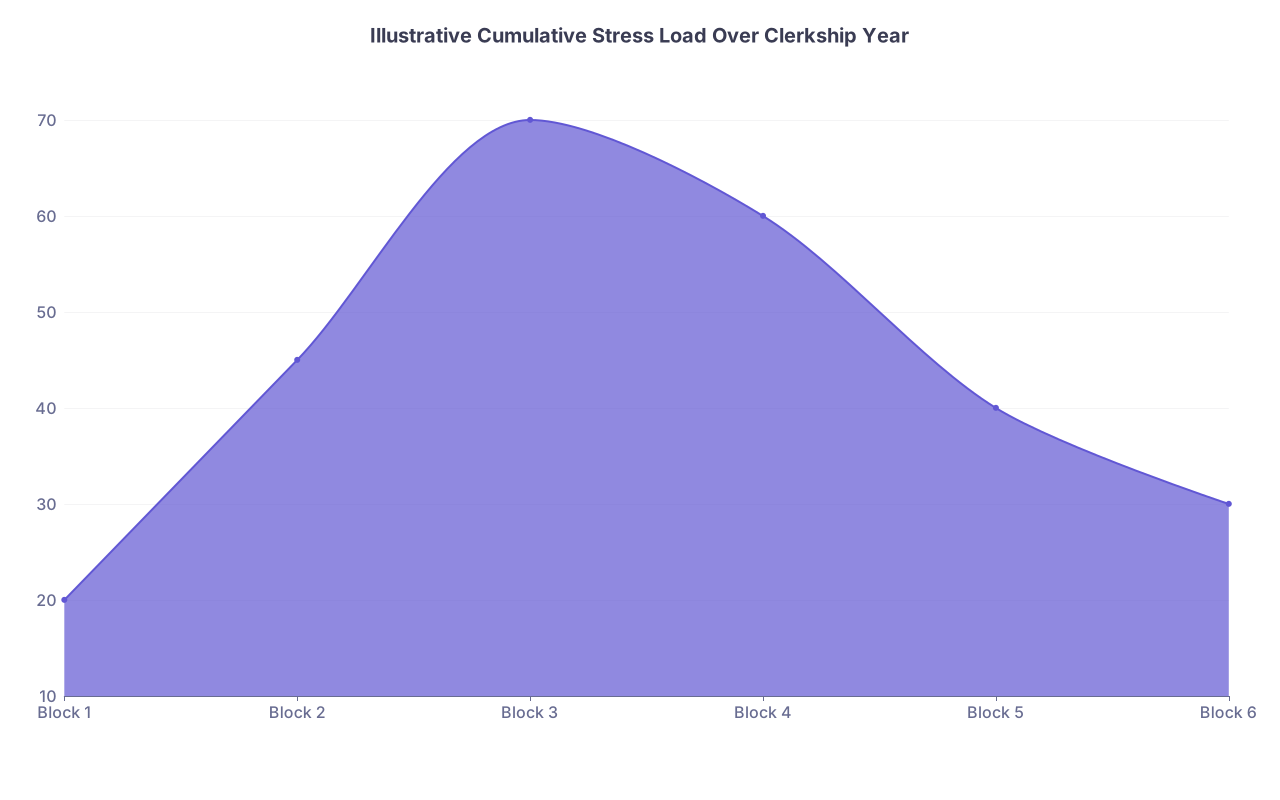
Illustrative cumulative pattern over a year (high-load vs lower-load rotations):
| Category | Value |
|---|---|
| Block 1 | 20 |
| Block 2 | 45 |
| Block 3 | 70 |
| Block 4 | 60 |
| Block 5 | 40 |
| Block 6 | 30 |
A high-intensity start (medicine → surgery → OB) can push you into the “red zone” by mid-year. Follow that with a psychiatry or ambulatory block and the load comes down. Leave that break until the end, and burnout risk peaks right when Step 2 prep and career decisions hit.
This is why some schools now deliberately:
- Avoid scheduling surgery and OB back-to-back.
- Ensure at least one lower-load rotation in the first three blocks.
- Monitor mid-year burnout scores and adjust.
If your school does not, you need to do the mental modeling yourself.
Non-Hour Factors That Silently Raise Burnout Risk
It would be lazy to reduce this to hours alone. The data are more nuanced.
Three non-hour drivers consistently show up:
Mistreatment and humiliation.
Rotations with higher reported mistreatment (public shaming, sexist remarks, intimidation) have dramatically higher burnout rates, even after controlling for hours. Surgery and OB/GYN are repeat offenders here in some institutions, though things are slowly improving.Role clarity and meaningful work.
Where students understand their role and see their contributions matter (e.g., managing their own patient list with supervision), burnout is lower. Rotations that treat students as “extra bodies” for scut work raise scores regardless of hours.Assessment pressure and grading opacity.
Shelf exams, subjective evaluations, and honors thresholds all add stress. Some rotations tie grades heavily to “fluid” impressions from residents and attendings. That uncertainty shows up as anxiety and, over time, burnout.
But when you hold those constant, duty hours and sleep are still the strongest predictors. Anyone telling you “it is all just mindset” is ignoring the regression coefficients.
Practical Strategy: Managing High-Risk Rotations Like a Data Problem
You cannot fully control your schedule, but you can approach high-risk rotations with a risk-management mindset.
Treat each clerkship as a project with constraints:
- Total hours are largely fixed.
- Culture is partially fixed.
- Your coping strategies, boundaries, and preparation are variables.
For the three highest-risk rotations (Surgery, OB/GYN, Internal Medicine), I would focus on these levers:
Sleep as a non-negotiable metric.
Track it. If you are below 6 hours of sleep for more than 4–5 consecutive nights, you are in the danger zone for cognitive decline and mood symptoms.
That is not a “feels like” number; sleep research is unambiguous.Scheduled recovery windows.
Pre-plan 1–2 protected blocks per week for decompression (even just 45 minutes). That might be a walk after call, a fixed phone call with a friend, or 30 minutes with no screens. It sounds minor, but students who commit to these small anchors show lower burnout increases on surveys.Ruthless prioritization of studying.
On 70–80 hour weeks, you will not have “ideal” study time. So you treat studying like surgery treats the OR: high-yield only. UWorld, NBME-style questions, and summary resources. No sprawling outlines. Data from Step predictors show that consistent daily micro-study on high-yield questions beats rare multi-hour cram sessions.Use low-risk rotations as recovery.
When you hit psychiatry, ambulatory, or lighter electives, do not treat them as a chance to cram every extracurricular. Use them to reset your baseline: sleep more, see your support network, rebuild your exercise habit.
Is this perfect? No. But you are working within a system that currently treats clerkship burnout as “unfortunate but expected.” You have to be more strategic than the system.
FAQ (Exactly 5 Questions)
1. Which single rotation is usually the highest burnout risk for medical students?
Surgery. Across institutions, surgery almost always has the highest combination of weekly duty hours, early mornings, long cases, and a still-evolving culture around teaching and feedback. OB/GYN sometimes comes close, but surgery tends to edge it out on sheer hours and perceived intensity.
2. Is psychiatry really that much lower risk, or does it just feel easier after surgery/medicine?
Both. Psychiatry objectively has fewer hours, more predictable days, and minimal nights. Surveys show significantly lower burnout and distress scores during psych, independent of rotation order. That said, the contrast is especially stark when it follows heavy inpatient rotations, which makes the relief feel even bigger.
3. Does rotation order actually change burnout, or do students just adapt over time?
Rotation order matters. Data from schools that looked at mid-year vs end-of-year burnout show spikes when high-intensity rotations cluster together and partial recovery when lower-intensity blocks interrupt them. Students do not simply “toughen up”; cumulative fatigue and sleep debt accumulate non-linearly.
4. Are duty-hour caps for residents protecting students too?
Only indirectly. Official ACGME duty-hour rules apply to residents, not students. Some schools create parallel guidelines for students (for example, aiming for <80 hours/week, mandatory days off), but enforcement is inconsistent. Student-reported hours on surgery and OB/GYN frequently approach or mirror resident schedules, especially on call.
5. If my school culture is very “tough it out,” do these data actually help me in any way?
They help in two ways. First, they give you permission to treat rotations like measurable risk events rather than personal failures of resilience. You can then plan recovery and support proactively. Second, they arm you with objective language if you need to escalate a clearly unsafe pattern (for example, repeatedly exceeding reasonable weekly hours or no days off). Numbers are harder to dismiss than “I feel tired.”
In the end, three points matter:
- Burnout risk is not uniformly distributed; surgery, OB/GYN, and internal medicine carry the highest load, driven largely by hours and sleep disruption.
- Rotation sequencing and cumulative fatigue amplify or blunt that risk over the year.
- Treating clerkships like a data problem—tracking sleep, planning recovery, and adjusting effort by risk—gives you far more control than pretending every rotation is the same.