
What if the one day you completely fell apart is the only thing anyone will ever remember about you?
The Fear You’re Not Saying Out Loud
Let me guess the reel running in your head:
“That OSCE where I froze and almost cried. That NBME I bombed after barely sleeping. That day I had a panic attack before the shelf. That one meltdown in front of my attending. That’s it. That’s what I’ll be known for. That’s who I really am.”
And underneath that:
“If I were actually cut out for this, I wouldn’t break like that. Real med students just grind through it.”
You’re not crazy for thinking this. Med school is basically a pressure cooker built on perfectionism and selective memory. People remember your worst moment far more vividly than your hundred average days. Or at least it feels that way.
Let me be blunt: your brain is lying to you. But it’s lying in a very convincing, very detailed way.
Let’s pull it apart.
What “One Breakdown” Actually Looks Like in Med School
I’m not talking about some vague “stress.” I mean the stuff you probably don’t tell anyone or else you downplay it to a joke.
- You cried in the bathroom between OSCE stations and had to splash water on your face before going back in.
- You blanked on a super basic Step-style question and spiraled so hard you physically shook during the rest of the exam.
- You got feedback that you seemed “overwhelmed” and “not confident” during your surgery clerkship and you still hear those exact words at 2 a.m.
- You had an actual panic attack in the call room and then immediately went back to pre-rounding like nothing happened.
- You emailed an attending to say you were “sick” when the truth was you couldn’t stop crying long enough to safely drive in.
And now you’re terrified that this is:
- In your dean’s letter.
- A permanent red flag in your “file.”
- The story attendings tell each other: “Yeah, that student who couldn’t handle it.”
- A preview of residency: you, breaking all the time, everyone regretting they chose you.
Here’s the part no one tells you when you’re in the middle of that shame spiral:
Almost everyone around you has had some version of that same movie. They just don’t air it publicly.
How Much Do People Actually Remember About You?
You’re convinced your breakdown is burned into everyone’s memory in 4K. It’s not.
Let me show you how people’s memories actually work in med school.
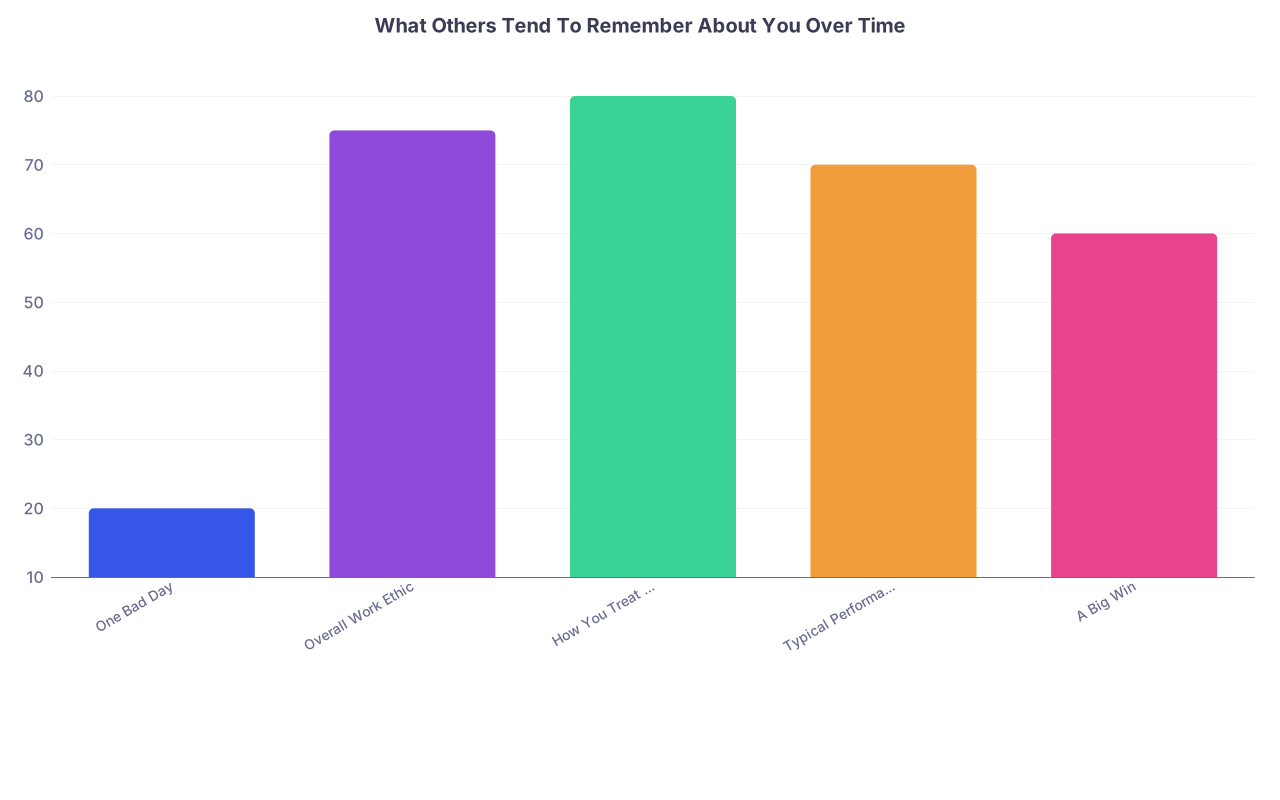
| Category | Value |
|---|---|
| One Bad Day | 20 |
| Overall Work Ethic | 75 |
| How You Treat Others | 80 |
| Typical Performance | 70 |
| A Big Win | 60 |
Is that exact data from a study? No. It’s just reality from watching how attendings and residents talk about students:
- “She was solid, always prepared, great with patients.”
- “He was a bit checked out, hard to read.”
- “Very kind. Nurses liked him.”
- “Really bright but sometimes scattered.”
Do you hear it? Patterns. Averages. Themes. Not:
“On November 2nd, during week 3 of internal medicine, she cried for 10 minutes.”
I’ve seen attendings give glowing comments about students who had obvious rough days. I’ve also seen students who never once “broke down” still get mediocre comments because their everyday behavior wasn’t great.
Your breakdown is not the full dataset. It’s an outlier. Your fear is that everyone is using that outlier as the mean. They’re not.
The Story You’re Telling Yourself vs The Story Others See
Here’s what your brain does:
- “I had a panic attack before that exam” → “I can’t handle pressure.”
- “I broke down after getting harsh feedback” → “I’m too sensitive for medicine.”
- “I missed one day because I mentally couldn’t function” → “I’m unreliable and weak.”
Meanwhile, what other people usually see is way more boring:
- You missed a day → “Student called out, probably legit. Back tomorrow.”
- You seemed off one week → “They looked stressed. Med school is rough.”
- You cried during feedback → “That hit them hard. Hopefully they’re okay.”
You’re turning one chapter into the title of the entire book. Most people don’t even read that closely.
I’ve watched a resident rip into a student during rounds, then later say, “They’re actually doing fine, just needed some push.” The student, on the other hand, spent weeks convinced they were seen as incompetent.
The emotional weight of an event for you is not equal to the professional weight of that event for others. Your heart is carrying 100 pounds; their memory is carrying maybe 5.
But What If It Is On Your Record?
Let’s talk worst-case, since your brain is already living there.
Maybe you:
- Took a leave of absence for mental health.
- Had to remediate an exam or rotation after falling apart.
- Got a comment in your MSPE (dean’s letter) about “needing support” or “growing in resilience.”
- Asked for accommodations after a really bad crash.
So yes, maybe something is literally, formally, in writing. That’s the nightmare, right? “Now they’ll always see me as broken.”
Here’s the annoying truth: programs do care about patterns. Chronic unprofessionalism? Big deal. Repeated failures? Big deal.
But a single documented bad period with a clear recovery? They actually like that story when it’s framed right. Not because they’re soft, but because it screams: this person has been tested.
In interviews, I’ve heard faculty say things like:
- “I’d rather have someone who knows they need therapy than someone white-knuckling through until they explode as an intern.”
- “If they had a rough year and bounced back, that’s real resilience. Life will punch them again in residency.”
If anything shows up officially, the key isn’t to pretend it never happened. It’s to own it calmly, without melodrama:
“I went through a really difficult stretch in M2 with anxiety and burnout. I got help, adjusted how I approached studying and self-care, and my performance since then reflects that. I’m actually more stable and self-aware because of it.”
That kind of answer lands. I’ve seen it.
Short-Term Pain vs Long-Term Arc
Med school trains you to obsess over snapshots: this exam, this grade, this eval, this OSCE. But your career isn’t a snapshot; it’s a ridiculously long, messy timeline.
Here’s a rough zoom-out:
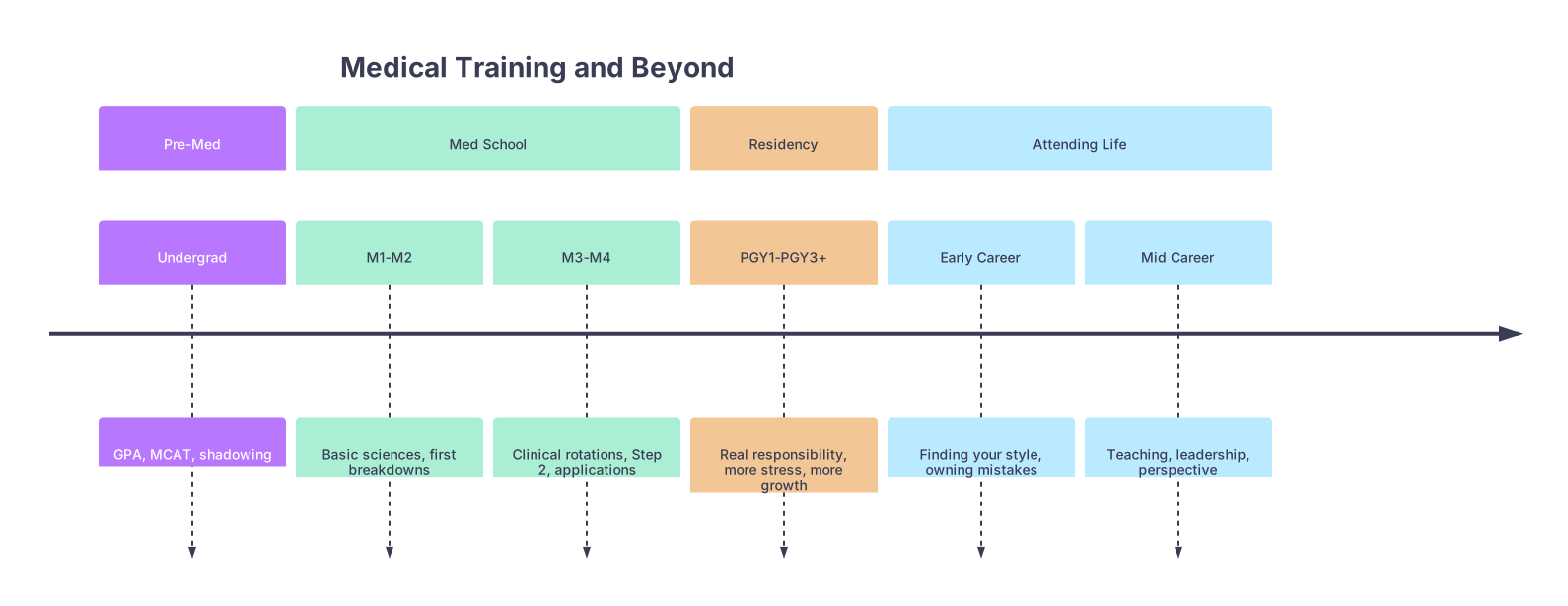
| Period | Event |
|---|---|
| Pre-Med - Undergrad | GPA, MCAT, shadowing |
| Med School - M1-M2 | Basic sciences, first breakdowns |
| Med School - M3-M4 | Clinical rotations, Step 2, applications |
| Residency - PGY1-PGY3+ | Real responsibility, more stress, more growth |
| Attending Life - Early Career | Finding your style, owning mistakes |
| Attending Life - Mid Career | Teaching, leadership, perspective |
Your “huge” breakdown right now is sitting somewhere in a tiny slice labeled “M2 spring” or “third-year fall.” You’re acting like that one dot controls the whole graph.
It doesn’t. It can influence the slope a bit—maybe you adjusted how you study, got therapy, became more compassionate with yourself. But it’s not the entire trajectory unless you decide to freeze your identity at that exact moment.
The most unhelpful thing you can do is decide, “That breakdown proved I’m fragile,” and then live the rest of med school like you’re just waiting for the next disaster.
A better frame:
“That breakdown was my system screaming that something needed to change. That was data. Brutal data, but data.”
What Actually Defines You Long-Term (Spoiler: It’s Boring Stuff)
You’re afraid you’ll be “the one who broke.” But here’s what actually ends up defining people over years:
| What Feels Defining Now | What Actually Defines You Long-Term |
|---|---|
| One panic attack | How you show up most days |
| One failed exam | Your eventual competence and growth |
| One harsh feedback | Whether you learned from it |
| One bad eval | Patterns in your evaluations |
| One leave of absence | How you came back and function now |
Nobody’s introducing a colleague 10 years from now with, “This is Dr. Lee, who cried after her M2 neuro exam.”
They say:
“She’s the one the nurses love.”
“He’s the guy who teaches really well.”
“She’s insanely thorough.”
“He’s calm during chaos.”
Patterns. Habits. How you handle the day-to-day grind. That’s what wins.
And honestly, people who’ve been absolutely wrecked at some point often end up being the best colleagues. They get it. They’re the ones who tell the intern, “Go eat, I’ve got this,” because they remember exactly what it feels like to be at the edge.
How to Stop Letting That One Moment Run Your Life
You can’t erase what happened. You can change the weight you’re giving it.
Here’s a simple mental reframe process you can actually do today.

Write the “disaster story” your brain is telling.
Be brutally honest:
“I had a panic attack before my pharm exam. That means I’m unstable, and attendings will see me as weak, and I’ll never survive residency…”Underline only the objective facts.
Stuff that would hold up in a chart note.
“Had a panic attack before pharm exam. Scored 1 SD below my usual performance. Took the rest of the day off.”Now write an alternate story that uses only those facts.
Something like:
“I hit a point where my coping wasn’t enough. My body forced a stop. It cost me one exam score and one day. That was a sign I needed adjustment, not a verdict on my entire career.”Ask: What changed (or needs to change) because of that event?
Maybe you started therapy. Started sleeping more than 4 hours a night. Stopped studying with people who triggered you. Told your advisor the truth. Those changes are what actually carry forward.Decide on one tiny behavior that pushes against the “I’m broken” narrative.
Something like:- Emailing student mental health to book an appointment.
- Telling a trusted classmate, “I had a rough time last block and I’m trying to do this differently.”
- Setting a non-negotiable bedtime before exam week.
Not dramatic. Just evidence, slowly, that you’re not stuck in that moment.
But What If It Happens Again?
Here’s the thought you probably haven’t said out loud:
“What if this breakdown wasn’t a one-time thing? What if I am someone who can’t handle medicine?”
That’s the fear under the fear.
Let me separate two realities.
Yes, this path is brutally hard on mental health.
People with underlying anxiety, depression, trauma, or perfectionism are absolutely more vulnerable to breakdowns during med school. That doesn’t equal “unfit.” It equals “needs real support.”Needing support is not the same as being incapable.
Lots of very solid residents and attendings are on meds, in therapy, or living with diagnoses. Quietly. Competently. Successfully. The bar is not “no cracks.” The bar is: can you function, seek help, protect patients, and keep growing?
If breakdowns are frequent, prolonged, or escalating, then the question isn’t “Am I a failure?” It’s “What level of help do I need to be okay?”
Sometimes that answer is more therapy. Sometimes a med adjustment. Occasionally, yes, a leave.
None of those automatically eject you from medicine. They just mean your path isn’t the glossy brochure version. Honestly? No one’s is.
A Quick Reality Check From The Other Side

Think about a resident or attending you respect. Someone good. Competent. Human.
You know what they’re probably not doing?
Sitting around going, “You know that M3 I had four years ago who looked like they might cry on rounds once? That student was clearly unsuited for medicine.”
They barely remember. When they do remember, it’s usually softened: “They were going through a lot then, I think they turned out fine.”
The only person replaying that meltdown in HD, frame by frame, is you.
And yeah, sometimes people are jerks. Sometimes an attending does say something like, “If you can’t handle this, how will you handle residency?” That stings. Deeply.
But even that doesn’t equal a verdict. It equals one person, on one day, probably projecting their own unresolved crap onto you. Their voice doesn’t get to be the narrator of your whole story unless you hand them the mic.
How To Carry This Forward Without Letting It Haunt You
You don’t have to turn your breakdown into some cheesy “blessing in disguise.” You’re allowed to just say: that sucked. That was awful.
But you also don’t have to let it be the headline of your identity.
If you want something concrete:
- Name it: “That was a breakdown, not a biography.”
- Extract the data: What did it expose about your limits, your environment, your coping?
- Adjust something real: schedule, support, expectations, environment.
- Refuse to use it as proof you’re fundamentally flawed.
And then? Keep showing up. Not perfectly. Just consistently. Let your everyday actions start to drown out that one awful moment.
Because in the long run, they will.

FAQ – Exactly What Your Brain Is Still Worried About
1. What if my breakdown happened in front of an attending or the whole team? Isn’t that career-ending?
Embarrassing? Yeah. Career-ending? No. Teams have seen much worse: shouting, blatant unprofessionalism, dishonesty. A med student crying or visibly overwhelmed doesn’t even crack the top ten. At most, it becomes a line like, “They were going through a hard time that month.” If your overall behavior is solid, people file it under “human moment,” not “permanent liability.”
2. Will a mental health–related leave of absence ruin my chances at residency?
It complicates things a bit, but it’s not an automatic death sentence for your application. Programs increasingly see LOAs for mental health, illness, family issues. What matters is: Did you come back and function well? Do your later evaluations show reliability and competence? If you can calmly explain, “I had health issues, I addressed them, and I’ve performed consistently since,” many PDs respect that more than the person who never stopped but is secretly falling apart.
3. My dean’s letter mentions “resilience” and “growth” after a difficult period. Is that code for ‘this person broke’?
Sometimes, yes, that’s code for “they struggled at one point.” But it’s also code for “they improved.” Most PDs can read between the lines. They care far more about what your later clerkship comments say. If the tone is: “early difficulties, then strong performance,” it reads as a success arc, not a red flag. They’re building teams for real life, not fantasy robots.
4. How do I stop replaying that worst day on a loop?
Your brain keeps replaying it because it thinks doing so will somehow prevent it from happening again. It won’t. Try this instead: give yourself a 5-minute “worry window” where you literally let yourself replay it, write it down, feel gross about it. Then, when the thought pops up outside that window, label it: “old tape.” Redirect to one small action in the present—review one page of notes, send one email, drink water. It’s about training your brain that we’re not living there anymore.
5. What if I actually am too fragile for this and I just don’t want to admit it?
If you’re functioning, passing, showing up, caring about patients, and worrying this much about doing a good job—you’re not fragile, you’re strained. Fragile would be not caring at all, or ignoring every sign you’re not okay until something catastrophic happens. The fact that you’re questioning, “Can I do this in a healthy way?” is a strength, not a weakness. If you’re really unsure, that’s a conversation for a therapist or trusted advisor, not a verdict your 3 a.m. anxiety gets to hand down alone.
Open whatever calendar you use right now and block off one 30-minute slot in the next 7 days labeled: “Check in with myself (not my grades).” When that time comes, ask: “What did that breakdown show me I need more or less of?” and write down one tiny change you’re willing to make. Just one.