

What do you do when a patient you barely know slides a pre-filled “emotional support animal” form across the desk and says, “Can you just sign this quickly?”
If you’re in clinical training or early practice, this one sneaks up on you. It sounds simple and kind—helping someone keep their pet—but the legal and ethical trap doors under it are very real.
Let’s walk through how to handle these requests without being exploitative, gullible, or unnecessarily harsh.
1. Get Clear On What You’re Actually Being Asked For
First thing: not every “animal letter” is the same thing. If you treat these as interchangeable, you’ll either over-promise or under-protect your patient—or yourself.
| Type | Purpose | Legal Framework |
|---|---|---|
| Emotional Support Animal (ESA) | Housing / sometimes travel | Fair Housing Act, state laws |
| Service Animal | Task-trained for disability | ADA, disability law |
| Therapy Animal | Visit others (hospitals, schools) | Organization policies |
| General Pet Letter | Vague “helps my mood” note | Usually no legal standing |
Emotional Support Animal (ESA) letters
This article is about ESA letters—the ones people use for:
- No-pet housing or waiving pet fees
- Sometimes airline accommodations (much tougher after federal rule changes)
These usually require you to state:
- The patient has a disability (yes, using that word)
- The ESA alleviates one or more symptoms of that disability
- The patient is under your care
This is not a casual “I like my dog” note. You are, functionally, writing a disability-related legal document.
So before you say yes or no, you need to know:
- Is this an ESA request (housing, disability) or just “my dog helps me feel better”?
- Is there a specific form (from a landlord, etc.) or are they asking for a generic letter?
- What jurisdiction are you in? (Because state laws and medical boards handle this differently.)
If you do not even know what category you’re dealing with, that’s your first problem to fix.
2. Your First Response In the Room: What To Say, Word-for-Word
You do not need to decide instantly. You do need to respond professionally and set the frame.
Basic structure:
- Acknowledge the request.
- Clarify what’s being asked.
- Set expectations that this requires evaluation, not a quick signature.
You could say:
“I see this is an emotional support animal letter for housing. These are essentially disability accommodation letters, so I don’t sign them on the spot. What I can do is review your situation, your mental health history, and my legal obligations, and then I’ll let you know whether I can ethically and legally write one for you.”
If they push: “My last doctor just signed these, it takes two seconds.”
You answer:
“I don’t do it that way. When I write something like this, I’m certifying to a landlord that you have a qualifying mental health condition and that this animal is necessary to treat it. That requires proper assessment and documentation. If we have not done that yet, we need to start there.”
Notice what you’re doing here:
- You’re not saying “no” reflexively.
- You’re not saying “sure” to avoid conflict.
- You’re reframing this as a clinical and legal decision, not a customer service request.
3. The Ethical Core: Three Questions You Must Be Able to Answer “Yes” To
If you’re going to write an ESA letter, you should be able to confidently say “yes” to all three of these:
- Does this patient meet criteria for a mental health–related disability?
- Have I personally evaluated and treated this condition adequately to make that call?
- Is there a reasonable clinical basis that this specific animal is part of the therapeutic plan?
Let’s unpack in real-world terms.
1. Disability, not just distress
The Fair Housing Act standard is not “this person is stressed and their cat is nice.” It’s roughly:
- A physical or mental impairment
- That substantially limits one or more major life activities
So “I get sad when I’m alone” is not the same as:
- “I meet full criteria for Major Depressive Disorder and cannot function without this animal’s support.”
- “My panic attacks prevent me from leaving my apartment unless I have the dog with me.”
If your note casually converts “mild situational anxiety” into “disability” because they need to avoid a $300 pet fee, that’s not just bending the rules. That’s misrepresentation. That’s you lying for them.
2. Actual clinical relationship
Writing ESA letters after:
- One telehealth visit
- A 10-minute urgent care encounter
- A “meet-and-greet” new patient appointment
…is how clinicians get in trouble with medical boards.
You need:
- A real history (psych, social, functional impairment)
- Some level of ongoing relationship—or a clear, thorough single evaluation if that’s your practice model
- Documentation that backs what you’re saying in the letter
If your note says “this patient is under my care for Generalized Anxiety Disorder” and you’ve never formally diagnosed that, never documented functional impairment, and never discussed treatment options, your chart and your letter will contradict each other.
Medical boards really don’t like that.
3. The animal is plausibly therapeutic
You’re not being asked to certify that this is the only possible treatment. Just that it:
- Mitigates symptoms,
- Helps in some specific way (sleep, panic reduction, social engagement),
- Fits into a reasonable treatment plan.
Vague language like “pet helps emotional well-being” is weak. Better:
- “The patient’s dog provides consistent grounding and reduces episodes of panic, which has been observed and reported in treatment over the last 8 months.”
If you can’t say something specific like that? You don’t know enough to write the letter.
4. The Legal Landmines You Cannot Pretend Don’t Exist
This part is where a lot of good-intentioned clinicians get burned.
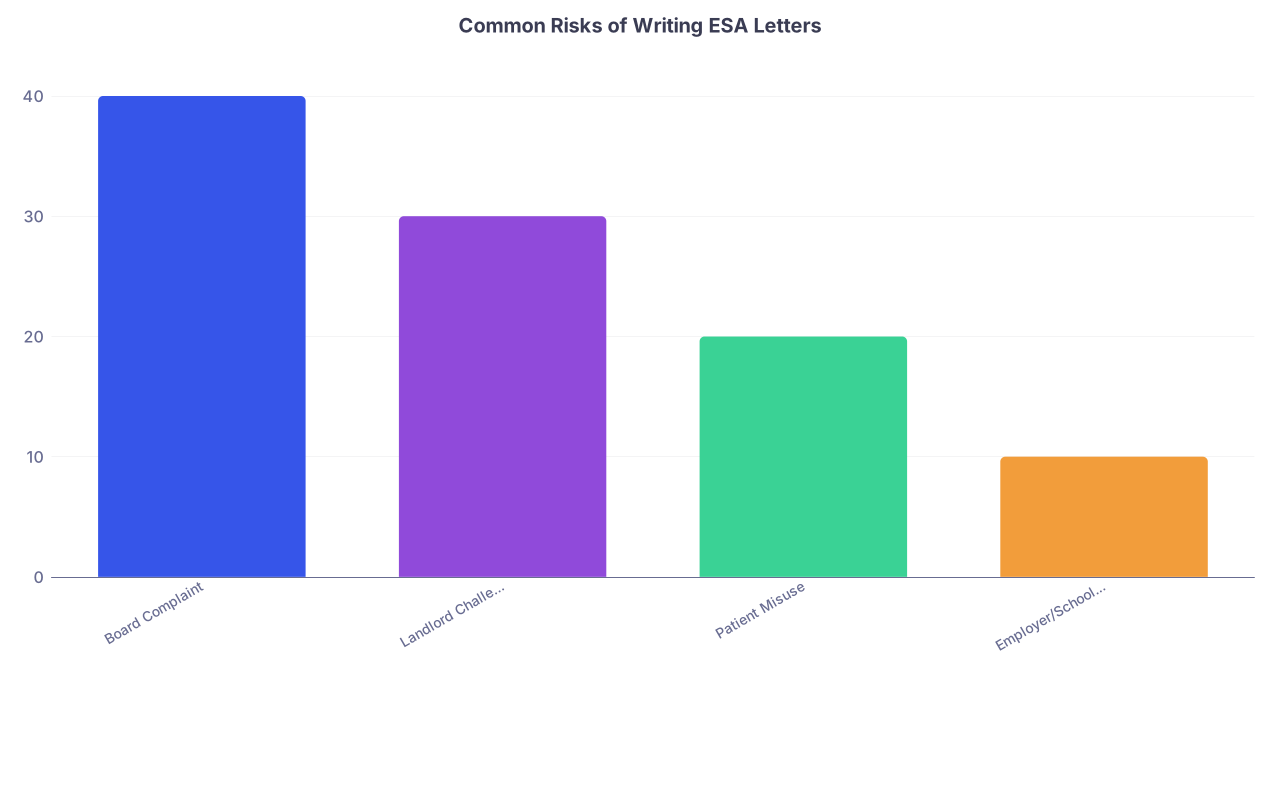
| Category | Value |
|---|---|
| Board Complaint | 40 |
| Landlord Challenge | 30 |
| Patient Misuse | 20 |
| Employer/School Disputes | 10 |
You are not just “vouching” for a pet
You are effectively providing:
- A disability verification
- For a legal accommodation
- That can cost landlords or associations money
Places this can blow back on you:
- Board complaints: patient, landlord, or third party says you misrepresented disability, or wrote letter without proper evaluation.
- Legal subpoenas: your chart and letter get pulled into an eviction or discrimination case.
- Institutional scrutiny: if you’re employed (hospital, university clinic), risk management may have strong views on clinicians freelancing these letters.
Vague or lazy documentation will absolutely haunt you
If you write a letter saying:
“Patient has severe anxiety and requires an ESA.”
…and your chart only shows:
- “Pt anxious about exams. Recommended mindfulness app. RTC PRN.”
You are the problem, legally and ethically.
Standard: your chart should independently justify what your letter says, without the letter needing to exist.
5. A Step-by-Step Process That Won’t Get You Killed Later
Here’s how to handle an ESA request in a repeatable, defensible way.

| Step | Description |
|---|---|
| Step 1 | Patient requests ESA letter |
| Step 2 | Clarify purpose and type |
| Step 3 | Check clinic and state policies |
| Step 4 | Schedule evaluation visit |
| Step 5 | Assess disability criteria and function |
| Step 6 | Discuss limits and document thoroughly |
| Step 7 | Write specific ESA letter |
| Step 8 | Decline letter and offer alternatives |
| Step 9 | Existing therapeutic relationship? |
| Step 10 | Meets criteria and ESA reasonable? |
Step 1: Clarify and slow it down
- Identify housing vs travel vs vague “need a letter.”
- Tell them this requires a dedicated evaluation or part of an established treatment plan.
- Set a follow-up if needed.
Step 2: Check your environment
Before you ever write your first ESA letter, you should know:
- Does your clinic or institution have a policy? (Some forbid them outright.)
- What does your state medical board say about them?
- Does your malpractice insurer have guidance?
If your employer bans ESA letters, your answer is easy:
“Our practice does not provide emotional support animal letters. I can help document your mental health condition and discuss treatment, and you may seek a specialist who offers this service.”
Step 3: Do a real evaluation
At minimum:
- Psychiatric history (diagnoses, symptoms, treatments tried)
- Functional impact: school, work, self-care, social functioning
- Current treatment: meds, therapy, coping skills
- Role of the animal: what specifically changes when the animal is present?
Document this as you would any other serious mental health visit. Because that’s what you’re claiming to treat.
Step 4: Decide yes or no
You can say yes if:
- There’s a real, documented psychiatric condition
- There’s clear functional impairment
- The animal’s presence plausibly mitigates that impairment
- You have or are establishing a genuine therapeutic relationship
You should say no if:
- They don’t have a qualifying condition
- They’re obviously shopping for a quick signature
- They suggest misrepresentation (“can you just say it’s severe?”)
- You’re outside your own comfort or expertise
And then you have to tell them.
6. How To Say No Without Lighting the Room On Fire
Declining doesn’t have to be adversarial, but it does have to be firm.
Scenario 1: Mild symptoms, no disability
“I absolutely believe your dog is helpful and comforting. However, the law requires that I certify you have a mental health disability that substantially limits major life activities. Based on what we’ve discussed and what I’ve documented, I do not see that level of impairment. It would be dishonest for me to call this a disability. I can keep treating your anxiety and help you in other ways, but I won’t mislabel your condition for the purposes of this letter.”
Scenario 2: No clinical relationship yet
“I don’t write emotional support animal letters on a first visit. These are legal disability documents and require a more complete assessment and ongoing care. If you’d like to establish care, we can schedule further visits and address your mental health needs. If you’re only looking for a one-time letter, I’m not the right clinician for that.”
Scenario 3: Patient wants you to exaggerate
They say: “If you could just say it’s severe depression, that’s what the landlord needs to see.”
You respond:
“I do not change diagnoses or exaggerate symptoms for disability or housing forms. My job is to document truthfully what I see clinically. If that’s not enough for the landlord, I still won’t falsify it.”
If they threaten to leave your practice or complain, let them. Bending on this once guarantees it will be worse the next time.
7. If You Do Say Yes: How To Write a Clean, Defensible ESA Letter
If, after all that, you decide this is appropriate, write the letter like someone might read it in front of a judge and your medical board. Because they might.
Focus on:
- Verifying disability status
- Linking symptoms to need for ESA
- Being specific but not oversharing
Key elements:
Your credentials and relationship
- “I am a board-certified family physician who has been providing ongoing care to [Patient Initials] since [month/year].”
Confirmation of disability
- “I am treating [Patient] for a mental health condition that meets the definition of disability under applicable law, meaning it substantially limits one or more major life activities.”
Role of the ESA
- “The presence of [species, e.g., a dog] helps to mitigate symptoms including [e.g., panic episodes, sleep disturbance] and supports [Patient] in performing daily activities such as attending work and engaging in social interaction.”
Scope
- “This letter is provided to support a reasonable accommodation request for an emotional support animal in housing under the Fair Housing Act.”
No unnecessary details
- Do not list exact diagnosis codes, medication lists, or personal life details unless absolutely necessary and with patient consent.
Document in the chart the exact content of the letter or upload a copy. If it’s not in the EHR, it didn’t happen.
8. Handling Common Messy Scenarios You Will Actually See

Scenario A: “I got an online ESA letter but my landlord says it has to be from my local doctor”
Translation: some commercial ESA mill took their money, wrote a junk letter, and now you’re being asked to clean it up.
Your move:
“I cannot simply re-sign or endorse a letter from an online service. If you want me to consider an ESA letter, I’ll need to evaluate your mental health condition directly, document it, and then independently decide whether an ESA is clinically appropriate. That will take one or more visits. If you’re only looking for someone to re-sign what you already have, I won’t do that.”
You are not the quality control department for shady ESA websites.
Scenario B: College student wants ESA for dorm
Complicated because:
- University housing has its own process
- Parents are often involved
- Stakes feel high to the student
Your approach:
- Evaluate as usual for anxiety, depression, etc.
- Consider other accommodations: reduced course load, counseling, proximity to home, single room without ESA.
- If you do support an ESA, keep the letter focused on functional impairment and why the ESA is a reasonable accommodation compared with alternatives.
If the student’s symptoms are mild stress adapting to college, say no. That’s not discrimination; that’s accurate clinical judgment.
Scenario C: Patient has legitimate severe mental illness, but the animal is actually a problem
Say:
- Dog is aggressive
- Animal is poorly controlled and bites guests
- Landlord or roommates have valid safety concerns
Your ethical obligation is not “animal at all costs.”
You can say:
“I agree you have a serious mental health condition and need accommodations. I am not comfortable stating that this specific animal is a safe and reasonable accommodation given the behavior concerns described. We should explore other ways to support you—possibly with a different animal, structured support services, or a different type of accommodation.”
You are allowed to distinguish between “need for support” and “need for this particular dog who has bitten three people.”
9. Protecting Yourself and Still Being a Decent Human Being
You do not have to choose between:
- Being a hardline “I never write those” robot,
and - Being everyone’s letter factory.
There’s a middle ground.
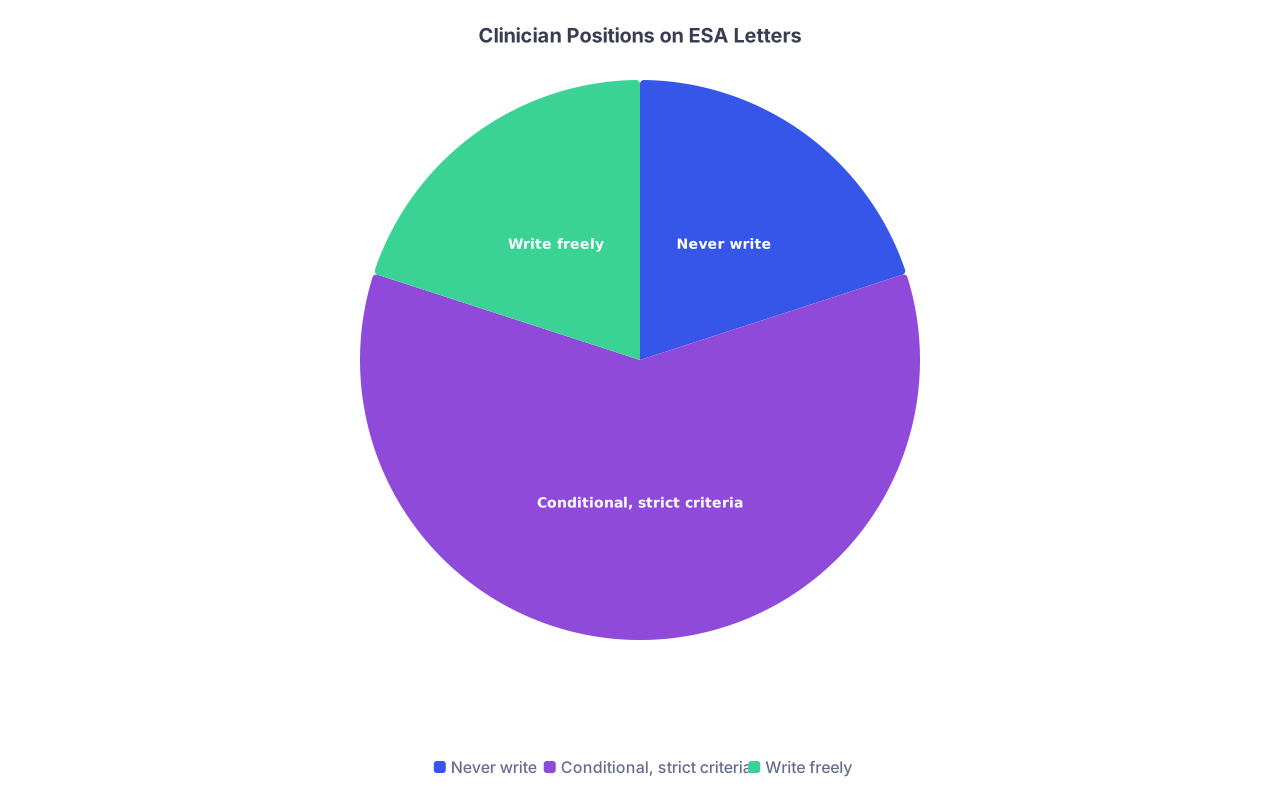
| Category | Value |
|---|---|
| Never write | 20 |
| Conditional, strict criteria | 60 |
| Write freely | 20 |
The sustainable spot is: “Conditional, strict criteria.”
Practical habits:
- Decide your own threshold before you’re in the room with an emotional patient.
- Know your clinic’s policy cold.
- Use consistent phrases so you’re not improvising ethics under pressure.
- Document your reasoning for yes and for no.
You’re allowed to care about your patient’s attachment to their animal and also refuse to launder a non-disability situation into a legal disability. Both can be true.

10. Quick Personal Policy Template You Can Steal
If you’re early in training or practice, write something like this for yourself:
- I only write ESA letters for established patients or after a complete mental health evaluation.
- I require documented evidence in my chart of a qualifying mental health disability and functional impairment.
- I will not falsify or exaggerate severity for the sake of accommodation.
- I will document the rationale clearly when I do provide a letter.
- I reserve the right to decline and offer alternative support if ESA is not clinically justified.
Then stick to it. The patients who respect boundaries will stay. The ones who wanted a rubber stamp will go find someone else. Let them.

FAQ (Exactly 3 Questions)
1. Am I required to write an ESA letter if a patient has a clear psychiatric diagnosis?
No. A diagnosis alone does not obligate you to provide any specific documentation. You are required to provide clinically appropriate care, not to sign every form a patient requests. You still have to decide whether an ESA is a reasonable, necessary part of their treatment and whether you’re comfortable and competent making that determination.
2. Can primary care clinicians write ESA letters, or should this only be done by psychiatrists or therapists?
Primary care clinicians can write ESA letters, and many do. The key is not your specialty; it’s whether you have adequately assessed and are treating the mental health condition. If you don’t feel comfortable with the complexity or severity, referring to a mental health specialist for evaluation (and possible documentation) is entirely appropriate.
3. What if I wrote an ESA letter in the past and now feel it wasn’t appropriate—can I revoke it?
You generally cannot retroactively erase what you already wrote, but you can document updated clinical opinions and decline to provide further letters. If asked to renew, you can say you’re no longer clinically supporting the ESA as a necessary accommodation and explain your reasoning in the chart. If there’s active legal conflict (eviction, lawsuit), talk to your institution’s legal counsel or malpractice carrier before sending any new communication.
Key takeaways:
- ESA letters are disability accommodation documents, not casual “pet notes,” and require real evaluation, diagnosis, and documentation.
- You’re allowed—and expected—to say no when criteria aren’t met, to avoid misrepresentation and legal risk.
- If you do say yes, write a focused, accurate letter backed by a solid chart, and treat it like something that may be scrutinized later.


