

Last month a resident told me about a patient who looked her up and down and said, “I don’t want a Black doctor. Get me someone else.” She froze, finished the sentence she was on autopilot, then walked out and cried in the stairwell. Thirty minutes later her senior was asking why the note wasn’t done.
If you stay in medicine, some version of this will happen to you or a colleague. Not “if.” When. So let’s talk about what you actually do in that moment – clinically, legally, and for your own sanity.
Step 1: Recognize What’s Actually Happening
You’re not dealing with “patient preference.” You’re dealing with discriminatory refusal.
This is different from:
- A Muslim woman requesting a female OB because of modesty.
- A trauma survivor saying they prefer not to be examined by men.
- A patient needing a language-concordant provider because they don’t understand English.
Those can be accommodated when reasonable and when they don’t harm anyone else.
What you’re facing is:
- “I don’t want a [Black/Asian/foreign] doctor.”
- “I don’t want a woman touching me.”
- “I don’t want a Muslim/Jew taking care of me.”
- “You’re gay, right? I don’t want that. Get me a normal doctor.”
That’s discriminatory. It hits all at once: shock, anger, shame, maybe fear. Your brain will want to argue, educate, or just vanish.
Here’s the rule: your first job is to keep the patient medically safe and yourself physically safe. Not to win the argument, not to prove you belong there.
Step 2: Stabilize Safety and Time
You have a few seconds to decide: is this an emergency or not?
Use this mental split:
- Is the patient unstable or at immediate risk (crashing vitals, chest pain, stroke, sepsis, active bleeding, etc.)?
- Or are we in “non-emergent” land (routine consult, stable admission, follow-up, clinic visit)?
In emergencies, you treat first. Always.
You can literally say: “I hear that you’re upset, but right now my job is to make sure you’re safe. We’ll address this later; I need to take care of you.”
If they’re stable and safe, you have more leeway to step out and get backup immediately. Do not stand there solo and absorb repeated abuse if you can avoid it.
Step 3: What to Say in the Room – Scripts You Can Use
When you’re blindsided, having words preloaded matters. Here are real phrases I’ve seen work.
1. The clear boundary + redirection
For discriminatory refusals that are not yet screaming-level hostile:
“I’m sorry, but our hospital does not reassign clinicians based on race/gender/religion. I’m the doctor assigned to your care and I’m here to help keep you safe. Let’s focus on your [chest pain/breathing/problem] right now.”
If they push:
“I understand you have strong feelings. We do not accommodate requests based on race, religion, or other protected traits. You have the right to seek care elsewhere, but while you’re here, I’m the physician on your team.”
Say it calmly. No apologizing for who you are. You’re setting the institutional line.
2. When you need to safely extract yourself
If it escalates, or you feel unsafe:
“I’m going to step out now. I’ll let my team know about your concerns.”
Then you leave. You don’t have to stand there being abused because “the patient is always right.” They’re not. And you’re not a punching bag.

| Step | Description |
|---|---|
| Step 1 | Patient makes discriminatory refusal |
| Step 2 | State boundary and treat |
| Step 3 | Once stable step out and debrief |
| Step 4 | State boundary briefly |
| Step 5 | Exit room |
| Step 6 | Notify senior or attending |
| Step 7 | Document and plan next steps |
| Step 8 | Emergent medical issue |
Step 4: Loop In Your Team – Do Not Handle This Alone
If you walk out of that room and just try to swallow it, you’ll carry it all night. And it will bleed into your next patients.
You need to do three things quickly:
- Find your immediate senior/attending.
- Involve nursing (they often saw it coming or have history).
- Notify charge nurse or unit leadership if it was extreme.
Use simple, factual language. Something like:
- “The patient in 312 said they refuse care from me because I am [Black/a woman/Muslim/etc.] and asked for another doctor.”
- “They stated, quote, ‘I don’t want a [slur] doctor.’ I left the room after setting a boundary because I did not feel safe.”
You’re not “complaining.” You’re reporting a workplace incident that affects care.
What should happen from your senior/attending:
- Validate that this is not acceptable.
- Take over immediate clinical needs if required.
- Help decide whether to maintain the boundary or transfer care in a structured way.
- Support documentation and, if indicated, reporting as a safety event.
If your attending shrugs and says, “Just suck it up, the patient’s sick,” that’s not leadership. That’s moral laziness. You still have options (more on that later).
Step 5: Legal and Ethical Ground – What You’re Actually Obligated To Do
Here’s the tension: patient rights vs. your right to non-discrimination.
What the law generally says (US-focused)
You need to know the basics. In broad strokes:
- Hospitals and clinics cannot discriminate on the basis of race, religion, sex, national origin, etc. (Title VI, Title VII, and various civil rights laws if they’re receiving federal funds – and most do).
- As an employee or trainee, you are protected from workplace discrimination and harassment. Patient behavior can count as harassment, and the institution has a duty to address it.
- EMTALA (in the US) obligates stabilizing emergency care regardless of who the patient is or what they say. That means you can’t refuse to treat a crashing racist in your ED. You treat them, then step away when safe.
What ethics says
Medical ethics is not “patient gets whatever they want.” It’s a balance of:
- Beneficence (help the patient)
- Non-maleficence (do no harm)
- Autonomy (respect patient choices)
- Justice (fairness, including fairness to staff)
Ethically, patients do not have a right to a different clinician because of prejudice. The AMA, ACP, and others are very clear on this.
So ethically and legally:
- You must ensure the patient isn’t abandoned in an emergency.
- You can refuse ongoing non-emergent care if the patient’s discriminatory behavior makes a therapeutic relationship impossible.
- The hospital is supposed to back you and create a plan that doesn’t reward the discrimination.
Do institutions always live up to that? No. But that’s the standard.
| Situation | Your Obligation |
|---|---|
| Active emergency, unstable patient | Must treat to stabilization |
| Stable inpatient with discriminatory refusal | May request transfer of care |
| Outpatient clinic, non-urgent visit | May decline to continue visit/relationship |
| Repeated harassment creating hostile environment | Should escalate, may request removal from assignment |
Step 6: Deciding Whether to Continue or Transfer Care
Here’s the hard part. How much do you personally tolerate?
Important distinction:
- Emergency: You continue at least until someone else can safely take over or the patient is stable.
- Non-emergency: It’s reasonable to say, “I cannot provide effective care in this context,” and request reassignment.
Factors to weigh:
Your safety
If there’s any hint of physical threat, stalking, or unhinged behavior, that’s a hard line. You escalate. Security may need to be involved. This is non-negotiable.Psychological impact
One nasty comment is different from repeated slurs, threats, or sexualized remarks. If you’re shaking and dissociating every time you think about going back in, that’s not “being resilient.” That’s harm.Availability of alternatives
In a rural hospital with one overnight doc, there may literally be no one else. In a huge academic center with 8 residents on service, there usually is.Clinical urgency
A stable cellulitis on antibiotics is different from a tenuous LVAD patient who needs continuity.
Sometimes the most ethically coherent option is:
- You stabilize or complete time-sensitive tasks.
- Your attending (who has power and distance) explains clearly that the behavior was unacceptable.
- If possible, another team member takes over with documentation that the transfer is despite the discrimination, not in response to it.
It is not your job as the targeted person to martyr yourself to make that point. Institutional policies should carry that weight.
Step 7: Document Like a Lawyer is Reading It
Assume your note will be scrutinized later by risk management, legal, or the ombuds office. Write clearly, factually, no editorializing.
In your note (preferably a separate event note or progress note):
- Describe the behavior and exact words if you can remember them:
“During routine assessment, patient stated, ‘I do not want a Black doctor. Get me someone else.’” - State your response:
“I informed the patient that our institution does not reassign clinicians based on race and that I am the physician assigned to their care.” - Document if you felt threatened or unsafe:
“Given escalating volume and repeated use of racial slurs, I did not feel safe remaining in the room alone and exited to discuss with the supervising physician.” - Note who you informed and any plan:
“Case was discussed with Dr. Smith, attending physician, and charge nurse. Plan is for Dr. Smith to address patient behavior and determine ongoing care team structure.”
Do not write: “Patient is racist.” That’s commentary. Stick to quotes and behavior. Let readers draw their own conclusions.
Also submit a safety/incident report if your hospital has that system. Those get tracked and sometimes trigger policy reviews.
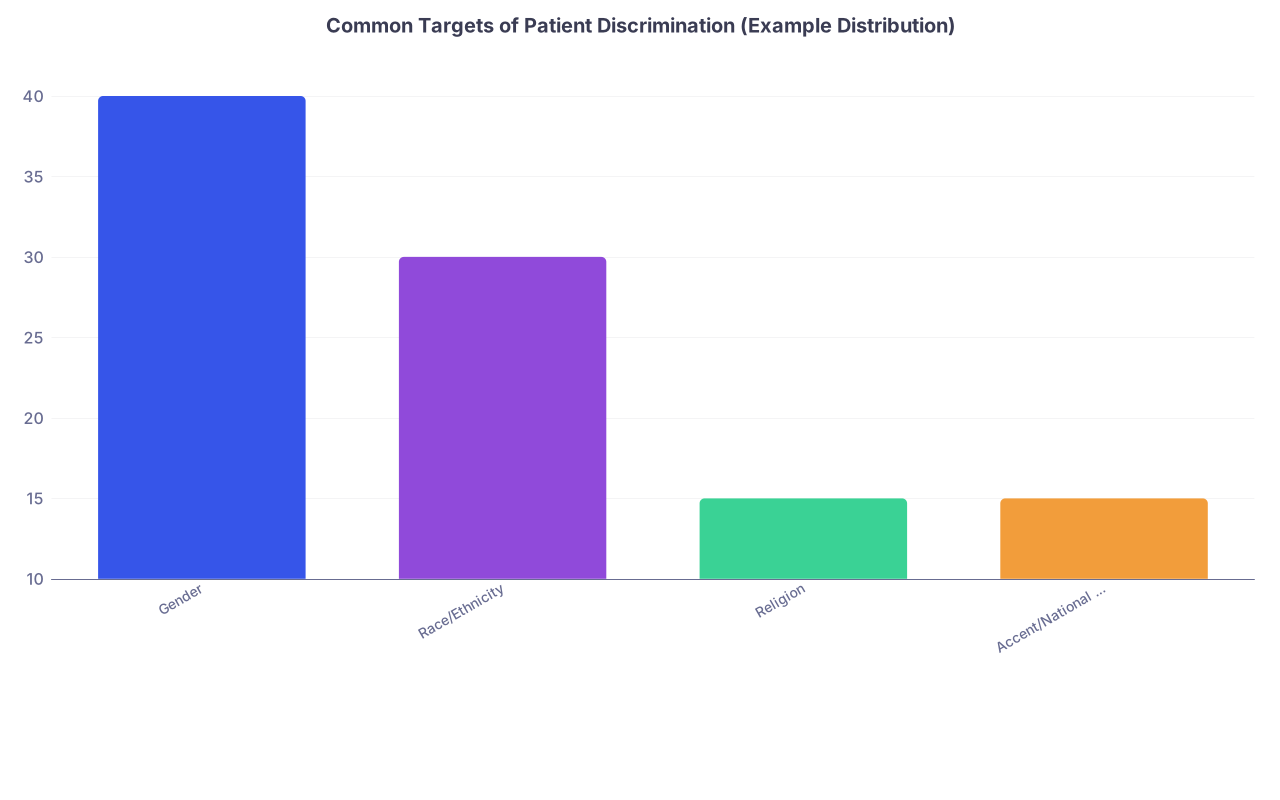
| Category | Value |
|---|---|
| Gender | 40 |
| Race/Ethnicity | 30 |
| Religion | 15 |
| Accent/National Origin | 15 |
(Numbers illustrative, but the pattern is real: gender and race are the top targets.)
Step 8: Managing Your Own Reaction – Short Term and Long Term
You’re not a robot. You’re a human who just got told “I don’t want your kind in here.”
Short term, after the immediate dust settles:
- Step out of clinical flow for 5–10 minutes if you can. Bathroom, empty call room, stairwell.
- Text someone who gets it: co-resident, partner, that one upper level who actually cares.
- Do one grounding thing: cold water on your face, 10 deep breaths, quick walk.
Then you make a decision: can you safely and effectively see your next patient?
If the answer is honestly no, say so. You can tell your attending:
“I’m more shaken than I expected. I need 10–15 minutes before I pick up the next patient.”
Most good attendings will accommodate that. If they don’t, log that mentally about them. That’s information about who is safe and who is not.
Long term, this is about not letting these moments accumulate into burnout and cynicism.
What actually helps:
- Talking with peers who’ve been there. Minority and women physicians swap these stories all the time. Shared experience softens the edge.
- Using institutional resources strategically: Employee Assistance Program, DEI office, ombuds, spiritual care. Not because you’re “weak,” but because you’re human in a system that often gaslights this stuff.
- Reflective writing or debriefing with a mentor. Yes, it sounds corny. No, it’s not optional if you want a 30-year career.

Step 9: When Your Institution Fails You
Let me be blunt: some places will protect the racist donor or the belligerent VIP more than they’ll protect you.
You might hear:
- “Just switch rooms, it’s easier.”
- “Don’t make a big deal out of it; the patient is sick.”
- “We have to keep patient satisfaction high.”
That’s institutional cowardice dressed up as pragmatism.
You still have moves:
Escalate one level up
If your attending brushes it off, talk to the program director, chief resident, or service director. Bring your documentation.Use formal channels
- File a formal incident report.
- Email risk management or HR if the event was extreme.
- Talk to GME or ombuds if you’re a trainee.
Find your allies
Every institution has a few people who are known to “go to bat” on these issues. DEI leaders, some chiefs, some risk managers. Ask around and find them.Know your line
If it’s a pattern – the hospital keeps reassigning women and minority clinicians to “keep the peace” with abusive patients – start planning your exit. And be honest about that in future interviews when asked why you left.
You’re not obligated to stay in a place that regularly sacrifices you to appease bigotry. That’s not “part of the job.” That’s workplace abuse.
Step 10: What to Do If You’re a Bystander or Leader
If you’re the senior, the attending, or even just a co-resident watching this happen, your response matters. A lot.
Bare minimum as a bystander:
- Say something like, “That’s not acceptable,” in front of the patient if you can do so safely.
- Check in with your colleague afterwards: “I saw what happened. That was not ok. How can I support you right now?”
- Offer to swap tasks, cover a page, or take a patient so they can regroup.
As an attending or leader, you need a script too. For example:
To the patient:
“We do not tolerate discriminatory behavior toward our staff. Dr. Lee is a fully qualified physician. You may choose to leave against medical advice, but we will not accommodate requests based on race or religion.”
To the team:
“You did the right thing walking out. No one here is required to endure harassment. We’ll figure out coverage that does not reward this behavior.”
That one speech, said once, can undo 20 gaslighting experiences for a trainee.
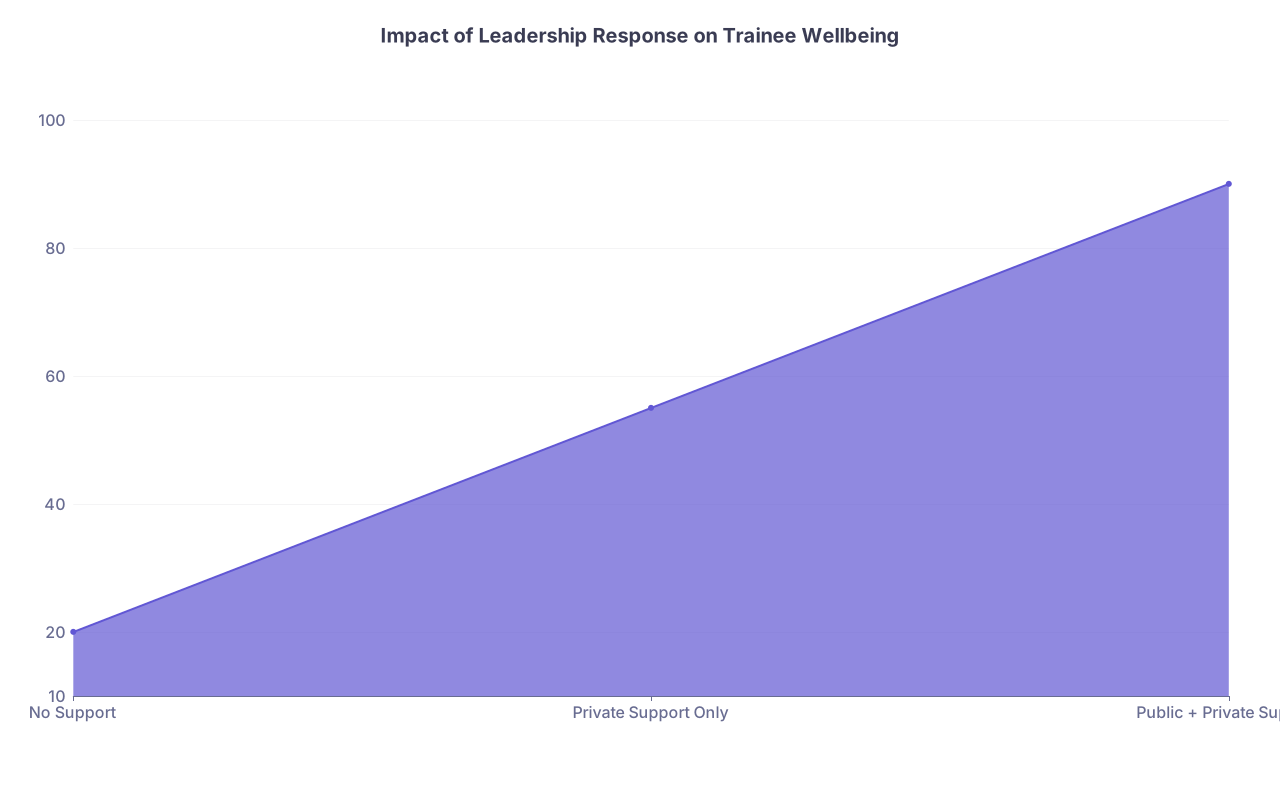
| Category | Value |
|---|---|
| No Support | 20 |
| Private Support Only | 55 |
| Public + Private Support | 90 |
(Think of this as perceived institutional support level – point is: public backing matters.)

Quick Reference: If This Happens Tomorrow
- Assess: Is the patient medically unstable?
- If unstable: Set a brief boundary, treat until safe, then step out.
- If stable: State clearly you don’t switch based on protected traits; exit the room.
- Immediately notify senior/attending and nursing; document.
- Decide with your team: continue with boundaries, or transfer care.
- File an incident/safety report and consider follow-up through GME/HR/ombuds.
- Take 5–15 minutes to decompress. Talk to someone. Do not just swallow it and move on like nothing happened.
FAQs
1. Am I ever allowed to just refuse to see the patient again?
Yes, in non-emergent situations and especially when there’s ongoing harassment, you can say you’re unable to provide effective care under these circumstances. Do it through your chain of command – inform your attending or supervisor and request transfer of care. Document why. For emergencies, you stabilize first, then step back when safe.
2. What if the hospital tells me to switch patients “to keep the peace”?
Document that recommendation (even in a personal log), and consider pushing back: “I’m concerned that reassigning care based on race/gender sends the wrong message and contributes to a hostile environment for staff.” If they insist, comply if you must for safety and patient care, but escalate later through formal channels and allies. Repeated patterns of this are a serious red flag about the institution.
3. Are there any discriminatory requests we should accommodate?
It depends on the reason and context. Requests based on modesty, prior trauma, or language barriers can be ethically acceptable when feasible and when they don’t harm others or reward prejudice. Blanket “I don’t want a [race/religion] doctor” should not be accommodated. The key question: is this about bias or about legitimate comfort/safety rooted in trauma, culture, or communication?
4. How detailed should I be when documenting slurs or offensive language?
Be specific and factual, even if it feels ugly on the page. Put direct quotes in quotation marks: “Patient stated, ‘I don’t want a Muslim doctor.’” Avoid editorial comments like “patient was extremely racist.” Your job is to record behavior and words, not label motives. That kind of precise documentation protects you and clarifies what actually happened.
5. What if colleagues minimize it and say I’m being too sensitive?
You’re not. Having your identity attacked in your workplace is not a sensitivity issue; it’s an occupational hazard and a boundary issue. If peers or seniors dismiss it, that’s information about them, not about you. Seek out people who take it seriously – program leadership you trust, mentors, DEI staff, ombuds – and use institutional channels. And if the culture consistently gaslights these events, start planning for a better environment. You’re allowed to want more than “surviving” your own workplace.
Key points: You’re never obligated to accept abuse as “part of the job.” You must stabilize emergencies, but you’re allowed to set boundaries and step back when it’s safe. And you’re entitled to institutional backup – if you’re not getting it, that’s not your failing; it’s theirs.


