

The clean, comforting narrative that “we never give treatment without consent” is only half true in psychiatry.
Sometimes, in rare but very real cases, clinicians or families hide medication in food or drink—covert medication—believing it is the only way to prevent harm. Ethically, this is some of the roughest terrain in clinical practice. And the way people talk about it in lectures is often far too sanitized.
Let me walk you through the real issues, as they actually show up on wards, in homes, and in ethics consults.
1. What “Covert Medication” Actually Means (And What It Is Not)
Covert medication is not simply “treating someone who does not agree with you.”
Covert medication means:
- The patient is given a medication
- The medication is intentionally hidden (e.g., crushed in food, dissolved in drinks)
- The patient is not aware they are receiving that medication and has not validly consented to that route
That is deception. Not just “poor communication.” It is clinically and morally different from:
- Involuntary treatment with transparency: e.g., depot antipsychotic administered under a mental health act, with legal authority, where the patient knows what is being done even if they object.
- Treating incapacitous patients with authorized surrogates: e.g., a delirious patient in ICU given haloperidol under a substitute decision-maker’s consent, documented and above-board.
- Emergency treatment: Rapid tranquilization in an acute violent episode, where risk is imminent and capacity cannot be assessed properly, but the actions are visible and documented.
Covert medication is specifically about the hidden nature of administration.
And it happens. I have seen family members quietly admit on day 3 of an admission: “We have been putting his risperidone in his food for six months.” I have seen nurses in long-term care facilities ask the consultant, with that careful tone, “Doctor, what do we do when a severely demented patient spits out their medication every time?”
You cannot meaningfully discuss this topic without acknowledging that covert medication is already in the system—sometimes condoned, sometimes improvised, often undocumented, and almost always ethically messy.
2. The Ethical Fault Lines: Autonomy vs. Protection
Everything in this debate sits on a few core ethical tensions. Let’s break them down cleanly.
2.1 Autonomy and Informed Consent
Psychiatry is already under suspicion for eroding autonomy. Covert medication doubles that suspicion.
Autonomy requires:
- Information
- Capacity
- Voluntariness
- A clear, understood choice
Covert medication intentionally withholds information, so there is no way consent can be valid. Even if the patient previously agreed “in general” to treatment, that does not automatically authorize deception about route and timing. Ethically, you are not just bending autonomy; you are going straight through it.
Why this matters:
- Respect for persons is not optional; it is a foundational principle, not decorative.
- Patients with mental illness already face stigma and coercion. Hidden treatment feeds a narrative that their wishes never matter.
So if you think covert medication might be justified, you must be honest with yourself that you are overriding autonomy on purpose. Do not pretend otherwise.
2.2 Beneficence and Nonmaleficence
On the other side: real risk, real suffering, real harm if you do nothing.
Common real-world scenarios:
- A patient with severe psychosis, refusing all visible medication, repeatedly assaulted neighbors, and is now refusing all treatment in the community. Family fears lethal violence. Treatment dramatically reduces risk when taken.
- A person with late-stage dementia, with severe aggression and refusal of oral meds, hitting staff and other residents, yet calms with antipsychotics when given—but will spit them out if clearly seen.
- A patient with profound anorexia nervosa, rigidly refusing psychotropic medication while medically unstable, lacking insight into risk.
Here beneficence (acting in the patient’s best interests) and nonmaleficence (preventing harm) push hard in the opposite direction. There are circumstances where not medicating carries a high probability of serious harm to the patient or others, not just “mildly worse symptoms.”
This is why professional bodies rarely say an absolute “never.” Instead they say: extraordinary, last-resort measure, under strict conditions.

3. Legal and Regulatory Landscape: You Cannot Ignore It
Ethics and law are not identical, but in covert medication they intersect heavily. Different jurisdictions approach this differently, but the patterns repeat.
3.1 Capacity Law and Substitute Decision-Making
Most mental health and capacity statutes hinge on two steps:
- Does the patient have capacity to decide on this specific treatment?
- If not, who is the legally authorized surrogate or which legal framework applies?
Key point: Lack of capacity does not automatically authorize deception.
Even when a guardian or healthcare proxy consents to treatment:
- Many legal systems still expect transparent attempts at administration.
- Some explicitly restrict covert administration except under clear policies or court oversight.
If you are in the EU, UK, Canada, Australia, etc., there are usually guidelines or case law. In the US, state laws differ widely but the elements are similar: capacity, emergency exception, substituted judgment, best interests.
3.2 Mental Health Acts and Involuntary Treatment
Involuntary hospitalization under a mental health act does not automatically mean you may hide medication.
Most mental health acts:
- Authorize treatment to prevent deterioration or serious harm.
- Expect documentation, second opinions in some cases, and transparency about what is being administered.
Some clinicians mistakenly assume: “He is committed, so we can just crush the meds in his yogurt.” That is not a safe legal assumption. Covert medication can be seen as:
- Assault or battery (unauthorized touching/administration)
- Violation of human rights principles (e.g., dignity, autonomy, informed consent)
If challenged legally, covert medication often looks much worse than simply administered involuntary treatment with documentation and overt procedure.
3.3 Institutional Policies
Hospitals, nursing homes, and community services increasingly develop specific policies on covert medication. Typical features:
- Covert medication is not allowed for capacitous patients who refuse treatment.
- Where considered, it requires:
- Formal capacity assessment
- Multidisciplinary review (physician, nurse, pharmacist, sometimes social worker, ethics)
- Documentation of failed alternatives
- Time-limited plan with regular review
- Informing and involving family or legal proxies, when appropriate
You will see language like “last resort,” “exceptional circumstances,” and “serious risk.” And you should treat that language as real, not ornamental.
| Feature | Covert Medication | Overt Involuntary Treatment |
|---|---|---|
| Patient awareness | Not aware of medication | Aware, even if refusing |
| Basis | Often informal, occasional policy-based | Statutory (mental health act, court order) |
| Documentation | Often poor or absent | Typically explicit and structured |
| Ethical main issue | Deception and autonomy | Coercion and autonomy |
| Legal risk | High, may look like assault/deception | Lower if statutes followed and documented |
4. The Rare But Real Clinical Scenarios – How They Actually Look
Now the interesting part. Let me sketch the scenarios where covert medication gets seriously considered.
4.1 Advanced Dementia in Long-Term Care
This is probably the most common context.
Picture this:
An 82-year-old woman with advanced Alzheimer’s disease. No meaningful verbal communication, severe agitation, resisting personal care, hitting staff and other residents. She refuses medications, spits them out, or clamps her mouth shut.
Antipsychotics and mood stabilizers are not perfect, but in her case, previous trials clearly reduced aggressive outbursts and improved sleep. Without them:
- She injures a frail roommate
- Staff must restrain her more often
- She is at high risk for falls and injury
Options:
- Physical restraint (ethically heavy, physically risky)
- Transfer to a higher-security facility
- Environmental/behavioral interventions (already maximized)
- Overt parenteral administration (traumatic, requires restraint)
- Covert oral medication in food or drink, under a capacity and best-interest framework
Ethically, a well-run facility will:
- Confirm she lacks decision-making capacity regarding treatment.
- Seek consent from the legal surrogate (e.g., next-of-kin or court-appointed guardian).
- Hold a multidisciplinary case conference.
- Document that all less-intrusive alternatives were tried and failed.
- Use the lowest effective dose, with clear time limits and regular review.
- Make the covert route a means to achieve previously agreed best-interest treatment, not a habitual shortcut.
Even here, many ethicists remain uneasy. Because once staff get used to this, it can slide into “routine” for any “difficult” patient. That slide is what you must constantly guard against.
4.2 Severe Psychosis With High Violence Risk in the Community
Now take a younger adult with chronic schizophrenia.
He has:
- A pattern of psychotic decompensation when off meds
- History of serious violence toward strangers
- Current delusions that medication is poison
- Refuses every visible form of medication
The mental health team is stretched. Community treatment orders exist but are weakly enforced. The family lives with him and is terrified.
A desperate mother might say, “I put it in his juice. When he is on it, he stops talking to the television and he sleeps. When he is off, the police come.”
Here the players often diverge:
- Clinicians: Officially cannot endorse covert medication in a capacitous refuser; may suspect he lacks capacity during active psychosis.
- Family: Forced into ethical grey area without guidance. They might already be doing it, or ask explicitly for “something we can just put in his coffee.”
Legally, in many systems, if he lacks capacity and meets criteria for involuntary treatment, the ethical path is:
- Bring him under a formal mental health act process.
- Administer medication overtly, documented, even if against his stated wishes.
- Avoid deception; accept the moral weight of coercion and work within legal safeguards.
Endorsing family-led covert medication, off the record, exposes them and the clinician to serious legal and moral risk. This is where you must be very clear: if you think the risk justifies treatment without consent, then own that and use the legal tools, not secret shortcuts.
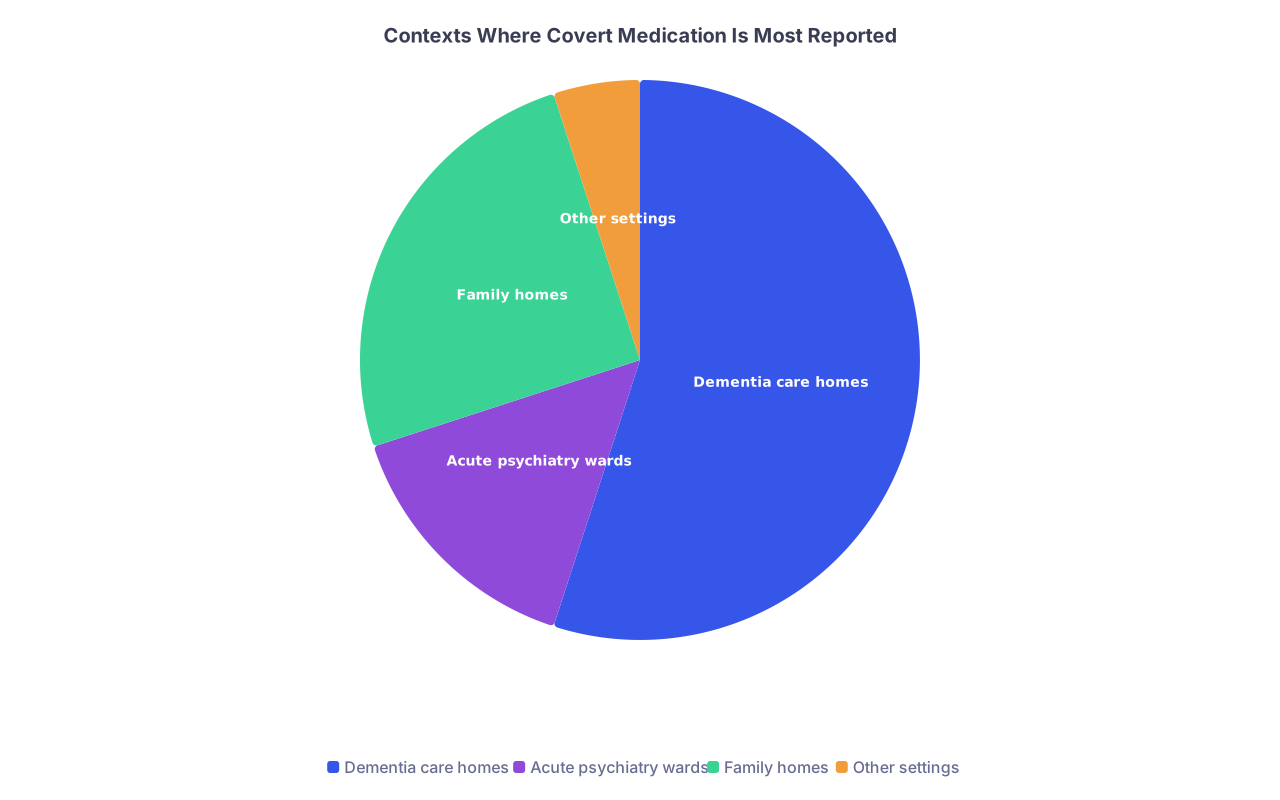
| Category | Value |
|---|---|
| Dementia care homes | 55 |
| Acute psychiatry wards | 15 |
| Family homes | 25 |
| Other settings | 5 |
5. Ethical Framework: When Is Covert Medication Even Arguably Defensible?
You need a structured way to think about this, otherwise decisions become purely emotional.
5.1 Necessary Preconditions
In my view, covert medication is only ethically arguable when all of these are met:
- Severe risk: There is a substantial risk of serious harm (to self or others) or gross deterioration without treatment, not just “mild distress” or “non-compliance is annoying.”
- Impaired capacity: The patient lacks decision-making capacity about this specific treatment, assessed and documented.
- No safer, less-intrusive alternatives:
- Evidence-based nonpharmacologic options exhausted
- Overt administration attempts repeatedly failed
- Legal frameworks for overt involuntary treatment either not available or clearly more harmful overall
- Time-limited and proportionate:
- This is a bridging measure, not permanent “policy”
- Doses at minimum effective level
- Regular review with intent to restore transparency as soon as feasible
- Multidisciplinary oversight:
- Not a unilateral “doctor’s hunch”
- Involvement of nursing, pharmacy, social work, perhaps an independent clinician
- Ideally, formal ethics consultation
- Surrogate or legal authorization (where law allows):
- Legally authorized decision-maker informed and consenting
- Or a court/tribunal order where required
If you cannot check those boxes, you have no business justifying covert medication. You are moving from “rare but defensible” into “ethically and legally reckless.”

| Step | Description |
|---|---|
| Step 1 | Identify concern about refusal |
| Step 2 | Do not use covert meds |
| Step 3 | Assess decision capacity |
| Step 4 | Try nondrug+transparent options |
| Step 5 | Consider legal involuntary routes |
| Step 6 | Multidisciplinary and ethics review |
| Step 7 | Time limited covert plan with review |
| Step 8 | Severe risk present |
| Step 9 | Capacity intact |
| Step 10 | Alternatives effective |
| Step 11 | Legal route feasible with less harm |
| Step 12 | Team agrees criteria met |
6. Documentation, Communication, and Risk Management
If you are anywhere near this territory, sloppy documentation will destroy you. Ethically and legally.
6.1 What Needs to Be Documented
At minimum:
- Detailed capacity assessment specific to the medication decision
- Clear description of:
- Clinical risks without treatment
- Past history (e.g., previous decompensations, violence, self-harm)
- Nonpharmacologic measures attempted and their outcomes
- Attempts at overt treatment and reasons for failure
- Legal framework used:
- Capacity law, mental health act, guardianship, surrogate details
- Multidisciplinary input:
- Names and roles, minutes of discussion, any dissent
- Exact plan:
- Drug, dose, route, duration, review date
- Criteria for stopping covert route (e.g., improved engagement, change in capacity)
- Communication with family or legal proxies:
- What they were told
- Their questions and responses
Failure to document transforms an ethically nuanced decision into what looks like secret medication. Which, frankly, is how most courts and regulators will interpret it.
6.2 Talking With Families
Families are often the ones who bring covert medication up first. They are living with the chaos, the fear, the day-to-day burden. They also carry enormous guilt.
You need to be straight with them:
- Explain the ethical and legal constraints.
- Clarify that:
- You cannot “secretly prescribe” something they just slip into drinks without any framework.
- If the situation is that serious, you may need to consider formal involuntary treatment or capacity pathways.
- Offer alternatives:
- Long-acting injectables with transparent administration
- Crisis response plans
- Environmental and behavioral strategies
- Carer support services
And if you end up in the narrow set of circumstances where covert medication is considered:
- Involve them formally.
- Avoid making them feel like they are alone in an ethically questionable act to which you turn a blind eye.
7. Personal Development: How You As a Clinician Handle This
This is not just about rules. It is about the kind of psychiatrist or physician you are becoming.
7.1 Develop a Reflex Against Casual Deception
If you get “comfortable” with covert medication, you are a problem. That sounds harsh, but I mean it.
You should feel a knot in your stomach every time it is raised. That emotional discomfort is not a weakness; it is an ethical alarm system. The day it feels like “just another way to get the meds in” is the day you are sliding into abuse of power.
7.2 Learn to Tolerate Risk Without Panic
Many covert-medication stories start with: “We were terrified something might happen.”
Risk is never zero in psychiatry. You will see patients leave against advice, refuse treatments, relapse. If you equate every non-compliance with “intolerable risk,” you will quickly justify all sorts of coercion.
Mature practice means:
- Discriminating real, substantial, near-term risk from general unease.
- Being able to say, “This is dangerous and we must act,” but also, “This is uncomfortable but not enough to justify overriding autonomy.”
7.3 Use Ethics Committees Early, Not As Damage Control
Most hospitals have some version of:
- Clinical ethics service
- Legal liaison
- Complex case conference
Use them before a crisis. I have seen residents only call ethics when the complaint has already been filed or a journalist is sniffing around. That is backwards.
In a borderline case, bring an ethics consultant in before anyone crushes a tablet. They will not magically solve it, but they force clearer thinking and shared responsibility.
8. What Students and Trainees Need to Know for Exams vs Real Life
Because yes, this topic now shows up in OSCEs, written ethics stations, and law exams.
8.1 For Exams
Typical pattern:
- Scenario: Patient with dementia refuses medication, staff suggest hiding it in food.
- You are asked: “Is this ethical/legal? What should you do?”
Markers look for:
- Recognition that covert medication = deception and loss of autonomy.
- Clear identification that:
- Capacity must be assessed.
- If capacitous and refusing → covert medication is not acceptable.
- If lacking capacity → use legal frameworks, seek surrogate consent, and consider covert meds only as last resort with oversight.
- Mention of:
- Exploring nonpharmacologic options
- Considering less restrictive alternatives
- Involving multidisciplinary team and ethics
The “exam answer” is usually more conservative than anything you see in actual messy practice. That is fine. Learn the clean version first.
8.2 For Real Practice
Real life is uglier:
- Families may already be doing it before you ever meet the patient.
- Staff may quietly suggest, “Can we just crush it? She will never know.”
- Systems may be under-resourced; legal frameworks may be slow and clumsy.
Your job is to:
- Drag the conversation out of the shadows and into structured discussion.
- Convert ad hoc, undocumented deception into either:
- No covert meds at all, with alternative management.
- Or a properly justified, time-limited, documented plan that everyone owns.
9. The Core Truths You Cannot Afford to Forget
Let me strip this down to the essentials.
Covert medication is deception, not just ‘another route’.
If you are considering it, be honest that you are overriding autonomy, not just nudging it.It should remain rare, tightly controlled, and time-limited.
Dementia care with severe risk, absence of capacity, and failed alternatives is the classic context. Anything beyond that better have very strong justification.If the risk is high enough to think about secret drugs, it is high enough to use formal legal mechanisms.
Do not “outsource” risk management to hidden pills in a cereal bowl. Use mental health laws, capacity statutes, documented involuntary treatment when appropriate.
If you keep those three in your head, you will already be miles ahead of the average vague “we just do what is best for the patient” conversation that gets people—and patients—into serious trouble.


