

The way most hospitals handle “discharge against medical advice” (AMA) is statistically indefensible. The data show predictable harm, elevated readmissions, and messy legal misconceptions—yet policies lag years behind the evidence.
Let me walk through what the numbers actually say about AMA discharges: who leaves, what happens to them, and where the legal risk really sits. Spoiler: the biggest liability problem usually begins before the patient signs anything.
What the data actually show about AMA discharges
Across large datasets, AMA discharges are rare in absolute numbers but extremely high-yield in terms of risk. They are a small slice of discharges that account for a disproportionately large share of bad outcomes.
Large U.S. and international series consistently put AMA discharges somewhere around 1–2% of hospitalizations overall, with higher rates in specific populations.
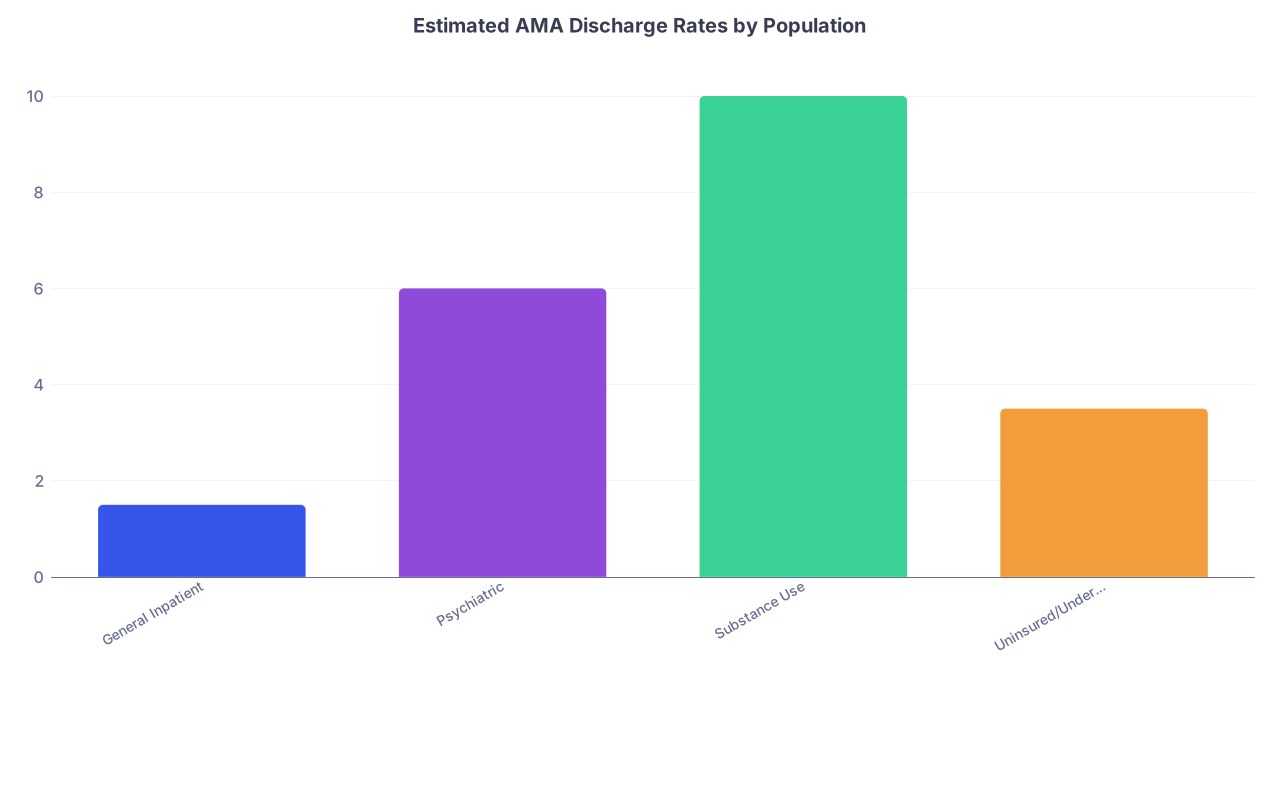
| Category | Value |
|---|---|
| General Inpatient | 1.5 |
| Psychiatric | 6 |
| Substance Use | 10 |
| Uninsured/Underinsured | 3.5 |
These are not exact numbers from a single study; they are conservative midpoints from multiple publications. The pattern is stable:
- General adult inpatients: ~1–2% leave AMA
- Psychiatric inpatients: 4–10% leave AMA
- Patients with substance use disorders: 6–15% leave AMA in some series
- Uninsured or Medicaid patients: consistently higher AMA rates than privately insured
The profile of a “typical” AMA patient differs by institution, but several predictors are remarkably consistent across cohorts:
- Younger age (often 30s–40s)
- Male sex
- Lower socioeconomic status
- Substance use disorder (alcohol or drugs)
- Prior AMA discharge(s)
- Lack of primary care follow-up
This is where most commentary stops: a demographic summary. But the more important story is outcome data.
Mortality and readmission risk: the hard numbers
Multiple studies have quantified the increased odds of mortality and readmission among AMA patients, adjusting for illness severity and comorbidities.
A common pattern:
- 30-day readmission risk: roughly 2–3 times higher
- Short-term mortality: 2–4 times higher in some cohorts
- ED revisits: often double or more compared to routine discharges
| Outcome | AMA vs Routine Discharge (Adjusted) |
|---|---|
| 30-day readmission | 2.0–3.0 × higher |
| 30-day ED revisit | 1.8–2.5 × higher |
| 90-day mortality | 2.0–3.5 × higher |
| 1-year mortality (some) | 1.5–2.0 × higher |
Again, specific numbers differ by diagnosis and study design, but the direction is not controversial. The effect sizes are large and consistent. From a risk-stratification standpoint, “left AMA” is effectively a red flag variable.
Take heart failure as an example. A patient who leaves AMA during a decompensation admission often has:
- Incomplete diuresis
- No med reconciliation
- No clear follow-up
- Often, no prescriptions filled
Clinically, you already know the likely outcome: they bounce back. The data agree. Several condition-specific analyses (heart failure, COPD, infections) show AMA as an independent predictor of early rehospitalization.
For a hospital that tracks quality metrics, AMA discharges are tiny in volume but extremely “expensive” in avoidable utilization. When you run cost models, AMA patients often show:
- More ED visits in the 30–90 days post-discharge
- More unscheduled admissions
- Higher per-patient cost over a 6–12 month horizon
So from the numbers: AMA is not a paperwork issue. It is a risk-concentration phenomenon.
Why patients leave AMA: patterns in the data, not just anecdotes
There is a persistent myth among clinicians that AMA equals “patient is noncompliant and unreasonable.” The data say something harsher: AMA is often a marker of system failure.
Surveys and qualitative studies consistently highlight a limited and repeating set of reasons, which fall into a few dominant buckets:
- Perceived clinical recovery / “I feel better”
- Family and work obligations (childcare, job risk, caregiving)
- Frustration with communication, wait times, or perceived disrespect
- Financial concerns (loss of wages, cost of stay, lack of insurance)
- Substance use and withdrawal (craving, poor withdrawal management)
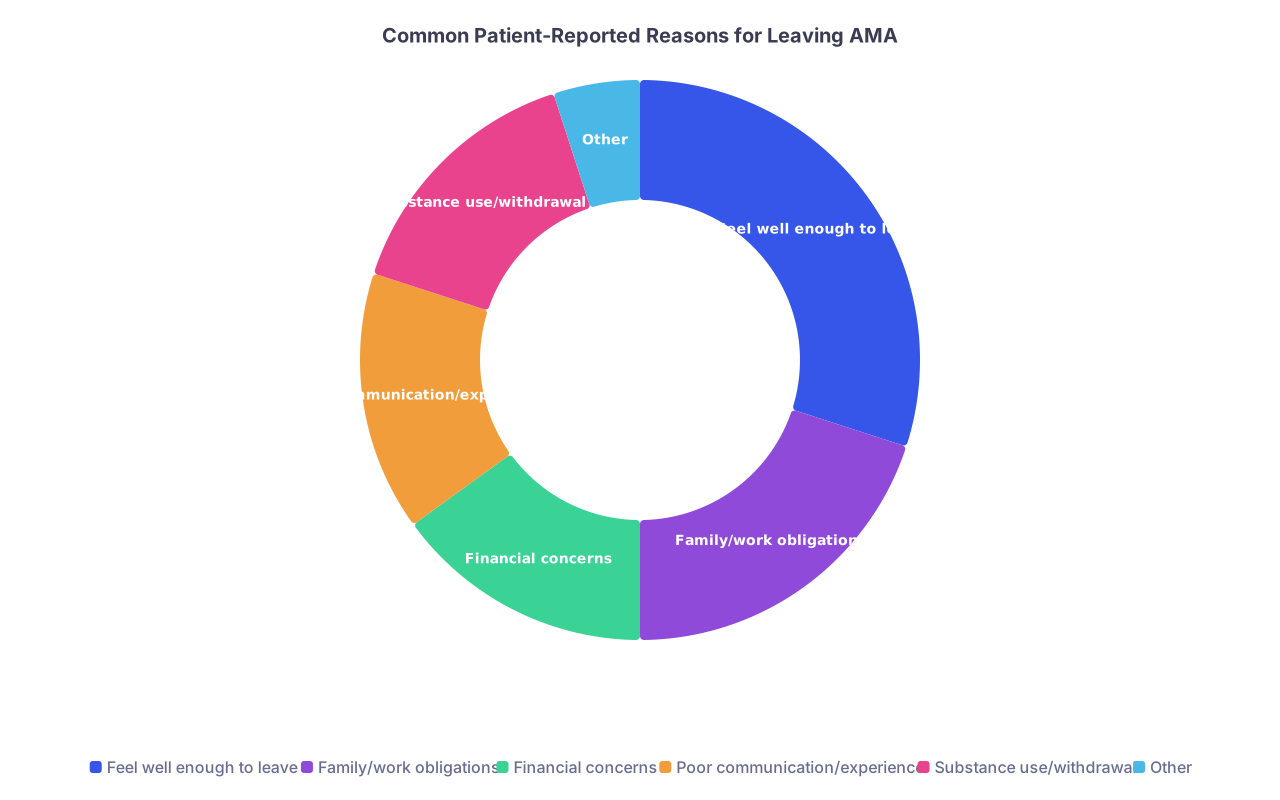
| Category | Value |
|---|---|
| Feel well enough to leave | 30 |
| Family/work obligations | 20 |
| Financial concerns | 15 |
| Poor communication/experience | 15 |
| Substance use/withdrawal | 15 |
| Other | 5 |
Again, these percentages are composite, but the rank order is consistent across multiple settings.
From a data analyst’s perspective, the phrase “against medical advice” is misleading 30–40% of the time. Many patients are not actually “against” the advice. They simply perceive no clinically acceptable option that fits their social and financial reality.
For medical ethics, that matters. Because you are not assessing capacity in a vacuum. You are assessing capacity under structural pressure and often undercounseled risk.
Capacity, consent, and documentation: where the legal risk really lives
Most clinicians worry that AMA discharges create more liability. The better reading of the legal literature and case patterns: a properly handled AMA discharge reduces liability compared to an unplanned elopement or coerced stay.
The caveat is “properly handled,” and that is precisely where practice frequently fails.
The three variables lawyers actually care about
When you look at malpractice cases involving AMA in detail, the same three questions recur:
- Was the patient decisionally capable at the time of leaving?
- Was the risk explained in a way a reasonable person could understand, and was that explanation documented?
- Did the clinician offer a safer, reasonable alternative plan (harm reduction) rather than an all-or-nothing ultimatum?
If the answer is “yes” to all three, the AMA form itself is almost a footnote. If any of these are “no” or “unclear,” the signed form will not save you.
The capacity question is the most abused. Capacity is decision- and time-specific. Yet I routinely see progress notes with a single line: “Patient has capacity and wishes to leave AMA.” No mention of:
- Orientation
- Understanding of diagnosis
- Ability to paraphrase risks and alternatives
- Influence of intoxication, delirium, or psychosis
From a legal standpoint, that might as well say: “We did not actually evaluate capacity, but we needed this bed.”
Contrast that with a data-driven approach: treat capacity as a binary classifier you must justify with observable features. You would never sign off on a lab-based diagnosis with “looks infected.” Capacity deserves at least the same level of operational detail.
What the evidence says about “good” AMA practice
There are no randomized trials of AMA protocols vs standard care (ethics committees would have a problem with that), but several observational series show patterns that reduce readmissions and legal risk.
Harm reduction and “partial AMA”
Some hospitals quietly use what I call “partial AMA strategies,” though they do not usually use that term. The concept is simple: do not force a binary choice between “full admission as planned” and “walk out with nothing.”
Instead, negotiate a safer compromise:
- Shorter stay with clear criteria (e.g., “We can target discharge in 24 hours after these two labs and an x-ray”)
- Transition to observation or day-hospital status if available
- Outpatient IV therapy where infrastructure exists
- Written prescriptions, explicit return instructions, scheduled follow-up
Studies that looked at structured discharge counseling (even when patient leaves AMA) show:
- Increased follow-up attendance
- Reduced ED revisits
- Improved patient satisfaction scores
- No increase in medico-legal actions
This is not surprising. You are converting what would have been an “unplanned exit” into a risk-managed, time-compressed discharge.
From a risk modeling standpoint, you move the patient’s risk curve closer to a standard discharge by:
- Reducing information asymmetry
- Providing a clear safety net
- Documenting shared decision-making
The documentation triad that actually matters
Forget the ritual of “patient signed AMA form.” What actually changes your legal risk is a triad of documentation:
- Capacity assessment: Specific cognitive and understanding checkpoints.
- Risk communication: Concrete examples, not vague threats (“you could die” is legally weak; “your infection could spread to your blood and cause organ failure within days” is stronger).
- Alternatives offered: Discharge plans, prescriptions, follow-up arrangements, social work involvement, safe-transport discussions.

| Step | Description |
|---|---|
| Step 1 | Patient requests to leave |
| Step 2 | Assess capacity |
| Step 3 | Consider hold or surrogate |
| Step 4 | Explain diagnosis and risks |
| Step 5 | Offer alternative plans |
| Step 6 | Document discussion |
| Step 7 | AMA form signed or refused |
| Step 8 | Provide written instructions |
| Step 9 | Capacity adequate |
The step that is most often missing in notes I review: step F. There is a tendency to frame the encounter as “stay and accept full plan vs leave and accept total risk”. Courts look very unkindly on that kind of binary coercion when there were intermediate options.
Measurable risks: readmissions, mortality, and cost
Let us quantify the impact of AMA discharges on systems and patients more concretely. A useful way is to think in terms of expected additional events per 100 AMA discharges, relative to matched routine discharges.
Assume:
- Baseline 30-day readmission after routine discharge for a given condition: 15%
- AMA readmission risk: 30% (2× higher)
For every 100 patients discharged routinely, 15 will be readmitted in 30 days. Among 100 “otherwise similar” patients who leave AMA, 30 will be readmitted. That is 15 “excess” readmissions per 100 AMA discharges.
Scale that:
- A moderate-size hospital with 400 AMA discharges per year may see ~60 excess readmissions attributable to AMA behavior alone (rough estimate).
- If the average cost of a readmission is $10,000–$15,000, that is $600,000–$900,000 in additional direct costs. Not counting ED visits and downstream utilization.
Now factor mortality. If baseline 90-day mortality for a sick cohort is 5%, and AMA status triples risk to 15%, that is an absolute increase of 10 deaths per 100 AMA discharges in this high-risk group.
No, not every hospital has those exact rates. The point is direction and magnitude: the effect sizes are big enough that even conservative estimates produce non-trivial harm and cost.
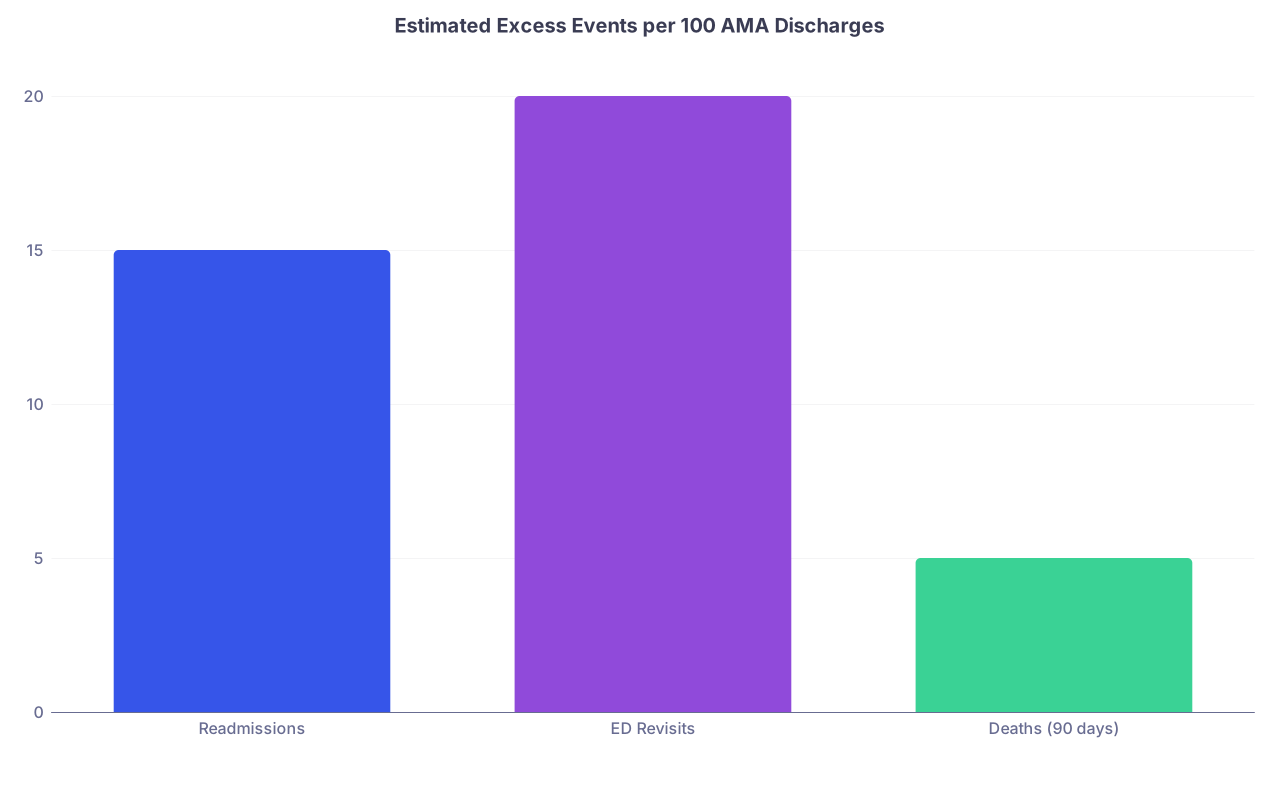
| Category | Value |
|---|---|
| Readmissions | 15 |
| ED Revisits | 20 |
| Deaths (90 days) | 5 |
If you are serious about quality metrics, AMA discharges are low-hanging fruit. You cannot eliminate them, but you can significantly reduce avoidable harm with targeted interventions:
- Early social work involvement for high-risk patients (substance use, no PCP, prior AMA)
- Standardized capacity and risk documentation templates
- Policy that no AMA discharge occurs without an attempt at harm-reduction planning
Legal misconceptions: what AMA forms do and do not do
I have heard this line from residents more times than I can count: “As long as we get the AMA form signed, we are covered.” That is flatly wrong, and courts have said so.
An AMA form is:
- Evidence that a conversation took place
- Evidence that the patient expressed a desire to leave despite advice
- Evidence relevant to comparative fault (how much responsibility is on patient vs clinician)
An AMA form is not:
- A waiver of all malpractice liability
- Proof that the patient had capacity
- Proof that the risk explanation was adequate
From a legal-analysis standpoint, AMA forms function like any other informed consent form: they are necessary but not sufficient. Courts look behind the form to the content and context.
Common litigation patterns involving AMA discharges include:
- Failure to recognize or document incapacity (e.g., intoxicated patient allowed to sign AMA and leave, later suffers harm)
- Failure to diagnose a critical condition prior to AMA (e.g., missed MI, stroke, surgical abdomen)
- Coercive language documented or testified (patient pressured, threatened with financial or legal consequences to stay or to sign)
- Inadequate follow-up planning when patient clearly articulated barriers
In such cases, plaintiffs’ attorneys sometimes argue that “against medical advice” was really “against inadequate or miscommunicated advice,” and juries often find that persuasive when documentation is thin.
If you care about medico-legal risk reduction, the following practices have strong face validity and support from case analysis:
- Avoid financial threats (“insurance will not pay if you leave AMA”) unless you have clear, accurate policy information—which most clinicians do not. Many such statements are factually wrong and later used against the clinician.
- Use lay language and document patient’s own words in the note: “Patient states, ‘I understand I could die if I go home, but I need to care for my children.’”
- Document specifically which tests and treatments the patient is declining (and which they accept).
Ethical analysis: autonomy vs beneficence, with numbers in the background
Ethically, AMA discharges sit at the crossroads of respect for autonomy and duty of care. The numbers make that tension sharper, not softer.
The beneficence argument is statistically straightforward: leaving AMA is associated with significantly higher risks of harm and death. If you model this like a decision tree, staying almost always dominates leaving in terms of expected health outcomes.
But autonomy demands that a decisionally capable adult can choose a dominated option. Even a very bad one. The ethical question becomes: do they understand the shape of the decision tree?
From an ethics perspective, robust AMA handling requires:
- Genuine exploration of the patient’s value hierarchy (e.g., is avoiding job loss more important to them than avoiding a 5% short-term mortality risk?)
- Clear translation of probabilities into meaningful terms for the patient
- Honest acknowledgment of system factors (costs, logistics) rather than pretending the only issue is “medical advice”
I have watched too many encounters where the physician’s entire counseling is: “You could die if you leave.” Vague. Apocalyptic. Weak. Patients have heard that line applied to everything from pneumonia to minor chest pain.
Numbers help here. Not because you need precise percentages, but because your language becomes grounded:
- “Most people in your situation who leave now end up back in the hospital within a few days or weeks.”
- “In similar cases, we see a much higher chance of serious complications when people leave early like this.”
- “Your risk of something bad happening in the next few weeks is several times higher if you go home now instead of staying for treatment.”
Translate risk ratios into human terms. That is ethically cleaner and legally more defensible.

Personal development: how to get better at AMA encounters
For trainees and early-career clinicians, AMA discharges are a litmus test of both ethical maturity and documentation discipline. You can get significantly better at them with deliberate practice.
Concrete habits that matter:
- Pre-emptive identification: When you see the classic risk profile (young, substance use, financial stress, prior AMA), bring in social work and case management early. Do not wait for the 10 p.m. “I’m leaving now” conversation.
- Script your core explanation: Have a mental template for explaining capacity, risk, and alternatives in plain language. Rehearse it like you rehearse ACLS.
- Document in structure, not prose: Use a template that forces you to fill in capacity elements, risks explained, alternatives offered, and patient’s own words.
If I were building an EMR smart-phrase for AMA notes, it would look roughly like this (and yes, this is how I personally structure it):
- Capacity: orientation, understanding of diagnosis, ability to restate risks, absence/presence of intoxication or delirium.
- Risks: specific to condition (e.g., “worsening infection, sepsis, death”).
- Alternatives offered: partial stay, outpatient options, follow-up appointments, prescriptions.
- Patient statement: verbatim summary of their reasoning.
- Witness (if available): nurse or staff who also observed discussion.

You are not just protecting yourself. You are creating a reliable narrative that respects the patient’s autonomy and makes their reasoning visible to the next clinician who encounters them in the ED two days later.
System-level data: using metrics to change policy
Hospitals that take AMA seriously do not just write policies; they track metrics. At minimum, the data that matter are:
- AMA rate per 1,000 discharges, by service line
- 30-day readmission among AMA vs routine discharges
- ED revisit rate within 7 and 30 days after AMA
- Condition-specific AMA frequencies (e.g., sepsis, HF, psych, SUD)

If you segment by attending, ward, or time of day, you will usually find clusters. For example:
- Night shifts with thin staff may have higher AMA rates
- Particular services (e.g., surgery vs medicine) may show very different patterns
- A small number of clinicians may be responsible for a large share of AMA discharges
That is not about blame; it is about targeted intervention. A focused communication-skills workshop for the highest AMA cluster might reduce system-wide AMA rates more than a hospital-wide lecture.
Key takeaways
Three points are non-negotiable if you care about AMA discharges from a data-driven, ethical, and legal perspective:
- AMA status is a strong risk marker: Patients who leave AMA have 2–3× higher readmissions and mortality in many cohorts. Treat “AMA” as a high-risk flag, not a minor administrative note.
- Liability hinges on capacity, communication, and alternatives—not the signature: A signed AMA form does little without documented capacity assessment, specific risk explanation, and reasonable harm-reduction options offered.
- You can move the needle: Early identification, structured counseling, and partial AMA strategies measurably reduce harm and protect both patients and clinicians. The data are clear; the real question is whether practice will catch up.


