

The usual advice about hiding a cancer diagnosis at a family’s request is dangerously vague.
You’ll hear: “Respect cultural norms.” “Honor the family’s wishes.” “Every case is unique.” That sounds compassionate. It’s also how doctors end up in front of hospital ethics committees, medical boards, and—less often but very real—civil courts.
If you’re asking whether you can ethically and legally conceal a cancer diagnosis from a competent adult patient because the family asked you to, the answer in almost every modern jurisdiction is: no. Not without very specific, narrow conditions being met. And no, “that’s how we do it in our culture” is not a magic legal shield.
Let’s cut through the sentimental noise and look at what the ethics codes, laws, and actual outcomes say.
What the Law and Major Ethics Codes Actually Say
Start with the foundation, not the folklore from the ward.
In essentially all Western jurisdictions and in most modern health systems globally, competent adult patients have two core legal rights:
- The right to informed consent
- The right to refuse information (and to appoint someone else to receive it)
Those are not the same thing as “the right of the family to decide what they hear.”
If you look at the big frameworks:
| Framework | Stance on Telling the Truth |
|---|---|
| AMA Code of Medical Ethics | Physicians must be honest; withhold info only if patient explicitly prefers not to know |
| WMA Declaration of Lisbon | Patient has right to know and right *not* to know; choice belongs to patient |
| European Convention on Human Rights & Biomedicine | Informed consent requires adequate information; allow exceptions only if patient waives |
| Typical US/EU Medical Malpractice Law | Failure to disclose material diagnosis can be negligence unless patient opted out |
None of these codes say: “You may withhold a cancer diagnosis from a competent adult because the family asked you to.”
They say:
- You must tell the truth.
- You can modify how and when you tell it.
- You can honor a patient’s explicit wish not to know.
That “explicit wish” is crucial. It has to come from the patient, not from their adult child who is panicking in the hallway.
The Family’s Favorite Myths (and Why They’re Wrong)
I’ve lost count of how many times I’ve heard some version of this in the corridor outside an exam room:
“Doctor, please don’t tell her it’s cancer. She’ll lose hope and die faster.”
This is not just emotionally driven. It’s factually wrong or, at best, selectively true.
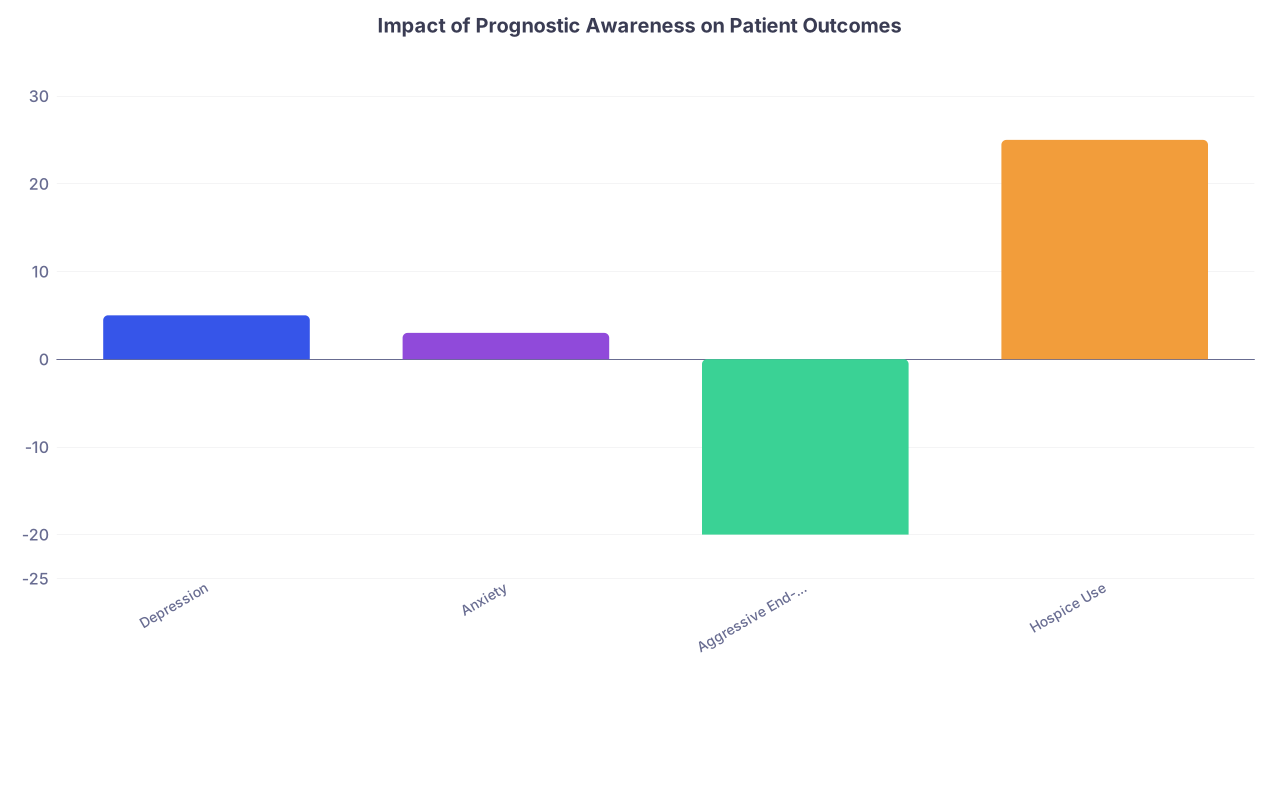
| Category | Value |
|---|---|
| Depression | 5 |
| Anxiety | 3 |
| Aggressive End-of-Life Care | -20 |
| Hospice Use | 25 |
Interpretation (from multiple oncology and palliative-care studies, especially in advanced cancer):
- Patients who understand their prognosis show slightly higher depressive symptoms early on (one digit more on standardized scales—not catastrophic).
- Anxiety results are mixed; sometimes lower when uncertainty decreases.
- They receive significantly less aggressive, non-beneficial end-of-life care (ICU, chemo in last weeks).
- They use hospice/palliative services more, which correlates with better symptom control and family outcomes.
So yes, reality hurts. But lying or concealing information tends to produce a different kind of harm: late referrals, chaotic last days, unresolved family conflict, complicated grief. You trade short-term “calm” for long-term damage.
The evidence does not support the myth that “not telling” is automatically better for psychological well-being or survival. It mostly supports the opposite: an honest, paced, empathic disclosure leads to more realistic choices and, in some metrics, better quality of life.
Cultural Relativism vs. Professional Obligations
The laziest way this gets handled is with a vague phrase: “But in this culture, families protect the patient.” I’ve seen Western-trained physicians fold instantly when confronted with a united family saying, “In our country, we don’t tell old people they have cancer.”
Here’s the uncomfortable truth:
You are bound by the professional and legal standards of the place where you practice, not by the informal norms of whichever culture the family claims to represent.
And the more diverse the setting, the more dangerous it is to treat “the family” as a singular voice for culture. I’ve watched this play out:
- The son insists the mother must not be told.
- The daughter corners you later and whispers, “She always said she wants to know everything. Please don’t lie to her.”
- The patient, when finally asked privately, says, “Of course I want to know what’s wrong with me. Why wouldn’t I?”
No culture is monolithic. “We never tell” often means “I’m terrified and I don’t want to deal with her reaction.”
If you hide behind “respecting culture” to avoid your own discomfort, you’re not being culturally sensitive. You’re outsourcing your ethical duties to the loudest relative.
The Narrow Exceptions: When Concealment Might Be Defensible
There are a few limited situations where not immediately stating “you have cancer” might align with both ethics and law. They’re more constrained than most people think.
1. The Patient Explicitly Chooses Not to Know
This is the big one. Many patients, especially older or from more paternalistic-care cultures, say things like:
“Doctor, I don’t want to know the details. Just talk to my son. He decides.”
You can work with this. But you cannot just guess that this is what they’d say.
You need:
- A clear conversation with the patient, when they’re competent, asking how much they want to know.
- Documentation that they declined detailed information or designated a surrogate for information/decisions.
That’s ethically and often legally acceptable: the patient’s right not to know and to delegate decision-making.
What you cannot do:
Let the family tell you, “She wouldn’t want to know,” without ever testing that directly with her.
2. Temporary Withholding for Therapeutic Reasons
The old “therapeutic privilege.” Historically abused. Now tightly constrained.
The idea: If immediate disclosure would cause serious, imminent harm (e.g., a psychotic break, immediate suicidal action), you can delay or modify how you disclose. But you must have solid, clinical grounds, not just a hunch that “bad news could upset him.”
Modern ethics and courts are skeptical of therapeutic privilege. It’s not a blank check. It’s a rare, time-limited exception, and you’re expected to:
- Involve psychiatry/psychology if possible.
- Reassess and disclose once the acute risk is managed.
- Document the rationale clearly.
“Her son thinks she’ll be sad” does not meet this bar. Not even close.
3. Lack of Decision-Making Capacity
If the patient truly lacks capacity—advanced dementia, acute delirium, severe cognitive impairment—you’re not “hiding” the diagnosis so much as recognizing they cannot meaningfully use it. In those cases, disclosure primarily shifts to the legal surrogate.
Even then, the law usually wants you to respect any known prior preferences of the patient. If the family is insisting on secrecy that contradicts a documented, prior autonomous wish (“I always want to know if I have cancer”), you’ve got a problem.
How This Goes Wrong Legally
Let’s be blunt: lawsuits over “you told me too much” are rare. Lawsuits over “you did not tell me enough” happen frequently.
Here’s a pattern I’ve seen in case summaries and ethics consultations:
- Patient isn’t told they have cancer “to protect them.”
- They consent to procedures and treatments labeled as “just a small surgery” or “routine medication” without clear risk/benefit framing.
- Complication occurs.
- Patient or another family member later learns the underlying diagnosis and that alternatives (or no treatment) were not discussed honestly.
- Claim: lack of informed consent, battery (unconsented touching), emotional distress.
Courts overwhelmingly see failure to disclose a material diagnosis as a breach unless there is clear, documented evidence that the patient chose not to know.
And the family that begged you to lie? They’re often nowhere to be found when legal responsibility lands. It lands on you, the physician, because the duty of informed consent is non-delegable.
The Real Ethical Conflict: Autonomy vs. Beneficence vs. Family
So what are you actually balancing?
- Patient autonomy: their right to know, to decide, to prepare.
- Beneficence/non-maleficence: acting in their best interests, avoiding harm.
- Family-centered care: acknowledging that illness is relational, not individual.
The common mistake is ranking “family comfort” as equal or above patient autonomy. It is not.
Ethically defensible approach:
- Weight the patient’s expressed values most heavily.
- Incorporate family concerns into how and when you disclose, not whether you disclose, unless the patient has opted out of information.
- Treat family fear as something to be addressed, not obeyed.
Let me be direct: If a competent patient says to you, in private, “Doctor, I want to know exactly what’s going on,” your obligation is to tell them. Even if every relative outside is begging you not to.
What Evidence-Driven “Best Practice” Actually Looks Like
There’s plenty of data on prognostic disclosure in oncology and palliative care. The pattern is consistent:
- Patients generally want more information than physicians think.
- Families want doctors to be more protective than patients actually prefer.
- Honest, gradual disclosure improves alignment between desired and received care.
- Avoidance and vagueness correlate with more intensive, less value-concordant end-of-life interventions.
So what works in practice?
You do not walk in and drop “You have stage IV pancreatic cancer and a median survival of six months” as your first sentence. But you also do not lie.

| Step | Description |
|---|---|
| Step 1 | Meet patient privately |
| Step 2 | Assess understanding |
| Step 3 | Ask how much they want to know |
| Step 4 | Disclose diagnosis honestly |
| Step 5 | Clarify who should receive details |
| Step 6 | Talk with designated family |
| Step 7 | Plan next steps with patient |
| Step 8 | Wants full info |
| Step 9 | Wants limited info |
Key moves that align with both law and ethics:
- Talk to the patient alone, at least briefly. Families sometimes prevent you from doing this. Insist. It’s your only real protection.
- Ask: “Some people want to know every detail. Others prefer that I speak mainly to a family member. How do you prefer I handle information about your health?”
- Respect that stated preference and document it.
- If they want full information, give it in layers: start broad, then invite questions.
You can absolutely say:
- “We’ve found a serious problem with the cells in your lung. It’s a type of cancer. The good news is we have treatments. The more difficult part is that this is not something we can completely cure in most people. We should talk about what that means for you.”
That’s still honest. You’re not obligated to hit them with survival curves in minute one. But you cannot call lung cancer “just an infection” because the family panicked.
What About Trainees and Power Hierarchies?
If you’re a med student or resident, you’re probably not the one making the final call. But you’re often the one in the room when the attending goes along with concealment.
Legally, ultimate responsibility rests higher up the food chain. Ethically, you still have a spine.
You can:
- Ask, quietly but clearly: “Has the patient told us they do not want to know the diagnosis?”
- Suggest: “Maybe we should ask her directly how much she wants to know before we agree to the family’s request.”
- Document facts, not judgments, in your note: “Family requested non-disclosure of cancer diagnosis. Attending discussed.”
Is this comfortable? No. But pretending you didn’t see the ethical problem doesn’t make it go away.
The Bottom Line: Stop Hiding Behind “Protecting Them”
The sentimental story is that family-requested concealment is loving protection. Sometimes, maybe. But often it’s anxiety management for relatives, at the cost of the patient’s autonomy and your legal neck.
Here’s the distilled truth:
In modern medical law and ethics, a competent adult’s right to know—or explicitly not know—trumps family preferences. Your job is to find out what that patient wants, not what makes the family less anxious.
Evidence from oncology and palliative care shows that honest, empathic disclosure usually leads to better alignment of treatment with patient values, more appropriate end-of-life care, and no consistent catastrophic psychological harm. The “truth will kill them faster” narrative is mostly fiction.
Concealing a cancer diagnosis at the family’s request, without a clear patient directive or true lack of capacity, is ethically shaky and legally risky. At best, you might delay full disclosure for carefully documented therapeutic reasons. You cannot ethically turn a blind eye and pretend the patient has no voice.
If you remember nothing else: ask the patient, in private, how much they want to know. Then do what they asked, not what everyone else wishes were true.


