

The most dangerous prescriptions you’ll ever write are the first ones with only your name at the bottom.
If you treat those orders like “just more of what I’ve been doing on rotations,” you’re setting yourself up for legal and ethical trouble. The law doesn’t care that you feel supervised. Once your name is on that line, you’re on the hook.
This is the three‑month legal prep window almost nobody teaches you. I’m going to walk you through what you should do month by month, week by week from about 90 days before graduation until your first solo order goes live in the EHR.
Month –3: Get Your Legal Foundation Straight
At this point (about 90 days before graduation), you should:
- Map your licensing path
- Clarify your exact role on Day 1
- Start your paper trail and documentation habits
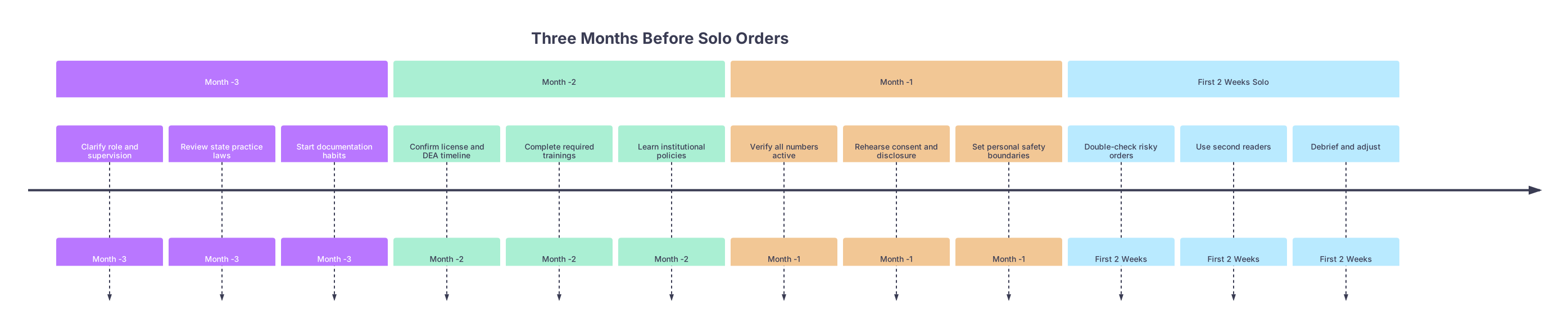
| Period | Event |
|---|---|
| Month -3 - Clarify role and supervision | Month -3 |
| Month -3 - Review state practice laws | Month -3 |
| Month -3 - Start documentation habits | Month -3 |
| Month -2 - Confirm license and DEA timeline | Month -2 |
| Month -2 - Complete required trainings | Month -2 |
| Month -2 - Learn institutional policies | Month -2 |
| Month -1 - Verify all numbers active | Month -1 |
| Month -1 - Rehearse consent and disclosure | Month -1 |
| Month -1 - Set personal safety boundaries | Month -1 |
| First 2 Weeks Solo - Double-check risky orders | First 2 Weeks |
| First 2 Weeks Solo - Use second readers | First 2 Weeks |
| First 2 Weeks Solo - Debrief and adjust | First 2 Weeks |
Week 1–2: Define your actual authority
You’d be shocked how many interns reach orientation with no idea what they’re legally allowed to do.
In these two weeks:
Clarify your training level and title
- Will you be:
- PGY‑1 in residency?
- Transitional year?
- Prelim?
- Why it matters: different programs and states have different rules for what a PGY‑1 can order independently.
- Will you be:
Ask your future program two blunt questions Email or ask your program coordinator/PD:
- “On Day 1, what orders am I allowed to enter independently, and which require co-signature?”
- “Are there any institutional or state restrictions specific to PGY‑1s (e.g., for chemo, blood products, restraints, or high‑risk meds)?”
You’re not asking for vibes. You want:
- Policy documents
- Resident handbook
- Any “Privilege Delineation” forms that define what residents can do
Find your state’s practice rules Go to your state medical board website. You’re looking for:
- Scope of practice for residents
- Supervision requirements
- Any language about “house officers” or “training licenses”
If there’s a PDF titled something like “Resident Licensure Requirements” or “House Staff Manual,” download it. Keep a folder. You’ll reference it for years.
Week 3–4: Learn the legal basics you’re about to be judged against
Ethics and law are not the same. You need both.
In this stretch, at minimum, refresh:
Negligence basics – the thing you’ll hear in every malpractice talk
- Duty: you had a physician‑patient relationship
- Breach: you fell below standard of care
- Causation: your breach contributed to harm
- Damages: there was actual harm
Supervision reality
- If you’re uncertain and don’t ask for help when a reasonable intern would have → that’s where you get burned.
- “I was busy” and “nobody told me” are not defenses. I’ve sat in risk meetings. Those lines get you eye rolls, not protection.
Vicarious liability
- Yes, the hospital and attending get named in suits.
- No, that doesn’t erase your responsibility. Your documentation and decisions will still be dissected.
At this stage, you should also start thinking:
“If this patient were harmed, would a reviewer reading my note understand my reasoning and level of uncertainty?”
That’s the legal lens you’re going to practice with.
Month –2: Lock Down Licensure, Numbers, and Required Training
By two months out, your goal is to remove administrative excuses from your risk profile. No illegal prescribing. No ordering outside your license. No “I thought it went through” nonsense.
Weeks 5–6: Map every number tied to your name
You are about to become a walking stack of identifiers. Get clear early.
| Item | Typical Timing |
|---|---|
| State license (or training license) | 1–3 months pre-start |
| NPI (National Provider Identifier) | During final year |
| DEA registration | After license, pre‑start or early PGY‑1 |
| Institutional provider ID | Orientation week |
During these two weeks:
State license / training license
- Know whether your state uses:
- Full license for residents
- Limited/training license via the GME office
- Ask:
- “Who actually submits the application, me or GME?”
- “What date is my license expected to be active?”
Critical rule:
You do not sign solo orders that legally require a license until that license is verifiably active. “HR said it should be fine” does not count.- Know whether your state uses:
NPI
- If you do not have an NPI, apply now. It’s free and fast.
- Keep the number in your records, and confirm it’s correctly linked to your future institution.
DEA registration
- Many programs prefer or require that you wait until after you start. Some provide institutional DEA coverage.
- Ask explicitly:
- “Do interns have individual DEA numbers, or is there an institutional DEA?”
- “If institutional, what are the rules for how my name is attached to controlled prescriptions?”
You never write a controlled prescription under someone else’s DEA in a way that misrepresents who prescribed.
Weeks 7–8: Required legal/ethical trainings – do not phone these in
This is the stretch where those “mandatory modules” start showing up. Most people click through while watching Netflix. That’s dumb.
Focus on four categories that hit legal risk hardest:
Informed consent
- What elements are legally required in your state:
- Diagnosis or nature of condition
- Proposed intervention
- Risks, benefits, and alternatives (including no treatment)
- Who’s performing the procedure
- Which procedures you may consent for as an intern vs which require attending involvement.
- What elements are legally required in your state:
Capacity and surrogates
- How your institution and state define:
- Decision‑making capacity
- Hierarchy of surrogate decision makers
- Documentation requirements when declaring someone lacks capacity
- How your institution and state define:
EMTALA (if you’ll be in the ED or accepting transfers)
- Know the two core duties:
- Medical screening exam for all who present
- Stabilizing treatment or appropriate transfer
- Understand that dumping or refusing unstable patients because beds are tight is not just annoying. It’s a federal violation.
- Know the two core duties:
HIPAA / confidentiality
- Where people actually mess up:
- Talking about “the GI bleed in 402” in elevators
- Texting patient info unencrypted
- Accessing charts “just to check on interesting cases”
- Where people actually mess up:
You’re building mental checklists now. Those habits will save you when you’re tired and moving fast.
Month –1: Prepare for Day‑1 Orders, Consent, and Documentation
At this point, you’re about 4 weeks away. Anxiety should be turning into specific questions, not vague dread.

Weeks 9–10: Learn your institution’s “red flag” categories
Hospitals have quiet lists of things that get residents in trouble. You want that list.
Ask chief residents or a trusted senior:
“If a PGY‑1 gets called to the program director’s office for something in the chart, what is it usually about?”
You’ll hear the same themes:
Restraints
- There are always detailed policies:
- Who can order
- Required documentation
- Time limits and re‑evaluation
- Botched restraints can lead to regulatory citations and lawsuits.
- There are always detailed policies:
Blood products
- Consent requirements
- Documentation of indication and discussion of risks
- Protocol for emergent transfusion when consent isn’t possible
Code status and goals of care
- How “DNR,” “DNI,” “comfort care,” “limited interventions” are defined locally
- Who can enter these orders, and what documentation must accompany them
High‑risk meds
- Heparin/warfarin
- Insulin
- Opioids/benzodiazepines
- Chemotherapeutic agents
For each category, you want:
- Policy document (PDF or intranet link)
- A real example from a senior of “what went wrong once”
You’ll remember the stories more than the policy language. That’s fine. Both help.
Weeks 11–12: Rehearse consent and “hard conversations”
You’re about to have your first truly solo consent and code status talks. Ethically and legally, this is where weak training shows up.
In these weeks:
Write and practice 2–3 standard consent scripts
- Example: paracentesis, central line, lumbar puncture.
- Each script must hit:
- What we’re doing – in normal language
- Why we’re doing it
- Main risks (not exhaustive lists)
- Real alternatives, including deferring
- Space for patient questions
Practice with classmates or a mirror. Yes, out loud. The first time shouldn’t be at 2 a.m. with a scared patient and a nurse staring at you.
Code status conversation framework Build a simple internal structure:
- Understand: “What do you know about what’s going on with your health right now?”
- Align: “How do you feel about hospital care, interventions, ICU if needed?”
- Explain options clearly without jargon
- Document:
- Who was in the room
- What you explained
- Decisions made and any uncertainty
Know when to pull the attending in Ethically and legally, your job is not to prove you can handle everything alone. You call for backup when:
- Family is in conflict
- Language barriers + unclear understanding
- High‑stakes, irreversible choices (amputation, withdrawal of life support, etc.)
Document that you involved senior staff. That’s not weakness. That’s professionalism.
Last 7 Days Before Graduation: Personal Safety Rules for Your Future Self
This is the “line in the sand” period. You’re not just learning rules now. You’re deciding what you will and won’t do under pressure.
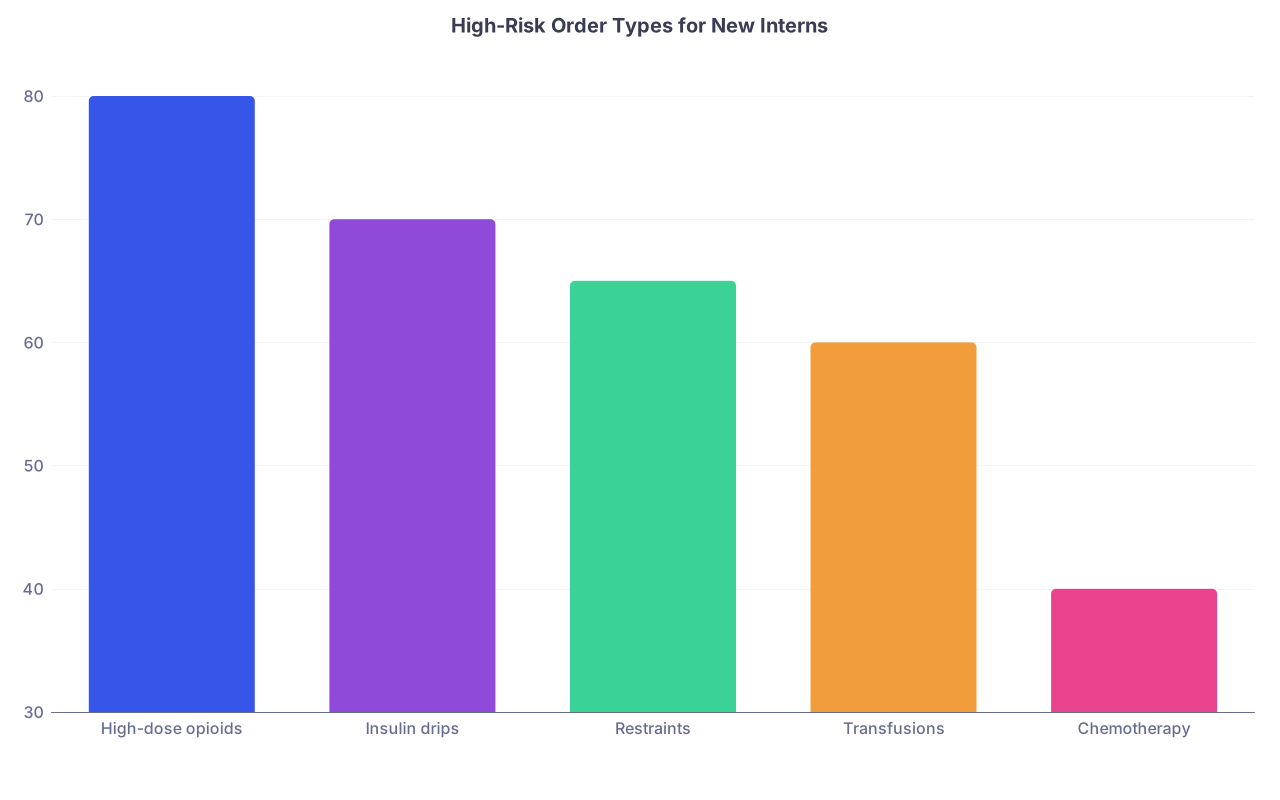
| Category | Value |
|---|---|
| High-dose opioids | 80 |
| Insulin drips | 70 |
| Restraints | 65 |
| Transfusions | 60 |
| Chemotherapy | 40 |
(Values here roughly represent how often I see new interns get in trouble with each category, relative to the others.)
Day –7 to –5: Set your personal “hard stops”
Write this down somewhere private. Call it your Non‑Negotiable Safety Rules. Examples:
- “I will not start or escalate a high‑dose opioid regimen in a chronic pain patient without attending input and proper documentation of the plan.”
- “I will not sign consent for a major procedure if I do not understand the procedure reasonably well and cannot answer basic questions honestly.”
- “I will not enter a restraint order without:
- Directly seeing the patient
- Documenting behavior and alternatives attempted
- Knowing the policy requirements for re‑evaluation.”
These are not for show. They’re what you fall back on when a senior says, “Just put it in, we’re behind,” and your stomach drops.
Day –4 to –2: Documentation templates in your own words
You’re about to write thousands of notes. Most will be fine. A few will be dissected line by line if something goes wrong.
Create simple text snippets (in your brain, or in a safe note repository) for:
When you’re uncertain but acting reasonably
- “Given X and Y findings, differential includes A, B, C. At this time, clinical presentation most consistent with B. Plan is to treat as B while monitoring closely for evolution toward A (sepsis, etc.). Discussed with senior/attending Dr. ___ at [time], who agrees with plan.”
When you deviate slightly from a guideline
- “Usual guideline would suggest X. Deviating in this case because Y (patient comorbidity, allergy, prior adverse reaction). Discussed risks/benefits with patient/family; they agree with plan.”
That’s the kind of language that shows judges, juries, and peer reviewers you were thinking, not guessing.
Day –1: Mental reset and boundaries
The day before graduation, do not cram. You won’t retain anything meaningful.
Do this instead:
Look back at:
- Your state practice rules
- High‑risk institutional policies
- Your Non‑Negotiable Safety Rules
Decide who your “call first” person is:
- The senior who said, “Always call me, no matter how small it feels.”
- A co‑intern you trust to sanity‑check tough situations.
Ethically, medicine is a team sport. Legally, your name is still individual. You need both truths in mind at once.
First 2 Weeks of Solo Orders: Real‑Time Application
You’ve graduated. You’re in orientation or just coming out of it. The EHR now happily puts your name on orders. This is the stress test.

Week 1: Slow down on anything that can kill someone fast
You cannot treat all orders equally. You triage your attention.
Any time you’re about to order:
- IV potassium
- Insulin (especially drips or complex regimens)
- Anticoagulation (heparin, DOACs, warfarin)
- High‑dose opioids or benzos
- Chemotherapy or other specialty infusions
Stop. Ask yourself:
- “Do I understand why I’m ordering this right now?”
- “Do I know the monitoring plan?” (labs, vitals, neuro checks, etc.)
- “Have I seen a senior do this exact thing and explain it before?”
If any answer is “no,” you call someone. That’s the rule.
Week 2: Use second readers on high‑risk decisions
Build a habit:
- One second reader (senior, attending, pharmacist, experienced nurse) on:
- New anticoagulation starts in borderline cases
- Code status changes
- Initiation of restraints
- Transfers to or from ICU
It adds 2–3 minutes. It saves you from doing something that looks indefensible in hindsight.
Also in this week:
- Debrief your first “I didn’t feel great about that” cases with someone you trust.
- Notice patterns:
- Are you consistently rushed on discharge prescriptions?
- Are you weak on renal dosing?
Those patterns are where legal trouble often starts: not the big dramatic misses, but the small, repeated, sloppy ones.
Final Thoughts: The Short List to Remember
Strip away all the noise, and three things matter before you sign orders solo:
Know your actual authority.
State license status, institutional policies, and training level define what you can legally do on Day 1. Find the documents, not just the hallway rumors.Be explicit about uncertainty and supervision.
When in doubt, call. Then document that you called, what you discussed, and why the final plan made sense at the time.Set personal safety rules and stick to them.
Especially for high‑risk meds, restraints, consent, and code status. Those lines you draw for yourself are what stand between “tough case” and “career‑changing lawsuit.”


