The biggest ethical failures on the wards rarely start on the wards. They start in MS1 and MS2, with students who treated ethics as trivia instead of training.
Here is the fix: a concrete MS1–MS2 roadmap that builds an ethical foundation before you ever touch a pager.
Big-Picture Timeline: What You Are Building When
Before we go month-by-month, you need the skeleton. During MS1–MS2 you are not “learning ethics” in the abstract. You are building four things, in order:
- A vocabulary for ethical reasoning (so you can name what feels off).
- A framework for analyzing cases under pressure.
- Habits for how you behave with patients, peers, and digital systems.
- A personal spine so you do not fold when a resident says, “Just document it this way.”
Here is how that unfolds:
| Stage | Focus | Main Output |
|---|---|---|
| MS1 Fall | Vocabulary + Awareness | Basic principles, red-flag radar |
| MS1 Spring | Frameworks + Cases | Repeatable analysis approach |
| Summer (M1–M2) | Real-world exposure | Stories, reflection, boundaries |
| MS2 Fall | Clinical prep + gray zones | Scripts, escalation plans |
| MS2 Spring | Transition to wards | Personal ethics playbook |
Now we go chronologically.
MS1 Fall: Build Your Ethical Vocabulary and Radar
At this point you should stop thinking of ethics as “soft stuff” and treat it like pharmacology: specific, testable, and dangerous if you get it wrong.
Month 1–2: Get the Basics Locked In Early
Goal: By the end of the first 8 weeks, you should be fluent in the core principles and legal anchors.
Focus on five pillars. Not fifteen. Five.
- Autonomy
- Beneficence
- Nonmaleficence
- Justice
- Respect for persons / dignity
Concrete steps (Weeks 1–8):
Week 1–2: Build your mini-lexicon
- Make a one-page “Ethics Core Sheet” summarizing:
- Definitions of the five principles
- Capacity vs competence
- Informed consent elements
- Confidentiality basics (especially HIPAA and state privacy laws)
- Attach it to your anatomy binder or note app. You will actually review it that way.
- Make a one-page “Ethics Core Sheet” summarizing:
Week 3–4: Tie ethics to your early courses
- Any patient vignette in anatomy or physiology? Ask:
- Who has decision-making authority here?
- What information would I owe this patient?
- What could go wrong if privacy is ignored?
- Write one 3–5 sentence reflection per week connecting a pre-clinical case to an ethical principle. Fast, not polished.
- Any patient vignette in anatomy or physiology? Ask:
Week 5–8: Understand the legal floor
- Learn the minimum legal rules you are expected to obey from day one:
- HIPAA basics (what counts as PHI, where you can/c cannot talk about patients).
- Mandatory reporting: child abuse, elder abuse, threats of harm.
- Basic consent rules: minors, emergent situations, surrogate decision makers.
- Go to one institutional talk on compliance or privacy. Pay attention when they describe “actual violations we have seen.” Those concrete examples will stick.
- Learn the minimum legal rules you are expected to obey from day one:
Warning sign: If by the end of Month 2 you cannot quickly explain the difference between informed consent and shared decision-making, you are behind. Fix it now, not on surgery.
Month 3–4: Start Seeing Ethical Problems Everywhere (Quietly)
Goal: Train your “ethical red-flag radar.”
By mid-fall MS1, at this point you should be:
- Recognizing when autonomy is being overridden “for their own good.”
- Noticing sloppy language about patients in lectures or small groups.
- Feeling an inner “this is off” alarm that you can actually articulate.
Practical routine for Weeks 9–16:
- In small groups, when you feel something is ethically odd, ask:
- “What is the patient’s understanding here?”
- “Do they have capacity in this scenario?”
- “Who is making the decision, really?”
- Once per week, take a case from class and run through three questions:
- What is the primary conflict of values here?
- Which stakeholders are being overlooked?
- If I were the MS3 in the room, what would I actually say or do?
You are not trying to be “the ethics person” in every discussion. You are training your own internal narrator to label what is happening.
MS1 Spring: Build Your Ethical Framework and Muscle Memory
Now you have vocabulary. At this point you should start practicing structured analysis, not just opinions.
Month 5–6: Learn a Stepwise Case Approach
Pick one simple ethical framework and commit to it.
Example 6-step approach:
- Identify the clinical facts (what is actually happening).
- Identify the ethical question in one sentence.
- List stakeholders and their interests.
- Name the relevant principles/laws (autonomy, beneficence, capacity, etc.).
- Generate options (at least two, ideally three).
- Justify a decision and anticipate objections.
Now, weeks 17–24, practice:
- Take one case per week (from lecture, OSCE, a textbook, or ethics consult service blog) and actually write out these 6 steps.
- Time-box to 15 minutes. Treat it like a question set, not an essay.
- Once a month, present a case to a peer or small group using this structure. Force yourself to speak in a linear, defensible way.
This is what will save you when an attending says, “You disagree with this plan? Defend your position.”
Month 7–8: Add Law and Policy Reality Checks
Ethics without law is fantasy. Law without ethics is dangerous.
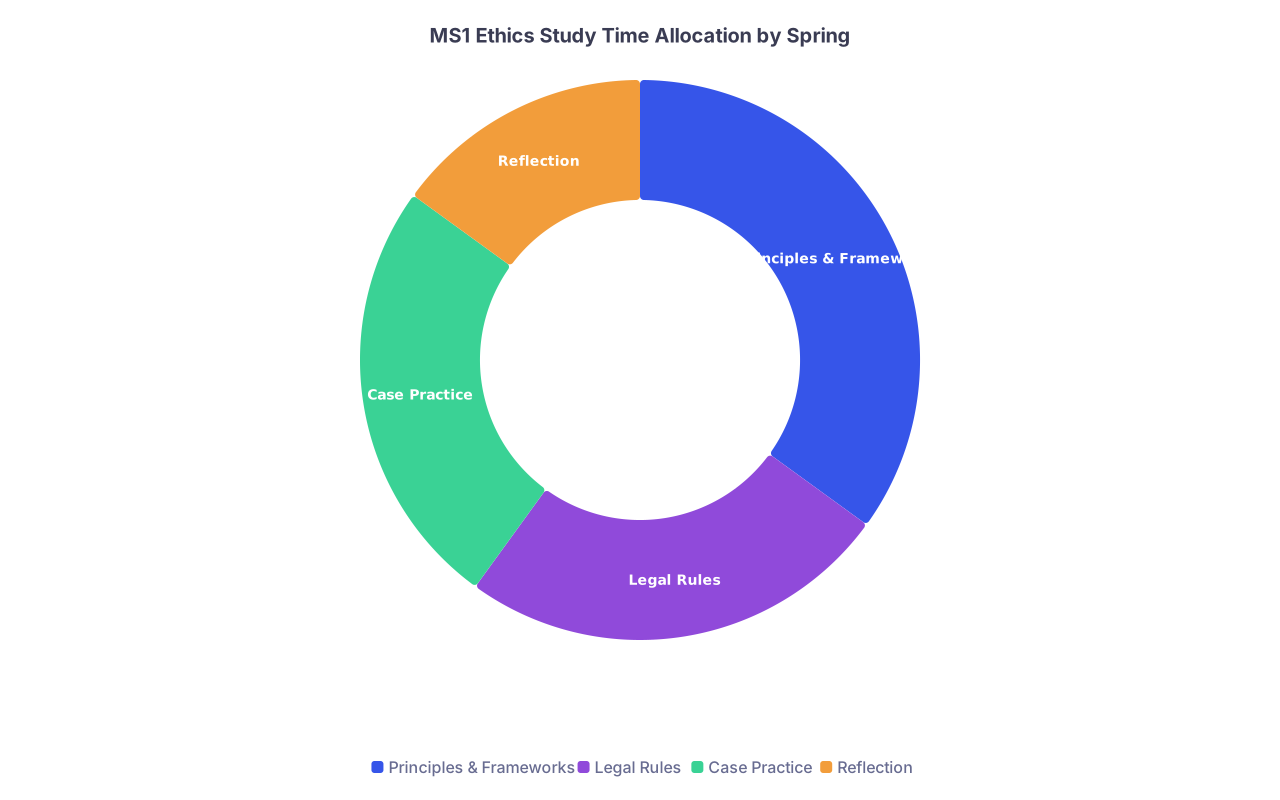
| Category | Value |
|---|---|
| Principles & Frameworks | 35 |
| Legal Rules | 25 |
| Case Practice | 25 |
| Reflection | 15 |
In these months, you should:
- Learn the big recurring legal themes:
- Advance directives and DNR orders
- Surrogate decision-making hierarchy in your state
- Basics of EMTALA, informed consent doctrines, and capacity evaluations
- Tie them to cases. For each:
- What is legally required?
- What is ethically preferable?
- What happens when those diverge?
Once a month, do this drill:
- Pick a classic scenario: e.g., Jehovah’s Witness refusing transfusion, unrepresented ICU patient, non-adherent diabetic patient.
- Outline:
- Legal minimum
- Ethically ideal
- What you would actually recommend as the MS3 or MS4 in the room
The point: you start anticipating the tension between “what the law allows us to do” and “what a decent physician ought to do.”
Summer Between MS1–MS2: Real-World Exposure and Boundaries
This is where students either grow or get sloppy.
At this point you should be deliberately choosing experiences that will expose you to real ethical tension, not just more shadowing for your CV.
Early Summer (Weeks 1–4): Choose Experiences with Ethical Friction
If you have options, prioritize:
- Palliative care or oncology shadowing
- Emergency department volunteering
- Community clinics serving uninsured or undocumented patients
- Research involving human subjects (with IRB exposure)
These environments are full of real dilemmas: futility, resource allocation, communication gaps.
Your simple weekly structure:
- Week 1–4: For every shift, write down:
- One moment where communication broke down
- One moment where a patient’s values clashed with the plan
- One moment where system limitations drove care
You do not need solutions yet. You are collecting raw data.
Mid–Late Summer (Weeks 5–10): Practice Boundaries and Confidentiality
Summer is when students get casual. And that is how careers get torched.
Non-negotiables you should implement:
- No patient talk in public spaces: cafeterias, public transport, social media DMs. Ever.
- No screenshots of patient info, even “de-identified.” You are not as anonymous as you think.
- No sharing vivid stories with identifying details at social events.
Do a self-audit:
- Google your own name.
- Check your social media for anything that could be interpreted as mocking patients, attending, or vulnerable populations.
- Lock privacy settings down and assume anything you post may one day be read in court.
You should end the summer with:
- 5–10 short case notes from your experiences.
- 2–3 instances where you felt real moral discomfort and wrote out why.
- Clear personal rules about confidentiality and professional boundaries.
MS2 Fall: Translate Ethics into Clinical Behavior
Now you know words and concepts. At this point you should start rehearsing exactly what you will say and do in real situations on the wards.
Month 1–2 of MS2: Build Scripts for Common Ethical Moments
You will not have time to “reflect deeply” when your senior tells you “just put in the note.”
So you prepare scripts now for recurring situations:
- When a patient asks, “Will I be OK?” and no one has told them the full picture.
- When a resident bad-mouths a “non-compliant” patient loudly in the hallway.
- When family members ask you for results they technically should not get from you.
- When you witness questionable consent (“He signed the form, it’s fine”).
Spend weeks 1–8 doing this:
Pick one scenario each week.
Write 2–3 sentences you could realistically say as an MS3:
- “This sounds really important. I want to make sure the primary team is part of this conversation so we give you the right information.”
- “I’m uncomfortable talking about them this way. Can we reframe what is going on with their situation?”
- “I’m just a student, but I can ask the team to come back and explain the options again if that would help.”
Practice out loud once. Yes, you will feel silly. Do it anyway.
By the end of Month 2, you should have 8–10 “go-to” lines that align with ethics and still respect hierarchy.
Month 3–4 of MS2: Learn How to Escalate Without Getting Crushed
You will see something wrong. You will be junior. Both will be true.

Your job this semester is to map out how you will raise concerns.
Steps for weeks 9–16:
- Map your institution’s pathways:
- Who is your immediate go-to? Usually your resident, then fellow, then attending.
- Who are the “off-line” options? Clerkship director, student affairs dean, ombuds office, ethics consult line.
- Write down for yourself:
- “If I see X (e.g., serious privacy breach, falsified note, racist comment to a patient), my first step is Y, second step is Z.”
Then practice case-based escalation:
Once a week, take a hypothetical:
- Resident copies forward a note saying “normal exam” on a patient clearly not examined.
- Nurse asks you to “just change the order so it looks like the team entered it earlier.”
- Attending dismisses a patient’s explicit refusal with “he does not know what he wants.”
For each, write:
- What you would say in the moment, if anything.
- What you would do after, and in what order.
- Where you would document your concern for your own records (secure, private, factual).
You are not aiming to be a hero in every scenario. You are aiming to avoid being complicit in clear wrongdoing.
MS2 Spring: Build Your Personal Ethics Playbook for the Wards
This is your last pre-clinical semester. At this point you should be consolidating, not just cramming pharm.
Month 5–6 of MS2: Create Your Ethics “Pre-Clerkship Checklist”
You are about to start real clinical work. Treat ethics like BLS – a required certification.
Build a one-page checklist you review before each clerkship block:
- Core principles (the five from MS1)
- Red-flag behaviors you will not participate in:
- Falsifying data or exam findings
- Gossiping about patients in non-clinical spaces
- Using demeaning language about any patient group
- Boundaries:
- You will not “friend” patients on social media.
- You will not accept expensive gifts.
- You will not access charts for patients you are not involved with.
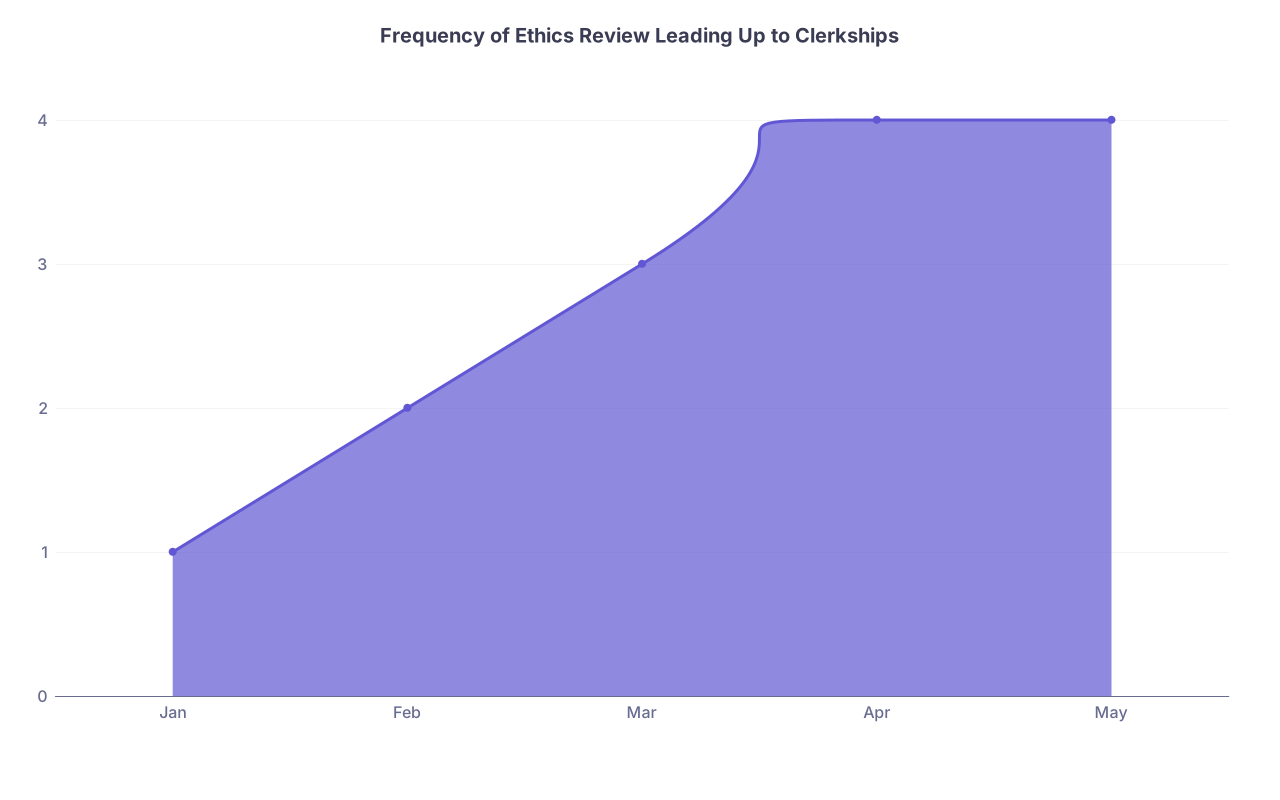
| Category | Value |
|---|---|
| Jan | 1 |
| Feb | 2 |
| Mar | 3 |
| Apr | 4 |
| May | 4 |
Set calendar reminders:
- Two weeks before each clerkship: re-read this sheet.
- First weekend of each clerkship: jot down one situation that might test your boundaries on that service (e.g., “surgery culture”, “OB triage volume and shortcuts”).
Month 7–8 of MS2: Rehearse OSCE-Style Ethical Encounters
You need reps, not theory.
In the last 8–10 weeks before you hit the wards:
- Do at least 5–10 simulated or peer-role-played encounters focusing on:
- Breaking or clarifying bad news with empathy and honesty.
- Handling a request you cannot ethically or legally fulfill.
- Responding to a biased or racist comment from a patient.
- A family conflict about goals of care.
Structure each 20-minute practice:
- 10 minutes role-play.
- 5 minutes: peer tells you what felt respectful vs evasive.
- 5 minutes: you write 3 bullet points:
- What I did well
- What felt off
- What I will say differently next time
This is also when you finalize your personal ethics statement, for yourself:
- One paragraph:
- What kind of physician you refuse to become
- What lines you will not cross, even under pressure
- How you expect yourself to behave when you are exhausted and angry
You may never show this to anyone. It still matters.
The One-Day Reset: What You Can Do Today
Do not “file this away.” Build something now.
Today, before you do anything else:
- Open a new doc titled “Ethics – MS1–MS2 Playbook.”
- Write five headings:
- Principles
- Framework
- Law & Policy
- Scripts & Escalation
- Personal Boundaries
- Under “Principles,” write very short definitions of autonomy, beneficence, nonmaleficence, justice, and respect for persons.
- Under “Framework,” paste a 5–6 step case analysis structure.
That is it. Ten minutes.
You have just created the spine of your ethical foundation. Now, use each stage of MS1 and MS2 to put real muscle on it—so when you walk onto the wards, you are not learning ethics from whoever is loudest on the team.