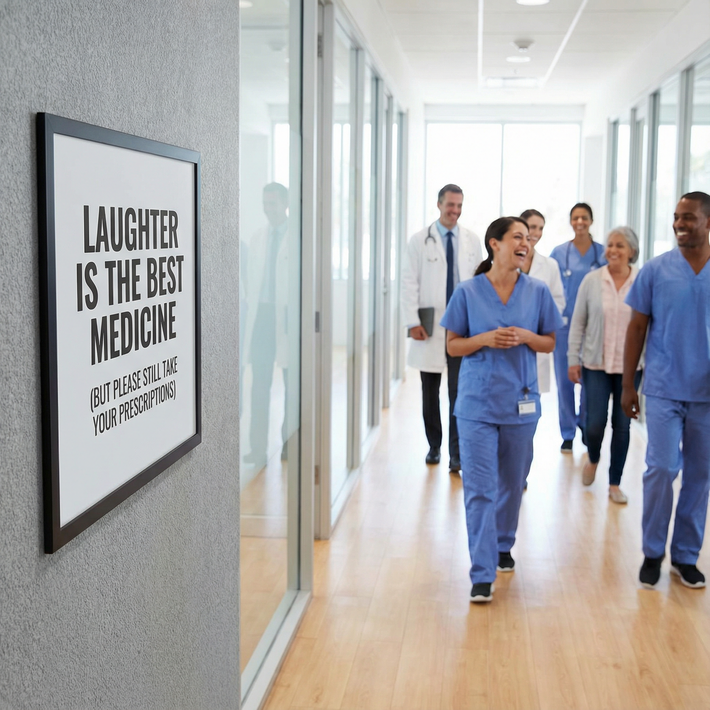
These two comment styles are not the same thing, and people keep writing them as if they are. That is the whole problem.
An honors comment is a signal flare. Short. Polished. High-stakes. It exists to tell future readers, often residency reviewers moving fast through a pile of applications, that this learner performed at an unusually high level. It is not there to workshop your personality as a writer. It is not there for wit. It is there to rank without saying "rank."
A narrative eval note does a different job. It captures what happened over time: how the student worked, communicated, improved, handled patients, fit into a team, recovered from mistakes, and responded to feedback. It can be broader, messier, and more human because real performance is broader, messier, and more human. This is the format where context belongs.
That difference matters because humor lands differently depending on the function of the document. In an honors comment, humor usually muddies the signal. Even a harmless joke can make a clean endorsement feel less serious. In a narrative note, a small amount of warmth can work because the note is already built to hold texture and personality. But even there, bad humor goes bad fast. I have seen one throwaway "funny" line become the only thing anyone remembers from an otherwise excellent evaluation. Brutal. And avoidable.
So let me break this down specifically: what each format is supposed to do, why readers decode them differently, and exactly where humor helps versus where it starts to cost the trainee.
What an Honors Comment Is Supposed to Do
The honors comment has one job: compress excellence into a sentence or two that another evaluator can trust immediately.
That means the best honors comments are not merely nice. They are efficient endorsements. They answer, in very little space, four hidden questions:
- Was this learner outstanding?
- In what way?
- Compared with whom?
- Would you want this person again?
Strong honors comments sound like this:
- "Among the strongest students I worked with this year; consistently prepared, clinically sharp, and trusted by patients."
- "Performed at the level of an early intern, particularly in ownership of patients and clarity of presentations."
- "Top-tier student whose work ethic, teamwork, and diagnostic reasoning set them apart on service."
Notice what these lines do. They are specific enough to be credible and broad enough to travel well. A residency reader does not need the backstory. The signal is obvious.
The expected tone is polished, flattering, and unambiguous. That is not stiffness for its own sake. It is because selection documents are read under pressure. Program directors and committee members skim. They compare. They look for language intensity, comparative framing, and whether the writer sounds fully willing to stake their name on the student. If your line makes the reader pause and wonder, "Wait, was that a joke?" you already lost ground.
This is why humor is risky here. Not because medicine must be joyless. Because the honors comment is a bad place for mixed signals.
A few examples of comments that sound playful but actually weaken the endorsement:
- "Dangerously enthusiastic before morning coffee."
- "The kind of student who makes you question why your interns are not this organized."
- "Would happily clone for future rotations."
The first one is just dumb in this setting. The second may flatter the student, but it also introduces a weird jab at other trainees. The third is common and mostly benign, but even that line works only if it follows clear evidence. Alone, it is fluff.
My position is simple: if the goal is selection, cleverness is overrated. You are not writing a yearbook quote. You are writing a recommendation fragment inside a high-stakes filter. Keep it clean. Keep it sharp. Let the praise carry the weight.
What Narrative Eval Notes Are Actually For
Narrative eval notes are where educators are supposed to describe real observed performance. Not vibes. Not ranking theater. Actual behavior.
This is where you document things like:
- How the student handled patient interviews
- Whether they improved their oral presentations
- How they responded when corrected
- Whether they noticed workflow needs without being asked
- How they interacted with nurses, residents, and families
- Whether their professionalism was steady under pressure
A good narrative note sounds grounded. You can almost see the shift it came from. "Followed up independently on overnight labs and updated the team before rounds." "Built rapport quickly with anxious patients in clinic." "Initially over-detailed in presentations, but improved substantially after mid-rotation feedback." That is useful writing.
Because narrative notes are descriptive, they can tolerate more personality. Not nonsense. Personality. There is a difference.
This is the format where a little warmth can make the student feel real. For example:
- "Brought a calm, steady presence to a hectic consult week."
- "Had a knack for getting the shy teenager in clinic to actually talk."
- "Quickly became the person the team trusted to close the loop on small but important tasks."
Those lines have style, but they are still clinically interpretable. That is the standard.
Where humor can work in a narrative note is very narrow: it should humanize without blurring meaning. Something like, "The team joked that she had a sixth sense for missing discharge paperwork, but the real point is that she consistently identified operational problems before they became patient-care delays." That is acceptable because the joke is immediately translated into a concrete strength.
But there is still a hard boundary. Narrative notes must remain fair, understandable out of context, and professionally safe. Future readers do not know your tone. They do not know your team culture. They do not know whether "our chaos coordinator" was affectionate or insulting. Private humor dies badly on paper. What felt funny in the workroom can look biased, juvenile, or mean six months later in a committee packet.
I have read plenty of narrative notes where the writer clearly thought they were being charming. What came through instead was sloppiness. If a line cannot survive being read cold by a stranger in a selection meeting, it does not belong in the note.
When Humor Helps: The Narrow Cases Where It Works
Humor helps only when it strengthens recall without changing the assessment. That is the rule.
The safe version of humor is inclusive, warm, and attached to an actual clinical trait. It does not punch down. It does not rely on embarrassment. It does not create ambiguity about whether the learner was good or merely entertaining. If the reader remembers both the smile and the strength, the line worked. If they remember only the joke, it failed.
Here are the narrow patterns that can work.
1. Gentle wordplay tied to a real skill
Example: "He was our unofficial 'closure consultant' on rounds, reliably catching unanswered questions and unresolved plans before the team moved on."
Why this works:
- The phrase is light.
- The underlying trait is concrete: follow-through.
- No one is left wondering whether this was praise.
2. Observational warmth
Example: "Her calm with distressed patients was contagious; even the room seemed to settle when she walked in."
Not laugh-out-loud funny. Good. That is usually the level you want. It humanizes the learner and makes the note memorable without getting cute.
3. Playful metaphor with immediate translation
Example: "He approached clinic flow like an air-traffic controller, tracking details across multiple patients without losing accuracy or warmth."
Again, the metaphor is doing work. It creates a vivid image of organization and situational awareness.
What does not qualify as "helpful humor":
- Sarcasm disguised as affection
- Teasing that depends on the student being in on the joke
- Hyperbole with no factual anchor
- Comments about appearance, quirks, accent, age, or social style
- Anything that would sound worse if copied into the dean's letter
That last test matters. I use it all the time. If the line would look ridiculous or unsafe when lifted into a formal summary, cut it.

I have seen humor work best in comments about reliability, rapport, and team presence. Those are interpersonal traits that can be difficult to capture in sterile language. A well-placed light phrase can make the learner vivid. But the humor has to remain subordinate to the assessment. Always.
Here is the easiest practical test: remove the joke and read the sentence again. If the sentence still contains a strong evaluative point, you are probably safe. If removing the joke leaves nothing but air, the humor was carrying too much weight.
When Humor Hurts: Common Failure Modes
This is where most writers get themselves into trouble.
Sarcasm
Sarcasm is poison in evaluations. Full stop. Even when the writer thinks the affection is obvious.
"Only mildly obsessed with pre-rounding." "Refused to let incomplete data stand in the way of a complete presentation." "An overachiever in the most exhausting way."
You may think these read as playful. They do not. They read as criticism with plausible deniability. Residency committees are full of people trained to detect coded language. Sarcasm makes them wonder what problem is being hinted at.
Inside jokes
If the line only makes sense to your team, it does not belong in a formal note.
"The raccoon of call rooms." "Our human discharge pager." "Did not miss a chance to reorganize the sacred COW."
Maybe hilarious in the moment. On paper? Nonsensical, exclusionary, and occasionally humiliating.
Ambiguity
Ambiguity is deadly because reviewers fill gaps with their own assumptions. A funny line can split a room. One reader sees warmth; another sees shade.
Take this: "Never met a differential she could not make longer." Is that praise for thoroughness? Or criticism for lack of prioritization? Depends who is reading. That is exactly the problem.
Humiliation disguised as humor
Comments about awkwardness, nervous habits, volume, fashion, food, dating, sleep, caffeine, crying, or "quirks" are unacceptable. I do not care if the team laughed. The written record is not your open-mic set. Once the remark is documented, it can follow the trainee in ways that are grossly disproportionate to the writer's intent.
Cross-cultural misfire
Humor does not travel cleanly across generations, specialties, regions, or committees. What one attending calls deadpan, another reads as hostility. What one team experiences as banter, another reads as disrespect. High-stakes evaluations are not the place to test whether your tone is universal. It is not.
The deeper problem is credibility. A bad joke makes the evaluator look unserious. It raises ugly questions: Is this person fair? Do they actually have evidence? Are they masking bias with humor? Were they more interested in sounding clever than being accurate?
And reputationally, the joke often becomes the only durable memory. I have watched otherwise solid evaluations get summarized in conversation by one stray line. Not the student's patient care. Not their improvement. Not their leadership. Just the joke. That is how you know the writer failed.
Reading Between the Lines: How Residency Committees Decode the Writing
Residency committees are not reading comments the way trainees read them. Trainees often focus on tone. Committees focus on signal.
They look for:
- Comparative language: "among the best," "top 10%," "intern-level"
- Repetition across writers: if three people independently mention judgment or teamwork, that matters
- Behavioral evidence: what did the student actually do?
- Consistency: does the tone match the grade and the rest of the application?
A funny line is unstable because readers decode it differently. One person hears affection. Another hears faint criticism. A third assumes the writer had little real content and padded with charm. None of those are good outcomes in a selection context.
Here is the pattern recognition I teach students and junior faculty:
Humor as signal
Rare and acceptable. The joke reinforces a clearly stated strength.
Humor as camouflage
Common and bad. The writer uses wit to soften criticism they do not want to state directly.
Humor as liability
Most dangerous. The line adds ambiguity, embarrassment, or bias and distracts from the actual assessment.
If you are reading your own evaluations, learn to identify which category you are dealing with. If the comment has clear evidence and unmistakable praise, relax. If it leaves a sting or makes you decode subtext for ten minutes, there probably is subtext. Trust your ear.
Practical Writing Rules for Students, Residents, and Faculty
Here is the clean decision rule.
If the goal is selection, keep honors comments crisp. If the goal is documentation, humor must never obscure the takeaway.
That one rule will save people a lot of grief.
For evaluators, I use a four-part drafting checklist:
- Is this kind?
- Is this specific?
- Is this unbiased?
- Is this understandable out of context?
If the answer to any one of those is no, revise it. If the line depends on your tone of voice to sound benign, remove it. Written evaluations do not come with facial expressions.
For students and residents receiving these comments, do not spiral over one awkward line immediately. First, extract the substance. What clinical point is actually being made? Then look for patterns across multiple evaluations. One clumsy joke may just be clumsy writing. Repeated coded language is different and worth addressing.
If something feels embarrassing or unfair, ask for clarification through the right channel:
- trusted advisor
- clerkship director
- residency mentor
- program leadership if the comment is clearly inappropriate
And for faculty: stop trying to be the funny one in formal evaluations. Save it for teaching rounds, where tone and relationship are visible. In the permanent record, clarity is respect.
Conclusion: Keep the Message Clear, Let the Humor Stay Subordinate
The distinction is straightforward. Honors comments are built to signal excellence. Narrative eval notes are built to explain behavior, context, and development. Because the jobs are different, the tolerance for humor is different.
My view is firm. Humor almost never improves an honors comment. The format is too compressed and the stakes are too high. Narrative notes have a little more room for warmth, but only when the humor serves the observation rather than competing with it.
That is the real standard: does the line make the assessment clearer, kinder, and more memorable in the right way? Or does it make the reader stop and decode your tone? If it is the second one, the joke is not harmless. It is bad writing.
Use humor only when the clinical message survives intact and becomes easier to remember. Never when the laugh arrives first.
A good rule of thumb. If the reader might laugh before they understand the assessment, you went too far.