

Are ‘Breakthrough’ FDA Designations Really Game-Changers?
The hype around FDA “breakthrough” therapies is wildly out of proportion to what the data actually shows.
You’ve seen the headlines: “Breakthrough drug offers hope,” “Game‑changing new therapy gets FDA breakthrough status,” reporters parroting press releases as if the designation itself cures cancer. Physicians repeat it in clinic. Patients cling to it. Investors love it.
But here’s the uncomfortable truth: breakthrough therapy designation is mostly a regulatory speed‑bump remover, not a scientific miracle label. And it’s routinely overinterpreted, oversold, and misunderstood—even by clinicians who should know better.
Let’s strip this down to what the evidence actually says.
What Breakthrough Therapy Designation Really Is (and Isn’t)
First, definitions. No feelings, just statute.
“Breakthrough Therapy Designation” (BTD) was created by the FDA Safety and Innovation Act (FDASIA) of 2012. The law says a drug can get BTD if:
- It’s intended to treat a serious or life‑threatening condition, and
- Preliminary clinical evidence indicates it may demonstrate substantial improvement over existing therapies on one or more clinically significant endpoints.
Translation in normal language: early data (often from small, uncontrolled, or surrogate‑endpoint trials) suggests the drug could be better than what we already have—for something bad enough that it matters.
What BTD actually confers:
- More frequent FDA meetings and guidance
- “All hands on deck” interaction with senior reviewers
- Potential for rolling review of sections of the NDA/BLA
- Eligibility to combine with other expedited programs (priority review, accelerated approval, etc.)
What it does not mean:
- It is not a declaration that the drug works.
- It is not a quality seal on study design.
- It is not a guarantee of approval.
- It is not a guarantee of meaningful clinical benefit long‑term.
It’s a process flag, not a clinical endorsement.
But the world doesn’t treat it that way.
The Evidence: Do Breakthrough Drugs Actually Perform Better?
Let’s look at outcomes, not headlines.
There have been several serious looks at drugs with FDA expedited designations, including BTD. The pattern is not flattering.
A few key findings you never hear in press conferences:
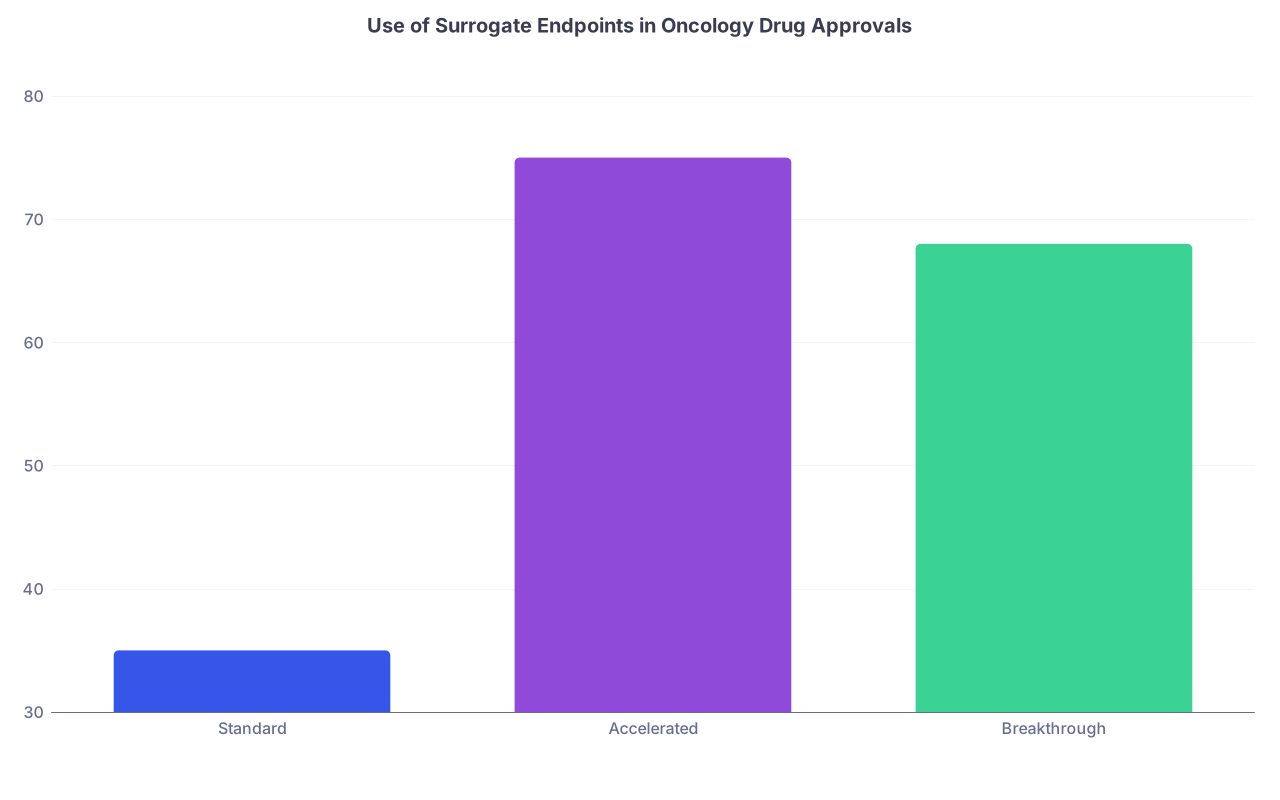
| Category | Value |
|---|---|
| Standard | 35 |
| Accelerated | 75 |
| Breakthrough | 68 |
That chart reflects a broad trend from multiple analyses (e.g., clinical pharmacology reviews, JAMA and BMJ papers): drugs approved via expedited pathways—including breakthrough—lean heavily on surrogate endpoints, especially in oncology. Surrogates that often have weak or unproven correlation with overall survival or quality of life.
A few uncomfortable datapoints from the literature:
- A JAMA Internal Medicine analysis of cancer drugs approved on the basis of surrogate endpoints (PFS, tumor response) found that most never demonstrate an overall survival benefit even years later. Many of those drugs had expedited designations.
- Multiple reviews of FDA approvals have found that breakthrough‑designated drugs are more likely to be approved on the basis of:
- Single‑arm trials
- Small sample sizes
- Nonrandomized designs
- Short follow‑up
In other words: the “breakthrough” label often travels with weaker evidence at the time of approval, not stronger.
Do they at least perform better once on the market?
Not consistently.
- Post‑marketing studies frequently downgrade the effect size of many “breakthrough” drugs. Initial effect estimates shrink with better trials, longer follow‑up, or real‑world data.
- Safety signals sometimes emerge once the drug hits a broader, sicker, more heterogeneous population—something early “promising” trials are notoriously bad at detecting.
Let me be blunt: a chunk of “breakthrough” drugs turn out to be modestly effective, highly toxic, or clinically underwhelming once the dust settles. A smaller subset are genuinely spectacular. The designation itself doesn’t distinguish which is which.
The Myth: “Breakthrough” Means Better for Patients
Why does this matter? Because clinicians and patients actually change decisions based on this label. They should not.
Here’s the myth in practice:
- Patient: “I read there’s a breakthrough drug for my cancer. Can I get that?”
- Clinician (tired, rushed, half‑remembering a headline): “Yes, there’s a new breakthrough therapy we can consider.”
- Reality: The “breakthrough” drug showed improved response rate on a surrogate endpoint, in a noncomparative Phase II trial, with unknown long‑term toxicity and no proven survival advantage.
That’s not some hypothetical. I’ve seen versions of that conversation in oncology clinics more times than I care to count.
Let’s put some structure around this. How does BTD relate to what you actually care about as a clinician or patient—survival, function, safety, and cost?
| Dimension | What People Assume | What Data Often Shows |
|---|---|---|
| Efficacy | Large, durable benefit | Modest/uncertain benefit at approval |
| Evidence quality | Strong, definitive trials | Small, early, or surrogate‑based data |
| Safety profile | Carefully characterized | Limited, with surprises post‑approval |
| Speed to approval | Much faster | Somewhat faster, but not always huge |
| Long‑term value | High and enduring | Highly variable, many disappointments |
The ethical problem: when you treat “breakthrough” as synonymous with “clinically superior,” you’re doing marketing, not medicine.
What the Designation Really Changes: Speed, Scrutiny, and Shortcuts
Now, to be fair, breakthrough designation does change some things in a meaningful way. Just not the way the PR people imply.
Think of BTD as a regulatory acceleration and hand‑holding package. The FDA essentially says, “We’re going to work with you closely and possibly accept less traditional evidence, because this might be a big deal for a serious condition.”
Here’s the basic flow:

| Step | Description |
|---|---|
| Step 1 | Early promising data |
| Step 2 | Apply for BTD |
| Step 3 | Standard development path |
| Step 4 | More FDA meetings |
| Step 5 | Adaptive or smaller trials |
| Step 6 | Expedited review and possible approval |
| Step 7 | Postmarketing studies |
| Step 8 | BTD granted? |
Notice the trade‑off: more speed now often means more uncertainty that has to be cleaned up later—if it ever is.
Ethically, you’re shifting the burden of uncertainty from pre‑marketing trials into the real world, onto actual patients, with real bodies and real lives, not trial subjects with tight eligibility criteria and follow‑up.
That might be acceptable for certain conditions (metastatic cancers with dismal survival, lethal rare diseases in children) if you’re honest about what’s happening. It’s not acceptable to pretend this is risk‑free or “obviously better.”
The Ethical Mess: Hype, Hope, and Conflicts of Interest
Let’s talk about the human side. Because the designation itself wouldn’t be a problem if everyone understood it correctly. They do not.
Three overlapping ethical failures show up again and again:
1. The Hype Machine
Once BTD is granted:
- Companies issue press releases loaded with words like “game‑changing,” “unprecedented,” and “transformative,” often quoting “breakthrough” in ways that blur the regulatory meaning with the colloquial one.
- Financial analysts and biotech media amplify the story with zero nuance. Stock pops. Social media goes wild.
- Health journalists—often undertrained in regulatory science—use “breakthrough” as shorthand for “dramatic benefit,” because that’s what normal people think the word means.
By the time the drug gets to your clinic, your patient has been marinating in this narrative for months.
2. Informed Consent That Isn’t
If you tell a patient, “There’s an FDA breakthrough therapy for your disease,” and do not immediately follow with what that actually means in terms of evidence, risk, and uncertainty, you’re not obtaining real informed consent. You’re nudging.
Ethically competent consent would sound more like:
“This drug has an FDA ‘breakthrough’ designation. That means the FDA is working closely with the company based on early signs it may help. But the trials so far are small and used an indirect measure of benefit. We do not yet know if it will help you live longer or feel better. Side effects could be significant, and there may be risks we don’t yet know.”
That’s not how these conversations often go. Time pressure, optimism bias, fear, and conflict of interest all get in the way.
3. Industry and Academic Conflicts
Plenty of clinicians sitting across from patients:
- Consult for the companies
- Sit on advisory boards
- Lead the breakthrough trials
- Or build their academic career on being “the [drug name] person”
That doesn’t mean they’re bad people. It does mean you as a clinician or trainee have to develop the habit of mentally discounting hype that aligns with someone’s career or financial incentives, including your own.
Breakthrough therapy designation is catnip for conflict‑ridden enthusiasm. It gives everyone plausible deniability: “Well, the FDA said it’s a breakthrough.”
No. The FDA said, “This might be important. We’ll look at it faster.” That’s it.
What the Numbers Say About Speed vs. Substance
Does BTD at least consistently speed things up?
Yes—somewhat. But the effect is less dramatic than you’d think, and speed comes tethered to uncertainty.
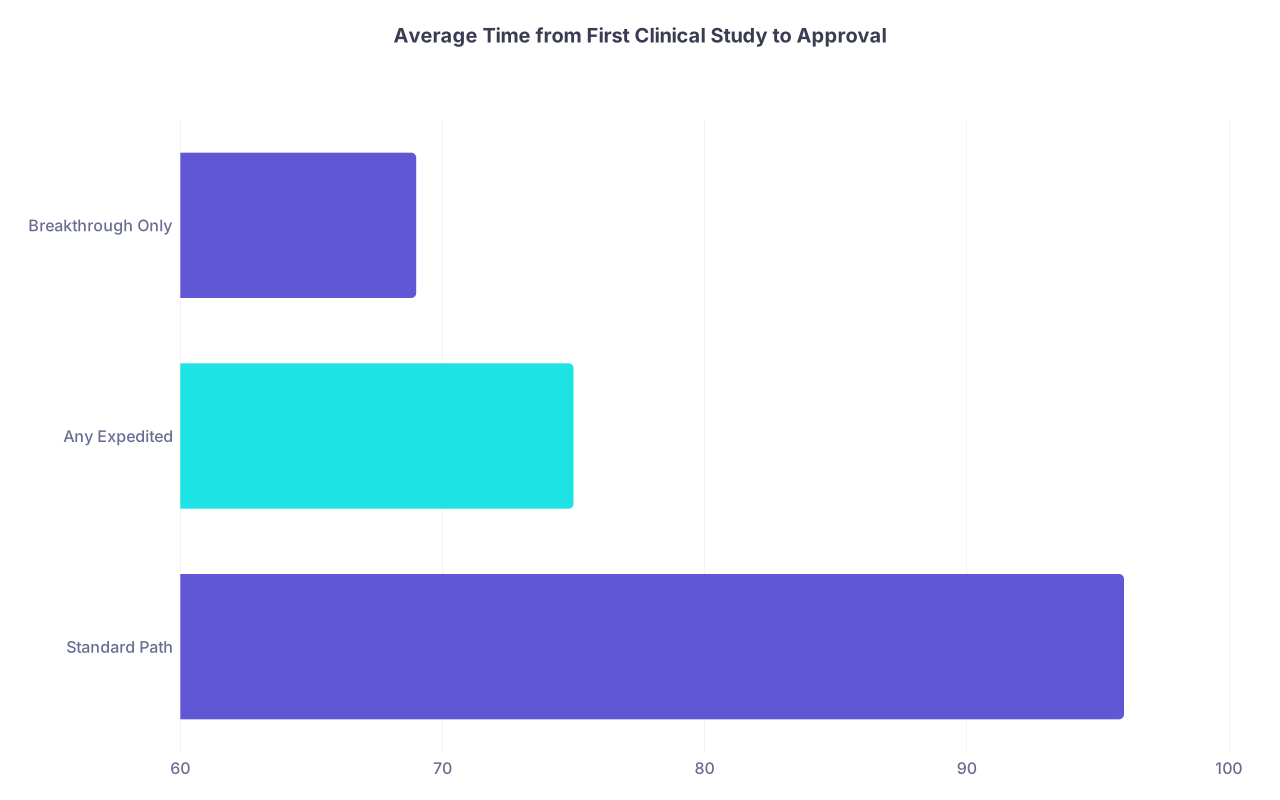
| Category | Value |
|---|---|
| Standard Path | 96 |
| Any Expedited | 75 |
| Breakthrough Only | 69 |
That’s representative of multiple assessments: you see on the order of a year or two shaved off development and review times when you bundle expedited programs, including BTD. That can matter a lot in lethal diseases.
The catch:
- Shorter timelines = smaller datasets at approval
- More use of surrogate endpoints
- More postmarketing commitments (which are frequently delayed or quietly abandoned)
From an ethical perspective, there’s no free lunch here. You’re explicitly trading epistemic certainty for temporal speed.
For some patients, that’s exactly the right trade. But only if they understand they’re stepping into a more uncertain evidence environment, not taking a proven “breakthrough.”
How You Should Actually Think About Breakthrough Designations
If you want to practice like a grown‑up scientist and not a press office, treat BTD as a yellow flag, not a gold star.
When you see that word attached to a drug, your automatic questions should be:
- What was the primary endpoint of the pivotal data that justified this? Clinical or surrogate? If surrogate, is there strong evidence that surrogate correlates with meaningful outcomes for this disease?
- What was the size and design of the supporting trial(s)? Randomized or single‑arm? How many patients? How long were they followed?
- What’s the magnitude of benefit, in absolute terms? Not relative risk reduction nonsense.
- What does the toxicity profile look like, and how confident are we in it? Early‑phase safety data is notoriously rosy.
- Are there post‑marketing requirements, and have they been completed? What did they show?
If you cannot answer those questions, the ethical move is not to pretend you can. It’s to say, explicitly, “We’re working with limited data here.”
For personal development, especially if you’re a med student, resident, or early‑career attending, this is a good litmus test of your maturity as a clinician‑scientist:
- Do you anchor on labels (“breakthrough,” “first‑in‑class,” “gene therapy”)?
- Or do you anchor on trial quality, patient‑centered outcomes, and uncertainty?
One of those positions is medicine. The other is fandom.
Real‑World Example Archetypes (You’ve Seen These)
I’ll generalize to avoid naming products, but you’ll recognize the patterns.
The Early Tumor‑Shrinkage Hero
- Single‑arm Phase II, 40–80 patients, high response rate in refractory cancer.
- Gets BTD. Everyone cheers.
- Later randomized data: modest improvement in PFS, no clear OS benefit, serious toxicity. Drug ends up used widely anyway because the “breakthrough” framing never dies.
The Rare Pediatric Disease Star
- Small n, no good existing therapy, biologically plausible mechanism.
- BTD + accelerated approval on a biomarker or functional scale.
- Post‑approval, families mortgage houses for access. Years later, confirmatory trials struggle to recruit, are delayed, or show smaller than expected effects. Nobody wants to pull the drug.
The First‑in‑Class Targeted Agent
- Legitimately unique mechanism, strong early effect in a narrow genetic subset.
- BTD appropriately used to get it to market fast.
- Over time, benefit holds up in that narrow group but is wildly overextended off‑label because “breakthrough,” leading to marginal benefit and significant toxicity in populations it was never really tested in.
You need enough skepticism to tell those apart—before repeating the “breakthrough” talking point in front of a patient.
Practical Ethical Takeaways for Clinicians and Trainees
Two roles you hold simultaneously:
- Interpreter of Evidence
- Shield between your patient and the hype machine
When dealing with any “breakthrough” drug:
- Strip the label in your head. Pretend the word doesn’t exist. Would you still be impressed by the data?
- Be explicit about uncertainty when you talk to patients. Don’t just mention risk—talk about how sure or unsure we are about the benefits.
- Watch your own emotional response. New therapies feel exciting, especially in specialties like oncology, neurology, and rare disease. Excitement is not a surrogate outcome.
- Be willing to say, “We should wait,” even when the rest of the world is sprinting toward the shiny new drug.
If you’re a trainee, this is one of the most valuable skills you can build: the ability to respect regulatory tools like BTD without confusing them for scientific verdicts.
Final Verdict: Are Breakthrough Designations Game‑Changers?
They can be—occasionally—for specific drugs in specific diseases.
But the designation itself is not the game‑changer. The underlying biology, the quality of the trials, and the honesty with which we handle uncertainty are the real levers.
So, three things to remember:
- “Breakthrough” is a regulatory speed tool, not a clinical quality seal.
- The evidence behind breakthrough approvals is often early, small, and surrogate‑heavy—treat it as provisional, not definitive.
- Your ethical job is to puncture the hype bubble for your patients, not inflate it, no matter how good the press release sounds.
Everything else is marketing.


