
The way many clinicians talk about “compassionate use” is dangerously oversimplified.
We throw around “expanded access” as if it is automatically the more humane option and “clinical trial enrollment” as the cold, research‑first alternative. That framing is wrong. And if you internalize it, you will make ethically bad recommendations to patients.
Let me break this down specifically, because this is where medical innovations collide head‑on with personal development and medical ethics.
1. What You Are Actually Choosing Between
Most people, including many residents, could not clearly define the difference between expanded access and clinical trial participation if you asked them at 3 a.m. on call.
Here is the blunt version.
Expanded access (EA), also called “compassionate use”:
- Use of an investigational drug, biologic, or device
- Outside of a clinical trial
- For a patient with serious or life‑threatening disease
- Who has no satisfactory standard options left
- When potential benefit justifies potential risks, and it will not “interfere with” clinical development
Clinical trial enrollment:
- Use of the same investigational product
- Under a formal protocol
- With pre‑defined endpoints, inclusion/exclusion criteria, monitoring, and data collection
- With randomization and control groups more often than not
The everyday ethical question: A patient sitting in front of you with progressive disease asks, “Should I try to get this drug through compassionate use, or should I enroll in the trial?”
You are not deciding between “care” and “research.” You are deciding between two ethically complex forms of care under uncertainty.
To see why that matters, you need the real structure, not the brochure version.
| Dimension | Expanded Access (EA) | Clinical Trial Enrollment |
|---|---|---|
| Primary Goal | Individual patient benefit | Generate generalizable knowledge |
| Protocol structure | Minimal, often single‑patient | Detailed, prespecified protocol |
| Randomization | No | Often yes |
| Data collection | Limited, inconsistent | Systematic, high quality |
| Regulatory burden | Moderate but focused | High, trial infrastructure |
| Access predictability | Case‑by‑case, discretionary | Defined by inclusion/exclusion |
If you keep those dimensions in your head, the rest of the ethical landscape starts to make sense.
2. The Four Big Ethical Tensions You Cannot Ignore
You can quote Beauchamp and Childress all day. What matters is how autonomy, beneficence, nonmaleficence, and justice actually clash in this decision.
2.1 Autonomy vs Illusion of Choice
On paper, both EA and trial participation respect patient autonomy: consent forms, discussions, signatures.
In reality, autonomy is under pressure from three predictable distortions:
Therapeutic misconception
Patients (and frankly, some clinicians) conflate investigational with personalized best care. They hear “compassionate use” and assume it means “the doctor really believes this will work for me.”
I have watched attendings say, “We can try to get this for you under compassionate use,” and you can literally see the patient’s face light up—because it sounds like a backdoor to a miracle.Option framing
- “Trial”: sounds experimental, risky, maybe second‑class compared to “real treatment.”
- “Compassionate use”: sounds caring, tailored, endorsed by the clinician.
The same drug, same phase, same unknown toxicity profile—framed very differently.
Information overload and timing
These decisions are rarely made in calm, lengthy family meetings. They happen at progression, after bad scans, with families in shock. The cognitive bandwidth for a nuanced risk–benefit discussion is minimal.
Ethical takeaway: If you present EA as the emotionally superior or more “caring” option, you have already sabotaged informed autonomy.
The honest script is closer to:
“Both options involve a drug that has not yet been proven to help people like you live longer or better. One option generates good data that help us know whether this helps anyone at all. The other is focused only on you, but the evidence we get from it is weak. Let’s talk about what matters to you.”
2.2 Beneficence vs Nonmaleficence: The Clinical Trade‑off
Let us be explicit about who actually benefits more often from each pathway.
In a late‑phase trial (Phase II/III), particularly with adaptive or single‑arm designs in oncology, the structure is often actually safer and more beneficial for the patient than a one‑off EA request:
- Defined stopping rules for toxicity.
- Known inclusion/exclusion criteria to avoid predictable catastrophes (QT prolongation, organ failure, etc.).
- Protocol‑mandated monitoring: ECGs, labs, imaging.
Expanded access, especially single‑patient INDs, can be much looser:
- You and a sponsor agreement.
- Variable monitoring, constrained by resources.
- Less clarity on where this patient sits in the known risk spectrum.
And yet we routinely see families push for EA after being excluded from a trial—for the same drug—because the exclusion criteria “feel unfair.” Example: a patient excluded from a trial because of an EF of 40% then asking for compassionate use of the same cardiotoxic agent. That is a walking nonmaleficence problem.
The ethically sound answer there is often “No,” or at least “Not without a very strong justification.” Beneficence does not mean giving people everything they ask for. It means protecting them from predictable, high‑probability harm when the benefit is speculative.
2.3 Justice: Whose Access, Whose Data?
Justice is where most well‑intentioned compassionate use turns ethically ugly.
A few hard facts:
- EA access is highly variable by site and by physician aggressiveness.
- Patients with more social capital (connections, literacy, time, money) are dramatically more likely to secure EA.
- Data generated from EA are usually low‑quality, and systematically biased toward the advantaged.
So what you get, in practice, is this:
- A well‑connected family engages an advocacy group, leverages social media, and pushes a company into granting EA.
- That same drug remains inaccessible to a lower SES patient in the same city who is at a safety-net hospital with less regulatory support.
- Neither case materially advances knowledge, because the EA reports are anecdotal, confounded, and non‑comparative.
Meanwhile, the clinical trial that could actually demonstrate whether the drug works at all is struggling to enroll and gets delayed.
At population level, that is ethically perverse: those with power get faster access to unproven drugs and delay the credible evidence that could justify broader, equitable access.
2.4 Individual Hope vs Collective Knowledge
Strip away the rhetoric and this is the core dilemma:
- Expanded access: maximizes an individual’s perception of being helped, under conditions of weak evidence.
- Clinical trial: maximizes the chance that we will know the truth about this drug for future patients, while still offering some reasonable chance of benefit to the participant.
There is no magic way to eliminate this tension. You can only be honest about it. And you must be, or you are just doing ethics theater.
3. The Regulatory and Practical Reality You Have to Work Inside
You cannot do good ethics if you do not understand the mechanics. Otherwise you promise things you cannot deliver.
3.1 The Structures: FDA, EMA, Local Regulators
In the U.S.:
- Clinical trials: IND protocols, IRB approval, DSMBs for larger studies, structured safety reporting.
- Expanded access:
- Single‑patient or intermediate‑size INDs or treatment protocols
- FDA Form 3926 (for single patient) that is not as onerous as people think
- Still needs IRB oversight (can be expedited), sponsor agreement, and drug supply.
The FDA actually approves the overwhelming majority of EA requests. The bottleneck is usually:
- Sponsor willingness (company says no)
- Logistics (paperwork, local infrastructure)
- Patient trajectory (they clinically decompensate before it is operational)
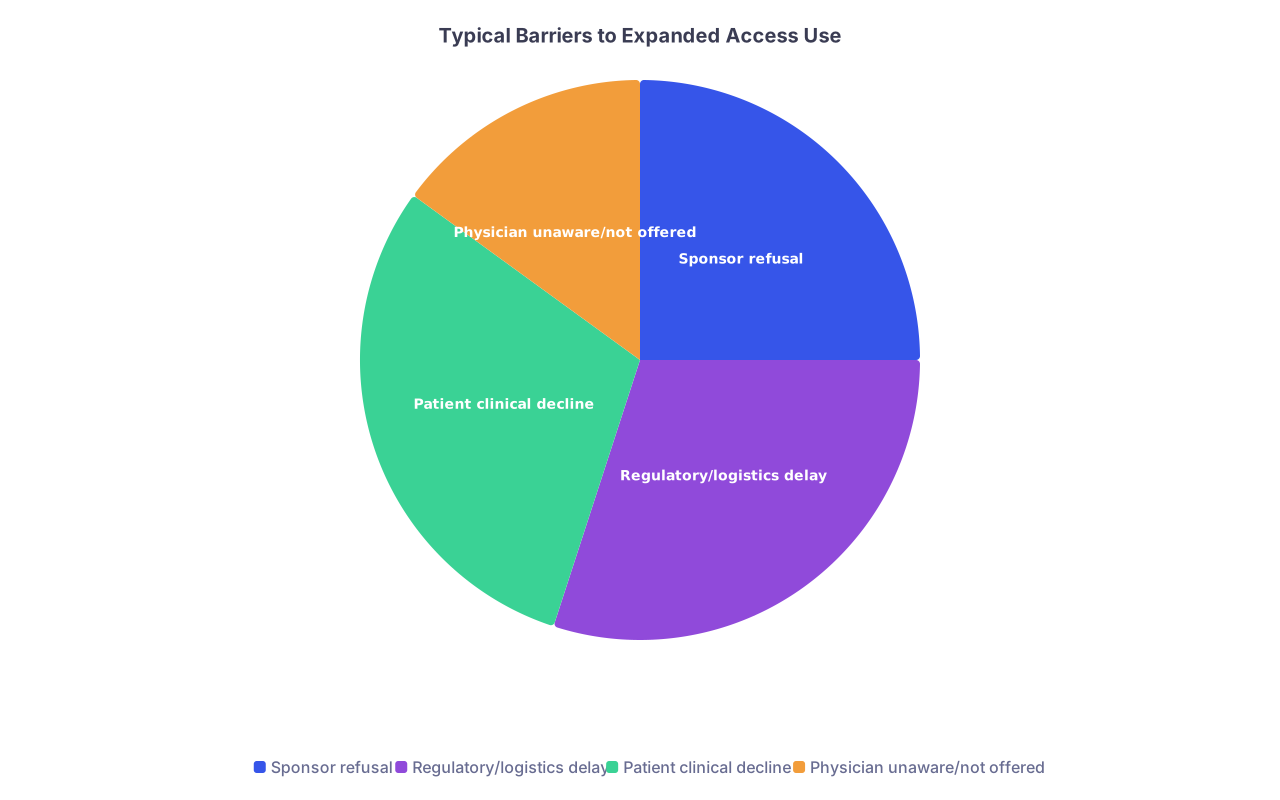
| Category | Value |
|---|---|
| Sponsor refusal | 25 |
| Regulatory/logistics delay | 30 |
| Patient clinical decline | 30 |
| Physician unaware/not offered | 15 |
In Europe, EMA guidance exists, but implementation is more fragmented at member‑state level. The themes are similar: serious disease, no alternatives, non‑interference with trials.
The “non‑interference with development” clause is not decoration. It sets up one of the most under‑discussed ethical edges.
3.2 Sponsors: Not the Villain, Not the Hero
Pharma decisions around EA are usually painted as heartless or purely PR‑driven. Reality is more mixed and frankly more rational.
Sponsors worry about:
- Supply constraints: limited drug production early on.
- Safety signals: severe EA‑related events muddying the perception of the program.
- Trial integrity: if they open broad EA too early, trial enrollment collapses.
You may not like these constraints, but they are real. And partly justified. A company that gives wide EA in Phase II and then cannot finish the Phase III trial may never get the drug approved at all.
Here is the uncomfortable truth: sometimes saying “no” to EA is ethically defensible when it preserves the ability to run the trial that could benefit thousands in the future.
If your ethical reasoning never arrives at “no” for EA, your framework is off.
4. When Expanded Access Is Ethically Defensible – And When It Is Not
Let’s get concrete. Here are patterns I have seen repeatedly.
4.1 Strong Case for Expanded Access
Scenario A:
- Drug: Targeted therapy with a clear mechanism, good early‑phase safety signal, and dramatic responses in a narrow biomarker‑defined group.
- Patient: Has that biomarker, meets trial criteria except geography (no trial site within 800 miles), has exhausted all standard options.
- Trial: Ongoing, but full enrollment at accessible centers. No practical path to trial participation.
Here, EA is ethically reasonable. You are not cannibalizing trial accrual meaningfully. The patient fits the likely‑benefit phenotype. Monitoring can be structured. The justice argument is not perfect, but refusing on “trial first” grounds would feel like proceduralism masquerading as ethics.
Scenario B:
- Drug: Approved in adult population with strong data. Pediatric trial starting but only at few centers; age range limited.
- Patient: Adolescent slightly below the lower age cutoff, with identical disease biology, no alternatives.
Again, EA can be ethically justified. There is a strong biologic rationale, and the trial’s age cutoff is more about regulatory pragmatics than serious scientific uncertainty about 16 vs 17 years.
4.2 Weak Case for Expanded Access
Scenario C:
- Drug: First‑in‑human cell therapy, Phase I just opened, DLTs and MTD unknown.
- Patient: Poor performance status, multiple comorbidities, high risk of treatment‑related mortality.
- Family: Insistent on “anything, at any cost,” demanding compassionate use.
EA here is ethically weak. Phase I trials are designed to figure out dose and immediate safety in controlled conditions with strict criteria. Offering EA outside that structure, to a patient considerably frailer than the trial population, is high‑risk speculation, not compassionate care.
Scenario D:
- Trial: Phase III with clear accrual challenges, but scientifically critical question.
- Physician: Frustrated with trial bureaucracy, prefers EA because it is “simpler,” starts offering EA for most eligible patients.
Now EA is actively undermining the trial. That is ethically unsound. Here, institutional oversight should clamp down.
5. The Subtle Biases in How Clinicians Lean
You are not neutral in this. Neither am I. Clinicians’ instincts about EA vs trials are shaped by:
- Professional identity: “I am my patient’s advocate; I fight for access.”
- Mistrust of research bureaucracy: Past experiences with IRBs, delayed approvals, sponsor inflexibility.
- Cognitive shortcuts: Believing early case series too quickly, anchoring on anecdotal “miracle” responders.
I have watched junior oncologists say, “I would not put my own mother in that randomized trial with a placebo arm,” then immediately propose EA of that same drug. That is incoherent. Placebo in addition to best supportive care is not inherently more dangerous than uncontrolled, off‑protocol use.
If your threshold for “experimental but ok for my patient” is lower in EA than in a well‑designed trial, you are being emotionally driven, not rational.
You also need to confront another bias: we systematically overestimate how much worse a control arm is compared to investigational therapy. In reality, for many drugs:
- True benefit is modest or absent.
- Control arms reflect real‑world standard of care.
- Toxicity is unknown or worse in the experimental arm.
In those scenarios, pushing EA aggressively is not heroic. It is ethically sloppy.
6. How to Actually Counsel a Patient: A Practically Useful Framework
The ethics literature loves abstract frameworks. Patients need you to make this operational in 15–30 minutes of conversation.
Here is a framework that actually works in clinic.
6.1 Step 1: Clarify Feasible Options – Not Hypothetical Ones
First question: “Are both EA and trial enrollment realistically on the table?”
Use a simple mental algorithm:

| Step | Description |
|---|---|
| Step 1 | Serious disease, no standard options |
| Step 2 | Discuss trial as primary option |
| Step 3 | Assess EA appropriateness |
| Step 4 | Proceed with trial |
| Step 5 | Trial available and patient eligible? |
| Step 6 | Trial unavailable or infeasible? |
| Step 7 | Patient declines trial? |
You cannot ethically recommend EA for a drug with no sponsor willingness, no local regulatory pathway, and no clinic capacity to monitor. That is fantasy, not beneficence.
6.2 Step 2: Discuss the Trade‑offs Plainly, Without Romance
When both are real options, your language needs to be brutally clear.
For a late‑phase trial vs EA of the same drug, I would say something like:
- “In the trial, you might get the study drug or standard treatment. We will monitor you closely and contribute to solid data on whether this works.”
- “With compassionate use, you get the drug for sure, but we will not be comparing it to anything. If you do worse, we will not know whether it was the drug, the disease, or something else. And your experience will help us much less in deciding if this drug should be approved.”
Then you tie it to their values:
- Patients who value contribution to future patients often choose the trial.
- Patients who are strongly focused on maximizing personal odds and are unusually suspicious of randomization may still lean toward EA, if you honestly believe safety is similar.
But you must not pretend that EA offers a higher probability of benefit just because it feels more “tailored.” There is usually no data to justify that claim.
6.3 Step 3: Name the Uncertainties – Out Loud
Do not sanitize it.
Say:
“We do not actually know if this drug helps people in your situation live longer. We have early safety data and a plausible mechanism, but no guarantees either way. Whether you get it through a trial or through compassionate use, that uncertainty remains.”
Patients handle uncertainty better than you think—when you respect them enough to say it clearly.
6.4 Step 4: Document the Rationale
From an ethical and legal standpoint, record:
- That both options (if present) were discussed.
- The patient’s expressed values: hope for cure vs contribution to science vs avoidance of hospitalization, etc.
- Why one option was recommended or chosen over the other.
That is not defensive charting. That is part of doing ethics in a traceable, accountable way.
7. System‑Level Responsibilities: This Is Not Just About Individual Virtue
If you are in a leadership or policy role, your obligations go beyond counseling.
Three system‑level questions matter:
Do we have a clear institutional policy on EA vs trial participation?
Not just “we follow regulations,” but actual thresholds for when EA is appropriate, how to avoid cannibalizing trials, and how to support clinicians with IRB and FDA paperwork.Are we tracking our EA patterns?
Who gets EA by race, language, insurance, distance from the center?
If it is skewed—as it usually is—you have a justice problem, not an individual‑heroism success story.Are we pushing sponsors toward more equitable, transparent EA criteria?
Some companies now publish EA policies and criteria. Many do not. You should be the annoying center that keeps asking why.
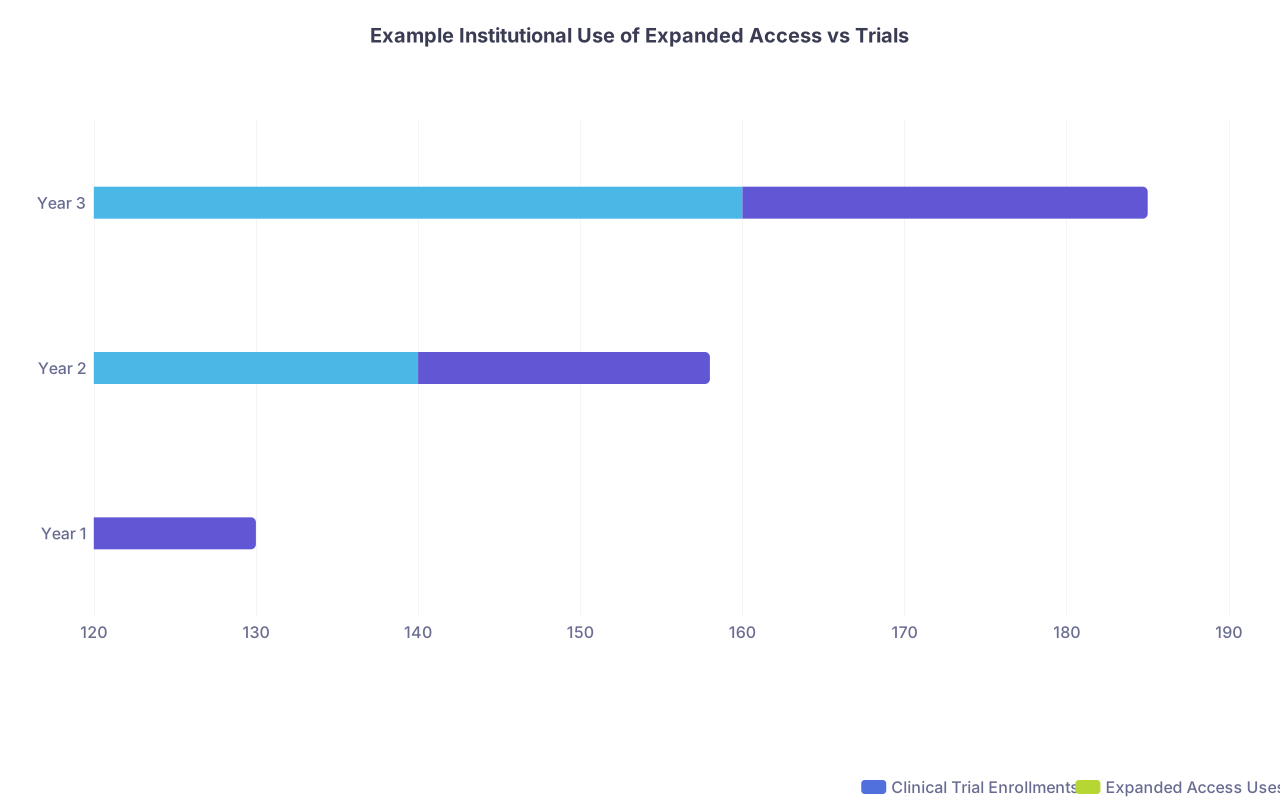
| Category | Clinical Trial Enrollments | Expanded Access Uses |
|---|---|---|
| Year 1 | 120 | 10 |
| Year 2 | 140 | 18 |
| Year 3 | 160 | 25 |
If you never see data like this from your own institution, nobody has any idea whether you are using EA judiciously or haphazardly.
8. Personal Development: The Kind of Clinician You Become Around These Choices
This topic is in “PERSONAL DEVELOPMENT AND MEDICAL ETHICS” for a reason. How you handle EA vs trial decisions shapes your identity as a physician.
8.1 Resist the Savior Narrative
You will be tempted to view yourself as the hero who “got the family compassionate use” by calling the right VP at a company. I have seen early‑career faculty dine out on these stories.
Ask a different question:
Did what you did meaningfully help this patient, or did it mostly make you feel powerful and compassionate?
When you admit to yourself that the data are thin and the benefit uncertain, you stop romanticizing the process and start thinking structurally.
8.2 Get Comfortable Saying “No” With a Straight Face
One of the hardest professional skills you will learn: saying “No, this is not ethically justifiable” without hiding behind faceless bureaucracy.
Not “The hospital will not let us.”
Not “The FDA will say no.”
Instead:
“I do not think this drug, in this situation, is likely to help you more than it harms you, and I will not pursue it for you on that basis. Let me explain why, and then we can talk about what we can still do that aligns with your goals.”
If that sentence terrifies you, good. That means you understand the stakes. Work until you can say it honestly.
8.3 Keep a Long Memory for Outcomes
You remember the one EA “success” forever. The patient whose scan shrank. The family that sends you a holiday card.
You conveniently forget the patients who had liver failure, died in the ICU after a massive cytokine storm, or just slowly declined with no response at all.
If you want to grow ethically, you have to track those outcomes in your own mind with brutal honesty. Recalibrate your intuition against actual data, not heroic stories.
9. The Bottom Line You Should Carry Forward
Three takeaway points, stripped of decoration:
Expanded access is not automatically more ethical or more compassionate than clinical trial enrollment. It is one tool among several, with serious justice, safety, and epistemic trade‑offs.
Your ethical obligation is to make the uncertainty and trade‑offs visible to patients, not to smuggle your own emotional preferences into the framing. Honest, specific language about what we know and do not know is non‑negotiable.
At both bedside and system levels, overuse or poorly targeted use of expanded access can delay good evidence and worsen inequity. Strong clinicians and strong institutions learn to say “yes” and “no” to EA in a principled, documented way—anchored to patient welfare and the integrity of clinical development, not to optics or pressure.