
Tumor-Agnostic Therapies: How Basket Trials Are Reshaping Oncology
It is 6:45 p.m. in the infusion center. Your last patient is a 38‑year‑old with metastatic cholangiocarcinoma. You have already told her once that surgery is not possible. She progressed on gem‑cis. Now the NGS report comes back: NTRK fusion positive.
You scroll through UpToDate, NCCN, drug monographs. The attending says quietly: “This is one of the rare ones. Tumor‑agnostic indication. Think larotrectinib or entrectinib.”
Disease label no longer matters. Bile duct, colon, lung, thyroid — you treat the alteration, not the organ. And the trial that made this possible? Not a classic lung cancer trial. A basket trial.
Let’s break down exactly what that means, how these trials work, and the ethical landmines you are going to stand on in the next decade.
1. From Organ-Based to Molecular: What “Tumor-Agnostic” Actually Means
Most of your training has been built around organ silos.
Colon cancer clinic. Breast cancer clinic. GU clinic.
The classical model:
- Disease is defined by organ of origin + histology
- Trials enroll “metastatic non‑small cell lung cancer, adenocarcinoma subtype”
- Guidelines are built per organ, then subdivided by stage and biomarkers
Tumor‑agnostic therapies flip this.
They are drugs approved based on a molecular alteration, irrespective of:
- Organ of origin
- Histologic subtype (to a point)
- Sometimes even patient age (adult and pediatric approvals)
You have seen the headlines:
- Pembrolizumab for MSI‑H/dMMR solid tumors
- Larotrectinib and entrectinib for NTRK fusion‑positive solid tumors
- Dostarlimab for dMMR tumors
- Nivolumab + ipilimumab in TMB‑high settings (more controversial, but same conceptual direction)
The key shift: biology over geography.
Historically: colon cancer with KRAS wild‑type → consider EGFR inhibitor, but still in a colon‑cancer framing.
Now: NTRK fusion in salivary gland tumor vs. NTRK fusion in pancreatic cancer → same drug, even if these organs never shared a treatment algorithm before.
This is not just semantic. It changes:
- How you screen (broad NGS vs single‑gene tests)
- How you refer (molecular tumor boards)
- How drugs reach market (basket trials, not organ‑specific phase III RCTs)
And it is exactly where basket trials come in.
2. What Exactly Is a Basket Trial?
Forget the classical phase III RCT with thousands of “metastatic lung adenocarcinoma” patients randomized to standard vs new drug.
Basket trials are built around a single biomarker or target, then “collect” multiple tumor types into parallel cohorts (“baskets”).
Basic structure:
- Inclusion: “Any unresectable or metastatic solid tumor with X alteration”
- Stratified into cohorts by tumor type (lung, colon, sarcoma, thyroid, etc.)
- Everyone receives the same investigational drug
- Primary endpoints often ORR (objective response rate), duration of response, sometimes PFS
Visually:

| Step | Description |
|---|---|
| Step 1 | Patients with advanced solid tumors |
| Step 2 | Standard care or other trials |
| Step 3 | Enroll in basket trial |
| Step 4 | Lung cancer cohort |
| Step 5 | Breast cancer cohort |
| Step 6 | Colorectal cohort |
| Step 7 | Sarcoma cohort |
| Step 8 | Other rare tumors |
| Step 9 | Receive same targeted drug |
| Step 10 | Do they have target alteration? |
Key point: everyone gets the same targeted agent, because the scientific hypothesis is:
“This alteration is the true driver, and if we inhibit it, tumors will respond regardless of tissue of origin.”
Sometimes cohorts are heavily imbalanced. For NTRK fusions, you might see:
- A few colon and lung cases
- Very rare breast or pancreatic
- Clusters in secretory breast carcinoma or infantile fibrosarcoma where the fusion is common
Basket trials are particularly valuable when:
- The alteration is rare overall (e.g., <1% of all solid tumors)
- You could never run a classical organ‑specific RCT in each tumor type
- There is strong mechanistic plausibility (e.g., oncogenic kinase fusions)
They are not the only design in this space (umbrella and platform trials matter too), but basket trials are the cleanest expression of tumor‑agnostic thinking.
3. Tumor-Agnostic Approvals: Concrete Examples You Will Actually Use
This is not theory. You are already ordering these drugs.
Let me line up the big ones and what they looked like from a trial and approval perspective.
| Drug | Target / Biomarker | Trial Type | Age Group |
|---|---|---|---|
| Pembrolizumab | MSI-H / dMMR | Basket / pooled | Adult + pediatric |
| Larotrectinib | NTRK1/2/3 fusions | Basket | Adult + pediatric |
| Entrectinib | NTRK fusions, ROS1 | Basket | Adult |
| Dostarlimab | dMMR solid tumors | Basket | Adult |
| Selumetinib* | NF1-related plexiform | Histology-agnostic-ish | Pediatric |
*Not formally “tumor agnostic” in the regulatory sense, but still biology‑over‑organ logic.
Pembrolizumab – MSI-H/dMMR (the regulatory watershed)
The 2017 FDA approval of pembrolizumab for MSI‑H/dMMR solid tumors was the first site‑agnostic oncology approval in the United States.
Data came from:
- Pooled cohorts across several trials (KEYNOTE‑016, ‑164, ‑012, ‑028, ‑158)
- About a dozen tumor types
- Common thread: all MSI‑H or dMMR
Key findings:
- ORR around 40% across diverse tumor types
- Durable responses in a meaningful subset
- Some complete responses persisting for years
Regulatory leap: the FDA accepted that the predictive biomarker (MSI‑H/dMMR → immune responsive) trumped organ classification.
Ethically, this changed your obligations. Ignoring MSI status in metastatic disease became hard to justify.
TRK inhibitors – Larotrectinib and Entrectinib
NTRK fusions are the poster child of molecularly defined niches:
- Ultra‑rare in common cancers (colon, lung)
- Very frequent in a few rare entities (secretory breast carcinoma, infantile fibrosarcoma, certain salivary tumors)
Larotrectinib’s development was essentially a pure basket strategy:
- Three early phase studies (LOXO‑TRK‑14001, SCOUT, NAVIGATE) pooled
- Combined ~55–100 evaluable patients in initial reports
75% ORR, deep and durable responses across >10 tumor types
- Included infants, children, adults
Same drug. Same target. From infant fibrosarcoma to adult salivary gland tumors.
Classical phase III per organ would be impossible; the basket design made the entire approval feasible.
The lesson for you: if you see a fusion in a rare tumor, your default should be to search for a basket trial long before you give up and default to third‑line chemo.
4. Why Basket Trials Matter Scientifically (Beyond Buzzwords)
Basket trials are not just a regulatory gimmick. They answer specific scientific questions you actually care about.
4.1 Central Hypothesis: “Driver Is Driver”
At the core is a blunt hypothesis:
If an alteration is truly oncogenic and “addiction‑forming,” then inhibiting it should work across any tissue that depends on that driver.
Basket trials let you:
- See whether context matters: Does a BRAF V600E colon cancer respond as well as BRAF‑mutant melanoma? (Spoiler: no, and that matters.)
- Detect organ‑dependent resistance patterns
- Identify tumors where the same driver is more or less actionable
And this directly feeds back to your practice.
For example:
- BRAF V600E in melanoma: robust responses to BRAF inhibitors
- BRAF V600E in colon cancer: needs EGFR blockade plus BRAF inhibition; monotherapy underperforms
- BRAF V600E in some brain tumors: different pharmacokinetics, blood‑brain barrier issues, distinct safety profiles
Basket data forces you to confront the reality that “same mutation” does not always mean “same response,” and that tissue biology, microenvironment, and co‑mutations still matter.
4.2 Small Signals, Rare Patients
For rare alterations, classical phase III design is a joke. You will never randomize 600 patients with NTRK fusion cholangiocarcinoma. That cohort might not exist on Earth.
Basket designs:
- Aggregate tiny numbers of patients across many centers and countries
- Use response rate and durability as surrogate evidence
- Lean heavily on mechanism and biomarker strength
Is this as rock‑solid as a huge phase III RCT? No. But the alternative is: no data at all, and patients cycling through non‑specific chemotherapy with 5–10% response.
And this is where ethics gets interesting.
5. Ethical Upsides: Where Basket Trials Are Actually Helping Patients
It is easy to get cynical about drug development. But tumor‑agnostic basket trials have delivered some very real ethical wins. Let me be specific.
5.1 Access for Rare Tumors and Orphan Populations
Traditionally, if you had:
- An ultra‑rare tumor (e.g., certain salivary gland carcinomas, pediatric sarcomas)
- A rare alteration within a common tumor (e.g., ROS1 rearranged cholangiocarcinoma)
You were invisible to most trials. Under‑recruited, under‑powered, under‑studied.
Basket trials explicitly invite these patients in:
- “Any solid tumor with X fusion” is inclusive by design
- Pediatric and adult inclusion is often built early, not as an afterthought
- Orphan tumors finally contribute to the evidence base
That is not a trivial moral upgrade. These populations were historically written off as statistical noise.
5.2 Faster Time from Biology to Bedside
Consider the old pathway:
- Discovery of target
- Preclinical work
- Phase I in heavily pretreated solid tumors
- Phase II in one or two organ types
- Phase III randomized vs standard
- Subgroup analyses by biomarker
- Narrow label
- Second wave of trials in other organs
Patients with rare alterations died in the gap between steps 4 and 7.
Basket trials compress that:
- Phase I/II basket designs with prespecified molecular cohorts
- Early, robust responses in multiple histologies
- Accelerated approvals with confirmatory follow‑up
From an ethical standpoint, accelerated access for strongly biomarker‑selected therapies with huge effect sizes (ORR 60–80%, durable) is absolutely justifiable. Waiting for a 2% OS benefit in a bloated phase III would be absurd.
5.3 Shifting the Standard of Care Toward Testing
Once the FDA grants a tumor‑agnostic label, the ground shifts.
For MSI‑H/dMMR, you now have:
- Pembrolizumab as a default option beyond first line
- Strong rationale for universal MMR/MSI testing in metastatic disease
Failure to test becomes an ethical failure, not just a missed billing opportunity. Basket‑driven approvals indirectly enforce more rational, comprehensive molecular profiling.
You already see this in tumor boards:
“Did we send the NGS yet?” has gone from a research question to a quality‑of‑care question.
6. Ethical Pitfalls: Where Basket Trials Get Messy
Now the uncomfortable part. Basket designs and tumor‑agnostic marketing bring real ethical problems. And no, “but it is precision oncology” does not make them vanish.
6.1 Cost and Equity: Biology Without Access is Useless
Here is the brutal reality: discovering an actionable alteration is only step one. Then you run into:
- Drug costs in the six‑figure range annually
- Insurance battles over “off‑label within label” situations (e.g., unusual histology, earlier lines)
- Geographic disparities in access to NGS, molecular boards, and academic trials
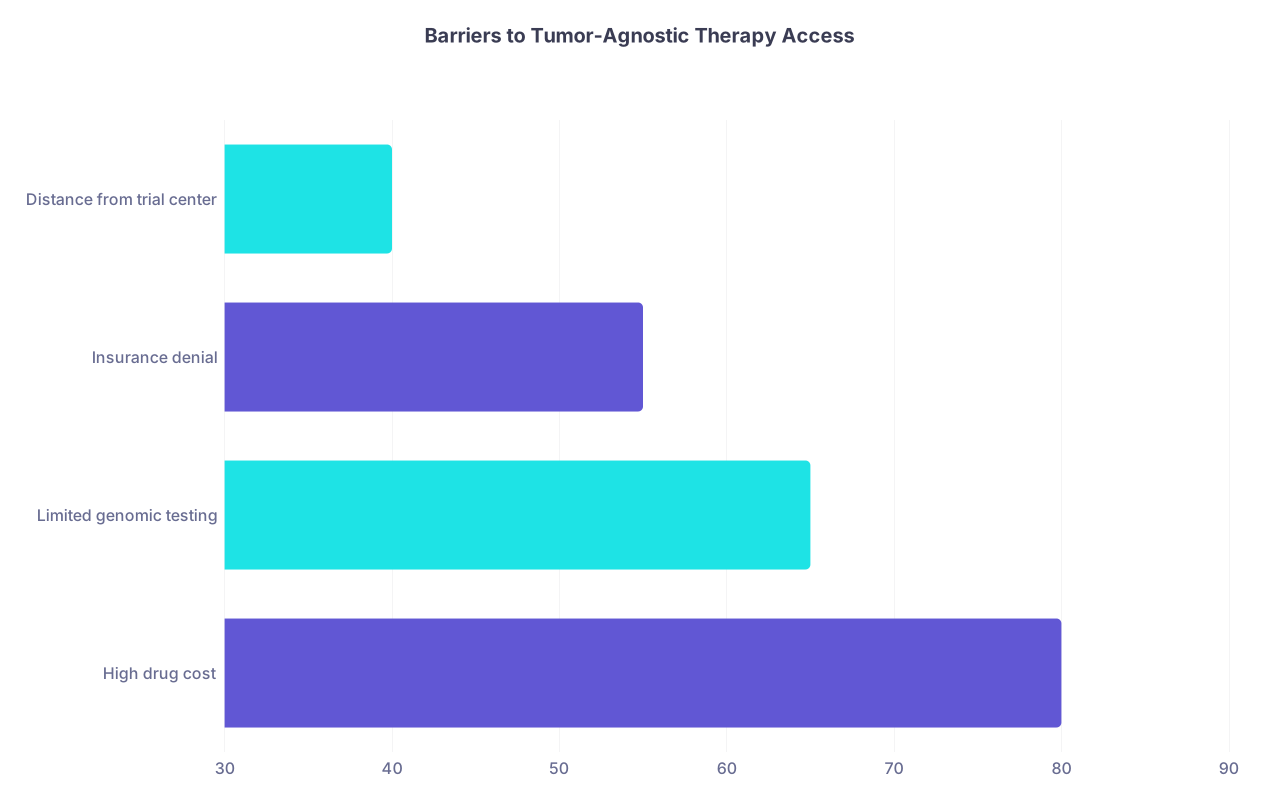
| Category | Value |
|---|---|
| High drug cost | 80 |
| Limited genomic testing | 65 |
| Insurance denial | 55 |
| Distance from trial center | 40 |
Those percentages are illustrative, but the ranking is right. Cost and testing are the biggest barriers. Then payers. Then geography.
Ethically:
- A “universal” tumor‑agnostic label is meaningless if only large academic centers can realistically use it.
- Precision medicine can widen disparities. Privileged patients get full NGS, second opinions, trial access. Others die of “generic stage IV cancer” because that is all their system can see.
If you are training or practicing in a resource‑limited setting, you are already making triage decisions about who gets full genomic work‑ups. Those are ethical decisions, whether anyone calls them that or not.
6.2 Small, Uncontrolled Trials and Inflated Expectations
Basket trials often lack control arms and enroll small numbers.
Regulatory agencies accept high ORR + duration in a heavily pretreated population as sufficient for accelerated approval. Reasonable.
But at the bedside, you encounter:
- Patients (and oncologists) who equate “target present” with “guaranteed dramatic response”
- Industry‑driven hype around “breakthrough” therapies from 50‑patient datasets
- Limited data on long‑term survival or optimal sequencing
Ethical risk:
- Overselling hope. Even with strong biomarkers, many patients do not respond. Resistance happens quickly in some contexts.
- Under‑communicating uncertainty. “We think this has a 50–70% chance of a meaningful response, but we do not actually know your organ‑specific likelihood” is an honest, uncomfortable sentence.
You owe patients realism, not marketing copy.
6.3 Consent Complexity: Explaining Cancer by Mutation, Not Organ
In consent discussions, the shift to mutation‑defined disease is cognitively heavy for patients.
You are now explaining:
- Why two patients with “stage IV colon cancer” might have wildly different options based on MSI, RAS, BRAF, HER2, NTRK, etc.
- Why a drug approved across “any solid tumor with fusion X” might work brilliantly in salivary carcinoma but minimally in pancreatic.
- Why insurance might cover a six‑figure drug because of three letters (MSI), but not another similar‑cost therapy.
Consent for basket trial participation, and for post‑approval therapy, must cover:
- The novelty of the approach and limited long‑term evidence
- The heterogeneity of outcomes across different organs
- Unknowns regarding late toxicities in pediatrics and long‑survivors
If your consent conversation sounds like a press release, you are doing it wrong.
6.4 Data Fragmentation and Publication Bias
Another quiet problem: data gets siloed.
- Industry‑led baskets may analyze only certain tumor types in depth
- Rare, non‑responding cohorts can vanish into conference abstracts and never shape guidelines
- Negative or modest‑signal baskets receive less attention, skewing perception
Ethically, selective reporting in tumor‑agnostic trials can create an illusion that “the mutation always wins”, when in reality tissue context often modulates response substantially.
As a clinician, you must keep an eye out for:
- Cohort‑specific data (e.g., “BRAF V600E in colon behaves differently”)
- Real‑world evidence that contradicts early basket exuberance
- Guideline nuance, not just labels
7. How This Changes Your Day-to-Day Practice
You are not a drug developer. You are the one sitting in front of people like that 38‑year‑old with NTRK‑positive cholangiocarcinoma, trying to turn this complexity into decisions.
Here is how basket‑driven tumor‑agnostic therapy changes your clinical rhythm.
7.1 Molecular Testing as a Non‑Negotiable
You cannot use what you never look for.
Minimum standard now in advanced solid tumors:
- MMR/MSI testing
- Broader NGS panel when feasible, especially in younger patients, never‑smokers, unusual histology, or any case where standard therapy is failing quickly
- Actionable biomarker panels aligned to tumor type (EGFR, ALK, ROS1, BRAF, HER2, etc.) plus “cross‑cutting” targets like NTRK fusions
You will hear “we do not need panel X in this tumor.” That attitude is increasingly indefensible, particularly in referral centers.
The ethical frame: missing a clearly actionable, tumor‑agnostic target because you did not send testing when it was feasible is not “bad luck.” It is a preventable error.
7.2 Integrating Molecular Tumor Boards
Basket‑eligible patients are often best managed with multi‑disciplinary input.
You should be:
- Presenting complex NGS results to molecular boards
- Asking blunt questions: “Is there any basket trial open for this KRAS G12C cholangiocarcinoma?”
- Documenting when no basket or off‑label options exist, to justify palliative focus
This is personal development territory. Learning to read NGS reports, interpret variant allele fractions, and differentiate “pathogenic” from “VUS noise” is your new literacy.
7.3 Conversations with Patients: Reframing “What Kind of Cancer Do I Have?”
Patients will increasingly think of their disease this way:
“I have stage IV cancer with an NTRK fusion”
rather than
“I have stage IV colon cancer.”
Your job is to:
- Acknowledge that this framing is partially correct but incomplete
- Explain that both the organ and the mutation matter for outcomes
- Clarify that targeted therapies are powerful but not magical, and that palliative care does not disappear just because the disease has a fancy target
It helps to use specifics:
- “In tumors like yours with this mutation, about 6–7 out of 10 patients respond to this drug. That is dramatically better than typical chemo. But it is not 10 out of 10, and responses can eventually wear off.”
That level of detail respects the patient’s intelligence and stakes.
8. Personal Development: What You Need to Learn (Beyond Memorizing Drug Names)
If you are in training now, you will practice in an era where tumor‑agnostic therapy is normal, not novel. Basket trials will keep multiplying.
So what should you actually build into your skill set?
8.1 Fluency With Trial Design
You should be able to look at a trial abstract and instantly recognize:
- Basket vs umbrella vs platform vs classical RCT
- Whether there was a control arm or just single‑arm data
- Which histologies were actually represented in meaningful numbers
- Whether your patient’s tumor type was in the trial or only “extrapolated”
That directly affects how confidently you can say “this drug is appropriate for you.”
8.2 Basic Genomics and Bioethics
No, you do not need a PhD in molecular biology. But you should:
- Understand driver vs passenger mutations, clonal vs subclonal alterations
- Know which biomarkers have strong predictive value (MSI‑H, NTRK, ALK, etc.) vs those that are still half‑baked
- Have a working grasp of consent issues around germline findings, incidental results, and off‑label targeted therapy
Ethically, genomics without comprehension is dangerous. You can easily mislead patients by over‑interpreting weak biomarkers.
8.3 Advocacy and Systems Thinking
The structural problems will not fix themselves.
On a practical level:
- Push your institution toward broader, more equitable NGS policies
- Argue for automatic testing pathways for certain stage IV diagnoses
- Work with social work and pharmacy to pre‑empt insurance denials when you know an NTRK fusion or MSI‑H is present
You are not just a prescription writer. You will often be the only person in the room who understands why a six‑figure drug is actually rational in a given context.
9. Where This Is Going Next
The first wave of tumor‑agnostic basket‑enabled therapies has been fairly clean: NTRK fusions, MSI‑H, a few others. Clear on/off switches. Huge effect sizes.
The next wave is going to be much murkier:
- Combinatorial biomarkers (e.g., high TMB plus PD‑L1, or specific co‑mutations)
- Epigenetic signatures and transcriptomic profiles
- Microenvironment‑driven markers (immune hot vs cold, stromal signatures)
You will see basket‑like designs based on:
- “Any solid tumor with signature X score above Y”
- “Any tumor with homologous recombination deficiency above a threshold”
This will further decouple disease from organ and push you into territory where biomarkers are continuous, not binary. The ethics of acting on wobbly predictive signals in this grey zone will be more complex than NTRK fusions ever were.
Expect:
- More accelerated approvals based on small, biomarker‑defined cohorts
- More post‑marketing failures when broader real‑world data does not match trial enthusiasm
- Increasing pressure on you to keep up, explain uncertainty, and resist hype
Key Takeaways
Tumor‑agnostic therapies, powered by basket trials, shift oncology from “where did the cancer start?” to “what is driving it?” and that fundamentally changes how you test, treat, and talk to patients.
Basket trials are ethically powerful for rare and molecularly defined cancers, opening access where classic RCTs are impossible, but they also bring serious equity, consent, and evidence‑quality challenges you have to confront honestly.
If you plan to practice oncology in the next decade, you must become fluent in trial design, genomics, and the ethics of high‑cost, biomarker‑driven therapy—because NGS reports and basket‑trial drugs will be in your hands, not just in journals.