
It’s January 2nd. You just got the email: “Starting this quarter, we’ll be expanding telehealth across the practice. Please begin transitioning appropriate visits over the next six months.”
You look at your schedule. Packed in-person clinic. A couple of half-baked “Video Visit” slots sprinkled in by admin. No one has really told you how to phase this in without wrecking your workflow, burning out your staff, or cutting ethical corners with privacy and consent.
Here’s how you handle the first 6 months—deliberately, ethically, and without turning your clinic into chaos.
Month 0: Pre-Launch (1–2 Weeks Before You Touch Telehealth)
At this point you should not be seeing telehealth patients yet. You’re building the rails.
Week 1: Map Your Baseline and Boundaries
Clarify scope and ethics guardrails (half day)
Sit down (you, one MA or nurse, maybe your clinic manager) and decide:- Which visit types are allowed for telehealth in your setting:
- Chronic disease follow-ups (diabetes, HTN, depression med checks)
- Lab/imaging result reviews
- Medication management
- Simple acute complaints (e.g., rash follow-up with photos, stable URI)
- Which visit types are prohibited or “strongly discouraged”:
- Chest pain, SOB, neuro deficits, vision loss
- Complex new diagnoses needing full PE
- Anything requiring procedures or in-office tests
- Ethical red lines:
- You will not use telehealth if you can’t safely assess the chief complaint
- You will not allow family to override patient privacy by hovering in the room
- You will not cut corners on documentation “because it’s online”
- Which visit types are allowed for telehealth in your setting:
Define your telehealth consent and privacy process (1–2 hours)
Don’t rely on the platform’s tiny “I agree” checkbox and call it a day.- Decide how you’ll get verbal consent every visit:
- “Before we start, I want to confirm you’re OK doing this visit by video, and you understand it’s similar to an in-person visit in terms of documentation, billing, and privacy.”
- Decide what you’ll document:
- “Telehealth visit conducted via [platform], patient located in [state], verbal consent obtained, patient alone/in presence of [relationship], limitations disclosed.”
- Set a standard “limitations” phrase:
- “Physical exam limited by video format; advised patient to seek in-person care or ED if symptoms worsen or certain red flags appear.”
- Decide how you’ll get verbal consent every visit:
Check licensing, billing, and local rules (boring, but necessary)
- Confirm you’re only seeing patients in states where you’re licensed.
- Verify which codes your billing team expects (e.g., 99213-99215 with modifier, or telehealth-specific codes).
- Understand any telehealth-specific documentation requirements in your system.
Week 2: Tech + Micro-Workflow Rehearsal
At this point you should rehearse end-to-end, no patients.
Run mock visits with staff (1–2 sessions)
- Simulate:
- Patient check-in
- MA pre-rooming questions
- Video link troubleshooting
- Visit, documentation, e-prescribing
- Post-visit instructions
- Have someone play “frustrated patient who can’t connect” and see what breaks.
- Simulate:
Create 3–4 templates and phrases in your EHR (1 hour)
You want:- A “Telehealth follow-up” note template
- A “Telehealth acute complaint with limited exam” template
- Smart phrases/canned text for:
- Consent and location
- Physical exam limitations
- Safety net instructions (ED precautions, in-person follow-up timing)
Set up your schedule structure
For Month 1, decide:- Which days: e.g., Tuesday and Thursday afternoons for video
- How many slots: start low and predictable:
- 3 telehealth visits per half-day (so 6 per week initial cap)
- Block them as clearly “VIDEO VISIT” in the schedule.
At the end of Month 0, you should have:
- Clear inclusion/exclusion criteria
- Ethical boundaries documented
- Technical workflow rehearsed
- A small, fixed number of telehealth slots on your schedule
Month 1: Controlled Pilot (Weeks 1–4)
This is the month you prove the concept safely. Small volumes. High observation.
Week 1–2: Start With “Easy Wins”
At this point you should be doing very simple, low-risk telehealth visits.
Limit to known, stable patients
- Example visit types:
- 3-month HTN follow-up with home BP logs
- Medication refill check-in for SSRI in stable depression
- Lab result reviews that don’t require physical exam
- Avoid:
- New patients
- Complex multi-problem visits
- Anything where you’re even slightly uneasy
- Example visit types:
Use a strict pre-visit screening script for staff
Train your front desk or MA to ask:- “What are you hoping to discuss on this visit?”
- “Do you have any chest pain, trouble breathing, severe pain, or new serious symptoms?”
- “Do you have access to a smartphone, tablet, or computer with camera?”
- “Are you in a private place where you’re comfortable to talk about your health?”
If the complaint doesn’t fit telehealth, staff converts it to in-person. No apologies. Just matter-of-fact: “For your safety, we need to see you in person for that issue.”
Time-box each video visit + add a buffer
- If your in-person visits are 20 minutes, schedule telehealth for 25 in Month 1.
- Add a 10-minute buffer at the end of each telehealth block for documentation and troubleshooting.
Week 3–4: Debrief and Adjust
By now you should have ~20–30 telehealth visits under your belt.
Do a weekly 30-minute “telehealth huddle”
You, 1–2 staff, maybe a supervisor:- What percentage of visits started late due to tech?
- How often did you convert to in-person same day because it felt unsafe?
- Any close calls ethically? (e.g., patient clearly not in private, pressure from family, concerning symptoms on camera)
Write down 3 non-negotiable safety rules
Examples:- “If we see red flag symptoms, we stop and redirect: ER or urgent in-person.”
- “If privacy is not adequate, we reschedule or reformat the visit.”
- “No controlled substance refills on telehealth unless strict, pre-defined criteria are met.”
Evaluate your own cognitive load
- Are you rushing through consent?
- Are you documenting limitations, or just clicking autopilot?
- Do you feel more anxious after telehealth days than clinic days? That’s a sign to slow volume expansion.
End of Month 1 target:
- 10–15% of your visits are telehealth
- No major safety concerns
- Ethical routines (consent, privacy checks, safety nets) feel semi-automatic
Month 2: Scale Up and Standardize (Weeks 5–8)
You’ve tested viability. Now you scale, carefully.
Week 5–6: Double Volume, Tighten Structure
At this point you should aim for structured growth, not random video chaos.
Increase to 20–25% telehealth volume
- Example: For a 40-visit week, target 8–10 telehealth visits.
- Keep them clustered (e.g., two telehealth half-days) rather than sprinkled randomly. Context switching kills you.
Formalize your “Telehealth Visit Types” list for schedulers
Create a one-page cheat sheet:
| Category | Telehealth? |
|---|---|
| Stable HTN/DM follow-up | Yes |
| New chest pain | No – In person |
| Medication refill (non-controlled) | Yes |
| New rash with photos | Usually yes |
| New severe headache | No – In person |
Post it at every scheduling desk. Email it. Print it. Repeat it.
- Refine pre-visit patient instructions
Send a standard message 24 hours before:- “Find a private, well-lit space”
- “Have your medication bottles, recent vitals (BP, weight), and a list of questions ready”
- “Test your camera and microphone; click the test link if available”
Week 7–8: Sharpen Ethics and Communication
You’re seeing more patients. Ethical corners are easier to cut under time pressure. Don’t.
Upgrade how you handle privacy and third parties
Start each visit with:- “Are you in a place where others can hear this conversation?”
- “Is there anyone else in the room or listening in?”
If someone’s present: - Ask the patient directly: “Are you comfortable with them staying for this visit?”
Document their answer. If you sense coercion, stop and reschedule.
Be explicit about limitations and safety nets on every visit
Say it out loud:- “Because we’re on video, I can’t do a full physical exam. If symptoms change or worsen, especially [X, Y, Z], I want you to seek in-person care or go to the ER.”
Type a version of this into the note. Yes, every time. This is ethics and risk management married together.
- “Because we’re on video, I can’t do a full physical exam. If symptoms change or worsen, especially [X, Y, Z], I want you to seek in-person care or go to the ER.”
Start tracking simple metrics
At the end of Month 2, know:- No-show rate: telehealth vs in-person
- Revisit rate: how many telehealth visits turned into in-person within 72 hours
- Tech failure rate: percentage needing reschedule or phone fallback
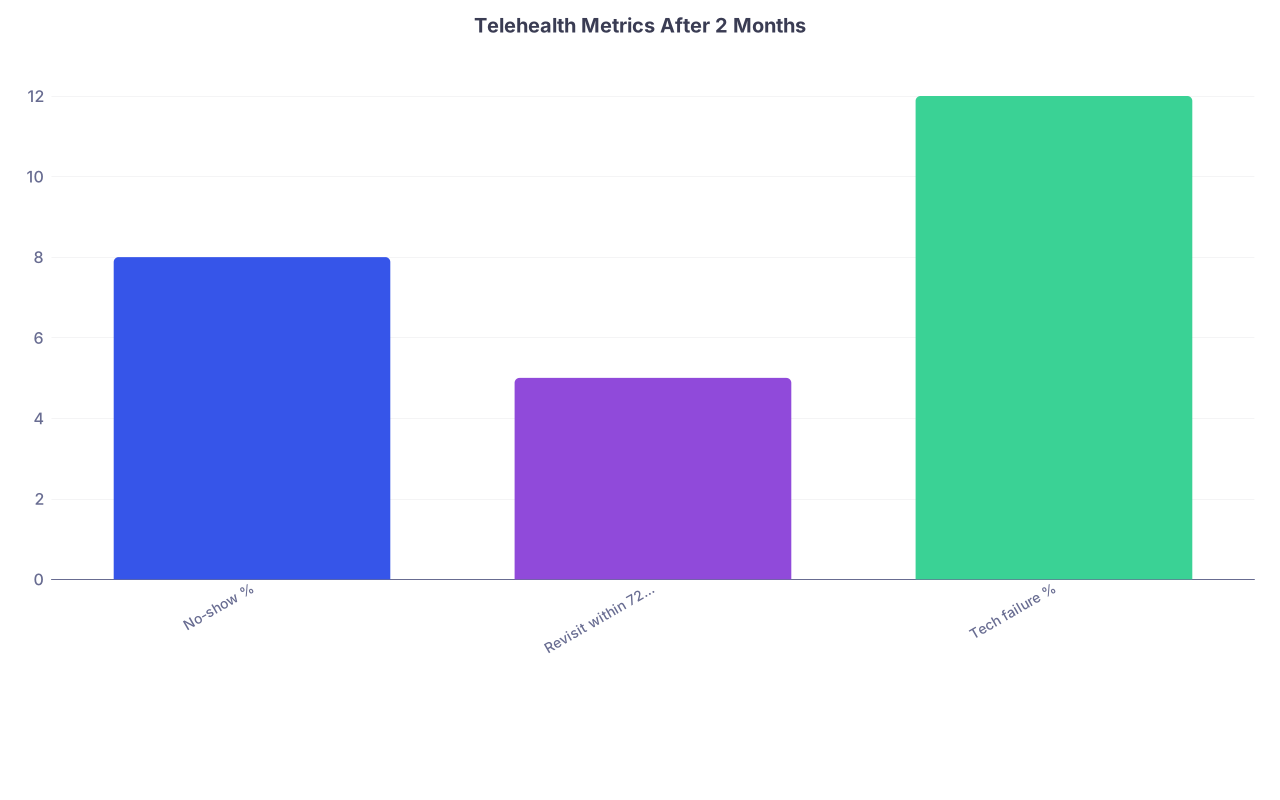
| Category | Value |
|---|---|
| No-show % | 8 |
| Revisit within 72h % | 5 |
| Tech failure % | 12 |
If those numbers look ugly, you fix processes before adding more volume.
Month 3: Integrate With In-Person Workflow (Weeks 9–12)
This is where most clinics stumble: telehealth and in-person running side by side, poorly coordinated. You don’t let that happen.
Week 9–10: Build a Hybrid Day Structure
At this point you should stop treating telehealth as a side project and treat it as part of your clinic day.
Design your “ideal hybrid day”
For example:- 8:00–10:00: Telehealth block (6 visits)
- 10:30–12:00: In-person
- 1:30–3:00: In-person
- 3:15–4:15: Telehealth follow-ups / quick checks
The key: Blocks, not random alternation.
Align staff roles across formats
- MA pre-rooms telehealth just like in-person:
- Chief complaint
- Med rec
- Vitals (home BP, weight, pulse ox if available)
- Front desk understands:
- How to handle late telehealth arrivals
- When to convert a failed video into a phone vs reschedule in-person
- MA pre-rooms telehealth just like in-person:
Guard your documentation time
Hybrid days compact your brain. At this stage:- Block 10–15 minutes mid-morning and mid-afternoon solely for wrap-up notes and callbacks.
- Protect it. If leadership wants to fill it with “one more telehealth slot,” say no unless the rest of your day is under control.
Week 11–12: Ethical Edge Cases and Boundaries
By the end of Month 3, you will start to see telehealth’s edge cases. That’s where ethics really matter.
Create a clear policy for controlled substances
Decide (with leadership if needed):- Initial controlled med starts require in-person visit
- Telehealth may be used for:
- Stable patients with recent in-person assessment
- Short bridging until next in-person if patient is safe and adherent
Document your rationale each time. If your gut says “this feels wrong,” it probably is.
Be ruthless about unsafe visit types
Start saying this phrase more:- “I’m concerned that I can’t safely evaluate this over video. I want you to come in so I can examine you properly.”
And mean it. You’re not failing at telehealth. You’re doing medicine correctly.
Handle patient expectations explicitly
Some will push:- “Can’t you just refill it? I don’t have time to come in.”
Your script: - “I understand the inconvenience. My responsibility is to make sure I’m prescribing safely. For this type of medication, I need to see you in person.”
Short, respectful, firm. Ethics over convenience.
- “Can’t you just refill it? I don’t have time to come in.”
Months 4–6: Optimize, Expand, and Sustain
By this point, the basics should feel normal. Now the focus shifts: performance, patient experience, and long-term sustainability.
Month 4: Refine, Don’t Just Expand
At this point you should improve quality before cranking volume.
Do a mini-audit of 20 recent telehealth charts
Look for:- Was telehealth medically appropriate?
- Did you document consent, patient location, privacy status?
- Did you include limitations and safety-net language?
- Any notes where your plan would obviously change in-person?
Fix patterns, not one-offs.
Get patient feedback, not just satisfaction scores
Ask 5–10 patients directly during visits:- “What made this work well for you?”
- “What was frustrating or confusing?”
- “Would you choose this again or prefer in-person next time, and why?”
Standardize teaching for trainees (if you supervise)
- Create a short “Telehealth 101”:
- Pre-visit prep checklist
- Ethical checklist (consent, privacy, limitations)
- When to convert to in-person or ED
- Review 3–5 of their telehealth notes and give pointed feedback.
- Create a short “Telehealth 101”:
Month 5: Strategic Expansion Based on Data
Now you can decide if and how to grow.
- Review your 3-month trend metrics
Look at:- Telehealth share of total visits over time
- Revisit/conversion to in-person rate trends
- No-show rates
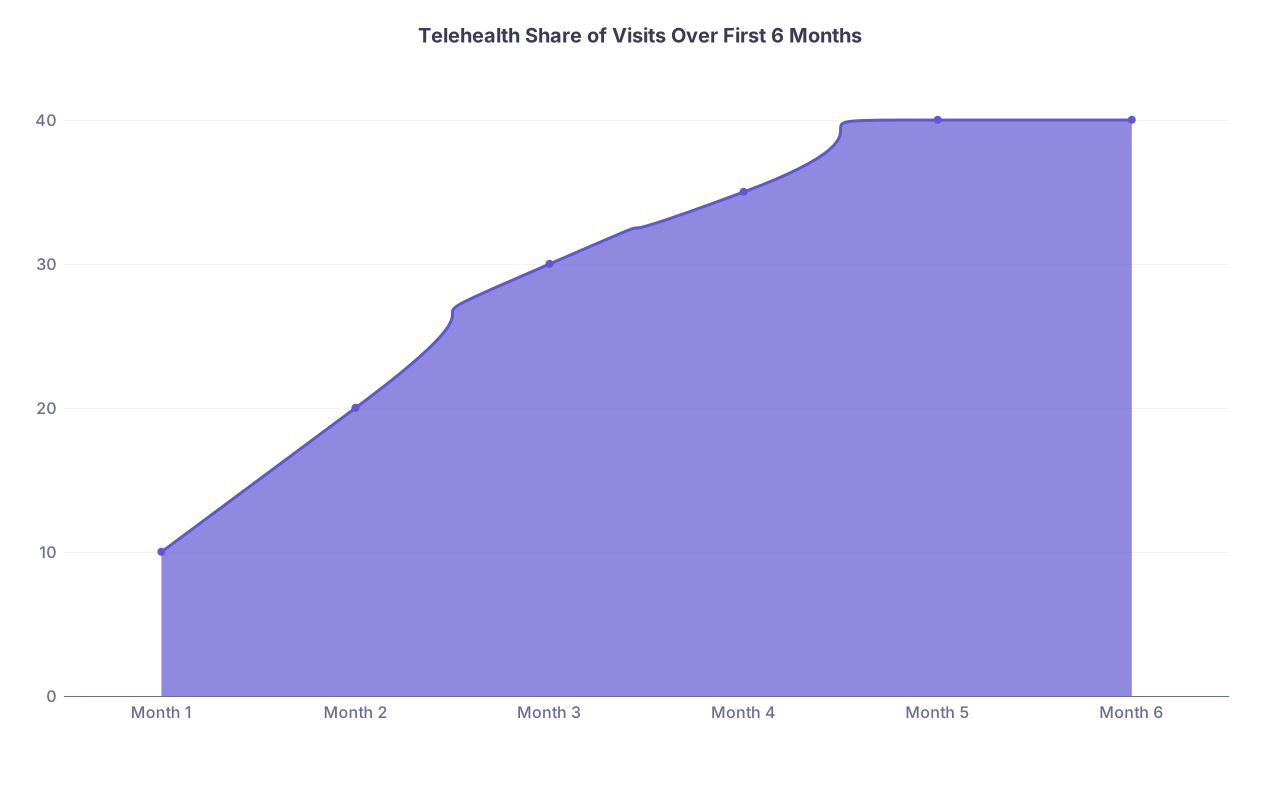
| Category | Value |
|---|---|
| Month 1 | 10 |
| Month 2 | 20 |
| Month 3 | 30 |
| Month 4 | 35 |
| Month 5 | 40 |
| Month 6 | 40 |
If conversion-to-in-person is stable and low, you’re selecting good cases. If it’s high, your screening criteria are too loose.
Intentionally add 1–2 new visit types
For example:- Adding post-discharge follow-ups by telehealth within 3–5 days
- Adding behavioral health check-ins with a clear crisis protocol
Write explicit rules for each new category, so staff know when it’s allowed and when it’s not.
Address clinician burnout risk early
Telehealth can be deceptively draining:- Staring at screens, reading micro-expressions
- Juggling tech issues and clinical reasoning
Adjust: - Cap telehealth to a reasonable percentage of your week (maybe 30–40%) unless you truly prefer it.
- Cluster video visits to reduce constant switching.
Month 6: Consolidate Into a Mature, Ethical Workflow
By now, this shouldn’t feel like “new tech” anymore. It should feel like a normal part of how you practice.
At this point you should codify your workflow so it survives schedule changes, staffing shifts, and policy updates.
Write your “Telehealth Playbook – Version 1.0” (2–3 pages)
Include:- Visit types: allowed, discouraged, prohibited
- Pre-visit screening script for staff
- Consent, privacy, location script and documentation expectations
- Standard note templates and smart phrases
- When to convert to in-person / ED and how to document that conversation
- Rules around controlled meds and sensitive topics
Build a quick decision support flow for yourself and trainees

| Step | Description |
|---|---|
| Step 1 | Telehealth scheduled |
| Step 2 | Review reason for visit |
| Step 3 | Convert to in person or ED |
| Step 4 | Start visit |
| Step 5 | Confirm consent, location, privacy |
| Step 6 | Assess symptoms |
| Step 7 | Complete plan with limitations noted |
| Step 8 | Appropriate for telehealth |
| Step 9 | Safety concerns or red flags |
Print it. Put it near your monitor. Use it until it’s muscle memory.
- Plan your next 6 months intentionally
Decide:- Do you want to maintain, increase, or slightly reduce telehealth share?
- Will you expand to more complex patients or keep it tightly defined?
- What ethical challenges did you see most often—and how will you educate new staff about them?
Visual: 6-Month Telehealth Rollout Phases
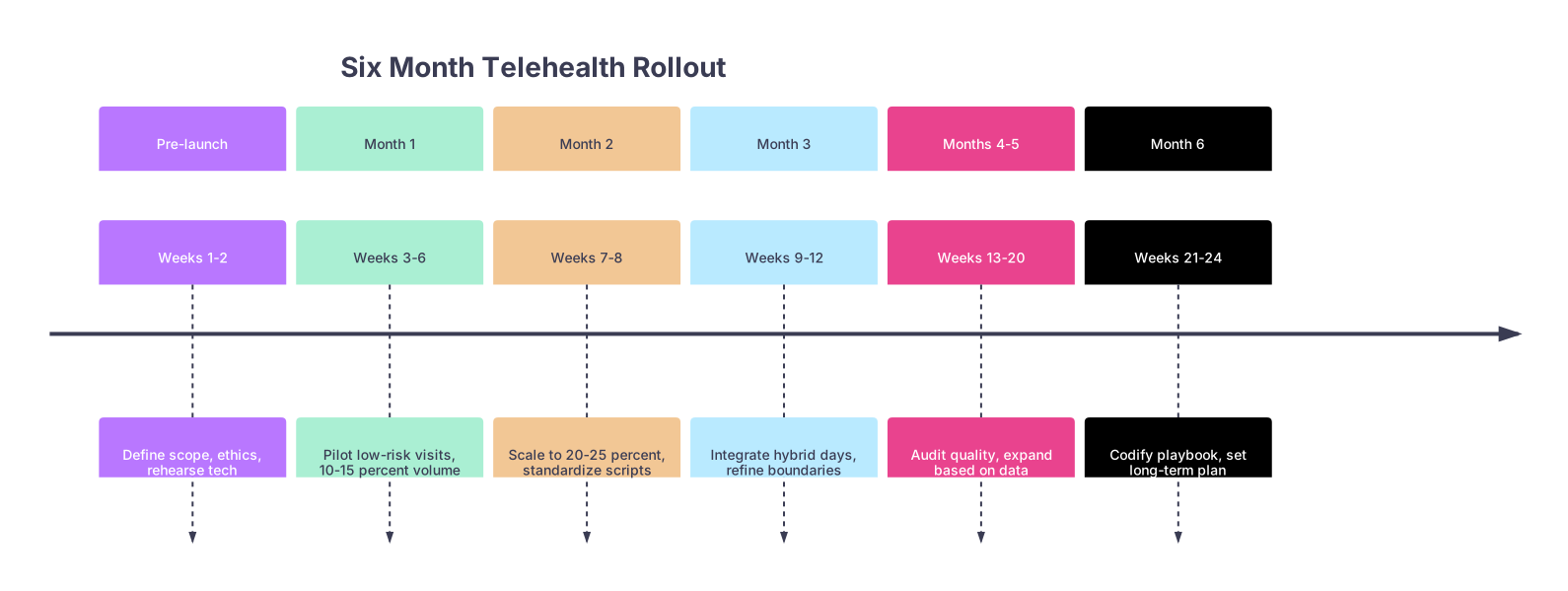
| Period | Event |
|---|---|
| Pre-launch - Weeks 1-2 | Define scope, ethics, rehearse tech |
| Month 1 - Weeks 3-6 | Pilot low-risk visits, 10-15 percent volume |
| Month 2 - Weeks 7-8 | Scale to 20-25 percent, standardize scripts |
| Month 3 - Weeks 9-12 | Integrate hybrid days, refine boundaries |
| Months 4-5 - Weeks 13-20 | Audit quality, expand based on data |
| Month 6 - Weeks 21-24 | Codify playbook, set long-term plan |
Three Things to Keep Front and Center
- Start small, then scale on purpose. Month 1 should feel almost boring. That’s the point.
- Ethics first, always. Consent, privacy, clear limitations, and safety nets aren’t “extras”—they are the telehealth visit.
- Codify what works. By Month 6, you shouldn’t be improvising. You should have a written, repeatable telehealth workflow that protects your patients and your sanity.
You do that over 6 months, and telehealth becomes just another way you practice good medicine—not a tech experiment that happens to your clinic.