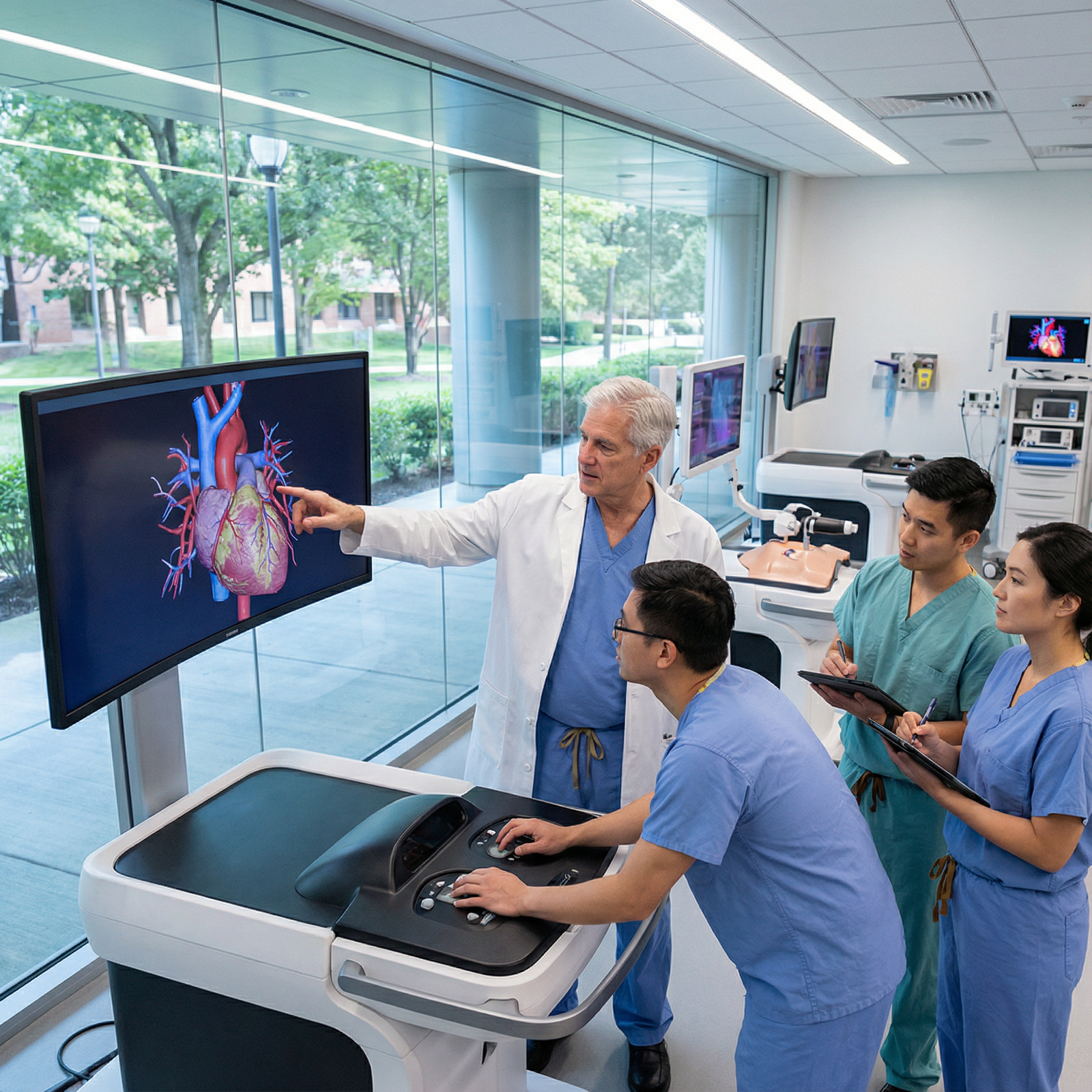
VR training does not magically make you a better proceduralist. At best, it makes you better at very specific, measurable micro-skills under tightly controlled conditions. The hype has run way ahead of the data.
Let’s cut through the sales pitches and look at what actually holds up under scrutiny.
What People Think VR Does vs What It Actually Does
I keep hearing the same lines from hospitals and med schools that just bought a shiny VR rig:
- “Our residents will become safe in VR before touching patients.”
- “This will revolutionize procedural competency.”
- “VR will standardize training and eliminate variability.”
That sounds great in a grant proposal. In practice, VR does three things reliably, and only three, across multiple meta-analyses and randomized trials:
- Improves performance on simulator metrics (time to completion, path length, error count).
- Sometimes improves early performance on bench tasks (box trainer, simple simulators).
- Has inconsistent and modest impact on actual performance with real patients.
The jump from “better at VR” to “better at procedures in the OR/ICU/ward” is where the evidence starts to crack.
What the Data Actually Shows
Let’s go through the types of evidence, starting with what VR is genuinely good at.
1. VR Improves Performance On… VR
This isn’t controversial: if you train on a task repeatedly in a virtual environment, you will get faster and make fewer mistakes on that same environment. That’s called task-specific learning, not magic.
Studies in laparoscopic VR trainers (e.g., LapSim, LapMentor, etc.) show:
- Faster task completion times
- Shorter instrument path lengths
- Fewer predefined “errors” (e.g., touching forbidden zones, excessive force)
You see similar things in:
- Central line VR simulators: fewer needle passes on the sim, better angle control.
- Endoscopy VR: better mucosal surface coverage, fewer simulated perforations.
But here’s where people overreach: improvement on the device is not the same as improvement in real procedures. A lot of papers silently assume this transfer; fewer actually test it.
2. Transfer to Real Patients: Narrow, Conditional, and Overstated
Where VR shines:
- Early learners, with almost no prior hands-on experience
- Repetitive, technically constrained procedures: basic laparoscopy tasks, simple arthroscopy, endoscopy basics
- Well-validated devices where performance metrics correlate with OR outcomes
A few findings that actually matter:
- Early RCTs in laparoscopy showed that residents trained on VR made fewer intraoperative errors and were faster on specific tasks like camera navigation and peg transfer when first stepping into real OR procedures.
- Some central line VR and ultrasound-guided procedure sims show improved first-pass success and fewer major errors for absolute beginners.
But then you dig deeper.
Multiple systematic reviews and meta-analyses across surgical and procedural specialties show a typical pattern:
- Large effect sizes for simulator performance (Cohen’s d often > 0.8).
- Small-to-moderate effect sizes for procedural performance in the real world, often limited to:
- Time
- Simple error counts
- Number of prompts required from supervisors
And crucially:
- Many studies have tiny sample sizes (n=10–40 residents).
- Outcome measures are often weak surrogates: checklists, “global rating scales,” or crude time-based metrics.
So yes, VR can move the needle. But usually by a few notches, early on, in narrow contexts. It does not turn a mediocre PGY-2 into a confident, independent operator.
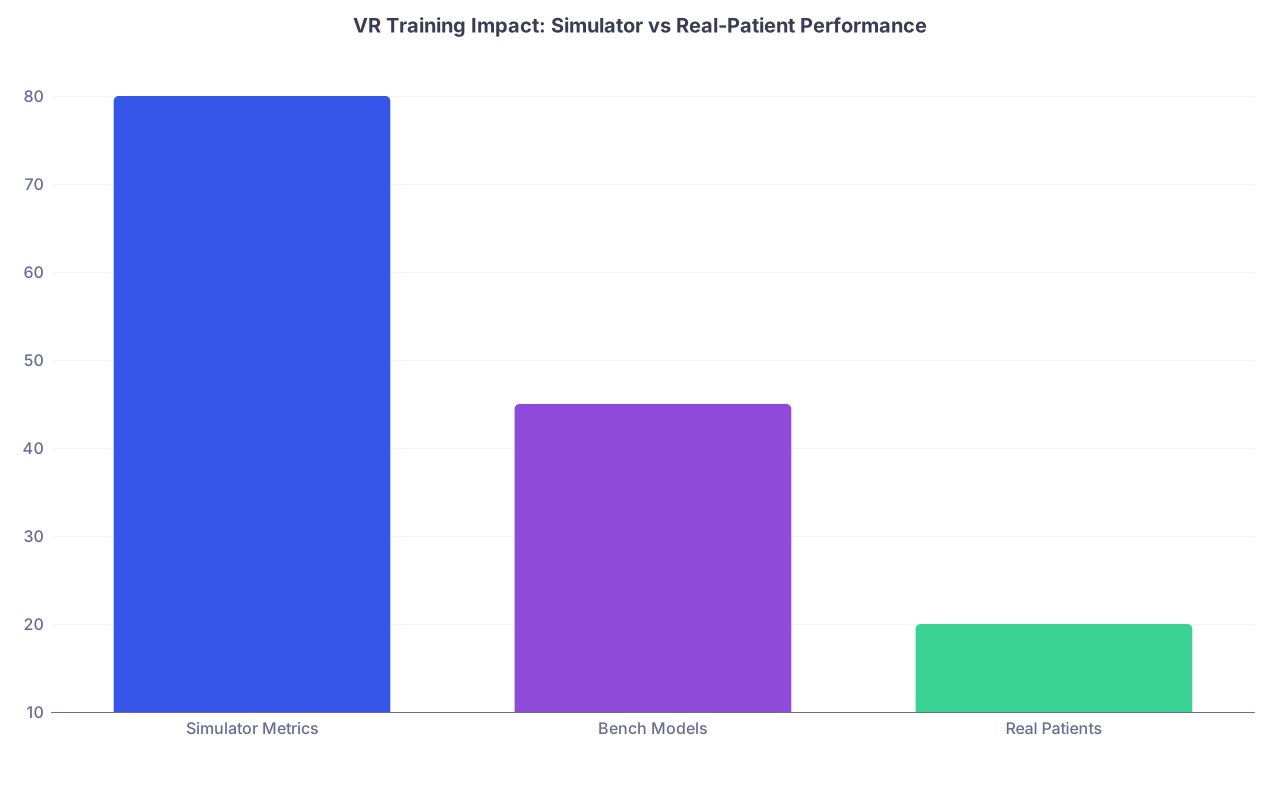
| Category | Value |
|---|---|
| Simulator Metrics | 80 |
| Bench Models | 45 |
| Real Patients | 20 |
Interpretation: effect sizes are large on the simulator, moderate on bench tasks, and small on real patient performance. This is the typical pattern across procedural VR studies.
The Big Myth: “VR Replaces Early Patient Contact”
This is the most dangerous misconception floating around curriculum committees.
The idea: “If residents master procedures in VR first, we can delay or reduce real-patient exposure and still keep competency and safety.” It sounds ethical. It feels safer. The data does not fully support it.
Three key problems:
VR environments are sanitized.
No vomiting patient, no bleeding obscuring the field, no uncooperative sedation, no family member asking you mid-procedure, “This is safe, right?” Real procedural competence is as much about cognitive load and team communication as motor skills. VR doesn’t replicate this well (yet).Most VR studies don’t measure meaningful patient outcomes.
They measure:- Time to completion
- Number of technical errors
- Supervisor rating scales
Almost none examine:
- Complication rates over months
- Longitudinal procedural independence
- Patient-centered outcomes (pain, satisfaction, readmissions)
Overtrust in VR performance can create false confidence.
I’ve seen residents who “passed all modules” then freeze during a real central line when the patient desats and the monitor alarms go off. VR didn’t train that response.
Ethically, using VR as an adjunct is defensible. Using it as a substitute for early, supervised procedural exposure is shaky at best and dishonest at worst.
Where VR Actually Adds Real Value
Let’s be fair. VR isn’t snake oil. It’s just being sold like it is.
VR tends to be most useful when used in these ways:
Deliberate practice of micro-skills
Breaking procedures into components:
- Needle angle and trajectory
- Bimanual coordination
- Scope manipulation and torque steering
- Camera control and horizon maintenance
VR lets learners repeat these tasks 50–100 times with automated feedback. That kind of volume is impossible on real patients.
Rare or high-risk scenarios
- Surgical complications (massive bleeding, difficult anatomy)
- Crisis events (air embolism during central line, tension pneumothorax during chest tube)
- Complex anatomy variations
You simply cannot wait for these to show up in the OR to train people safely. VR or high-fidelity simulation is the only realistic option.
-
Theoretically, VR can:
- Quantify path length, economy of motion
- Track errors reliably
- Set benchmarks for minimal competence
When paired with thoughtful validation, this can make assessments less subjective than “attending says you’re OK.”
But that last phrase is key: with thoughtful validation. Most programs are still in the “just trust the score because it’s on a screen” phase.
Where VR Training Stumbles
Let’s talk about the parts nobody likes to mention in vendor demos.
1. Poorly validated simulators
Not all VR platforms are created equal. Many “procedural sims”:
- Use cartoonish, non-realistic anatomy
- Have oversimplified or wrong tactile feedback
- Reward speed more than precision
- Lack evidence that their metrics correlate with real performance
If the simulator’s definition of “competent” doesn’t match reality, you’re just training to the test. That’s not education; that’s gaming.
2. No integration into a real curriculum
I’ve seen institutions drop six figures on VR gear and then:
- Leave it in a locked room
- Offer “VR time” as an optional, unguided activity
- Never tie performance to progression, remediation, or real feedback
Unsurprisingly, the impact on procedural competence is negligible. VR without:
- Clear learning objectives
- Faculty oversight or coaching
- Integration into assessment framework
…is a toy, not a training tool.
3. Overemphasis on speed
Many VR platforms rank learners by:
- Time to completion
- Number of errors (often binary or simplistic)
Residents start racing the clock. They brag about doing the “lap chole task” in record time. But in the OR, early in training, I care more about:
- Deliberate, controlled motion
- Respect for tissue
- Proper problem recognition and escalation
Speed is a tertiary metric. VR often makes it primary.
| Aspect | VR Strength? | Reality Check |
|---|---|---|
| Basic motor skills | Yes | Good early on, effect fades as experience grows |
| Crisis/rare event practice | Yes | Best used for scenario-based team sims |
| Assessment objectivity | Maybe | Only if metrics are validated and used well |
| Replacing early patient contact | No | Ethically weak and not supported by data |
| Long-term complication reduction | Unclear | Very limited, inconsistent evidence |
The Ethical Angle: Competence, Consent, and Honesty
You cannot talk about VR and procedural skills without touching ethics.
1. “I learned this in VR” is not sufficient disclosure
From a patient’s point of view, “I’ve done this 50 times on a simulator” is meaningless if you have done it zero times on a living human under supervision. Patients implicitly assume both:
- Adequate theoretical preparation
- Adequate real experience
There’s an uncomfortable gap when VR is overused as a replacement.
2. Program directors overclaiming safety
I’ve seen marketing copy along the lines of:
“Patients can rest assured our trainees are fully trained in VR before touching them.”
No. They are exposed to VR. “Fully trained” implies real-world competence that VR has not been shown to guarantee. Overstating this to justify device purchases is ethically sloppy.
3. Unequal access and selection bias
High-resource programs get:
- State-of-the-art sims
- Faculty with protected teaching time
- Structured assessment
Low-resource programs get:
- A single outdated box trainer, if that
If VR becomes embedded into certification or hiring decisions without adjusting for access, you’ve just baked socioeconomic disparity into procedural training. The meta-analyses showing benefit are often from well-funded academic centers—hardly representative.
What a Sane, Evidence-Based Use of VR Looks Like
If I were building a procedural training curriculum from scratch, here’s how I’d use VR without lying to myself about what it can and can’t do.
Early phase (novice learners)
- Use VR to teach:
- Anatomy orientation
- Basic hand–eye coordination
- Standardized steps of common procedures
- Integrate with didactics on:
- Indications/contraindications
- Complications and management
- Use VR to teach:
Clear performance thresholds
- Require minimum validated VR performance before first real-patient attempt
- But explicitly state: this is a gatekeeper, not proof of real competence
Rapid transition to supervised real procedures
- As soon as learners hit basic VR benchmarks, move to:
- Supervised bedside procedures
- OR experiences with graded autonomy
- As soon as learners hit basic VR benchmarks, move to:
Ongoing use for rare, complex scenarios
- VR sessions for:
- Crisis simulation
- Uncommon anatomic variants
- Team communication drills
- VR sessions for:
Transparency with patients and trainees
- Trainees understand:
- VR = tool for preparation and practice
- Real competence still requires real cases
- Programs avoid overselling VR as a safety guarantee.
- Trainees understand:

| Step | Description |
|---|---|
| Step 1 | Novice Learner |
| Step 2 | VR Micro skill Training |
| Step 3 | VR Performance Threshold Met |
| Step 4 | Supervised Real Procedures |
| Step 5 | Ongoing VR for Rare Events |
| Step 6 | Independent Competence |
So, Does VR Truly Improve Procedural Skills?
If you mean: “Does it make you better at a specific set of measurable technical tasks that map onto early parts of real procedures?”
Yes, especially for novices, and especially when the simulator is well-designed and validated.
If you mean: “Does VR by itself make you a safer, more competent proceduralist for real patients in the long run?”
The evidence is thin, inconsistent, and nowhere near the level of certainty the marketing suggests.
You still need:
- Repetition on actual patients
- Real supervision
- Exposure to complexity, complications, and chaos
- Good teaching and feedback
VR is a supplement, not a substitute.
The Bottom Line
- VR improves simulator performance and some early real-world metrics, but the effect on meaningful patient outcomes and long-term competence is modest and uncertain.
- Using VR as an adjunct to structured, supervised real-world training is ethical and helpful; using it as a replacement for early patient exposure is not supported by evidence.
- The programs that benefit most from VR treat it as a targeted tool for micro-skills and rare scenarios—not as a magic shortcut to procedural mastery.