
The drug pipeline is more influenced by industry money than anyone wants to admit.
That’s the uncomfortable truth sitting under every glossy “breakthrough” headline and every slick drug rep presentation. And if you’re like me, that thought is not abstract. It’s the thing that makes you lie awake wondering: am I going to become the kind of doctor who quietly looks the other way?
Let’s not pretend this is a theoretical ethics seminar. This is: you, in a clinic or hospital, with 10 minutes per patient, a new expensive drug, some glowing trial data, and a rep who “just wants to help.” And a patient who trusts you way more than you currently trust yourself.
You’re not asking, “What is industry influence?”
You’re asking, “How the hell do I not become complicit in this?”
Good. That anxiety is actually your best protection.
The Fear You Won’t Say Out Loud
Let me just say it for you.
You’re scared that:
- You’ll slowly stop noticing the bias in “evidence”
- You’ll rationalize questionable prescribing because “everyone does it”
- You’ll end up defending a drug you secretly know is probably not worth the cost or risk
- You’ll get so used to industry-sponsored everything that you lose your internal compass altogether
And the worst one: that one day a patient will be harmed by a drug you recommended, and you’ll realize you didn’t look hard enough for the truth because the sponsored data looked so damn reassuring.
I’ve seen this play out.
The oncology fellow saying, “Yeah, the survival benefit is like… what, a couple months median? But it’s the new standard.”
The attending shrugging about a cardiac drug: “Look, the trial was industry-funded, but what isn’t? This is what the guidelines say.”
The resident deciding between two GLP-1 agonists and realizing the one with all the flashy data also happens to be the one with the most aggressive marketing.
Nobody wakes up and decides, “I’m going to let pharma shape my clinical brain.”
It happens by erosion, not explosion.
So the question is: how do you stop the erosion?
What Industry Influence Actually Looks Like (Not the Cartoon Version)
Most people imagine “industry influence” as a shady envelope of cash. That’s not how the system really works. The real machinery is quieter and way more effective.
Here’s what it actually looks like in daily life:
- “Free” lunch + journal club sponsored by a specific company
- CME events subtly organized around the company’s drug
- Key opinion leaders (KOLs) giving talks with disclosures buried in slide 2, while slide 27 casually frames the drug as first-line
- Guideline committees with members who got consulting fees from the manufacturer
- Trials designed in ways that make the drug look better than it is: weak comparators, weird endpoints, short follow-up, selective populations
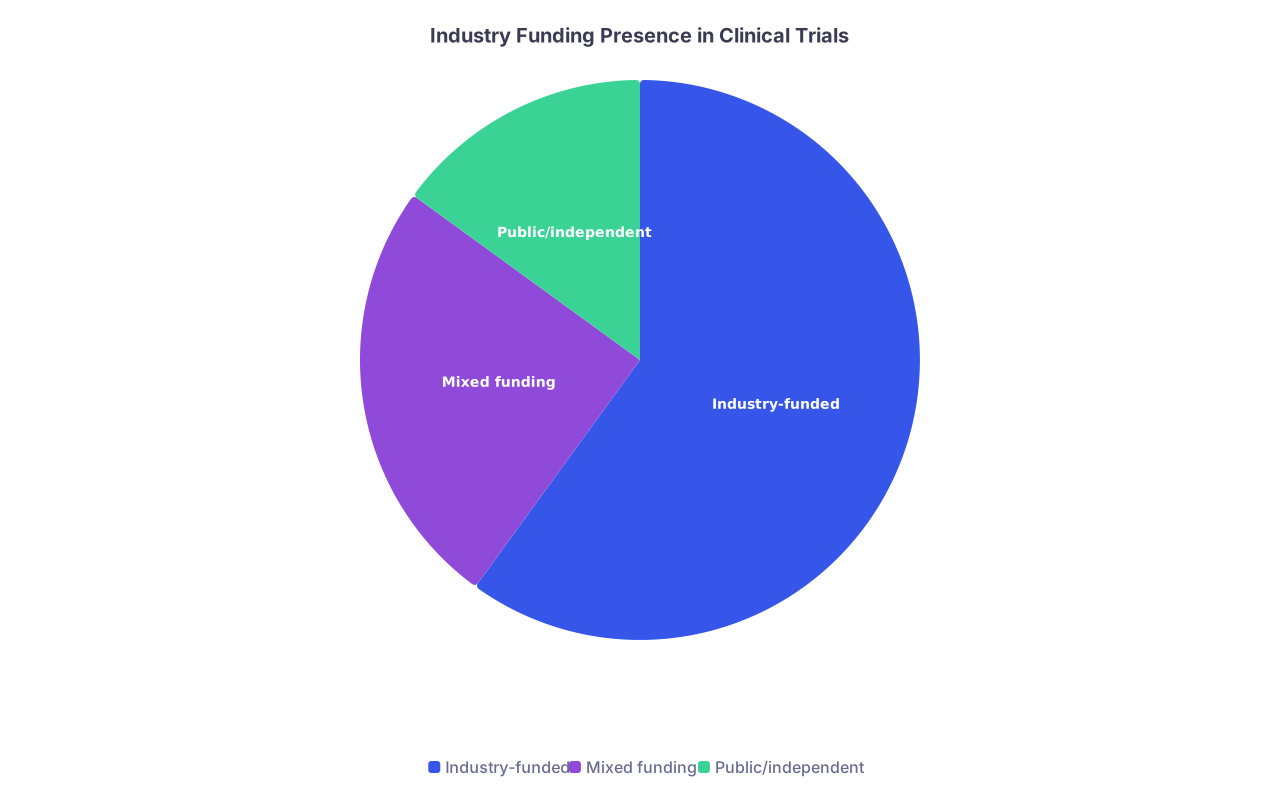
| Category | Value |
|---|---|
| Industry-funded | 60 |
| Mixed funding | 25 |
| Public/independent | 15 |
And you? You’re sitting in the middle of that, trying to decide if a new heart failure drug, or an anti-IL-whatever biologic, or an oncology agent is actually worth it.
You’re not paranoid for worrying. The system is literally engineered to make it hard to be neutral.
How New Drugs Get Sold to Your Brain
You can’t stay ethical if you don’t understand the tactics being used on you. So let’s rip off the dressing.
1. Trial design that looks “rigorous” but is actually stacked
You’ll see:
- Surrogate endpoints instead of real outcomes (HbA1c instead of mortality, plaque volume instead of strokes)
- Comparators that are outdated, underdosed, or not the true standard of care
- Carefully selected low-risk trial populations that don’t look like your patients at all
So you read: “Significant 20% relative risk reduction!”
But absolute risk change is tiny. Or outcome is soft. Or follow-up is 12 months for a drug patients will take for life.
2. Publication and spin
Industry picks:
- Which trials get written up
- Which get buried
- How the abstract is framed
You know how many people only read the abstract? Way too many. And the spin is almost always there: “trend toward benefit,” “consistent with prior data,” “excellent safety profile” based on carefully cherry-picked numbers.
3. Social proof and KOLs
You see a big name from a big center presenting at ACC, ASCO, or ADA, saying: “This is practice-changing.” They disclose “consultant for A, B, C” in tiny print. The conference room nods.
You think: well if they are on board, who am I to question?
That’s the whole point.
Practical Ways Not to Lose Your Ethical Backbone
Here’s the part you were actually looking for: what to do.
You don’t need to be some heroic lone whistleblower. You just need systems around yourself that make it harder to slide.
1. Develop a personal “drug skepticism checklist”
Before you emotionally buy a new drug, run it through a personal filter. Every. Time.
Ask yourself:
- Who funded the trial?
- Was the comparator legit? (Standard of care, right dose, right duration?)
- What were the primary endpoints? Hard outcomes or surrogates?
- What’s the absolute risk reduction, not just relative?
- What’s the NNT / NNH? Over what time period?
- Do the trial patients look like the ones I’ll treat? Age, comorbidities, race, severity?
- Are there independent (non-industry) meta-analyses or systematic reviews yet?
If you can’t answer at least half of these, that’s already your answer: slow down.
| Question | Red Flag Answer |
|---|---|
| Funding | Solely industry |
| Comparator | Placebo when SOC exists |
| Endpoint | Only surrogate outcomes |
| Follow-up duration | Very short |
| Population | Unlike your patients |
| Independent reviews | None yet |
If you start seeing three or more red flags, that’s not “paranoid.” That’s you being awake.
2. Decide your stance on industry before you’re in the room
This sounds extreme, but it works: write your own rules.
Something like:
- I don’t meet 1-on-1 with drug reps. Ever.
- I don’t accept food/gifts, even small ones.
- I don’t attend CME that’s obviously structured around one company’s product.
- I won’t join a speaker bureau.
- If I do any paid consulting, I will not also be a primary prescriber of that drug unless I can defend it in writing.
You can loosen or tighten those as you go, but having an upfront policy stops a lot of slippery-slope rationalizing later.
And yes, people will roll their eyes. “It’s just coffee.” “You’re overthinking it.”
Maybe. But the whole system is cumulative nudges. You opting out of some of those nudges is not overkill. It’s self-defense.
Staying Ethical When You’re at the Bottom of the Hierarchy
Here’s where it gets truly miserable: you’re a student or resident. You see what looks like straight-up industry capture of practice patterns. And you have… almost no power.
This is the worst-case scenario your brain keeps replaying: either you speak up and get labeled “difficult,” or you stay quiet and feel complicit.
What you can do without blowing yourself up
Ask neutral, data-driven questions
Not: “Isn’t this pharma-influenced?”
More: “Do we know the absolute risk reduction for this drug versus the older one?” or “Has there been any independent data yet, outside of the sponsor’s trials?”You’re not attacking. You’re “curious.” You can live with that.
Take notes on patterns
You’ll start to notice: certain attendings parrot specific company language. Certain departments love the newest thing even when the benefit is marginal. Just noticing it keeps your brain from normalizing it.Control what you read
Go beyond the glossy trial summary. Look at the methods. Check editorial commentaries that are not written by investigators. Use sources like TheNNT.com, independent guideline panels, Cochrane (when available).Practice saying, “I’m not fully convinced by the data yet”
Quietly. To peers. To yourself. You don’t have to win a debate. You just need to keep that muscle of doubt alive.

When Industry Influence and Patient Care Collide
The part that keeps you up is not the abstract ethics. It’s picturing a real patient in front of you.
Say you’re on endocrine clinic. New GLP-1 agonist. Trials funded by the company. Impressive weight loss data. Eye-watering cost. Long-term safety still evolving.
Here’s what staying ethical might actually look like in that moment:
- You’re transparent: “Most of the data we have so far is from studies funded by the company that makes this drug. The results look promising, especially for weight and blood sugar, but long-term effects and rare side effects may still emerge.”
- You disclose uncertainty: “We don’t have 10–15 year real-world data yet.”
- You discuss alternatives: “We can also consider older, cheaper drugs that have been around longer. They may not have the same weight effects, but their long-term safety is better known.”
- You consider the patient’s context: cost, access, preferences, risk tolerance
This is messy. There’s no clean answer. But you’re not silently pretending the evidence is pristine. That’s the ethical line.
Tools So You’re Not Just Relying on Gut Feel
Your anxiety is high enough; you don’t need to be manually doing meta-analyses in your head at 2 a.m.
You can build a small ecosystem of external “guardrails” to lean on:
- Independent summaries:
- TheNNT.com (risk/benefit broken down brutally)
- Independent blogs/podcasts that critique trials (e.g., some EM/IM evidence-based sites, without pharma ties)
- Hospital or academic pharmacists
Some of the most brutally honest people about drugs are clinical pharmacists who live in the land of dosing, interactions, and formulary fights. - Institutional policies / formulary restrictions
If your hospital made a drug non-formulary or restricted, ask why. Often they’ve already flagged the industry-inflated hype.
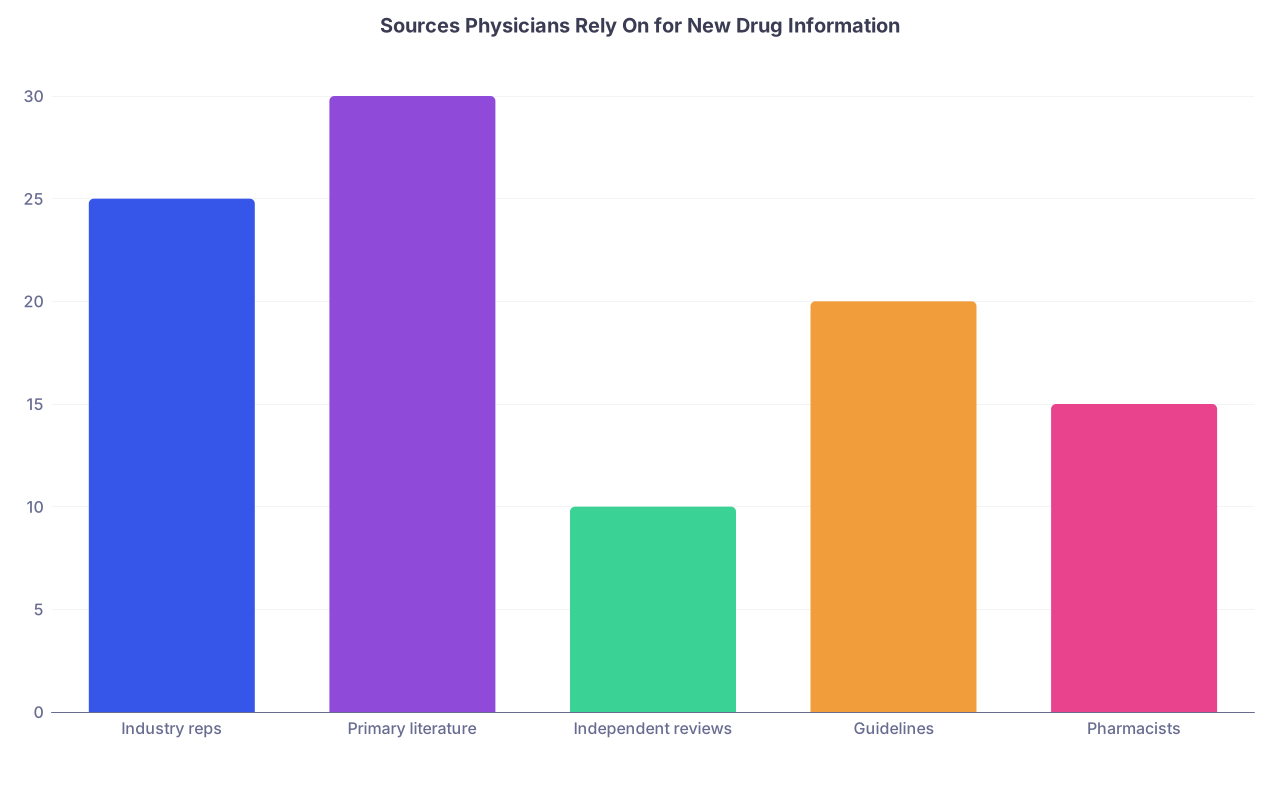
| Category | Value |
|---|---|
| Industry reps | 25 |
| Primary literature | 30 |
| Independent reviews | 10 |
| Guidelines | 20 |
| Pharmacists | 15 |
Notice how low “independent reviews” tend to be in real life. That’s where you can quietly choose to be different.
The Worst-Case Scenario You’re Imagining
Let’s name it.
You’re scared that:
- You’ll look back in 15 years and realize you helped normalize some high-cost, marginal-benefit nonsense
- You’ll have recommended drugs that later turned out to have serious harms that were underplayed early on
- You’ll feel like you should have seen the signs but didn’t want to rock the boat
Some of that may happen no matter what you do. Medicine is messy. Evidence evolves. “Best practice” in 2026 sometimes looks barbaric in 2040.
But there’s a difference between being wrong because science changed and being wrong because you never looked past the marketing.
That’s the line you control.
How to Build a Career That Doesn’t Slowly Corrode You
This is the long game.
Choose mentors who are openly skeptical of industry hype
When you hear an attending saying things like, “Let’s see what the independent data shows in a few years,” pay attention. These are your people.Keep a private “ethics journal”
Not as some performative bit. Just a place where you jot down:- Situations that made you uncomfortable
- How you responded
- What you wish you’d said or done
This is how you see your patterns. How you get braver without swinging to self-righteousness.
Revisit your stance every few years
You’ll change. The system will push harder. Industry money will be everywhere: conferences, research, your inbox. Updating your rules beats letting them silently soften.

| Step | Description |
|---|---|
| Step 1 | Awareness of Industry Bias |
| Step 2 | Create Personal Rules |
| Step 3 | Practice Skeptical Reading |
| Step 4 | Handle Real Patient Decisions |
| Step 5 | Reflect on Outcomes |
| Step 6 | Adjust Rules and Boundaries |
You don’t “solve” this once. You iterate.
You’re Allowed to Be Both Scared and Good at This
Let me be blunt: the people who scare me are not the ones worrying about industry influence. It’s the ones who’ve stopped worrying.
Your anxiety? Annoying, yes. But also your early warning system.
So here’s what you hold on to:
You can prescribe new drugs ethically if you:
- understand who funded the data
- insist on real outcomes over shiny surrogates
- stay honest with patients about uncertainty
You avoid becoming industry’s puppet not by being perfect, but by:
- setting personal rules now, while you still care this much
- asking uncomfortable data questions, even quietly
- keeping some independent sources you trust
You will sometimes get it wrong.
The ethical failure isn’t being wrong.
It’s not bothering to look past the sales pitch.
If you’re already worrying about becoming ethically numb to industry influence, you’re miles ahead of the people who are sleepwalking through it. Your job now isn’t to stop worrying. It’s to turn that worry into habits that will still be protecting your patients when the next “miracle drug” lands on your desk with a glossy brochure and a smiling rep.