
The belief that you need overseas mission trips to match into global health fellowships is wrong.
Not just slightly off. Backwards in several important ways.
If your mental model of “global health” is a week in Guatemala doing tooth extractions or giving out bags of amoxicillin, you’re already behind the field. And some fellowship directors will quietly red‑flag you for it.
Let me lay it out plainly: global health fellowships are not shopping for who has the prettiest Instagram photos in scrubs on a dirt road. They’re looking for people who understand systems, equity, ethics, and sustainability. And the traditional short‑term mission model often signals the exact opposite.
The Core Myth: “No Overseas Missions = No Global Health Career”
Here’s the myth you’ve probably heard, usually from a premed advisor, a church leader, or that one PGY‑2 who did three trips to Honduras:
“If you want to do global health, you have to go overseas during med school or residency. Programs want to see international missions on your CV.”
That sentence bundles several assumptions that fall apart under scrutiny:
- That “global health” = “clinical work abroad”
- That overseas = more valuable than work with underserved populations at home
- That any international mission experience is automatically a plus for fellowship applications
All three are shaky. The third one is flat-out wrong at many serious programs.
Let’s start with what fellowships actually care about.
What Global Health Fellowships Really Look For
Talk to program directors at serious global health outfits—places like UCSF HEAL, Brigham’s global health equity fellowships, Duke, Hopkins, U Washington. You hear the same themes:
- Longitudinal commitment, not vacation‑length dabbling
- Evidence you can work in partnerships, not as a hero
- Ethical awareness about power, colonialism, and resource disparities
- Some proof you can follow through on a project or scholarly product
“Overseas” is optional. Substance is not.
Here’s the part applicants miss: a lot of global health leaders are deeply critical of traditional short‑term missions. They’ve seen the damage. The dependency. The ego trips disguised as service.
So when they see:
- “Medical mission trip, 10 days, six different countries over four years”
they do not think “Wow, dedicated.” They think:
- “Ah, short‑term parachute care and probably no follow‑up. Do they get what’s wrong with that?”
Compare that with:
- “Three-year partnership with local FQHC serving migrant farmworkers, developed a hypertension outreach protocol in collaboration with community promotoras”
No passport stamp. But much stronger global health signal.
To make this concrete:
| Experience Type | How It Often Reads to Serious Programs |
|---|---|
| 1–2 short-term overseas missions | Variable; sometimes neutral, sometimes negative |
| 2–3 years with local immigrant/refugee care | Strongly positive |
| Longitudinal research on global health topic | Strongly positive |
| One-year structured global health track | Strongly positive |
| Social media–heavy “mission trip” branding | Often negative |
So no, you don’t “need” overseas missions. You need coherent, ethical, sustained engagement with health equity. That can be abroad. It absolutely does not have to be.
The Evidence Problem: What Short-Term Missions Actually Do
Let’s talk outcomes. Because hype is one thing; data is another.
The literature on short-term medical missions (STMMs) is…not flattering.
Multiple reviews (e.g., Martiniuk et al. 2012, Sykes 2014, Bauer 2017) highlight the same issues:
- Very little robust evidence they improve population health
- Poor continuity of care—teams leave, patients vanish from follow-up
- Questionable quality and safety when trainees operate with minimal supervision
- Burden on host systems (translation, logistics, coordination) that may outweigh benefits
Programs that train serious global health fellows know this literature. Many of them wrote it.
So when a CV screams “I love short-term missions!”, they ask an obvious question: Do you understand the critiques? Or are you still in the voluntourism phase?
To be fair, there are higher-quality models of overseas work:
- Long-term partnerships with local institutions
- Bilateral exchanges and training
- Work that responds to locally-identified priorities, not outsider agendas
- Clear accountability structures and evaluation
But here’s the catch: those are often harder to get as a student or early resident, especially if your home institution is weak in global health. Meanwhile, low-quality trips are easy. They’re advertised in church bulletins and on Instagram.
As a result, a lot of people’s “global health experience” is structurally suspect. Some fellowships will hold that against you—unless you show in your essays and interviews that you’ve grown beyond that model.
The Ethics: Romanticized Altruism vs. Real Responsibility
I’ve lost count of how many personal statements I’ve seen that start with some version of:
“On my trip to [country], I saw poverty like I’d never seen before…”
Let me be blunt: that framing is a red flag now.
Modern global health ethics cares about:
- Power dynamics
- Structural determinants
- Decolonizing global health
- Sustainability and local leadership
“Poverty tourism as awakening” is stale and, frankly, self-centered. If the moral core of your story is about your feelings when you “realized how privileged” you are, you’ve missed the point.
Overseas missions become a problem when they:
- Center the visiting team instead of the host community
- Create parallel systems instead of strengthening local ones
- Let trainees do more than they’re qualified for because “there’s no one else”
- Treat the local population as practice material or a backdrop for personal growth
Fellowships that take ethics seriously will not be impressed by those experiences unless you explicitly critique them and show you’ve learned.
This is where local, domestic work often looks better. Helping design a community health worker program for recent immigrants in your own city? That usually comes with more accountability, more continuity, and less savior narrative baggage.
So no—overseas missions are not ethically required to show you care about global health. In many cases, they’re ethically complicated enough that you’re better off skipping the weak ones and investing locally.
The Data on Matching: Overseas Trips Are Neither Necessary Nor Sufficient
Nobody has a huge randomized dataset on “who matched global health fellowships and what was on their CV.” But we do have patterns from program descriptions, published fellow profiles, and what directors say at conferences.
Look at a random sample of current global health fellows at major academic centers. You’ll see this mix:
- People with zero pre-fellowship overseas missions, but years of local work in immigrant/refugee health or health policy
- People with deep international engagement—longitudinal work with a single country or partner institution, often 5–10 years
- People with mixed portfolios: domestic work + 1–2 longer overseas blocks (months, not days)
What you won’t see very often at high-level programs: the classic med school pattern of “six different one-week trips to six countries.”
Directors care more about:
- Coherence of your story: Does your CV tell a focused narrative?
- Depth of engagement: Time, continuity, responsibility.
- Scholarly output: Did you actually produce something—poster, paper, curriculum, QI project?
Let me put numbers on the core issue: time.
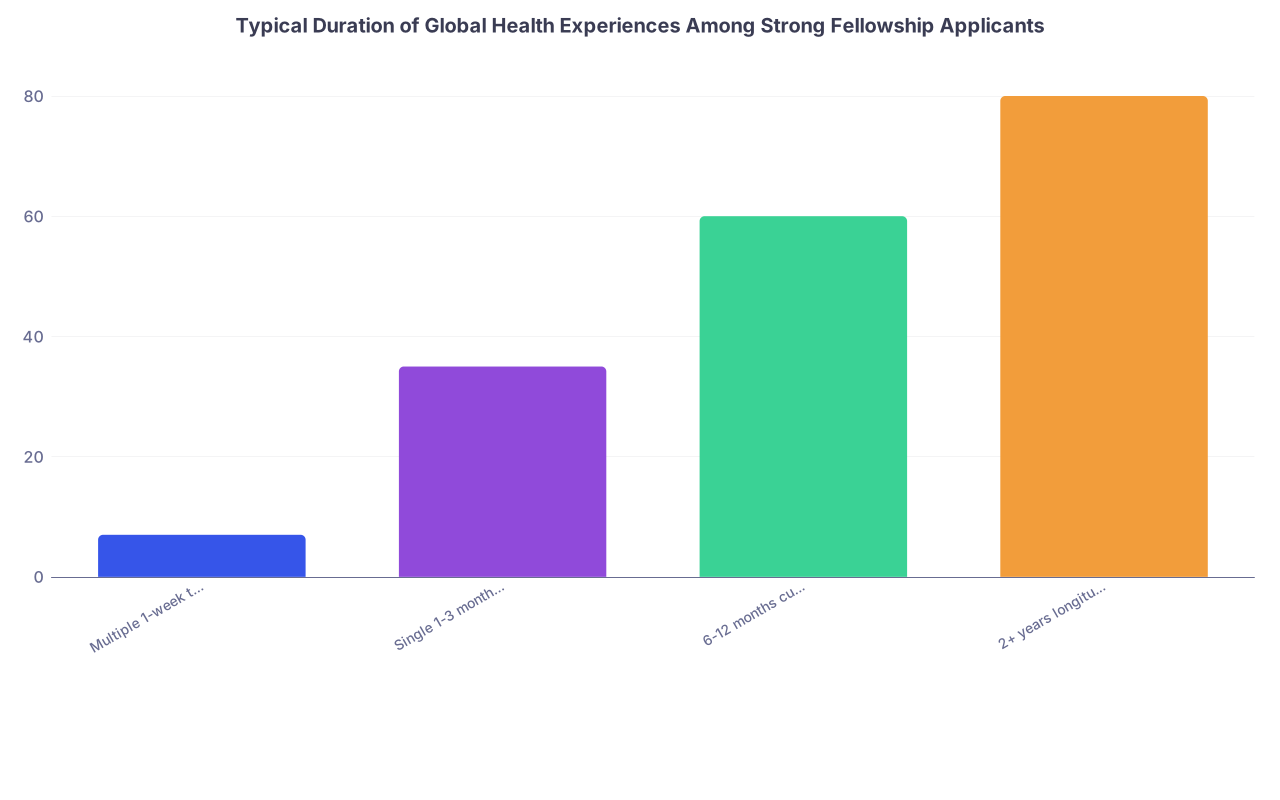
| Category | Value |
|---|---|
| Multiple 1-week trips | 7 |
| Single 1-3 month rotation | 35 |
| 6-12 months cumulative engagement | 60 |
| 2+ years longitudinal work | 80 |
Those values aren’t from a single registry; they reflect typical “strength” ratings when faculty informally score applications. One-week trips are fluff. Longitudinal commitment wins.
You do not need to leave the country to hit the 6–24 month band of engagement. But you do need to commit.
What Actually Makes You Competitive (With or Without Overseas Work)
Here’s the part that most advisors skip because it’s harder than “go on a trip”:
Global health fellowships are increasingly selecting for people who can think in systems and produce something beyond bedside heroics.
Strong applicants—again, regardless of passport stamps—usually have some combination of:
- Long-term clinical work with structurally oppressed populations
- A specific content interest (e.g., TB, HIV, maternal mortality, migrant health, climate and health)
- Evidence of systems thinking: QI projects, program-building, health policy, implementation science
- At least one substantial scholarly output: peer-reviewed paper, serious quality improvement with measurable outcomes, guideline development, etc.
None of that is inherently “overseas.” You can do it all without leaving your city.
And frankly, if you haven’t done it domestically, why should anyone trust you to do it in a context where the stakes and cultural complexity are higher?
This is what I see over and over:
- Applicant A: 3 overseas mission trips, each 1–2 weeks, plus generic volunteering at home
- Applicant B: 0 overseas missions, but 3 years working with a local refugee clinic, led a Hep B screening project, co-authored one paper on health access in that population
Every serious fellowship I know takes Applicant B first.
When Overseas Experience Does Help (And When It Hurts)
I’m not arguing you should never work abroad. That would be just as simplistic as “you must.”
Overseas experience helps when it:
- Comes through a structured, ethical program with real local partnerships
- Is long enough to see consequences (think months, not days)
- Shows growth over time in one place or with one partner system
- Leads to some output: research, curriculum, bidirectional training model, policy brief, etc.
- Is paired with humility and critical reflection about your role and the system’s needs
It hurts when:
- It’s obviously tourism with a stethoscope
- You brag about doing things that exceed your scope at home (“I got to do C-sections in [country]!”)
- You use stereotyped, objectifying language about “the poor people I helped”
- It looks like a checklist item instead of a genuine commitment
Imagine your interview with a fellowship director who has spent 15 years working with the same Ministry of Health in Malawi. Then imagine casually mentioning you “helped out in the OR” doing procedures you aren’t credentialed for because “they didn’t have anyone else.”
You won’t hear it out loud, but the conversation in their head is simple: “This person is a liability.”
If you do have overseas missions on your CV already, your task is to:
- Be honest about the limitations and ethical issues
- Highlight any true continuity or partnership
- Focus on what you learned about systems and humility, not just need and gratitude
If you don’t have them? No need to panic. You’re not at a disadvantage by default. You just need to show seriousness another way.
Building a Global Health Trajectory Without Missions
Let me be concrete about what you can actually do, from med school through residency, without hopping on a plane.

| Step | Description |
|---|---|
| Step 1 | Interest in Global Health |
| Step 2 | Join local clinic or community org |
| Step 3 | Take global or public health electives |
| Step 4 | Start small QI or research project |
| Step 5 | Present or publish work |
| Step 6 | Take leadership role in program |
| Step 7 | Apply to global health track or fellowship |
Some high-yield options:
- Work with local refugee, immigrant, or migrant worker clinics
- Partner with legal aid organizations or housing justice groups on health-related projects
- Join or help run your institution’s global or community health track
- Pick a single theme (e.g., maternal health, TB, HIV, mental health in displaced populations) and build projects around it over years
- Collaborate with faculty who already have global health research agendas—many of them have both overseas and domestic arms
You can even work on “global” questions (supply chains, financing, epidemiology, policy analysis) entirely from your laptop and local hospital system. A surprising number of major global health papers never required the first author to set foot abroad.
None of this is second-class. Serious programs see it as the core of the field.
And if down the road, during fellowship or as junior faculty, you enter a well-structured overseas partnership, you’ll be far better prepared than the person who chased mission trips for photos and personal narratives.
Where Missions Do Fit Ethically (A Narrow Lane)
There is a defensible lane for mission-style trips, but it’s narrow:
- They’re embedded in long-term partnerships run or co-led by local institutions
- There’s explicit accountability and evaluation
- Educational goals for visiting trainees are clearly secondary to local priorities
- There’s continuity—local teams handle follow-up, and visiting teams rotate in a coordinated way
If your program offers that, and you’ve already built a strong ethical and scholarly foundation at home, an overseas block can deepen your understanding. Think of it as graduate-level work, not a prerequisite credential.
For everyone else: you’re better off building depth locally than collecting stamps globally.
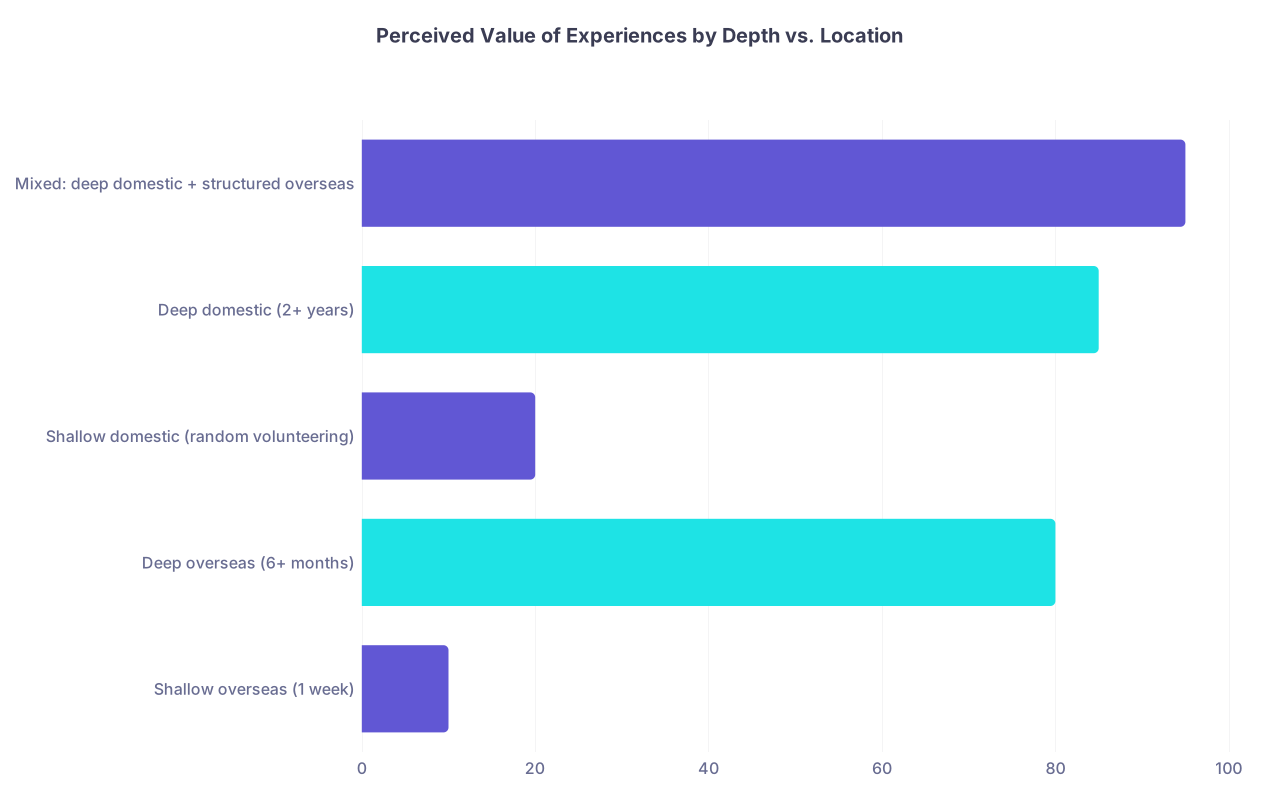
| Category | Value |
|---|---|
| Shallow overseas (1 week) | 10 |
| Deep overseas (6+ months) | 80 |
| Shallow domestic (random volunteering) | 20 |
| Deep domestic (2+ years) | 85 |
| Mixed: deep domestic + structured overseas | 95 |
That’s the real hierarchy most serious global health programs use, whether they spell it out or not.
The Bottom Line
You do not need overseas missions to match a strong global health fellowship. Often, they’re noise—or worse, a liability—unless they’re done in an ethical, structured, longitudinal way.
What fellowships actually want:
- Depth and continuity of engagement with health equity, which you can absolutely build domestically.
- Evidence of systems thinking and scholarly output, not a collection of short-term “service” trips.
If you care about global health, stop chasing the optics of missions and start building the substance of a career.


