
Last month, a resident pulled me aside after morning report, eyes still red from what I’m pretty sure were stress-tears in the call room. “I love medicine,” she said, “and I want to teach. But the idea of standing in front of a room and talking? My throat literally closes.”
So there it is: you want to teach medicine, but public speaking feels like your personal horror movie.
You’re not alone. And no, that’s not some generic reassurance line. I mean I’ve watched smart, thoughtful future clinician-educators stay quiet for years because they assumed “good teacher = charismatic lecturer.” If that were actually true, half the “famous” med school lecturers wouldn’t still be reading off 15-year-old PowerPoints.
Let me just say it clearly: you can have a real, meaningful career in medical education without being a TED-talk-level public speaker. But it’s going to require two things from you:
- Getting brutally honest about what kind of speaking actually scares you
- Redefining what “teaching medicine” looks like in the real world
Let’s pick this apart.
What Are You Actually Afraid Of?
People say “I’m afraid of public speaking” like it’s one monolithic thing. It’s not.
Are you afraid of:
- Standing at a podium in a huge lecture hall?
- Being cold-called in front of attendings?
- Getting asked a question you don’t know the answer to?
- Your voice shaking so badly that people notice?
- Or just… all of it?
There’s a big difference between “I physically panic if I have to talk in front of 80 people” and “I’m uncomfortable leading a small group of 6 students.” Unfortunately, our brains like to lump all of that together as “I can’t teach.”
But medical education isn’t just grand rounds and giant lectures. You can have:
- One-on-one teaching on the wards
- Small group facilitating
- Bedside teaching
- Mentoring and advising
- Creating online modules, videos, or question banks
- Writing curricula, guidelines, OSCE cases
- Running simulation sessions (which can actually feel less threatening than a live lecture)
Some of the absolute best educators I know are terrible on a stage… and brilliant at the bedside, in the workroom, or online. And they’re still promoted, still respected, still “the teaching person” in their departments.
So the first shift: stop equating “public speaking” with “teaching career.” They overlap, but they’re not identical.
Reality Check: How Much Public Speaking Do Medical Teachers Actually Do?
You’re probably imagining a worst-case scenario: you, alone at the front, massive lecture hall, 200 students staring, every mistake projected in 1080p.
Here’s the reality at a lot of academic institutions:
| Teaching Type | Typical Group Size |
|---|---|
| Bedside teaching | 1–4 learners |
| Workroom “chalk talk” | 4–10 learners |
| Small groups / PBL | 6–12 learners |
| Simulation session | 4–8 learners |
| Noon conference | 15–40 learners |
| Large lecture | 60–200+ learners |
Most early-career clinician-educators actually start with the top half of that table: small, contained, more conversational. You don’t jump straight to delivering the flagship cardiology lecture to 180 MS2s. Someone who’s been there for 20 years and weirdly loves microphones does that.
A lot of teaching is essentially:
- Sitting at a computer with a student going through imaging
- Standing by a whiteboard with 3 interns on wards
- Talking through a case over a table in a cramped conference room
Is it still “public speaking”? Technically, yes. But it’s a hell of a lot different from walking into a huge auditorium with a spotlight.
So the question isn’t “Can I teach without any speaking?” You can’t. This isn’t a silent job. The real question is: “Can I build a career that leans heavily into the formats that feel manageable and meaningful for me?” And that, honestly, is much more doable.
Paths in Medical Education That Aren’t Giant-Podium-Centric
Let’s get specific, because vague “there are many paths” platitudes don’t help when you’re already spiraling.
1. Bedside and Clinical Teaching
This is the quiet backbone of medical education.
You’re:
- Explaining why you ordered certain labs
- Walking a student through your differential
- Asking a resident to interpret an EKG in real time
That’s teaching. It’s also small-scale, contained, and usually feels more like a conversation than a performance.
Many clinician-educators build their reputation almost entirely on how good they are on rounds and in the workroom. They might give the occasional small conference, but their core identity is: “The attending who always teaches something practical and clear at the bedside.”
If the idea of a microphone makes you sweat but talking with one or two learners feels okay, this is a real path.
2. Small Group and Case-Based Teaching
PBL, TBL, case discussions, ethics sessions, problem-solving workshops. These feel less like performing and more like… moderating.
You’re not delivering a 60-minute monologue. You’re:
- Asking questions
- Redirecting discussion
- Clarifying misconceptions
- Writing key points on a whiteboard
Is there still anxiety? Yes. You’re still “the teacher in the room.” But you’re not “blasting content at a silent room for an hour.” You’re facilitating.
A lot of people with social anxiety or stage fright find this format more tolerable because it’s interactive, less spotlight, more shared responsibility.
3. Curriculum Design, Assessment, and Educational Scholarship
Here’s the dirty little secret of med ed: someone has to write the exam questions, OSCE cases, online modules, and learning objectives. Those people? Often not the ones hogging the stage.
You can focus on:
- Building question banks
- Creating asynchronous online modules
- Designing clerkship structures
- Writing simulation scenarios
- Doing education research (studying how people learn, not standing in front of them)
This is deeply impactful work. You may still do some teaching—most institutions want at least some direct learner contact—but you can absolutely skew your career toward the design/structure side rather than “performer” side.

4. Digital and Asynchronous Teaching
YouTube channels, internal video libraries, podcasts, interactive cases, written explainers. All of these can be “teaching medicine” without a live audience staring back.
Recordings can be:
- Edited
- Re-recorded
- Scripted
- Done in short, controlled segments
You can build a niche as “the person whose online modules everyone actually finishes because they’re clear and not soul-crushing.” Departments love people who can create good asynchronous content because it scales.
Yes, you’ll hear your own voice. You’ll see yourself on camera. That’s its own kind of discomfort. But it’s different from live pressure. You can pause. Delete. Try again.
But Won’t Every Teaching Career Eventually Force Me to Give Big Talks?
This is the part your brain is looping on, right? “Okay, maybe I sneak by for a while, but to be promoted… won’t they expect me to start giving grand rounds, keynotes, big lectures?”
Sometimes. But “big talks” aren’t as mandatory as you think.
Look at what actual promotion criteria often include:
- Teaching evaluations (any format)
- Curriculum contributions
- Educational leadership roles (clerkship director, small group coordinator, etc.)
- Educational scholarship (publications, workshops, innovations)
Big, flashy talks can help your “brand,” sure. But I’ve seen people promoted based primarily on:
- Running incredibly effective small group series
- Designing an entire OSCE program
- Creating a widely-used online resource
If your fear is “What if they make me do a big talk?” here’s the unglamorous truth: people who are good at big talks usually volunteer for them. Institutions rarely drag someone kicking and screaming to a podium. They don’t have time.
You may do some medium-sized talks. Maybe a noon conference to 25 residents. Maybe a workshop at a local CME meeting. But you can build up to that over years, not get thrown into it on day one.
Can You Actually Get Better at Public Speaking… Without Becoming Someone You’re Not?
I’m not going to gaslight you and say, “Just practice and you’ll love it!” Some people never enjoy it. They just get less destroyed by it.
Here’s the pattern I’ve seen with anxious-but-committed educators:
Year 1–2:
- Terrified of any teaching
- Start with one-on-one and very small groups
- Over-prepare everything, script intros, rehearse in their heads 100 times
Year 3–5:
- Start to realize they can survive a 15-minute chalk talk without blacking out
- Voice still shakes at the beginning, but they recover faster
- Begin experimenting with low-stakes local talks (journal club, case review)
Year 5+:
- Still identify as “not a natural speaker”
- Still get nervous before talks
- But they can function. They can teach. Learners often have no idea they’re anxious.
Perfect comfort isn’t the goal. Tolerable discomfort that doesn’t stop you—that’s the goal.
If you want to teach, it’s honestly worth doing at least some exposure work:
- Volunteer for one low-stakes session with students you already know
- Ask to co-teach with a more experienced educator so you’re not alone
- Start with 10–15 minute segments rather than full hours
- Use slides as scaffolding, not a script you read word-for-word
You don’t have to become “the entertaining speaker.” You just have to become “clear enough and calm enough that people can learn from you.”
How to Start Building a Teaching Identity Now (Without Panicking)
Let’s assume you’re still in med school or residency and your anxiety is high enough that you’re Googling this at 1 AM. What can you do this year that moves you closer to a teaching career without triggering a meltdown?
Here’s a realistic, anxiety-sensitive sequence:

| Step | Description |
|---|---|
| Step 1 | Interest in teaching |
| Step 2 | One on one tutoring |
| Step 3 | Small group co-teaching |
| Step 4 | Create online or written material |
| Step 5 | Lead short session 10 to 15 min |
| Step 6 | Take basic teaching skills course |
| Step 7 | Define preferred teaching niche |
You can:
- Offer to tutor one junior student in a subject you like
- Volunteer to help with an OSCE as a rater or case developer
- Join an education interest group or clinician-educator track
- Ask to observe good teachers and quietly take notes on what works
- Start writing quick, clear one-page explainers on topics—share them with your team
Almost all of this builds your educator identity without putting you on a stage.
And if you’re worried that admitting your anxiety will ruin your reputation—no. Not if you’re selective about who you tell. Plenty of respected educators are open about having performance anxiety and still get asked to teach constantly.
Worst-Case Scenarios (Because Of Course Your Brain Wants Those)
Let’s walk through them, since your mind is probably doing it anyway:
“What if I panic during a talk, blank out, and everyone sees?”
Then you… pause. Take a breath. Look at your slide. Ask a question to the audience while you regroup. I’ve watched this happen. It’s awkward for 10 seconds, and then people move on. Learners mostly care whether you respect them and explain things clearly, not whether your delivery is Netflix-special smooth.
“What if my fear is so bad I really can’t give talks?”
Then your job is to be honest with yourself and shape your career around that. Pick roles that emphasize:
- Curriculum design
- Assessment and OSCE development
- Asynchronous teaching
- Small-group and bedside work
You may never be the “keynote speaker” person. That’s okay. We don’t need everyone to be.
“What if programs won’t take me seriously as an educator if I’m not a big, charismatic speaker?”
Programs take you seriously when you:
- Show up
- Prepare
- Care about learners
- Deliver value
Charisma is a bonus. Not a requirement. The quiet, thoughtful attending who actually answers student questions in a non-condescending way often has more impact than the flashy one whose slides are gorgeous but ducks out after their performance.
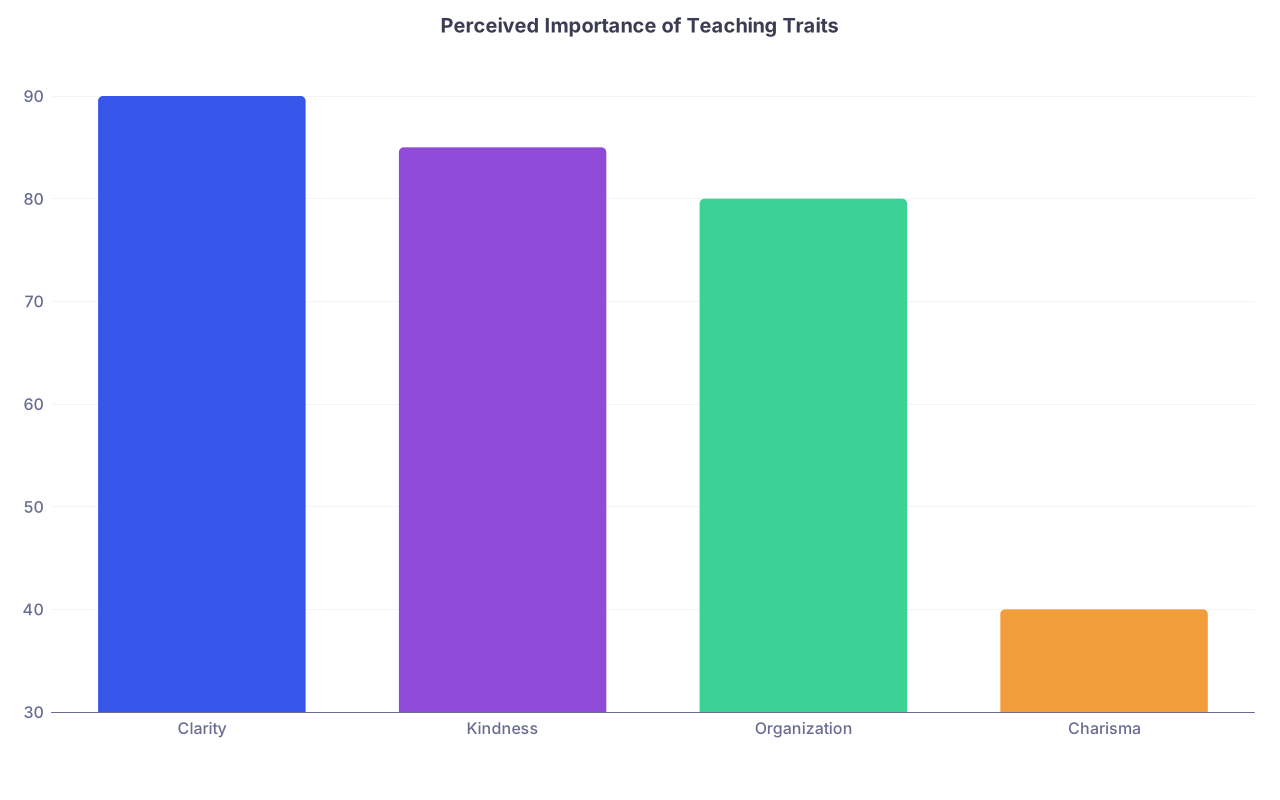
| Category | Value |
|---|---|
| Clarity | 90 |
| Kindness | 85 |
| Organization | 80 |
| Charisma | 40 |
That chart isn’t scientific, but it’s pretty close to how learners actually rate what matters.
FAQs
1. Do I have to tell anyone about my fear of public speaking if I want a teaching-focused career?
No. You don’t owe anyone that disclosure. You can selectively share it with mentors you trust if you want their help shaping your path, but you don’t need to label yourself publicly as “afraid of public speaking.” What you can say instead is what you do prefer: “I’m really interested in small group and bedside teaching, and in developing online resources.”
2. Will residency or fellowship force me to give big talks no matter what?
Most programs require some presentations—morning report, a short lecture, journal club. That’s reality. But “big auditorium, 150 people” is not automatic. Often it’s one noon conference here and there. You can work with mentors to choose lower-stakes formats, co-present with others, or start with case-based discussions rather than pure lectures. It may not be comfortable, but it’s usually survivable and infrequent.
3. Can someone with severe social anxiety realistically be a clinician-educator?
Yes, if they’re willing to treat the anxiety as something to manage, not ignore. That may mean therapy, medication, gradual exposure, and being very strategic about the roles they choose. I’ve seen people with genuine panic disorder carve out teaching careers by focusing on written and digital education, plus small-group work, while minimizing high-pressure talks. It’s not effortless, but it’s possible.
4. Will avoiding big talks limit my promotion or academic advancement?
It might limit certain roles—like becoming the nationally-known keynote figure—but it doesn’t automatically block promotion. Promotion committees care about teaching effectiveness, educational contributions, and scholarship. If you’re producing strong curricula, online resources, assessment tools, or education research, and doing effective small-group/bedside teaching, you can absolutely advance without being the star of grand rounds.
5. What’s one concrete thing I can do this month that moves me toward teaching without overwhelming me?
Pick a topic you understand well and write a one-page, bullet-style “teach sheet” for it—something you wish you’d had as a student. Use it once with a single learner on the wards or in clinic. That’s it. One learner, one short teaching moment, with your cheat sheet in hand. That counts as teaching. And it gives you a tiny, controlled win to build from, instead of waiting for some mythical moment when you suddenly “don’t fear public speaking anymore.”
If you strip this all down, here’s the core:
You don’t have to be a natural-born performer to teach medicine. You need to care, prepare, and find formats that don’t crush you.
And if you can stand the idea of being just a little bit uncomfortable in controlled ways, you can slowly expand your comfort zone enough to build a real, legitimate, respected career in medical education—without ever becoming the person who loves the spotlight.