

The usual way doctors “multi-task” during a visit is broken. You can use mindfulness while taking a history without slowing the visit—and if you do it correctly, it often makes the encounter faster, cleaner, and safer.
Let me be blunt: what slows you down is not paying attention. It is the mental tab-switching, the half-listening while you’re clicking, the internal monologue about time pressure and documentation. Mindfulness is the antidote to that, not an extra burden.
Here’s how to build it in without adding minutes to the clock.
The Core Idea: Micro-Mindfulness, Not Meditation Sessions
You are not going to shut your eyes, take 10 breaths, and do a body scan while your patient talks about chest pain. That’s fantasy-land.
What actually works in clinic or on the wards is micro-mindfulness:
- 1–3 second resets
- Anchored to things you already do (door handle, hand hygiene, logging into EMR)
- Focused on presence, not relaxation
Micro-mindfulness has one job: stabilize your attention in real time so you actually hear the history, pick up key cues, and stop repeating questions.
You’re not adding a new task. You’re changing the quality of attention you bring to the task you already have.
Where Mindfulness Fits in a History – Without Adding Time
Think of a standard visit. There are 4 natural “mindfulness hooks” that cost you basically no extra seconds.

| Step | Description |
|---|---|
| Step 1 | Outside door |
| Step 2 | Enter and greet |
| Step 3 | Open ended question |
| Step 4 | Listen and reflect |
| Step 5 | Focus HPI questions |
| Step 6 | Summary and next steps |
1. At the door: 2-second reset
You’re already pausing to knock or gel hands. Use it.
Quick mental script:
- Notice your feet on the floor.
- One slow exhale.
- Silent intention: “For the next few minutes, be here with this person.”
That is it. Two seconds. This does not slow the visit. It replaces the usual “ugh, I’m behind, EMR sucks, I need coffee” loop with something that actually helps.
2. First 60–90 seconds: Deep listening saves time
The biggest time-waster in history-taking: interrupting the initial narrative, then circling back 3 times to clarify what you could have heard cleanly the first time.
Use mindfulness to protect the opening story.
Try this structure:
- Sit, make brief eye contact.
- Ask one open-ended question:
“What’s been going on?” or “Tell me what brought you in today.” - Then: mentally lock in for 60–90 seconds. No EMR. No typing. Just listen.
Mindfulness move here:
- Place attention on the sound of their voice and your breath.
- Whenever your brain jumps to “next question / time / billing / checklist”, you just note “thinking” once and return to listening.
This is moment-to-moment mindfulness. You’re not “doing” a formal practice. You are using the same skill—notice distraction, return to the present—while the visit continues.
That short window of uninterrupted story often reduces the number of follow-up questions and contradictions you have to resolve later.
3. During focused questions: One anchor, not 10
Once you’re into HPI/ROS:
- You can type.
- You can ask closed-ended questions.
- You can still be mindful.
The key is to choose one anchor so you’re not scattered.
Common anchors that actually work in clinic:
- The feeling of your fingers on the keyboard
- The sensation of your feet in your shoes
- The rise and fall of your breath under your coat
Pick one and quietly keep 5–10% of your attention there while 90–95% stays on the patient and content.
This does not slow the visit. It often speeds cognition because you’re:
- Less likely to zone out mid-question
- Less likely to ask the same thing twice
- Less reactive when the story is complicated
When you notice you’ve lost the thread—mind has wandered to your pager, or you’re rehearsing what you’ll document—label it “planning” or “worrying,” and come back. That micro-reset is the mindfulness.
4. At transitions: Mindful summaries
Summarizing is standard of care. Mindfulness just makes it more accurate and less rushed.
Before you launch into your recap:
- One breath.
- Glance at the patient’s face, not the screen.
- Quick internal note: “Check if what I heard matches what they meant.”
Then give a crisp summary:
“So what I’m hearing is: over the last 3 days you’ve had worsening shortness of breath when walking to the bathroom, no chest pain, cough with yellow sputum, but no blood. You feel more tired, and the inhaler is not helping like before. Is that accurate, or did I miss something important?”
That last question—“or did I miss something important?”—comes from a mindful stance of humility and curiosity. It often triggers the one key detail you needed.
Again: this is standard communication. Mindfulness changes the quality, not the length.
Why Mindfulness Usually Makes You Faster, Not Slower
Let’s be very clear: poorly understood mindfulness (trying to be “calm” or “zen” all visit) can make you weird and slow. Skillful mindfulness does the opposite.
Here’s what it quietly fixes:
| Problem That Wastes Time | Mindful Alternative |
|---|---|
| Interrupting too early | 60–90 sec protected narrative |
| Repeating questions | Single-tasked listening for key details |
| Over-documenting irrelevant hx | Clear sense of chief complaint priorities |
| Emotional reactivity | Brief breath + noticing before reacting |
| Decision fatigue late in day | Micro-resets between patients |
The net effect in real practice:
- Cleaner histories → fewer clarifications
- Less rework → less time rewriting notes
- Fewer emotional detours (arguing, defensiveness) → more efficient visits
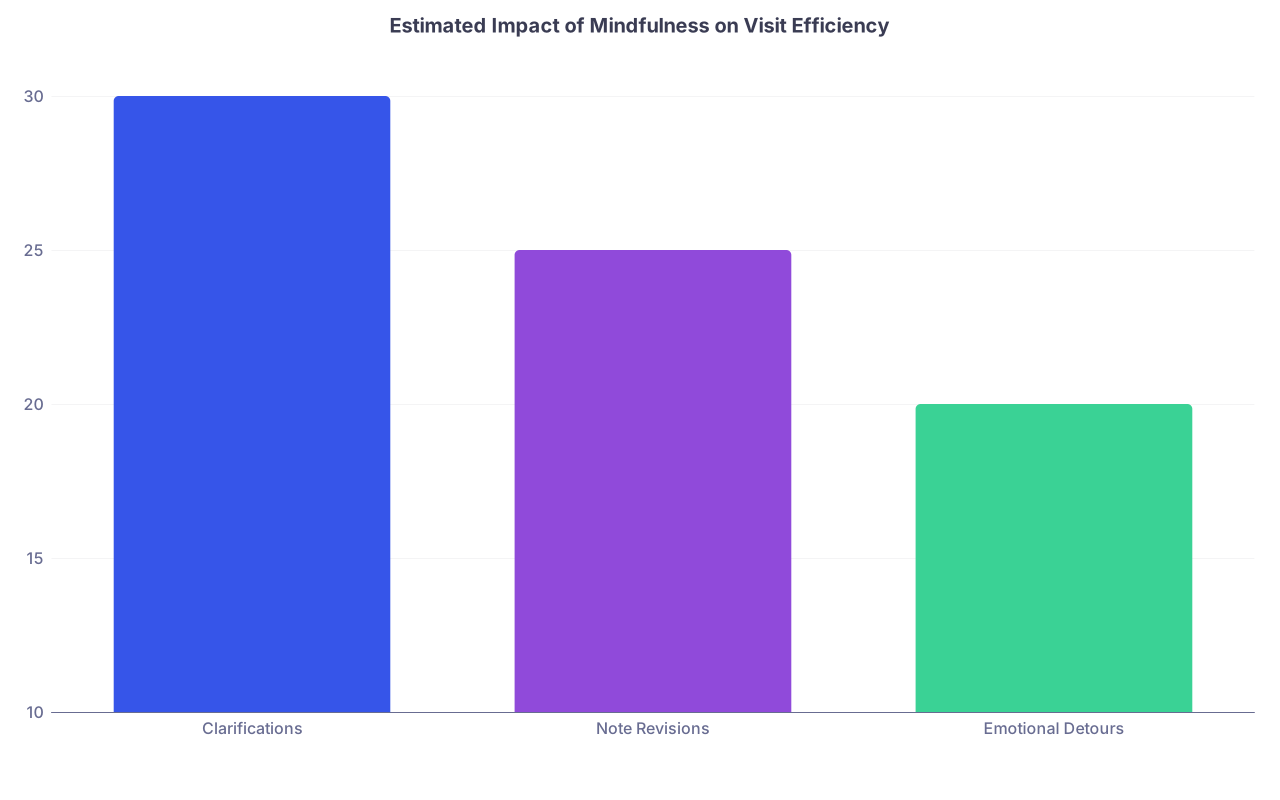
| Category | Value |
|---|---|
| Clarifications | 30 |
| Note Revisions | 25 |
| Emotional Detours | 20 |
Numbers above are illustrative, but the pattern is real: you lose more time to cognitive sloppiness than you ever will to a 2-second breath.
Concrete Scripts You Can Use Tomorrow
Let’s get practical. Here are scripts and micro-practices tailored to real constraints.
When you’re already behind schedule
Scenario: You’re 40 minutes behind, the MA whispers “they’re very upset about the wait,” and you’re ready to sprint.
Do this outside the door:
- Feel your feet.
- One slow exhale, longer than the inhale.
- Tell yourself: “I can’t fix the schedule by rushing this history and making mistakes.”
Inside, you can say out loud (this is both ethical and efficient):
“I know you’ve been waiting and I’m sorry about that. I want to make sure we use this time well, so I’m going to listen carefully and then ask some focused questions so we do not miss anything important.”
That sentence aligns expectations and buys cooperation. Then you protect that first minute of listening like your life depends on it.
When the story is chaotic and tangential
You know the patient. Fifteen comorbidities, 30 meds, no timeline. You feel your mind tightening.
Mindfulness behaviours here:
- Internally name your reaction: “overwhelmed, frustrated.”
- One breath. Do not let that state drive your behaviour.
- Out loud:
“You’ve got a lot going on. To make sure I understand, I’m going to first focus on the breathing issue you mentioned, then we can see what else we can safely tackle today.”
Then you redirect gently but firmly, returning to that shared focus each time the narrative explodes. Mindfulness is what lets you notice your own frustration early instead of snapping or giving up.
How to Practice This Without Burning a Day on a Retreat
If you never practice outside the visit, you’ll have very little bandwidth inside the visit. But you do not need hour-long sits.
A realistic build-out plan:
Step 1: One 3-minute daily practice
Pick one:
- 3 minutes of breath awareness after you park
- 3 minutes before bed, just noticing sensations in the body
- 3 minutes of “mindful walking” from the hospital entrance to your floor (feel each step, each contact of foot with ground)
Goal: train the basic muscle—notice distraction, return.
Step 2: Choose 1–2 in-visit anchors for a week
For one week, commit to just two things:
- Outside every patient room: 1 conscious breath + intention.
- First question: open-ended + 60 seconds of undivided listening.
That is it. No extra heroics.
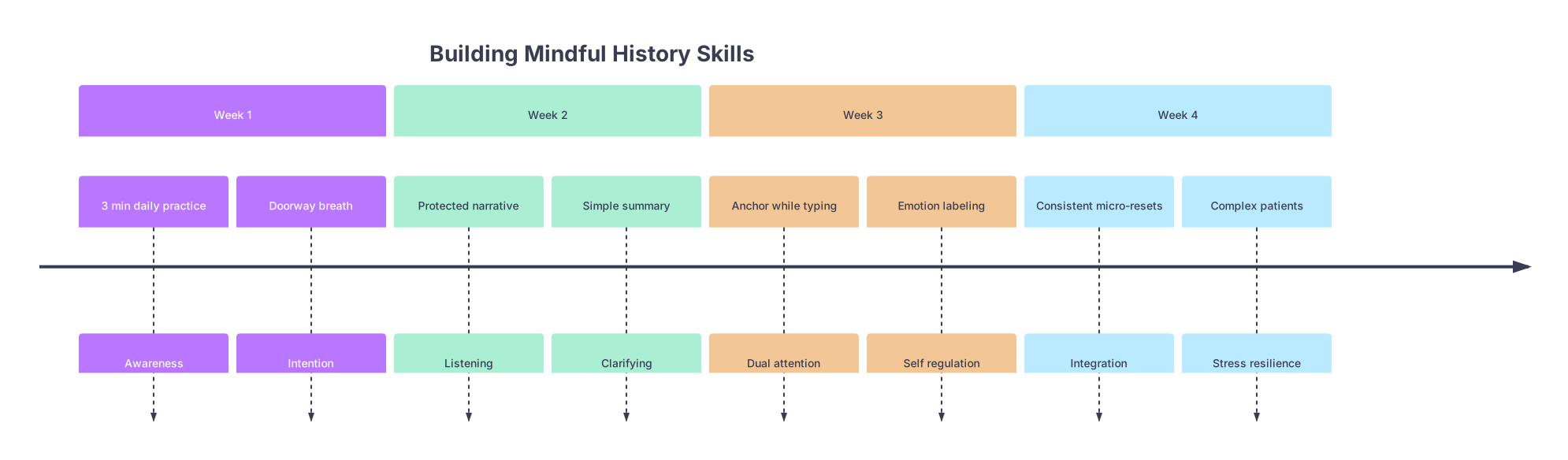
| Period | Event |
|---|---|
| Week 1 - 3 min daily practice | Awareness |
| Week 1 - Doorway breath | Intention |
| Week 2 - Protected narrative | Listening |
| Week 2 - Simple summary | Clarifying |
| Week 3 - Anchor while typing | Dual attention |
| Week 3 - Emotion labeling | Self regulation |
| Week 4 - Consistent micro-resets | Integration |
| Week 4 - Complex patients | Stress resilience |
You evaluate after a week: less mental fatigue? Fewer “wait, when did that start again?” moments? Most people notice a shift quickly.
Step 3: Layer in emotion-awareness
After the basics:
- Once per visit, quickly scan: “What’s my emotional state right now?”
- Name it: “tired,” “annoyed,” “bored,” “anxious.”
- Do nothing to fix it; just don’t let it drive decisions unconsciously.
This is where ethics comes in. Noticing that you feel irritated with a “difficult” patient creates just enough distance to choose a fair, professional response instead of a reflexive one.
Ethical Upside: Mindfulness Makes Care Fairer and Safer
You’re in a phase where personal development and medical ethics are supposed to intersect. This is one of the cleanest intersections.
Mindfulness during history-taking:
- Reduces implicit bias in attention
You actually hear the full story from the patient you subconsciously label “noncompliant,” instead of writing them off fast. - Improves informed consent quality
You catch that puzzled look when you rattle off options and can pause to check understanding. - Supports non-maleficence
Fewer missed details, fewer knee-jerk decisions under emotional load. - Respects autonomy
A mindful pause makes space for, “What matters most to you about this problem?” which changes management more often than you think.
This is not spiritual wallpaper. It’s operationalized ethics, minute by minute.

Common Pitfalls (And What To Do Instead)
Let me save you a few mistakes I’ve watched trainees and attendings make.
Trying to be perfectly calm all visit
You’re not a monk. You’re a clinician. The goal is not permanent serenity; the goal is clear, stable attention. You can be mindful and still be busy, annoyed, or sad.Using mindfulness as avoidance
“I’m feeling overwhelmed, so I’ll just focus on my breath and ignore this emotional conversation.” Wrong direction. The point of grounding yourself is to be more able to stay with the patient, not hide from them.Over-talking about mindfulness with patients
You don’t need to say, “I’m practicing mindfulness now.” Just be present. If you want to teach patients mindfulness, do it intentionally and separately.Making it complicated
If your mindful history routine has 7 steps and 4 internal affirmations, you will drop it when the floor is on fire. Keep it to tiny, repeatable moves.

Quick Comparison: Distracted vs Mindful History
| Aspect | Distracted Version | Mindful Version |
|---|---|---|
| Opening | Interrupts after 10–15 seconds | Protects 60–90 seconds of narrative |
| Attention | Split between EMR, pager, inner monologue | Single-tasked on patient, light anchor used |
| Emotional state | Unnoticed, drives tone and decisions | Noticed and named, then held lightly |
| Summaries | Rushed, screen-focused, minimal checking | Brief, patient-focused, explicit check |
| Result | Repetitions, missed cues, more frustration | Cleaner data, fewer missteps, calmer visit |
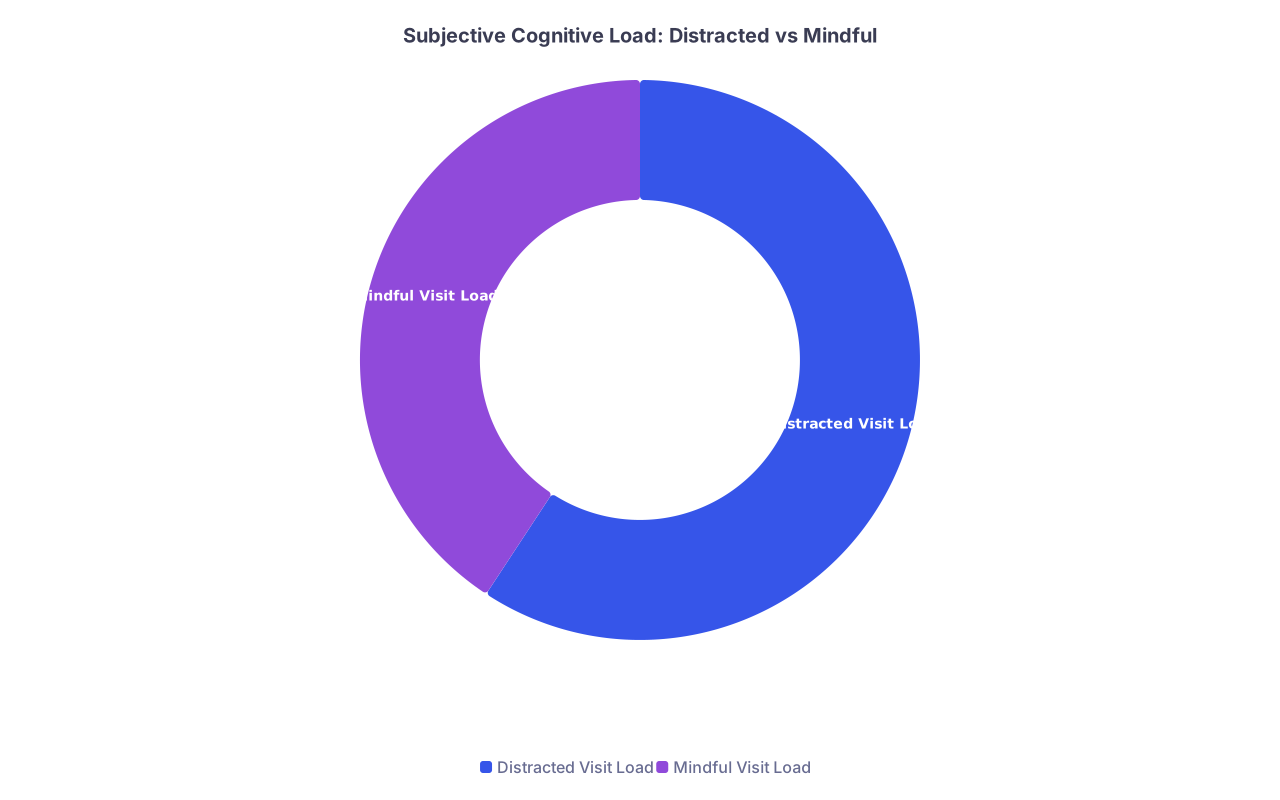
| Category | Value |
|---|---|
| Distracted Visit Load | 80 |
| Mindful Visit Load | 55 |
Again, numbers are illustrative, but clinicians consistently report that mindful visits feel less draining, even when the objective work is the same.
FAQ: Mindfulness While Taking a History
Will being more mindful make me run late with every patient?
No—if you do it correctly. You’re not adding new steps, you’re refining how you do what you already do. The only “extra” is a 1–2 second doorway breath and 60–90 seconds of protected listening, which are offset by fewer repeated questions, less backtracking, and fewer misunderstandings. Most people find they either break even or gain time once it’s a habit.Can I be mindful while I’m typing and clicking through the EMR?
Yes, but don’t overdo the multitasking. The simplest approach: when you’re asking focused questions and documenting, keep one light anchor—like the feeling of your feet on the floor—while most of your attention stays on the patient and content. When the story is complex or emotional, stop typing for a moment and shift to full, undivided listening. Alternating modes is often more effective than forcing constant dual-tasking.What if a patient is angry or confrontational—does mindfulness actually help or just make me a doormat?
It helps you stay clear and grounded, not passive. A mindful pause lets you notice your own surge of defensiveness, take a breath, and choose a firm but respectful response. You’re more likely to say, “I hear that you’re frustrated about the wait; let’s see what we can reasonably get done today,” instead of snapping or shutting down. That usually de-escalates faster and protects both patient relationship and your own sanity.Is this just another wellness fad, or is there real benefit for clinical performance?
There’s actual data showing mindfulness training improves attention, emotion regulation, and burnout metrics in clinicians. Practically, I’ve seen it translate into fewer documentation errors, better recall of key details, and fewer “I totally missed what they were actually worried about” moments. It is not a miracle cure, but as a cognitive and ethical tool during history-taking, it’s solid and repeatable.How do I start if I’m already exhausted and don’t have energy for “one more thing”?
Start offensively small. One 3-minute daily practice (breath, walking, or body scan) and one in-visit change: the doorway breath + intention before each patient. Nothing else. Do that for a week. If it feels like it’s costing you more than it gives, adjust. But most clinicians notice that those tiny investments reduce mental friction enough that they actually feel slightly less exhausted by the end of the day, not more.
Key points to leave with you:
- You absolutely can use mindfulness while taking a history without slowing the visit; done right, it often makes the visit faster and cleaner.
- Focus on micro-practices: a 2-second doorway reset, 60–90 seconds of protected listening, a light attention anchor while you work, and mindful summaries.
- The real payoff is ethical and practical—clearer histories, fewer mistakes, more respectful care—without needing to disappear to a meditation retreat to get there.


