

The worst microaggressions in training are not the loud, obvious ones. They’re the subtle cuts you almost talk yourself out of noticing.
You’re not imagining it. And you’re not overreacting. But you do need a framework, or this stuff will quietly eat you alive during training.
This is that framework.
Not abstract “be resilient” fluff. A stepwise, mindful response you can actually use on rounds, in the OR, at 2 a.m. in the ED, with attendings who write your evals and patients who can get you reported.
Step 1: Name What Just Happened (Internally First)
If you cannot name it, you will either suppress it or explode. Both backfire in medicine.
Common training microaggressions look like:
- “Where are you really from?” asked only to the Asian or Black student.
- Calling a Black male student “aggressive” for the same tone others use.
- Assuming the woman in a white coat is the nurse, while the male med student is “doctor.”
- Pronouncing your name correctly for years, then “suddenly forgetting” when stressed or annoyed.
- Jokes about accents, body shape, religion, or head coverings “just being funny.”
When something hits you, run a quick 3-question internal scan:
- Did this comment or behavior rely on a stereotype about my identity?
- Would they likely say this to a colleague of a different race/gender/accent/etc.?
- Did my body react? (gut drop, heat in face, tense jaw, sudden urge to shut down or fight)
If you get a yes to #1 or #2, or a strong physical reaction on #3, assume microaggression until proven otherwise. You do not need a courtroom-level burden of proof to treat yourself with care.
Now, the mindful part:
Inhale: “This is painful.”
Exhale: “I do not have to solve everything right now.”
That half-second pause is the wedge between reaction and response. Response is power. Reaction is how people later describe you as “emotional” or “difficult.”
Step 2: Triage – Decide Your Goal Before You Speak
You are not just deciding whether it was “bad enough.” You are deciding what outcome you want in this moment.
Here’s the mental menu I teach residents:
| Goal | Primary Priority |
|---|---|
| Self-preservation | Protect energy and safety |
| Real-time boundary setting | Stop the behavior now |
| Educational response | Nudge growth, preserve bridge |
| Documentation/escalation | Build record, seek backup |
You quickly ask: which goal dominates right now?
You’re a PGY-1, on thin ice with an attending who controls your eval, in front of a patient? Self‑preservation or minimal boundary.
You’re with a co-resident who respects you, off-stage from patients? Perfect time for education.
You’re repeatedly targeted by the same attending and patient care is affected? That’s documentation and escalation territory.
You don’t get points for martyrdom. You do not have to “be brave” every single time. Mindfulness here means consciously choosing your response aligned with your context and capacity, not just defaulting to silence or rage.
Step 3: The Micro-Reset – A 30-Second Internal Protocol
Before you open your mouth, stabilize your nervous system. Otherwise you’ll either freeze or overcorrect.
Here’s a fast, realistic protocol you can actually do on rounds, in clinic, or walking down the hall.
- Ground: Feel your feet in your shoes. Literally wiggle your toes.
- Breath: One 4–6 second inhale, one 4–6 second exhale.
- Label: In your head – “That was a microaggression. I am not crazy.”
- Choose: Pick your goal: Preserve / Boundary / Educate / Escalate later.
That’s it. 15–30 seconds. It keeps you from getting hooked by shame (“Maybe I’m too sensitive”) or fury (“Screw this entire place”), both of which drain you and rarely help.
Step 4: Real-Time Responses – Scripts You Can Actually Say
Let’s break it down by who’s doing it: attendings, peers, nurses/staff, and patients/families. The risk calculus changes with each.
A. When It’s an Attending or Senior Resident
Power dynamics are brutal here. You’re evaluated, graded, and sometimes sponsored by the same person who just hurt you.
If your main goal is self-preservation but you still want something on record in the moment, use low-friction, low-heat responses:
- The Clarifying Mirror
“Just to clarify, did you mean that because I’m [identity]?”
Neutral tone. Slightly confused face. You’re holding up a mirror, not accusing.
This does three things:
- Forces them to hear their words back.
- Creates a tiny pause where they can backtrack or rephrase.
- Signals to everyone else in the room that this was not okay, without you going nuclear.
- The Impact Statement Without Accusation
“When my name is shortened without asking, it makes me feel less respected as part of the team. I’d prefer you use [your name].”
Note the structure: “When X happens, it makes me feel Y. I’d prefer Z.”
This is assertive, not aggressive. Harder to punish without outing themselves.
- The Deferral (For When You’re Cornered)
On rounds, in front of patients is often the worst moment to dive in. You can table it.
“I actually have thoughts on that, but this might not be the best time. Could we circle back after rounds?”
Then you document and decide if you really want that one-on-one—or if it’s safer to take it to a trusted faculty, PD, or ombudsperson.
If your goal is escalation later, your priority right now is composure and memory. You do not have to fix them in real time to take action later.
B. When It’s a Co-Resident, Fellow, or Another Trainee
This is where you have the most room to practice mindful confrontation. You’re still in a hierarchy, but there’s more peer-level flexibility.
Use the “small, honest interruption”:
- “Hey, that comment about her hijab landed kind of off for me.”
- “Can I pause you? That joke about accents made me uncomfortable.”
- “I know you probably didn’t mean it this way, but calling the Black kids ‘aggressive’ and the white kids ‘energetic’ feels… off.”
If that feels too direct for your first attempts, try the “I’m going to be that person” softener:
“I’m going to be that person for a second—when we say ‘those people’ about patients from [group], it plays into stereotypes.”
This signals you’re not trying to score social justice points. You’re actually trying to keep the culture less toxic.
You can also invite curiosity instead of making a verdict:
“What made you say that?”
“Where did you learn that term?”
“Have you thought about how that might sound to someone who is [identity]?”
Sometimes, I’ve watched people talk themselves into realizing, “Oh, wow, yeah, that sounds bad,” without you ever labeling them as racist/sexist/etc. That’s a win.
C. When It’s Nursing or Other Staff
Medical culture loves hierarchy wars. Residents vs. nurses vs. techs vs. everyone. Microaggressions get mixed with turf battles, which complicates everything.
You’re walking into a delicate ecosystem. Be precise.
If it’s identity-based, not just garden-variety snark, you can say:
“When I’m called ‘girl’ instead of ‘doctor’ while my male co-resident is called by his title, it affects how patients see my role. Can we keep it consistent?”
Or:
“I’ve noticed my name is often mispronounced even after I’ve corrected it a few times. It makes me feel singled out. Can we try [correct pronunciation]?”
Don’t generalize to the whole group (“you nurses always…”). Focus on behavior and impact.
If the relationship is otherwise strong, follow up later when it’s quiet:
“Earlier you called me [term]. That really stuck with me. Can we talk about it for a second?”
Most people in these settings have been on the receiving end of microaggressions too. You may find unexpected allies.
D. When It’s Patients or Families
This is the messiest category. You’re told “the patient is always the priority.” And then the patient asks for “a white doctor,” or tells you “your English is really good,” or calls you a racial slur in the hallway.
You do not have to abandon yourself to care for them.
First, separate three questions:
- Is anyone in immediate danger? (You or staff being physically threatened or cornered.)
- Is this behavior impairing care? (Refusal to see you because of identity, undermining your role to staff.)
- Do you feel safe addressing it directly?
If safety is at issue, your priority is to get backup. Use security, your attending, your chief. This is not the moment for a teachable moment about unconscious bias.
If it’s more “casual” but harmful, and you feel safe, you have options:
The Gentle Call-Out:
“Many people do not realize this, but comments about where I’m ‘really from’ can feel like I don’t belong here, even though I’m part of your care team.”
The Boundary + Redirection:
“I am your doctor today, and I’m committed to your care. Comments about my race/gender/accent are not appropriate. Let’s focus on your health.”
If they request a different doctor based on your identity:
“I understand you have a preference. Our policy is not to change clinicians based on race/gender/religion. My job is to take good care of you. If you have concerns about my care, I’m happy to discuss them.”
Then loop in your attending. Document the request neutrally in the chart (“Patient requested a different physician due to discomfort with clinician’s [race/gender/etc.]. Attending notified.”) This matters later when programs pretend they’ve “never seen this happen.”

Step 5: What To Do After – Debrief, Document, Decide
The moment passes. You’re back at your workstation, half charting, half replaying the comment on a loop. What now?
A. Quick Solo Debrief (5 Minutes, Not an Hour)
You don’t need a retreat. You need a simple structure.
Three questions to journal or even just think through on your walk to the car:
- What exactly happened? (Concrete, no spin.)
- How did it affect me—emotionally, physically, professionally?
- What story am I telling myself about what this means?
The third one is where the poison hides:
“I’m not respected here.”
“I’m always going to be seen as less.”
“If I speak up, I’ll be labeled difficult.”
Write those stories down. Then ask: “Is this always true? Is there an alternative explanation that doesn’t erase the harm but gives me more room to move?”
This is not gaslighting yourself. It’s protecting your identity from being entirely defined by other people’s bias.
B. Documentation: CYA for Your Future Self
If there’s even a small chance you’ll want to escalate later, or patterns are forming, keep a simple log. Private, secure, not on your work computer.
Minimum fields:
- Date/time
- Location (rounds, OR, clinic room 3, nurse station)
- Who was involved (titles if not names)
- Exact words or behaviors (as close as you can recall)
- Witnesses
- Immediate impact (patient care, your evaluation, your role)
You’re not writing a manifesto. You’re building a factual trail. Down the line, this turns “They’re just being sensitive” into “This has happened 7 times with 3 witnesses.”
Step 6: Choosing When and How to Escalate
Escalation is not failure. It’s part of protecting yourself and, honestly, the patients who come after you.
But you need to be strategic.
Here’s a simple map:

| Step | Description |
|---|---|
| Step 1 | Incident occurs |
| Step 2 | Document only |
| Step 3 | Seek confidential consult |
| Step 4 | 1 on 1 discussion |
| Step 5 | Monitor for pattern |
| Step 6 | Talk to trusted faculty or chief |
| Step 7 | Formal report to PD or GME |
| Step 8 | Informal resolution, keep log |
| Step 9 | First time or pattern? |
| Step 10 | Want direct convo? |
| Step 11 | Patient safety or severe bias? |
Notice there’s no branch that says “Just suck it up forever.” You always have at least the “document and monitor” option.
Who can you go to?
- A trusted attending who has shown they understand equity issues.
- Chief resident (some are useless, some are phenomenal—ask upper levels who’s safe).
- Program Director, if the issue is significant or patient safety is involved.
- Institution’s GME office, ombudsperson, or DEI office—especially for patterns.
When you go, bring:
- Your log with dates and specifics.
- Any relevant emails/messages.
- Clear ask: “I want this behavior to stop without retaliation,” or “I need to be reassigned,” or “I’m asking for formal investigation.”
Lastly: if retaliation happens, document that too, immediately. Retaliation is often treated more seriously than the original incident, unfair as that is.
Step 7: Mindfulness Practices That Actually Fit in Training
“Just meditate more” is useless advice for a PGY-2 working 70+ hours a week. You need tools you can wedge into the life you actually have.
Here are three that I’ve seen residents actually use.
1. Micro-Check-Ins Between Patients (30–60 seconds)
Before you open the next chart:
- Feel your feet or the chair under you.
- One slow inhale, one slow exhale.
- Ask: “What am I feeling right now?” (without trying to fix it)
- Name it quietly: “Anger.” “Exhaustion.” “Shame.” “Numb.”
Naming moves emotions from pure physiology into conscious awareness. That alone reduces the chance you’ll discharge them onto the next patient or med student.
2. The Compassion Reframe (for Yourself)
After a rough encounter, especially if you stayed silent and are beating yourself up:
Place your hand lightly over your chest or on your forearm (yes, actually do it, not in theory).
Say internally:
“This is hard.
Anyone in my position would be struggling.
I did the best I could with the power I had today.”
Is it cheesy? Yes. Does it work? Also yes. I’ve watched burnout curves change when trainees stop attacking themselves for not being “strong enough” every time.
3. End-of-Shift Boundary Ritual
Your nervous system does not know when the shift ends unless you mark it.
Pick one tiny ritual:
- A three-breath pause in your car before turning the key.
- Washing your hands at home and mentally “washing off” the day.
- Taking off your badge and hanging it in the same spot with a deliberate exhale.
While doing it, acknowledge:
“Some things today were unfair. I don’t have to carry all of them into my night.”
That’s mindful boundary-setting. Not pretending it was all fine. Just refusing to re-live it on a loop.
Step 8: Building Allies and Not Doing This Alone
Handling microaggressions is brutal if you try to play solo hero. You need people who see the same reality you do.
Start small:
- Debrief selectively with 1–2 co-residents you trust, not the whole group chat.
- Notice which attendings interrupt bias on rounds; mentally tag them as potential allies.
- If your institution has affinity groups (e.g., SNMA, LMSA, WIMS, LGBTQ+ groups), show up once. You don’t have to be a “joiner” to benefit from their experience.
When a colleague is targeted and you’re not the one harmed, this is where you practice low-risk mindfulness:
- “I’m sorry that happened. I saw it too.”
- “If you want to report or talk to someone, I’ll back you up as a witness.”
- “Do you want to say something now or later? I’ll support whatever you choose.”
Silence isolates. Two people seeing the same thing already shifts the power imbalance.
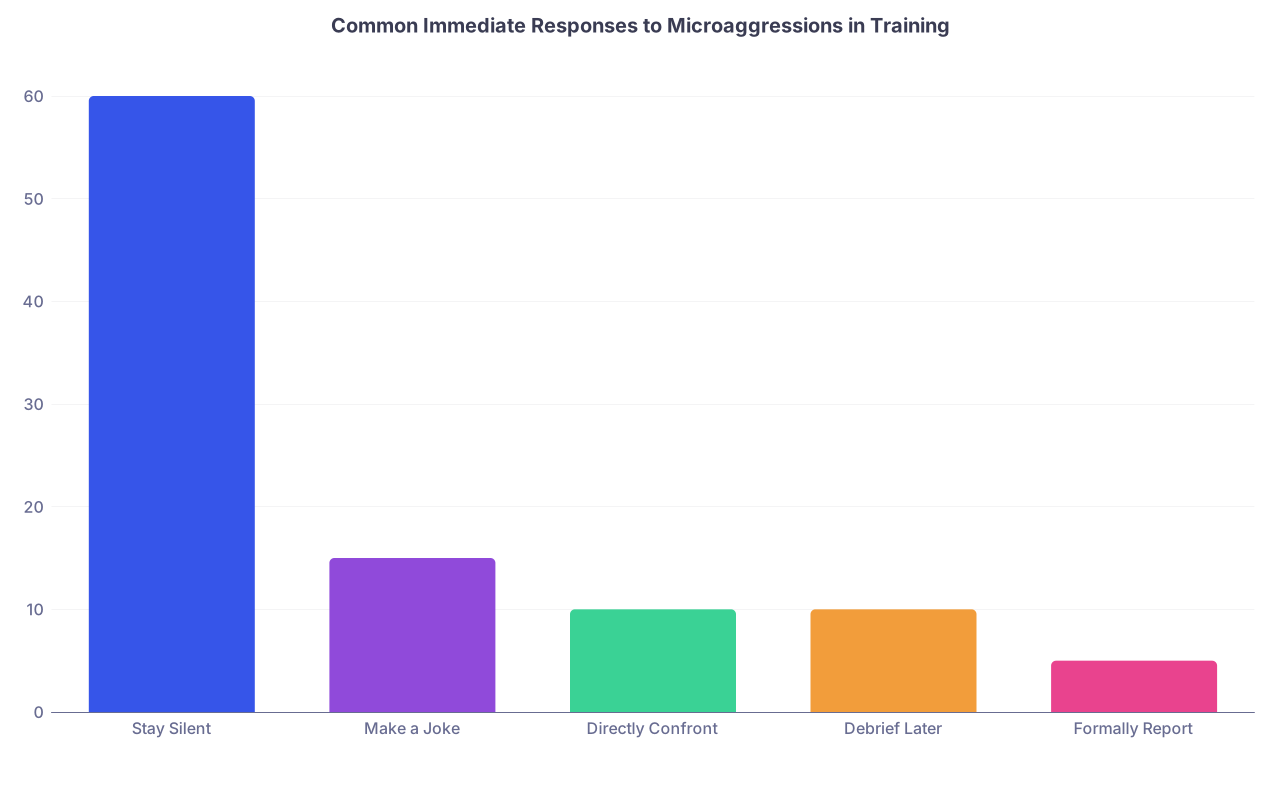
| Category | Value |
|---|---|
| Stay Silent | 60 |
| Make a Joke | 15 |
| Directly Confront | 10 |
| Debrief Later | 10 |
| Formally Report | 5 |
Final Reality Check
You will not handle every microaggression perfectly. No one does. Some days you’ll speak up and feel powerful. Other days you’ll stay quiet and feel sick later.
Three things to remember:
- Choosing when not to engage is also a mindful response, not a failure.
- You’re allowed to prioritize your safety, sanity, and career while still caring about justice.
- The goal is not to absorb everything; it’s to stay whole enough that you can keep practicing medicine on your own terms.
You are not overreacting. You are not alone. And you’re allowed to respond with both clarity and care—for yourself first, and then for everyone else.


