

The way most doctors switch specialties is backwards. They change because they’re burned out, angry, or seduced by lifestyle rumors—then scramble to justify it. That’s how you end up just as miserable in a different color scrubs.
If you’re even thinking of switching specialties, you need to get brutally clear on one thing first: motivation. Mindfulness is not about “relaxing” through this decision. It’s about removing the noise—fear, shame, ego, FOMO—so you can see what’s actually driving you.
Let’s walk through how to do that, step by step, in the real world of call schedules, toxic attendings, and match anxiety.
Step 1: Separate “I Hate My Life” From “I Picked the Wrong Field”
Most people confuse a bad situation with a bad specialty.
You’re exhausted. Your attending is a bully. Your program director barely remembers your name. You’re on your fourth 28‑hour call this month. Of course you fantasize about derm clinic and latte breaks.
Before you blow up your career path, you need to untangle:
- Temporary, fixable pain (program culture, specific rotation, a rough year)
- Structural specialty realities (night call forever, procedures vs cognitive work, acuity level)
- Your own internal habits (perfectionism, boundary issues, people‑pleasing, avoidance)
Mindfulness is useful here because it forces you to sit in the discomfort long enough to see what’s underneath.
Try this: 10-minute “What Exactly Hurts?” sit
Do this after a rough shift, not just on a peaceful Sunday.
- Sit somewhere you won’t be interrupted. Phone on airplane mode.
- Set a 10-minute timer.
- Close your eyes. Feel your body: jaw, shoulders, chest, gut. Notice where the tension is.
- When a thought comes (e.g., “I hate surgery”), don’t push it away. Label it:
- “Thought: I hate surgery”
- “Emotion: frustration”
- “Body: tight chest, clenched teeth”
- Now ask, quietly: “What specifically hurt today?”
- The hours?
- The type of work?
- The hierarchy?
- The uncertainty?
- Each answer that comes up: label it, feel it, don’t argue with it, don’t justify it. Just notice.
You’re not making a decision here. You’re collecting data.
If you repeat this for a week, patterns will show up. Maybe every sit circles back to “I dread operating, I feel dead in the OR but alive in clinic.” Or maybe it always comes back to “I feel stupid and humiliated around this one attending.”
Those are two very different problems. One is specialty‑mismatch. The other is a toxic teacher.
Step 2: Distinguish Pull vs Push Motivation
People switch specialties for two broad reasons:
- Push: “I can’t stand this anymore”
- Pull: “I feel genuinely drawn to that”
Mindfulness helps you see which is louder—and whether the pull is real or just fantasy.
Mini-exercise: Two-column sit
Do this on paper right before a 12-minute meditation.
On a blank page, draw a line down the middle.
Left side: “Reasons I want out of my current specialty.”
Right side: “Reasons I feel drawn to the new specialty.”
Fill both sides fast, no editing.
Examples I’ve actually heard:
Left side (current specialty – Surgery):
- Constantly nauseous before call
- Hate the OR culture, not the OR itself
- I don’t care about margins as much as attending wants me to
- I miss talking to patients
Right side (new specialty – Palliative):
- I feel calmer when I sit and talk
- I keep getting pulled into family meetings and I like it
- I remember patients’ stories, not their scans
- I want to be present at critical moments, not just “fix the hole”
Now:
- Sit for 12 minutes with the paper in front of you.
- Eyes closed, breathe naturally.
- For each item, picture a real moment that proves it.
- Not a fantasy. A real memory.
- Watch your body’s reaction to each side. You’ll usually feel:
- Heavy, constricted, resentful with push-only reasons
- Warm, energized, quietly steady with genuine pull reasons
If your list is 95% “push” and the pull side is vague—“better hours,” “they seem happier”—you’re not ready. You’re trying to run away, not toward something. That’s how people jump from one misfit specialty to another and repeat the same misery.
If your pull side is full of concrete, lived moments where you felt more like yourself—that’s data.
Step 3: Use Mindfulness to Strip Out Ego and Shame
Ethically, this is where it gets serious. You’re not switching a gym membership. You’re shaping the kind of physician you’ll be for decades. You owe your future patients honesty.
There are three common toxic drivers I see in specialty switches:
- Prestige hunger (“I need something more competitive to feel good about myself”)
- Shame/embarrassment (“I’ll look like a failure if I leave this fancy field”)
- Lifestyle myths (“Cardiology is just daytime consults and golf” – sure)
You will not out‑argue these with logic. You have to see them clearly in real time and refuse to let them steer.
Mindfulness drill: “What if no one knew?”
Do this one when you’re not exhausted.
- Sit comfortably. 10–15 minutes.
- Bring to mind your current specialty and your target specialty.
- Ask yourself—over and over, gently—“If no one ever knew what I matched into, what would I choose?”
- Watch what happens in your mind:
- Do images come up of telling your parents/friends/med school classmates?
- Do you imagine their reactions? Pride? Pity? Confusion?
- Every time you get pulled into “what they’ll think,” silently label it: “Story. Ego. Audience.”
- Return to the question: “If this were private—no CV, no white coat, no title—what kind of work do I actually want to spend my day doing?”
You’re looking for the moments where your body relaxes slightly. Where the shame voice gets quieter. That’s usually closer to your real motivation.
Ethically, your job is to choose the field where you can show up consistently as a competent, present, human physician for decades—not the one that looks best at a reunion.
Step 4: Clarify What “Good Medicine” Means to You
Specialty choice is partly a values choice. Different fields emphasize different aspects of “good medicine”:
- Procedures vs talking and thinking
- Acute saves vs long, slow companionship
- Breadth vs depth
- Certainty vs ambiguity
- Technology vs touch
If you don’t consciously articulate your values, you’ll unconsciously chase other people’s.

Values reflection: 4-question sit + write
Block 30 minutes you won’t give to anyone else. Door closed.
First: 10 minutes of simple breath awareness. Eyes closed, notice inhales and exhales. When thoughts jump in, label them “thinking,” return to breath. That’s your “mental dishwasher cycle.”
Then write very fast for 15–20 minutes answering these four, one by one:
- When did I feel most proud of how I practiced medicine this year?
- When did I feel most ashamed or misaligned?
- What kind of suffering do I feel most compelled to respond to?
- In 20 years, what would I want a patient to say about how I treated them?
Now look at what you wrote and ask:
- Does my current specialty let me live these values most days?
- Does my target specialty match these values more closely—or is it wishful thinking?
Example:
You write that your proudest moment was sitting with a patient’s family for an hour explaining a complex prognosis in plain language, and your most misaligned moment was rushing that same conversation because you had to run to the OR. That’s telling you something.
If your values scream “presence, communication, continuity,” and your target is trauma surgery because “I like action,” there’s a mismatch. If your values are “precision, clear outcomes, technical mastery,” and you’re forcing yourself toward psychiatry because you’re tired, that’s a warning too.
Step 5: Run Mental Simulations Mindfully (Not Fantasies)
Your brain is fantastic at building highlight reels. “Outpatient lifestyle.” “No weekends.” “Just clinic.” Reality is different. Every specialty has:
- Boring days
- Angry patients
- Administrative sludge
- Politics
- Call or some equivalent burden
Mindfulness lets you run honest simulations instead of fantasy porn.
Simulation practice: Future Day in Each Specialty
Pick two separate days to do this. One day: current specialty. Next day: target specialty.
Each day, set a 15-minute timer and:
- Close your eyes.
- Walk yourself through a normal weekday hour by hour.
- Include:
- The commute
- How your body feels walking into the ward/clinic/OR
- Your first patient encounter
- Charting
- Interactions with nurses, colleagues, consultants
- The moment something goes wrong
- Walking out of the hospital
But here’s the key: as you picture each segment, pay more attention to body sensations than the story.
- Do you feel your shoulders tighten imagining clinic after lunch?
- Do you feel relief picturing rounds?
- Do you feel boredom picturing procedures? Or excitement?
You’re not trying to create a “perfect” day. You’re testing your nervous system against the likely reality of this type of work.
If both simulations feel equally heavy, you may not have a specialty problem; you may have a burnout, depression, or toxic environment problem. Very different interventions.
Step 6: Use Mindfulness to Listen, Not Just Talk, When You Seek Advice
This is where most people go wrong. They gather opinions from:
- The loudest attending
- The happiest PGY‑2 in their dream field
- That one med school friend who “loves EM”
But they’re so anxious they don’t hear what’s underneath the words.
| Person Type | Why They Matter |
|---|---|
| Mid-career in your current specialty | Knows long-term reality beyond residency misery |
| Mid-career in target specialty | Can puncture myths, give grounded pros/cons |
| Someone who switched successfully | Knows logistics, emotional fallout, ethics |
| Someone who switched and regretted it | Shows hidden risks and self-deception patterns |
| A trusted, honest mentor outside both fields | Less invested in specialty status, more in you |
Mindful listening drill for these conversations
Before each conversation:
- Take 3 slow breaths before dialing/walking into the office.
- Set an intention: “I’m here to learn, not to sell my decision.”
During:
- Let them talk. Seriously. Do not interrupt with your pre‑built narrative.
- Notice your internal reactions:
- Defensiveness (“They just don’t get it”)
- Eagerness (“Yes, exactly what I wanted to hear!”)
- Fear (“If they’re right, I have to rethink everything”)
Silently label these: “defense,” “craving,” “fear.” Then let them pass and keep listening.
After:
Take 5 minutes alone. No phone. Ask:
- What did they actually say (facts)?
- What did I want them to say?
- What stuck with me 2 hours later?
That gap between “what they said” and “what I heard” is pure motivation data. If you’re twisting every story to justify one outcome, you’re not listening—you’re shopping for permission.
Step 7: Address the Ethical Piece Head-On
You’re not just deciding what you want. You are deciding:
- Which patient population you will commit to
- What kind of suffering you’re willing to face repeatedly
- How you’ll contribute to or drain an already strained system
Mindfulness is about seeing causes and consequences clearly, not numbing them out.

Ethical reflection sit: “Whom am I willing to suffer with?”
10–15 minutes, once or twice a week for a month.
Bring to mind different patient types relevant to your current and target specialties:
- The septic shock patient in the ICU
- The 25-year-old with new-onset psychosis
- The 6-month-old in the ED with sepsis
- The 82-year-old with metastatic cancer
- The 45-year-old with chronic pain and limited insight
Let each one occupy your attention for a minute or two. Feel your honest reactions:
- Which cases evoke avoidance or dread?
- Which evoke a heavy but willing “yes”?
- Which evoke quiet gratitude, like “I’m glad somebody is here for this”?
Your ethical responsibility is not to love every case. It’s to pick a field where, on balance, you can show up with integrity even on the days you’d rather run.
If your gut recoils from the core suffering of a field but you’re chasing it for money or status, be honest about that. You might still go that route, but don’t pretend it’s “calling.”
Step 8: Decide and Commit Without Torturing Yourself
Endless rumination masquerades as “thoughtful decision-making.” It’s not. It’s avoidance.
At some point, after weeks of mindful observation, you’ll likely be in one of three situations:
- Clear signal to switch. Pull is strong, push is consistent, values align, advice from people you trust matches what you’ve noticed internally.
- Clear signal to stay. You realize your misery is about your current program, burnout, or personal patterns, not the fundamental work of the specialty.
- Still ambiguous. Mixed signals, lots of fear, lots of “what if.”
Mindfulness doesn’t guarantee clarity. It guarantees honesty. If you’re in bucket 3, sometimes the ethical move is to stabilize first (sleep, mental health, maybe a leave) and not make a huge decision from the bottom of a hole.
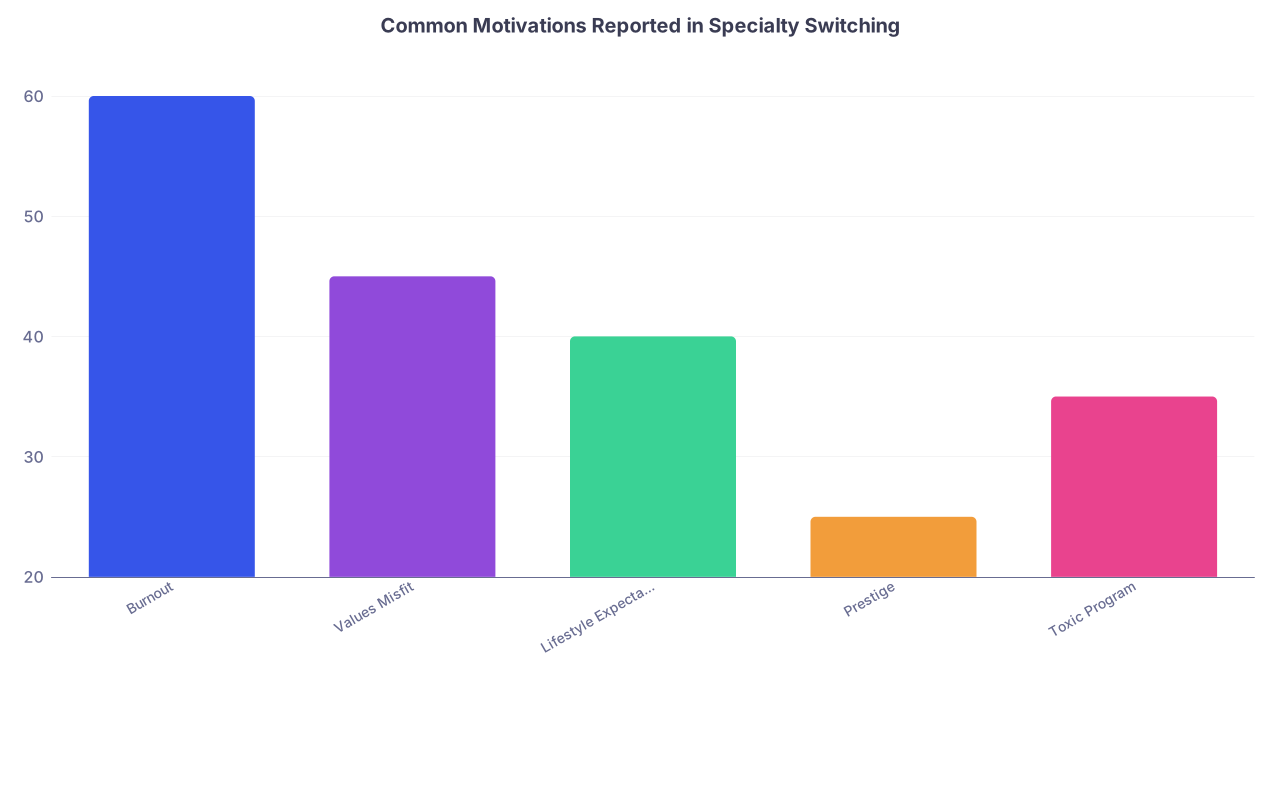
| Category | Value |
|---|---|
| Burnout | 60 |
| Values Misfit | 45 |
| Lifestyle Expectations | 40 |
| Prestige | 25 |
| Toxic Program | 35 |
Decision ritual: one intentional session
When you’re as clear as you’re going to get for now, do this:
- Block 45–60 minutes. Alone. No devices.
- Start with 10 minutes of breath awareness.
- Write at the top of a page: “Given what I know now, my decision is…”
- Finish that sentence in one shot. Don’t overthink.
- Then write:
- What I’m moving toward is…
- What I’m consciously sacrificing is…
- The risks I accept are…
- The ethical commitments I’m making are…
You’re making a time‑limited commitment: “Given what I know now, I will pursue this path for at least X months/years before reopening the question, unless something drastic shifts.”
This is not a trap. It’s a way to stop re-litigating the decision every week in your head.
End the ritual with 5 quiet breaths and one simple phrase on the exhale: “For now, this is enough.”
Step 9: Ongoing Mindfulness Once You’ve Switched (or Stayed)
The story doesn’t end after the paperwork goes through. You will have regret spikes. You will compare yourself to your co-residents who stayed or switched earlier. That’s normal.
Here’s how to use mindfulness after the decision:
- Short daily check-in (3–5 minutes): “What part of today’s work felt most aligned? Least aligned?”
- Monthly 20-minute values sit: revisit the four questions from Step 4 and see if your answers are evolving toward or away from your current work.
- Mindful self-compassion when regret flares:
- Notice the thought: “I’ve ruined my career.”
- Label it: “Catastrophizing.”
- Place a hand on your chest or abdomen, breathe, and say (internally): “This is hard. Lots of people doubt big decisions. I can learn from this either way.”
And keep an ethical lens:
- Am I still showing up for patients as fully as I can?
- Am I blaming the specialty for things that are actually about my habits or boundaries?
- Where can I adjust how I practice within this field before changing the field again?

| Step | Description |
|---|---|
| Step 1 | Discomfort in Current Specialty |
| Step 2 | Mindful Self-Assessment |
| Step 3 | Address Burnout or Toxic Environment |
| Step 4 | Gather Honest Input |
| Step 5 | Ethical Reflection |
| Step 6 | Decision Ritual |
| Step 7 | Transition Plan and Ongoing Mindfulness |
| Step 8 | Adjust Practice and Ongoing Mindfulness |
| Step 9 | Push vs Pull? |
| Step 10 | Switch or Stay |
You’re allowed to be wrong. You’re not allowed—ethically—to stay blind on purpose.
The Core Takeaways
- Use mindfulness to observe, not to anesthetize. You’re trying to see your real motivations—fear, ego, values, desire—without flinching.
- Clarify whether you’re being pushed by misery or pulled by genuine alignment. Then check that against your values and the actual suffering of the patients you’ll serve.
- Make a time‑bound, conscious decision and stop re‑deciding every week. Keep practicing small, regular check-ins so you can course-correct how you practice, not just where.


