

You should not default to telling every patient you practice mindfulness. You should know exactly why, when, and how you’re saying it—or keep it to yourself.
That’s the real answer. “Honesty is always best” sounds noble. In practice, with real patients, it’s sloppy.
Let me walk you through a clean framework so you’re not guessing in the exam room.
The Core Question: Who Is This Actually For?
If you’re asking “Should I tell my patients I practice mindfulness?”, you’re really asking three questions:
- Will this help the patient’s care?
- Will this damage boundaries or trust?
- Am I doing this for them, or for me?
If the benefit to the patient is clear and the risk to boundaries is low, disclosure can be useful. If it’s mainly about you wanting to be seen as “the mindful doctor,” keep it to yourself.
A good sanity test:
- If the patient never knew this about you, could you still provide excellent care?
If yes, disclosure is optional, not mandatory.
When Sharing Helps (And When It Clearly Hurts)
You do not need to advertise your personal mindfulness practice on every new patient visit. But sometimes, a well-timed, brief disclosure is powerful.
Situations Where Disclosure Can Help
These are the scenarios where “I also use mindfulness” can actually move the needle:
You’re prescribing or recommending mindfulness as part of treatment
Example:
- You’re recommending mindfulness for chronic pain, insomnia, anxiety, or hypertension.
- The patient says: “That sounds like fluff. Do you actually believe this works?”
A concise response like:
“I do a short mindfulness practice myself most mornings. It helps my focus and stress. The evidence for chronic pain and anxiety is solid, and I’ve seen it help patients like you.”This does three things:
- Normalizes the intervention
- Signals it’s not a throwaway recommendation
- Models that you’re not asking them to do something you’d never do yourself
The patient directly asks you something personal but appropriate
Like:
“You seem very calm. Do you meditate or something?”
“Do you do any of these techniques yourself, doctor?”Then you can answer honestly, briefly, without making it about you: “Yes, I practice mindfulness most days, just 10–15 minutes. But let’s focus on what might fit into your life.”
You’re using a guided practice in the visit
In palliative care, oncology, or chronic pain clinics, you may lead a 2–3 minute grounding exercise. Patients sometimes ask, “Do you do this yourself?”
A short, matter-of-fact answer: “Yes, this is part of how I manage stress too”
can reduce the “this is weird” factor and increase buy-in.You’re working in a setting where mind–body approaches are explicit and expected
Integrative medicine clinics, VA mindfulness groups, or behavioral health–embedded primary care. Patients are often there because they want these tools.
Here, saying, “I have a personal mindfulness practice and also use these approaches clinically” is aligned with the setting and expectations.
Situations Where You Should Not Disclose
Here’s where your personal practice becomes a liability:
The disclosure meets your emotional need, not the patient’s clinical need
Examples:
- You feel guilty about a rushed visit and try to “repair” it by sharing how you’re trying to be a better, more mindful person.
- You’re burned out and want validation: “I’ve been working on mindfulness to manage all this stress.”
That’s not patient care. That’s emotional leakage.
The patient has very different beliefs or clear skepticism
If a patient says:
- “I don’t want any of that meditation stuff.”
- “I trust God, not breathing tricks.”
You can still offer evidence-based stress management, but saying “Well, I meditate and it helps me” now centers your values over theirs. Respect their stance. Don’t sell your own lifestyle.
You’re starting to “overshare” personal details consistently
If the pattern becomes:
- “I also…”
- “In my own practice…”
- “When I feel anxious, what I do is…”
You’re slowly shifting the spotlight away from the patient. A single, concise disclosure is one thing. Repeated self-reference is another.
You’re dealing with high-stakes, emotionally volatile situations
In a code, breaking bad news, or heated conflict, the last thing needed is a comment about your personal meditation habit. Those moments demand full, clean, patient-centered presence. Nothing extra.
Ethical Ground Rules: What the Literature and Codes Actually Say
There’s no AMA line that says “Thou shalt not mention your meditation app.” But there are clear principles:
Primary aim: Promote patient welfare
The AMA Code of Medical Ethics is blunt: disclosures about yourself are only appropriate when they help the patient. Insight from psychotherapy literature applies here: self-disclosure is an intervention, not a reflex.
Maintain appropriate professional boundaries
Your job is not to recruit patients into your worldview or wellness ideology. Even if it’s a benign ideology like mindfulness.
Respect patient autonomy and diversity
Some cultures, faiths, or personal histories make “meditation” feel like religion-adjacent or foreign. Others see it as secular and practical. You have to read the room.
Avoid coercion or subtle pressure
If you say, “I do this and my most successful patients do too,” some patients will feel judged or weak if they don’t comply. They may nod while silently disengaging from you.
So, ethically, the rule is simple:
Personal mindfulness practice is fine. Using it as subtle marketing or persuasion is not.
A Practical Framework: Decide in Under 10 Seconds
You’re in the room. The thought comes up: “Should I say I practice mindfulness too?” Run this quick checklist in your head:
Purpose – Does saying this clearly support a clinical goal right now?
If the answer is fuzzy, don’t say it.Brevity – Can I express this in one sentence and immediately pivot back to them?
If it requires a story, save it.Patient fit – Based on what I know of this patient’s beliefs and reactions today, is this likely to increase trust and engagement—or risk alienation or confusion?
Boundaries – Does this feel more like teaching/modeling, or like venting/oversharing?
If you cannot confidently say:
- “This is for them,” and
- “I can keep it brief and professional,”
then you keep it to yourself.
How to Say It (Without Making It Weird)
If you do decide to disclose, do it like a professional, not a wellness influencer.
Keep it short, concrete, and neutral
Something like:
- “Yes, I have a regular mindfulness practice myself. It helps me stay focused, and the science for chronic pain and anxiety is strong, which is why I’m recommending it.”
- “I use brief mindfulness daily, but your situation is different, so let’s figure out what might work for you.”
What you’re deliberately not doing:
- “Mindfulness changed my life.”
- “I used to be so anxious; now I’m a new person.”
- “Once I started meditating, everything in my life improved.”
Those are testimonials. You’re not in a sales meeting.
Pivot back to the patient immediately
After your one-sentence disclosure, move right back to clinical work:
- “What worries you most about trying something like this?”
- “Given your schedule and beliefs, does this feel realistic or not at all?”
The center of gravity stays with the patient.
The Quiet Upside: Let Mindfulness Show, Not Be Announced
Here’s the part no one tells you:
If you actually have a solid mindfulness practice, you won’t need to talk about it very often. Patients will feel it.
They’ll notice that:
- You actually pause and listen before jumping in
- You don’t escalate when they escalate
- You recover quickly when interrupted or overwhelmed
- You catch yourself before responding defensively
I’ve heard patients say: “You’re the only doctor who ever seems unrushed,” even in a packed clinic. That’s your mindfulness practice working. No disclosure required.
The most ethical, powerful “sharing” of mindfulness is usually implicit:
- In how you respond to suffering
- In how you handle your own stress without spilling it on them
- In your ability to stay present during uncomfortable conversations
If you’re practicing well, the question becomes not “Should I tell them?” but “Do I need to?”
Common Use Cases: What To Do, Specifically
Let’s get concrete.

1. Primary care, patient with anxiety and poor sleep
You’re recommending CBT-I, basic sleep hygiene, and possibly a referral. You also want to suggest brief mindfulness.
You might say: “I often teach patients a 5–10 minute mindfulness exercise to help with racing thoughts at night. Many find it useful. I also practice a short version myself before bed on stressful days because the data and my experience both support it. Would you be open to trying something like that?”
If they look interested, proceed. If they look hesitant, drop the “I do it” part and just explore their concerns.
2. Chronic pain patient, skeptical of nonpharmacologic approaches
Patient: “So now you want me to meditate my pain away?” (eye roll)
You:
“There’s solid evidence that mindfulness can change how the brain processes pain. I know it can sound like fluff. I actually use similar practices myself to manage stress and focus, but in your case we’d treat it as one component of a broader plan, not magic.”
Then, immediately: “Given that, is your reaction ‘I’m curious’ or ‘Absolutely not’?”
You’re using your own practice as credibility scaffolding, not as pressure.
3. Palliative care family meeting
You guide a short grounding breath so the family can slow down before making decisions.
A family member: “Do you do this yourself, doctor?”
You:
“Yes, and I find it helps me be fully here in intense conversations like this. But this is about your family and what you need. How was that exercise for you?”
Simple, honest, re-centered.
Institutional and Legal Considerations (Briefly)
You don’t need a policy to say “I practice mindfulness.” But if you’re:
- Leading formal mindfulness groups
- Documenting mindfulness as a clinical intervention
- Billing for mindfulness-based approaches
then you’re in different territory. You’re no longer just a doctor who happens to meditate—you’re delivering structured mind–body care.
| Scenario | Informal mention ok? | Needs structure/policy? |
|---|---|---|
| Casual 2-min grounding in visit | Yes | No |
| Repeated guided sessions in clinic | Yes | Usually yes |
| Group mindfulness program | No | Yes |
| Billing under therapy codes | No | Yes |
If you cross into formal programs, make sure:
- You’re trained to the appropriate level
- You document clearly (what you did, why, patient response)
- You understand your institution’s stance on complementary/integrative care
None of that changes the basic disclosure rule: even in structured programs, your personal practice is optional information, not required content.
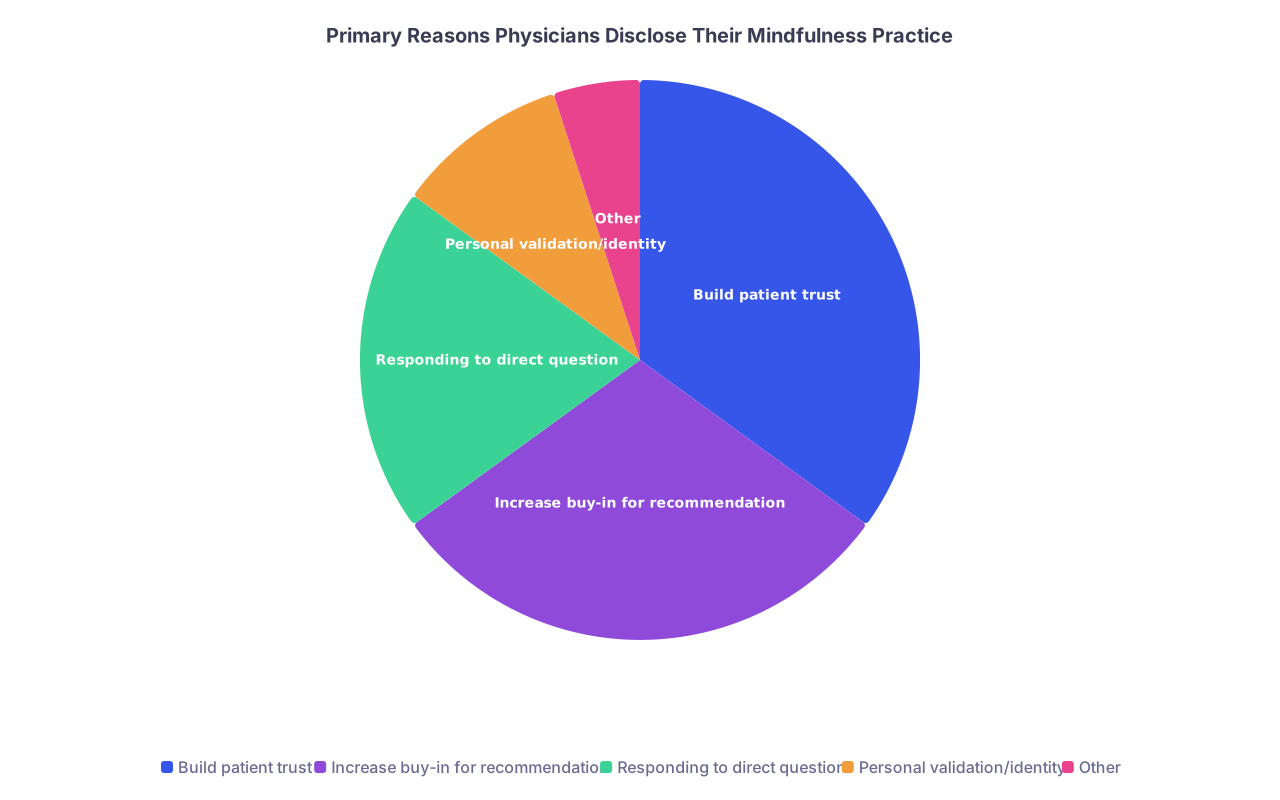
| Category | Value |
|---|---|
| Build patient trust | 35 |
| Increase buy-in for recommendation | 30 |
| Responding to direct question | 20 |
| Personal validation/identity | 10 |
| Other | 5 |
FAQ: Mindfulness Disclosure as a Physician
1. Is it ever required to tell patients I practice mindfulness?
No. There is no ethical or legal requirement to disclose your personal mindfulness practice. It is entirely optional and should be treated as a clinical tool—used only when it clearly benefits the patient.
2. Could hiding my mindfulness practice be seen as dishonest?
Not at all. Patients are not entitled to a full inventory of your coping strategies, diet, exercise, or hobbies. You’re responsible for accurate information about their care, not full transparency about your lifestyle.
3. What if a patient shares their spiritual or meditation practice and asks about mine?
You can briefly acknowledge overlap without over-aligning: “I also have a mindfulness practice, though it may look a bit different from yours. I’m glad you have something that supports you. Let’s talk about how it affects your health and stress.” You’re connecting without turning the visit into a peer conversation.
4. Can talking about mindfulness damage the therapeutic relationship?
Yes, if it feels like you’re pushing an ideology, disregarding their beliefs, or centering yourself. Patients who are skeptical, religiously cautious, or exhausted by wellness culture may see it as minimizing their suffering. That’s why disclosure should be selective and strategic.
5. How do I document mindfulness used in a visit?
If you simply mentioned it or used a 1–2 minute grounding exercise, a brief note like “Provided brief mindfulness-based breathing technique for anxiety; patient receptive” is plenty. Your personal practice does not belong in the chart. If you’re running structured sessions, follow your institution’s documentation standards.
6. Bottom line: what simple rule should I follow?
Use this: Only tell a patient you practice mindfulness if it clearly supports their care, you can say it in one sentence, and you immediately pivot back to them. If any of those fail—do not disclose.
Key takeaways:
- Your personal mindfulness practice is a clinical asset—but not a marketing pitch.
- Disclose only when it directly helps the patient, keep it brief, and maintain boundaries.
- The strongest evidence of your mindfulness is not what you tell patients. It’s how you show up in the room.


