
Most clinicians underestimate how much their own minds are shaping “difficult” encounters—and that blind spot is what gets them in trouble.
Let me be blunt: the patient is not the only one bringing baggage into the room. You are, too. Your history, your wounds, your biases, your fatigue, your family-of-origin dynamics. All of it walks in with you, whether you acknowledge it or not. That is countertransference. And if you are not using some form of mindfulness, you will act it out rather than work with it.
I want to walk through this in a way that is clinically useful, not theoretical fluff. You do not need to become a meditation guru. You do need a clear-eyed, disciplined way to notice what your mind is doing in the middle of a hard conversation—and then choose how to respond.
We will stay anchored in real clinical dynamics: the chronically late patient who triggers you, the demanding family member, the patient whose life choices remind you painfully of your own relative. This is where mindfulness earns its keep.
1. Countertransference: The Part of the Encounter That Belongs to You
Countertransference is not just a psychodynamic buzzword.
Simplified: transference is what the patient “puts on” you—seeing you as a parent, savior, enemy, judge.
Countertransference is what you “put on” the patient—reacting to them as if they were someone or something from your own life.
This is not only a psychiatry thing. It is everywhere in medicine.
Common patterns I repeatedly see in trainees and attendings:
- The “fixer” reflex: You feel driven to rescue certain patients, spend extra time, over-prescribe tests. Often tied to your own unresolved guilt or past helplessness.
- The “resentful” reflex: You feel irrational irritation at patients you label “non-compliant,” “difficult,” or “manipulative,” far out of proportion to their behavior.
- The “moral outrage” reflex: You feel intensely judgmental of certain lifestyles—substance use, repeated abortions, “poor choices”—and your voice or body language hardens.
- The “parentified” reflex: You treat some patients like children, over-directing and under-sharing decision authority, especially when they remind you of an actual family member.
- The “avoidant” reflex: You subtly shorten the visit, detour away from emotions, or delegate more when patient distress feels uncomfortably close to your own.
These patterns are rarely just about the patient. They are about what the patient evokes in you.
Ethically, this matters. Countertransference that is unrecognized leads to:
- Biased decision-making (undertreatment, overtreatment).
- Microaggressions and invalidation.
- Boundary violations (too loose or too rigid).
- Burnout from repeatedly acting out internal conflicts in the clinical space.
Mindfulness is not optional here. It is the main tool you have to notice and modulate these patterns in real time, fast enough to change your behavior before it does harm.
2. What Mindfulness Actually Means in Clinical Work
Let me strip away the wellness-industry nonsense.
Mindfulness, in this context, is a trainable capacity to:
- Notice your internal state (thoughts, emotions, body sensations, impulses) as it is happening.
- Hold it with some degree of non-reactive awareness—“Ah, this is anger / defensiveness / shame.”
- Maintain enough space between feeling and action that you can choose a response aligned with your values and professional role.
That is it. No incense required.
The key elements for clinicians:
- Present-moment attention: You catch your reaction in the room, not four hours later in the call room replaying the conversation.
- Non-identification: “I am experiencing anger” instead of “This patient is infuriating.” That small shift is massive ethically. The first is about you; the second is a judgment of them.
- Curiosity over judgment: “What is getting touched in me right now?” rather than “What is wrong with this patient?”
When I work with residents on this, I break it into three skills:
- Somatic awareness – noticing what your body is doing.
- Cognitive labeling – putting clear words to your internal state.
- Micro-pausing – creating a half-second gap before speaking or acting.
Those three are the skeleton of mindful countertransference work.
3. The Real-Time Sequence: What Happens Inside You in a Difficult Encounter
Most clinicians do not realize how fast this sequence runs:
- Trigger: Patient does or says something that hits a nerve.
- Body reaction: Tight jaw, shallow breath, heat, fatigue wave, adrenaline.
- Automatic thoughts: “Here we go again.” “She does not care.” “This is a waste of time.”
- Emotion: Anger, disgust, guilt, anxiety, helplessness.
- Impulse: Lecture, withdraw, rush, over-test, argue, rescue.
- Action: You say or do something that feels “justified” but is actually driven by your reaction, not the clinical picture.
Mindfulness inserts itself between steps 2–5.
You cannot stop the initial trigger or the first body reaction. Those are fast and often pre-conscious. But you can:
- Catch the body reaction.
- Label the thought/emotion.
- Pause the impulse.
- Choose a deliberate action.
That is the game.
4. Micro-Skills: Concrete Mindfulness Tools for Countertransference
I will keep this practical. These are not abstract “be more present” slogans. These are discreet, trainable behaviors.
4.1 Somatic Checkpoints
You need one or two reliable places in your body that tell you, “I am getting hooked.”
Common ones I see clinicians use:
- Throat tightness, voice getting clipped.
- Jaw clenching, teeth pressing.
- Chest pressure, holding breath.
- Stomach drop or nausea.
- Shoulders rising, back muscles tightening.
- A sudden heaviness or exhaustion mid-visit.
Pick yours. Literally write it down. You will know you are triggered when that body signal shows up.
Then you pair it with a quick intervention:
- One slow exhale, slightly longer than the inhale.
- Unclench jaw; drop shoulders.
- Feel feet on floor for 2–3 seconds.
You are not “fixing” the emotion. You are anchoring enough awareness to not be driven by it unconsciously.
4.2 Cognitive Labeling: Name It Cleanly
The brain calms down when you name your state with simple, accurate language.
In your head:
- “I am feeling angry.”
- “I am feeling dismissed.”
- “I am feeling helpless and guilty.”
- “I am feeling judged.”
- “I am feeling pulled to rescue.”
Note: you do not say this out loud to the patient. This is internal labeling. It does three things:
- Moves your brain activity slightly from limbic (reactive) to prefrontal (regulative).
- Makes the experience “an event in the mind,” not an absolute truth about the patient.
- Creates a small wedge of distance so you can ask, “Is this about now, or about me?”
4.3 Three-Breath Micro-Pause
This is the core interrupt.
When you notice your somatic cue and label your feeling, you then:
- Inhale normally.
- Exhale slightly longer and slower (this taps parasympathetic tone).
- Repeat for three breaths while maintaining eye contact or a neutral clinical posture.
This takes 10–15 seconds. The patient does not know you are doing anything unusual. They just see a doctor who looks thoughtful instead of reactive.
During those three breaths, run a quick internal script:
- “I am triggered. This is my reaction.”
- “What does this patient need from me clinically right now?”
- “How do I want to show up, given my role?”
Then you speak.
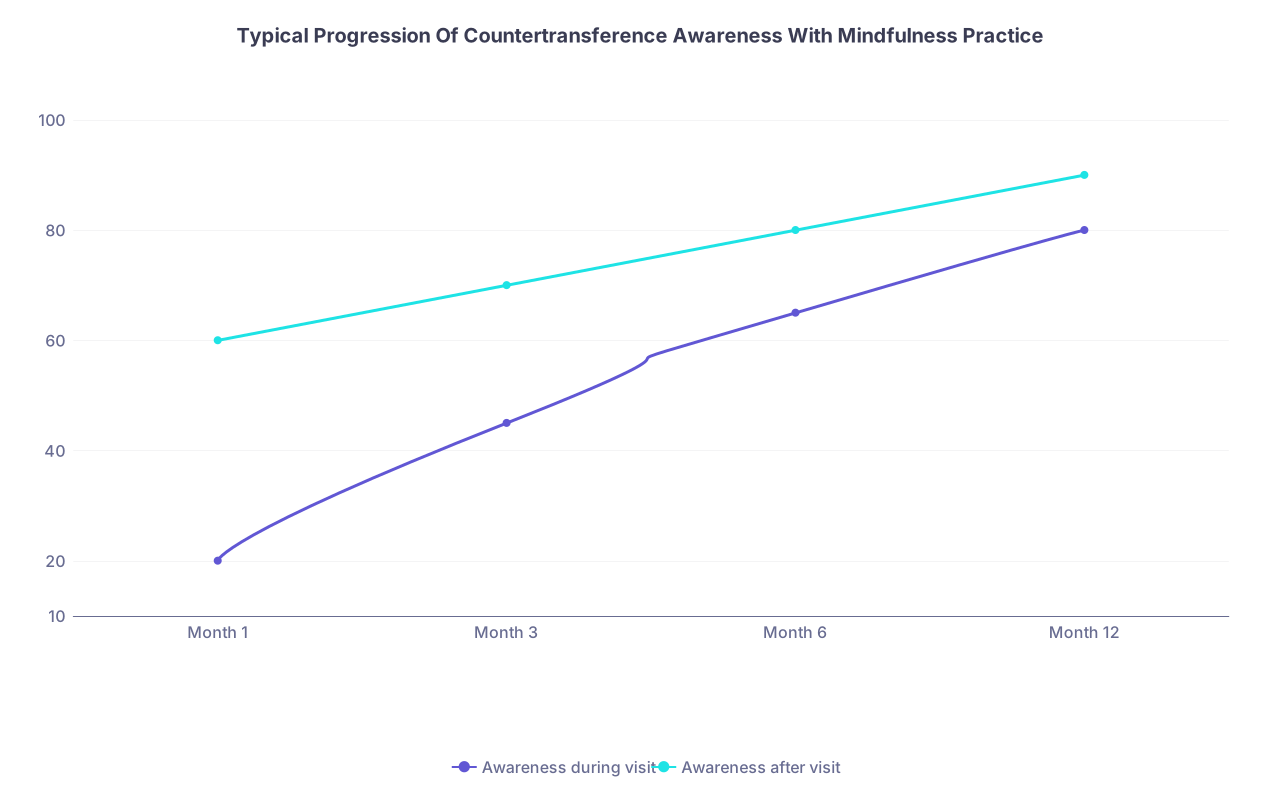
| Category | Awareness during visit | Awareness after visit |
|---|---|---|
| Month 1 | 20 | 60 |
| Month 3 | 45 | 70 |
| Month 6 | 65 | 80 |
| Month 12 | 80 | 90 |
5. Clinical Scenarios: How This Actually Looks in the Room
Let me walk through patterns I have watched play out, with and without mindfulness.
5.1 The “Non-Compliant” Patient Who Keeps Coming Back
Scenario: Middle-aged patient with poorly controlled diabetes. Repeatedly misses follow-ups, does not take medications as prescribed, keeps showing up in crisis.
Unmindful sequence:
- You see their name on the schedule, immediate eye-roll: “He never listens.”
- In the room: your tone is brisk, clipped. You ask, “So did you take the meds this time?” with a subtle accusation baked in.
- The patient senses judgment, shuts down, offers vague answers.
- You feel even more irritated, document “poor adherence,” and move on quickly.
Mindful approach:
- You see their name and notice the mental story: “He never listens.”
- Somatic cue: tight chest. Label: “I am feeling frustrated and helpless.”
- Three-breath pause before entering the room, silent script: “This frustration is my reaction. I do not know what his life is like. My job is to be curious and clear, not punitive.”
- In the room you say, neutrally: “Last time we talked about this medication. Can you walk me through how it has actually gone day to day?”
You listen for barriers—cost, side effects, housing instability, health literacy. - When frustration spikes again (it will), you notice it, soften your shoulders, and re-anchor to, “OK, what is one concrete step that is realistic for him?”
The ethics piece: You are less likely to punish the patient with reduced effort or engagement just because you feel defeated. You treat the actual situation, not your projection.
5.2 The Patient Who Reminds You of a Family Member
Scenario: Young adult with polysubstance use, manipulative-seeming behavior, chaotic interpersonal patterns. They look and sound eerily like your brother, who nearly destroyed your family with addiction.
Unmindful sequence:
- Intense anger and disgust inside: “I know this type. They will lie. They will ruin their mother’s life.”
- You speak in a cold, overly firm tone. You focus only on rule-setting, minimal empathy.
- You subtly dismiss their distress as “manipulation.”
- You either over-control (overly strict boundaries, no flexibility) or under-care (“They did this to themselves”).
Mindful approach:
- Somatic flare: stomach knot, jaw tight. Internal label: “This feels like my brother. I am angry and scared.”
- Acknowledge: “This is countertransference. This is not the same person.”
- Three-breath micro-pause while they speak.
- Reflective question to yourself: “What does this specific patient, right now, medically and psychologically need?”
Not: “What did my brother need?” Not: “What did my family go through?”
This re-grounds you in the present. - Behaviorally, you might say: “I hear that things have been out of control. My role is to help you stay alive and as safe as possible. Let’s look at what is realistic today.”
You can still set clear boundaries. Mindfulness does not mean permissiveness. It means boundaries based on clinical judgment, not on unresolved family rage.
5.3 The Charming Patient Who Makes You Want to Over-Give
Scenario: High-functioning, articulate, grateful patient. You feel energized around them, you linger, you bend scheduling rules, you consider sharing more of your personal life.
This is also countertransference.
Unmindful sequence:
- You feel special with them. You start checking extra labs “just to be sure.”
- You disclose more about your personal life than is appropriate.
- You may unconsciously favor them over others (extra time, extra calls).
- Over time, you feel drained or entangled if they become demanding or distressed.
Mindful approach:
- Notice warmth plus a subtle “I want them to like me” pull.
- Label: “I am feeling flattered and invested. I want to rescue / be the favorite.”
- Ask internally: “Is what I am about to offer something I would do for a typical patient in this situation?”
- If not, micro-pause and reset.
“I like this person” is fine. Letting that preference distort equitable care is not.
Ethically, this is as important as containing anger. Over-identification can lead to boundary violations just as quickly as hostility can lead to neglect.
6. Mindfulness and Medical Ethics: Where This Intersects with Your Professional Duties
You are not doing mindfulness just to “feel calmer.” You are doing it because unchecked countertransference can break ethical principles:
- Beneficence: Bias can make you over-treat or under-treat.
- Non-maleficence: Acting out anger, disgust, or rescue fantasies can cause harm—psychological and physical.
- Justice: Preferential treatment of certain “easy” patients and withdrawal from “difficult” ones is an equity problem.
- Respect for autonomy: Countertransference-driven paternalism (“I know better than this patient, they cannot be trusted with this decision”) erodes shared decision-making.
Mindfulness operationalizes ethical reflection at the moment of care. Instead of lofty principles in a policy document, you have:
- Real-time recognition: “I am about to let my frustration shorten this visit.”
- Ethical check: “That contradicts my duty to provide equitable care.”
- Behavioral pivot: “I will acknowledge the time constraint transparently but stay engaged and clear, not punitive.”
You will not be perfect. The standard is not “never feel countertransference.” The standard is “be aware enough to course-correct before harm is done, and to repair when you miss it.”

| Step | Description |
|---|---|
| Step 1 | Trigger in encounter |
| Step 2 | Body reaction |
| Step 3 | Noticing cue |
| Step 4 | Label emotion |
| Step 5 | Three breath pause |
| Step 6 | Reframe focus on patient needs |
| Step 7 | Proceed with clinical plan |
| Step 8 | Choose response aligned with values |
| Step 9 | Document and reflect after visit |
| Step 10 | Countertransference? |
7. Building Capacity: Training Your Mindfulness Muscle Outside the Room
Expecting yourself to suddenly be mindful under stress when you never practice outside of clinic is like expecting to run a 10K without training.
You do not need 45-minute sits on a cushion. You do need consistent reps.
7.1 Short, Daily Practices (5–10 Minutes)
Two straightforward options:
Breath-focused practice
Sit, eyes open or closed.
Feel the breath at the nose or chest.
When the mind wanders, gently note “thinking” or “planning” and come back.
This trains noticing and returning—exactly what you need in difficult encounters.Body scan, abbreviated (5 minutes)
Move attention through body regions, noticing tension, warmth, numbness.
This increases your baseline somatic literacy so you catch early cues of activation at work.
7.2 Intentional Reflection After Difficult Encounters
Right after a rough interaction, instead of just complaining to a colleague, try this quick structure:
- What did I feel in my body?
- What thoughts about the patient were strongest?
- Which of those thoughts felt familiar from my own history?
- How did my behavior shift because of those reactions?
- What would I like to try differently next time?
You are doing a miniature, targeted morbidity and mortality conference on your own mind.
You can even formalize this in a supervision or Balint group if your institution supports it. I have seen residents make huge gains after 3–4 such sessions.
| Pattern | Internal Cue | Mindful Intervention |
|---|---|---|
| Irritation / Anger | Heat in face, clipped speech | Label anger, 3 breaths, slow tone |
| Rescue / Over-Investment | Leaning in, time blindness | Ask “Would I do this for any patient?” |
| Disgust / Moral Judgment | Jaw clench, aversion feelings | Note judgment, recall patient context |
| Helplessness / Defeat | Slumped posture, sighing | Name helplessness, seek one small goal |
| Fear / Anxiety | Rapid heart, scattered talk | Ground in body, clarify next step aloud |
8. Boundaries, Not Blame: Using Mindfulness to Protect Both You and the Patient
There is a common misunderstanding: mindfulness means you just tolerate everything, endlessly empathic, never limit-setting. That is naive.
Mindfulness in this context does two things:
- Stops you from discharging your discomfort onto the patient.
- Clarifies when you genuinely need boundaries to protect the therapeutic frame and your own sustainability.
Examples:
A patient becomes verbally abusive.
Unmindful: you snap back, shame them, or abruptly leave.
Mindful: you notice your own adrenaline surge, take a brief pause, and calmly state, “I want to help, but I cannot do that while being yelled at. We can take a short break, or we can plan another time to talk when things are calmer.”A patient texts or messages excessively through portals, pulling you into late-night replies.
Unmindful: you respond out of guilt and end up resentful and burnt out.
Mindful: you notice the guilt and rescue pull, breathe, and respond once with clear boundaries: “I review messages during clinic hours; for urgent issues after hours you need to contact X.”
Mindfulness does not replace institutional policies. It makes it more likely that when you enforce boundaries, you do so cleanly—without contempt, passive aggression, or retaliatory coldness.

9. When Mindfulness Is Not Enough: Knowing When to Get Help
Sometimes the countertransference is too strong, too personal, or too tied to your own trauma for mindfulness alone to hold it.
Signs you need supervision, consultation, or your own therapy:
- You consistently dread seeing a particular type of patient (e.g., self-harm, obesity, substance use) and it affects your mood for the rest of the day.
- You find yourself bending boundaries repeatedly with one patient—extra time, special favors, personal disclosures—and feel both drawn and uneasy.
- You have intrusive thoughts about a patient outside of work that feel obsessive, erotic, or intensely angry.
- Colleagues gently (or not so gently) comment that you are “too involved” or “too harsh” with certain cases.
- You notice a pattern: your worst reactions cluster around dynamics that resemble your own personal history (parentification, abandonment, addiction, etc.).
Here is where ethics and personal development converge: you have a professional responsibility to work with your own material so that it does not distort care. That may mean:
- Regular case supervision with someone who can name countertransference without shaming you.
- Joining a Balint group or reflective practice group.
- Engaging in personal psychotherapy to unpack longstanding triggers.
Mindfulness is the flashlight. Therapy and supervision are the tools you use once you see what is in the room.
10. Integrating This Into Your Day Without Adding Another Burden
You are already overloaded. I know. So let us be realistic about integration.
Think in terms of “embedded” practices, not add-ons.
Three anchors:
Door handle pause
Before entering a room that you suspect will be challenging: one breath, name your intention.
“Notice my reactions. Stay curious. One step at a time.”Computer screen check
When you feel yourself rushing in documentation or writing a snarky note: quick body scan, label emotion, adjust tone.
Ask: “If this note were read aloud with the patient present, would I stand by it?”End-of-clinic review (5–7 minutes)
Scan your day:- Which encounter stuck with me?
- What did I feel?
- Was my reaction proportionate to the situation?
- What might that tell me about my own patterns?
You do not need to analyze every visit. Target the ones that leave an emotional residue. That is where countertransference is loudest—and where mindfulness practice will compound fastest.
Key Takeaways
- Countertransference is inevitable; unrecognized countertransference is dangerous. Mindfulness gives you just enough space to see your reactions and not be run by them.
- In difficult encounters, anchor in your body, name your emotion, take three deliberate breaths, and then choose a response that reflects your role and ethics—not your old wounds.
- This is a professional skill, not a personality trait. With small, consistent mindfulness practices and honest reflection (plus supervision when needed), you can transform “difficult patients” from threats into some of your best teachers in medicine.