
Most debriefings fail not because people are fragile, but because leaders are unprepared.
If you run emotionally intense debriefings in medicine and you are not using mindful leadership tools, you are leaving people unheld, lessons unlearned, and trauma unprocessed. I have watched “debriefs” that lasted four minutes, started with “So… what went wrong?” and ended with everyone more shut down than when they walked in. That is not reflection. That is ritualized blame.
Let me break down how to do this properly, with a clinician’s reality in mind: codes still run late, consults still page you mid-sentence, and nobody is handing out 90‑minute protected sessions after every bad outcome.
We will talk about debriefing after:
- A failed resuscitation or unexpected death
- A bad error or near miss
- A morally distressing case (futility, conflict with families, system constraints)
And we will ground it in two things: mindfulness skills and ethical responsibility.
Why Mindfulness Belongs in High‑Intensity Debriefing
Mindfulness in medicine is not sitting on a cushion chanting while the ED waiting room melts down. It is the capacity to stay present and grounded in the middle of chaos and pain, without reflexively spacing out, fixing, silencing, or attacking.
In emotionally intense debriefings, three things are always happening at once:
- Cognitive processing:
What happened clinically? Where were the misses? - Emotional processing:
Shame, grief, anger, fear of judgment, moral distress. - Relational dynamics:
Hierarchy, power, blame, avoidance, cultural and personality differences.
If you only run the first track (cognitive), the other two go underground. They will leak out later as burnout, snark, avoidance, and “I will never go into that room again.”
Mindful leadership tools actually give you leverage over all three tracks:
- Attention control: You choose what to amplify and what to let pass.
- Emotional regulation: You can absorb intensity without escalating it.
- Awareness of bias and ego: You notice when your agenda is taking over.
- Ethics: You remember that these are human beings, not just “learners.”
This is not soft. This is clinical risk management for the psyche of your team.
Step Zero: Regulating Yourself Before You Lead
If you walk into the debrief flooded, angry, or dissociated, the rest is theater.
Here is the pre‑debrief checklist I actually recommend to attendings, seniors, and charge nurses. It takes 60–120 seconds. Do it in the hallway, stairwell, medication room, wherever.
1. Three‑Breath Reset
- Breath 1: Notice
Inhale through the nose, exhale through the mouth. Silently: “Body.” Scan quickly—jaw, shoulders, abdomen, hands. - Breath 2: Soften
Micro‑release where you are gripping (drop shoulders 5 mm, unclench teeth, soften belly). - Breath 3: Intend
On the exhale, silently set intention: “I am here to support and to learn, not to judge.”
You do not need to be Zen. You just need to be 10% less reactive than the room you are about to enter.
2. Quick Check for Ego Contamination
Ask yourself bluntly:
- Am I secretly defensive about a decision I made?
- Am I angry at a specific person and ready to prove a point?
- Am I going in to look like a “good leader” rather than to serve the team?
If you answer “yes” to any, name it to yourself: “Defensiveness is here.” That simple mental label separates “you” from the reaction just enough so you do not act it out in the room.
3. Decide the Scope
Not every event gets a full 45‑minute debrief. You need tiers.
| Tier | Duration | Trigger Examples |
|---|---|---|
| Brief Huddle | 5–10 min | Typical codes, stable outcomes, low visible distress |
| Focused Debrief | 15–25 min | Unexpected death, complex resus, multiple trainees |
| Full Process Debrief | 30–45+ min | Child death, major error, moral distress cases |
You choose the tier before you walk in. Changing mid‑stream usually looks chaotic and undermines trust.
Structuring the Debrief: A Mindful, Ethical Framework
Most debriefing frameworks in simulation (e.g., PEARLS, advocacy-inquiry) can be adapted, but they are often emotionally tone‑deaf when lifted straight into real clinical trauma. You need a structure that explicitly:
- Normalizes emotional reactions
- Reduces shame and blame
- Surfaces learning
- Honors ethical complexity
Here is a pragmatic structure that works in real hospitals:
- Ground and frame
- Emotional check‑in
- Shared narrative of events
- Meaning, learning, and ethics
- Concrete takeaways and closure
We will walk through each, with mindful leadership tools embedded.
1. Ground and Frame: How You Open Dictates Everything
The first 60 seconds either opens the nervous system or slams it shut.
Ground the Room
Literally invite people to land.
Example script:
“Let us all just take a moment to arrive. If it is comfortable, put both feet on the floor. Take one deeper breath in… and out. We just went through something intense. We are going to spend about 15 minutes together, to talk about what happened and how we are doing.”
You are not “teaching meditation.” You are giving people permission to switch modes from action to reflection.
Frame the Purpose and Rules
Clarify the why and the boundaries, or the default will be “find the blame.”
You should hit:
- Purpose: learning + support
- Confidentiality (to the extent allowed)
- No-blame, system‑oriented tone (without lying about individual responsibility)
Example:
“The purpose here is twofold: to understand what happened, and to support each other. This is not about fault. If we identify things any of us, including me, would do differently next time, that is about learning, not punishment. What we share here stays in this group except where patient safety or formal reporting requires otherwise.”
You just injected ethics (non‑maleficence to colleagues, justice, truthfulness) into the container.
2. Emotional Check‑In: Short, Structured, Essential
Leaders skip this step because they are afraid it will blow open the room. Ironically, the opposite happens. Unacknowledged emotion hijacks the entire conversation.
You need a mindful, bounded way to check in that does not turn into unstructured group therapy.
Option A: One‑Word Round
Go around quickly, each person naming one word about how they are right now.
“Let us do a quick round. Just your name and one or two words for how you are in this moment—no explanations.”
You will hear: “numb”, “frustrated”, “sad”, “guilty”, “tired”.
Your job is to mirror without fixing:
“I am hearing a lot of sadness and frustration in this room, and some people feeling numb. That all makes sense after what we just went through.”
Mindfulness tool here: nonjudgmental acknowledgment. You see the emotion, name it, you do not rush to “at least…” platitudes.
Option B: Body Scan Prompt (30 seconds)
For very intense events:
“I want to invite you to briefly notice where this is landing in your body—jaw, chest, stomach. No need to share, just notice. Take one breath there.”
Mini somatic awareness practice. Helps move people from cognitive spin to embodied presence, which paradoxically makes the discussion calmer.
3. Reconstructing the Story Without Reigniting War
This is the high‑risk phase. People’s narratives differ. Hierarchy kicks in. Mindful leadership here means you manage process, not content.
Use a Timeline, Not a Cross‑Examination
You are not doing root cause analysis. You are building a shared map.
“Let us walk through what happened from the moment the patient first deteriorated, just to make sure we share the same picture. I will sketch a rough timeline as we go.”
Write on a whiteboard or paper where everyone can see: time stamps, key events, who was present.
While you do this:
- Discourage blame language
Convert “Respiratory was late again” to “Respiratory arrived at 14:18; what was happening before that?” - Encourage perspective sharing
“From the nursing station, how did that period between 14:10–14:20 feel?” - Slow down escalation points
When voices climb, you slow tempo: “Let us pause at the intubation decision. A lot was happening there. We will come back to it.”
Mindfulness tool: attentional shifting. You move focus away from “who screwed up” to “what was the team’s experience of this time window?”
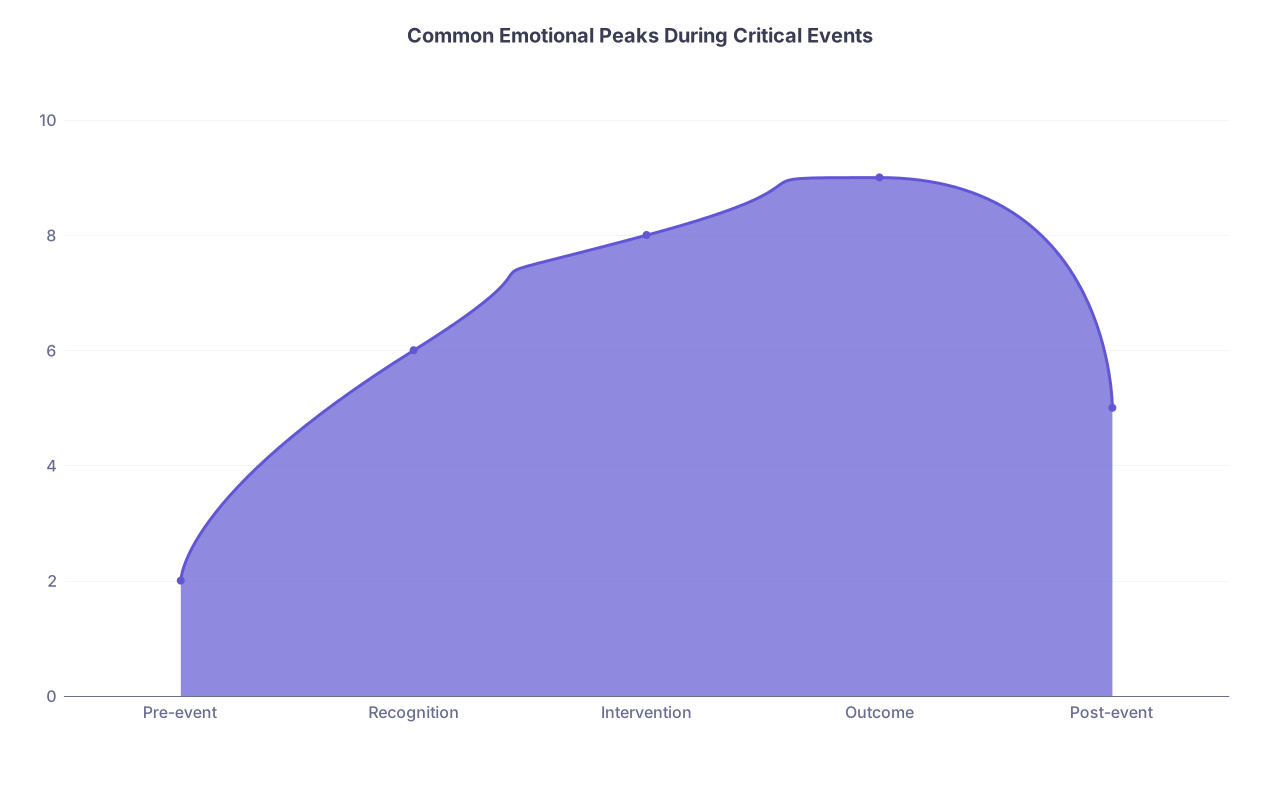
| Category | Value |
|---|---|
| Pre-event | 2 |
| Recognition | 6 |
| Intervention | 8 |
| Outcome | 9 |
| Post-event | 5 |
This rough “emotional intensity curve” is predictable. Expect spikes at recognition of deterioration, invasive interventions, and outcome disclosure. That awareness lets you slow the narrative right where people are most charged.
4. Moving Into Meaning, Learning, and Ethics
Here is where most clinical leaders revert to technical talk only. Safer, but incomplete.
Your task is to:
- Extract clinical learning
- Name systems issues
- Make space for ethical and emotional meaning‑making
A. Clinical and Systems Learning – Without Humiliation
Use advocacy‑inquiry, but soften the edge.
Example:
“I noticed that chest compressions paused for more than 10 seconds twice around the second rhythm check. I imagine there was a lot of confusion with airway and line access. What was happening for you all in that moment?”
You:
- Describe a specific observation
- Offer a hypothesis about the internal experience
- Invite their perspective
This is inherently mindful: you hold your own perspective lightly, curious rather than accusatory.
When someone admits an error:
Resident: “I froze. I should have called for help sooner.”
You model ethical, compassionate response:
“Thank you for saying that. Many of us have been in that exact position. The question is how we as a system support earlier escalation, not whether you as a person are defective.”
You protect dignity while not denying the reality of what happened.
B. Ethics and Moral Distress – Do Not Dodge This
Some cases are ethically brutal:
- Continuing aggressive care at a family’s insistence when the team believes it is futile
- Withdrawing life support after a perceived delay in recognition
- Resource constraints forcing earlier discharge than feels safe
You need to explicitly invite that layer.
Prompt:
“Beyond the clinical steps, a lot of us wrestle with the ethical side of cases like this. Things like: ‘Did we do the right thing? Did the system constrain us in ways that felt wrong?’ I want to open space for that. What ethical questions or discomfort is still sitting with you?”
Common responses:
- “I felt like we tortured the patient for the family.”
- “We knew we were short‑staffed, and it showed.”
- “I do not know how to face the parents after this.”
This is where mindfulness really matters. Your impulse will be to shut it down with reassurance. Resist that urge. Instead:
- Reflect: “It sounds like there is a lot of moral distress about the intensity of interventions at the end.”
- Normalize: “Many clinicians struggle with that tension between honoring family wishes and minimizing suffering.”
- Boundary: “We might not solve that here, but naming it is part of our responsibility.”
You are practicing ethical mindfulness: being willing to see what hurts, without numbing it under protocol talk.

5. Concrete Takeaways and Closure: Do Not Just Drift Out
You must land the plane.
A. Capture One or Two Specific Takeaways
Too many action items and nothing will change. Aim for 1–3 max.
Examples:
- “Next time we will assign a clear code leader before first medication.”
- “We will trial a visual board for roles in the resus bay.”
- “I will escalate chronic staffing concerns from this case to departmental leadership.”
You say out loud who owns each item. “I will…” not “Someone should…”
Mindfulness element: intention setting. You take the emotional and cognitive work and make a specific, present‑moment commitment.
B. Individual Wellbeing and Follow‑Up
This is the piece that separates performative debriefs from ethical leadership.
You scan the room: Who is still dissociated, tearful, or rigid? That is not the person you rush back to the busiest pod.
Say something like:
“This was heavy. Some of you may feel fine going back to clinical duties; others may notice you are more affected. Both are normal. If you need a few minutes before going back, tell me and we will make space. I will also check in with a few of you later today.”
Do not promise what you will not deliver. If you say you will check in, actually do it.
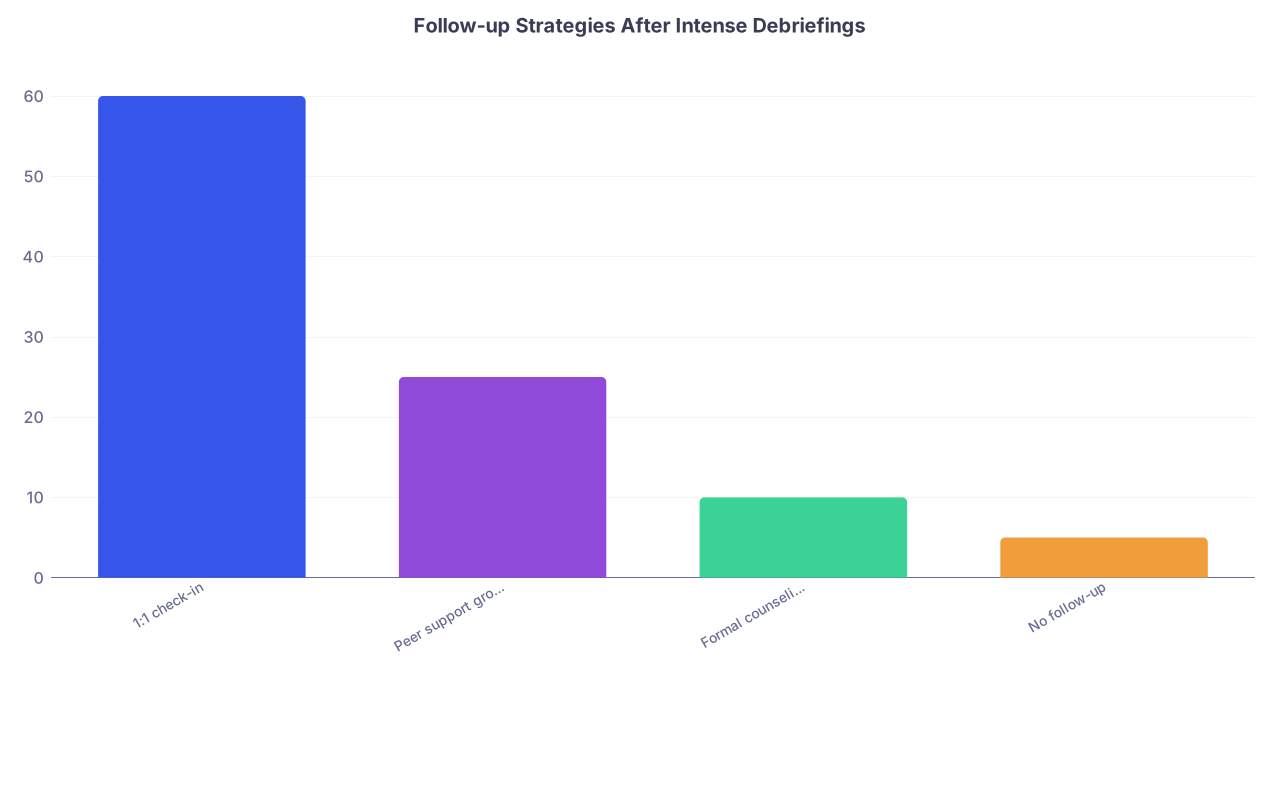
| Category | Value |
|---|---|
| 1:1 check-in | 60 |
| Peer support group | 25 |
| Formal counseling referral | 10 |
| No follow-up | 5 |
The reality: most clinicians report getting little to no follow‑up. That is ethically lazy and completely fixable.
C. Ritualized Closure
A simple closing ritual helps nervous systems shift out of the activated state.
Options:
- One breath together
- Brief moment of silence
- Simple verbal closure
Example:
“Let us take one last breath together before we go back out there.”
[Pause for breath.]
“Thank you all. You showed up fully for this patient and for each other.”
That is it. Do not tack on a lecture.
Mindful Micro‑Skills You Need in the Room
Let me distill the core skills you actually use, second by second.
1. Noticing and Naming
You say what you see, without dramatizing.
“I notice it got very quiet after that comment.”
“I am hearing a lot of self‑blame in your words.”
Naming is powerful. It often defuses without you needing to “fix.”
2. Strategic Pausing
Silence freaks clinicians out. That is why you should use it.
After a heavy statement, count to five silently before speaking. That pause:
- Signals that the content matters
- Gives others space to chime in
- Lets emotion move a little instead of being immediately shut down
3. Boundary Setting Without Shaming
Sometimes someone tips into personal attack or obsessive detail.
Attacking:
“This always happens when night shift is on. They are so slow.”
You respond:
“I want to keep this focused on systems and processes, not on blaming groups of people. Let us look at what in the setup made response time longer.”
Monologuing in minutiae:
“We started the second liter at exactly 14:32 and then the vent was switched…”
You cut in gently:
“I am going to pause you there so others can speak. We may need that level of detail later in a formal review, but for now let us stay with the key inflection points.”
This is mindful containment. You guard the container.
4. Owning Your Own Humanity
You are not a neutral robot. Use that.
“I also felt helpless at points during this case.”
“As the attending, there are choices I would revise if I had a time machine. That is part of this work.”
This models ethical vulnerability without oversharing or dumping on trainees.

Handling Common High‑Risk Scenarios
A few situations come up over and over. If you are not ready for them, you will get steamrolled.
Scenario 1: The Blame Missile
One person is clearly angry and wants a target.
“There was no attending in the room for the first 10 minutes. That is unacceptable.”
Wrong move: Defend yourself or the absent person immediately.
Better:
“You are pointing to a gap in senior presence early in the code. That sounds very concerning to you. Can you say more about how that affected your ability to care for the patient?”
Then, after some exploration:
“We will take a clear action item to review our attending coverage for codes at this hour. I also want to make sure we hear from others about how that period felt.”
You validate the concern, capture a systems action, and prevent a dogpile.
Scenario 2: The Silent Room
You ask an open question and get crickets.
Do not panic. Use structure.
- Try a more specific prompt: “From the nursing side, what felt hardest?”
- Or switch to the one‑word round: “Let us just go around with one word for how you are right now.”
If silence persists, you name it:
“It feels pretty quiet in here. I do not want to force anyone, and I also know that sometimes silence means people are protecting themselves. Know that I am available 1:1 later if that feels safer.”
You respect autonomy. That itself is ethical.
Scenario 3: The Overwhelmed Trainee
A resident breaks down in tears mid‑debrief.
You have three jobs:
- Protect them from humiliation.
- Keep the group psychologically intact.
- Ensure patient care coverage.
You can say:
“Thank you for letting that out. This is a safe space for that reaction. Would you prefer to stay here with us for a bit or step out with me or someone you trust for a minute?”
If they leave with a peer, you quickly reorient the group:
“Many of us remember our first case like this. Again, reactions like that are human, not weakness. Let us take a breath and continue.”
Later, you follow up 1:1. Not optional.

Integrating Mindfulness and Ethics Long‑Term
If debriefings are the only time you talk about emotions and ethics, they will always feel awkward and “extra.” The best units I have seen:
- Normalize micro‑check‑ins at the start of rounds: “One word on how you are arriving today.”
- Model brief grounding before family meetings: “Let us take one breath together.”
- Treat moral distress as a quality metric, not just an individual problem.

| Step | Description |
|---|---|
| Step 1 | Everyday Micro Practices |
| Step 2 | Team Trust Increases |
| Step 3 | More Honest Debriefings |
| Step 4 | Better Learning and Support |
| Step 5 | Lower Burnout and Moral Injury |
| Step 6 | More Capacity for Mindful Leadership |
You build capacity in loops, not in one heroic session after a disaster.
FAQ (Exactly 5 Questions)
1. What if I have almost no time—should I still debrief?
Yes, but scale correctly. A 5–7 minute brief huddle is still worthwhile. Frame it clearly: “We have 5 minutes before we need to be back. One round: what went well, what was hard, and one thing we might do differently next time.” Even 30 seconds to say, “This was rough, we will schedule a fuller debrief later,” is better than pretending nothing happened.
2. How do I manage my own emotional reaction while leading?
You use the same tools you are offering others: three‑breath reset beforehand, occasional mini pauses during, and honest but contained acknowledgment of your feelings. If you are too flooded to lead ethically (e.g., it was your long‑term patient, your clear error), delegate leadership to another senior and join as a participant. That is not weakness; it is responsible leadership.
3. Should debriefings ever include explicit talk about legal risk or incident reporting?
You can acknowledge that formal reviews and reporting pathways exist, but do not turn the debrief into a quasi‑legal deposition. State up front: “This space is for team learning and support; formal reviews will follow their own process.” If someone veers into legal speculation (“We are going to get sued”), you gently redirect to what is in the team’s control and, if needed, offer to discuss medico‑legal aspects separately.
4. How do I bring mindfulness into a very skeptical, old‑school team without eye‑rolls?
Do not call it “mindfulness.” Call it “taking a second to land” or “switching gears.” Keep practices short and functional—one breath, one‑word check‑ins, simple naming of what you see. When people experience that these moves make discussions more efficient and less painful, resistance drops. You do not need everyone to buy the philosophy; they just need to feel the benefit.
5. What if intense emotion or conflict surfaces that I do not know how to handle?
You are not obligated to resolve every wound in one session. Your obligation is to keep the space safe and honest. If conflict escalates beyond what you can hold, you set a boundary: “This feels bigger than what we can process well right now. I want to pause this part and arrange a follow‑up with support from our wellness/ethics/psych team.” That is mindful leadership: recognizing your limit, protecting the team, and securing appropriate help.
Take this with you:
First, your presence and regulation matter more than any script. Second, structure protects people—use a clear arc from ground → feel → understand → learn → close. Third, ethically run, mindful debriefings are not a luxury; they are part of your duty of care to your team, just as resuscitation is part of your duty to your patients.