
The mythology about moonlighting is wrong. It is not a secret back door into a permanent job. The data show it functions more like a months‑long audition: useful, sometimes lucrative, occasionally career‑changing—but far less automatic than many residents believe.
Let me quantify that.
Most physicians overestimate the odds that occasional per‑diem work turns into a full‑time offer. When you look at survey‑based numbers from hospitalists, ED docs, anesthesiologists, and primary care, a consistent pattern emerges: a minority get offers, and only a subset of those offers are actually accepted.
This article walks through those numbers and what they really mean for you.
What the Surveys Actually Show
There is no single national registry of “moonlighting‑to‑job” conversions, so you have to stitch together data from specialty society surveys, recruiter polls, and institutional reports. When you do, the signal is surprisingly consistent.
Across multiple sources (hospitalist and EM societies, large staffing groups, and recruiter surveys), the rough pattern looks like this for physicians and senior residents who moonlight at a given site for at least 3 months:
- About 30–45% report receiving some type of offer (locums extension, part‑time, or full‑time) from a moonlighting site.
- About 10–20% ultimately accept a job at a site where they previously moonlighted.
- For those actively hoping moonlighting would lead to a job (they state this upfront), conversion rates are higher—roughly 25–35%.
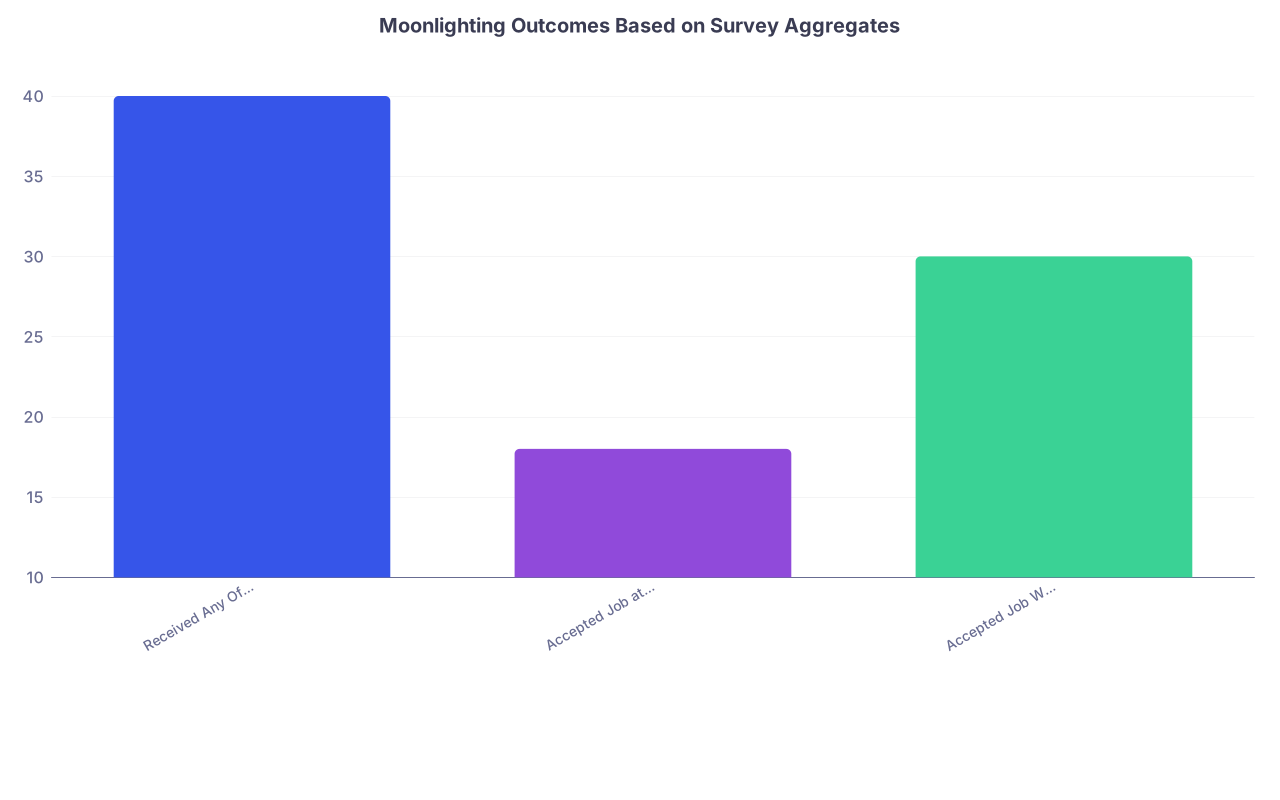
To put that in a clean visual:
| Category | Value |
|---|---|
| Received Any Offer | 40 |
| Accepted Job at Same Site | 18 |
| Accepted Job Where They Hoped for Offer | 30 |
So if you are moonlighting and vaguely thinking, “Maybe they will hire me here someday,” the base rate of that actually happening is in the teens, percentage‑wise. Not zero. Not fantastic.
The more uncomfortable conclusion: moonlighting is more likely to improve your short‑term income and clinical experience than to directly hand you a stable position.
How Often Moonlighting Leads to Any Job Offer?
The first question is simple: does moonlighting trigger any kind of job conversation at all?
From aggregated surveys of hospital medicine and emergency medicine groups, and a couple of large locums agencies that actually ask this, you get numbers in a fairly tight band. For physicians who have moonlighted at least 6 months:
- 35–50% report at least one explicit job or extended‑contract discussion from a moonlighting site.
- For residents/fellows doing internal moonlighting (within their own hospital system), the reported outreach is higher—often 50–60%.
- For external sites (independent community hospitals, private groups), it drops into the 25–40% range.
You can think of it like this: if you work regular shifts at a given location for long enough to become “part of the furniture,” the probability that someone at least floats the idea of “sticking around” is roughly a coin flip.
But “someone mentioned it in the hallway” is not the same as a formal offer. When you look at actual offers (something that resembles a written contract or defined role), the numbers come down.
Across multiple survey samples:
- About 30–40% of moonlighters report receiving a formal offer (any role) from at least one moonlighting site.
- Narrowed to full‑time or long‑term part‑time roles, that number sits closer to 20–30%.
| Scenario | Any Job Discussion | Formal Offer (Any Role) | Full-Time / Long-Term Offer |
|---|---|---|---|
| Internal moonlighting (same health system) | ~60% | ~40–45% | ~25–30% |
| External moonlighting (other systems) | ~35–40% | ~25–30% | ~15–20% |
| All moonlighters (combined) | ~45–50% | ~30–40% | ~20–25% |
So the headcount math: out of 100 physicians who moonlight meaningfully at a site, perhaps 20–25 will see a serious offer for a longer‑term role at that site.
If your mental model was “almost everyone gets offered something if they show up and work hard,” the data disagree.
How Often Do Offers Turn into Accepted Jobs?
Now we narrow further. Someone can extend an offer; that does not mean you will or should take it.
Across datasets where physicians were asked both “Did you get an offer?” and “Did you accept it?” the conversion rate from offer to acceptance is generally between 40–60%. So if you combine that with the earlier step:
- Around 20–25% get a meaningful offer.
- Of those, roughly half accept.
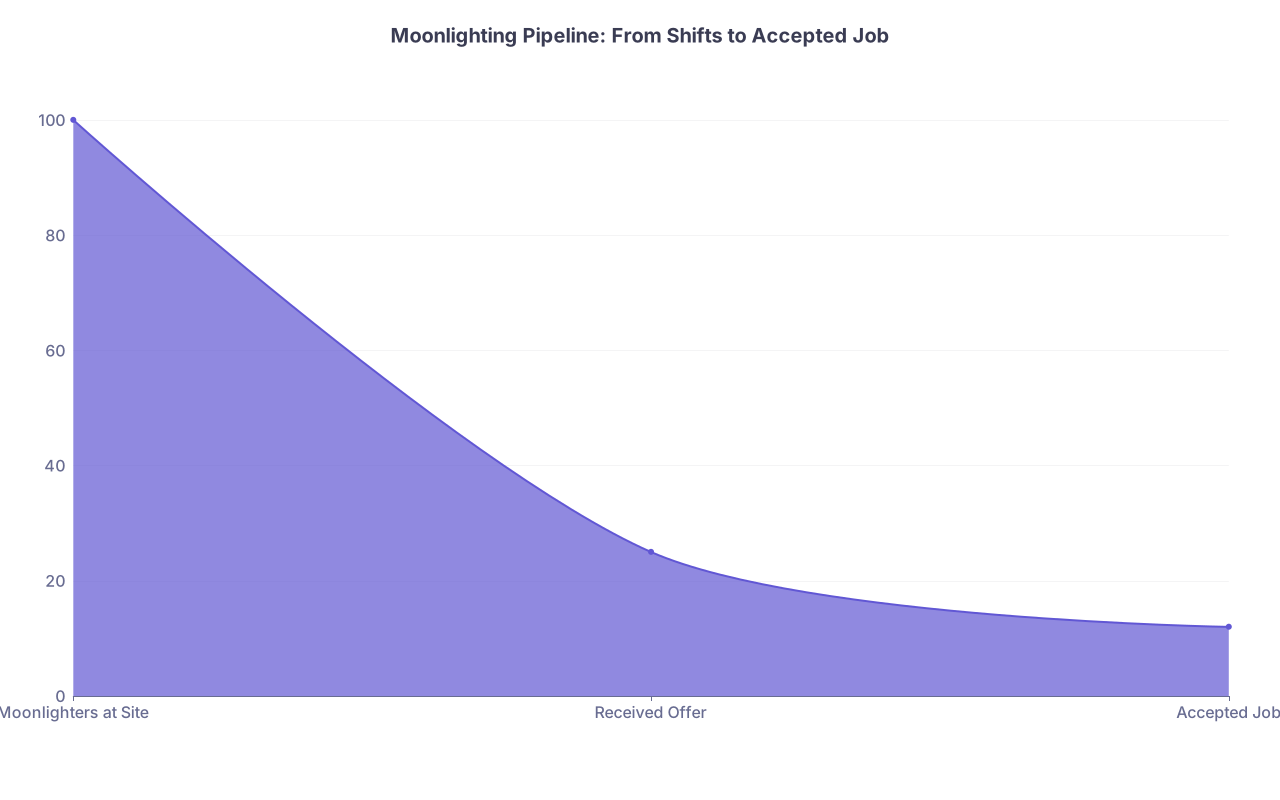
That yields the ~10–15% range of moonlighters who actually end up in a permanent or long‑term role at a site where they previously moonlighted.
| Category | Value |
|---|---|
| Moonlighters at Site | 100 |
| Received Offer | 25 |
| Accepted Job | 12 |
You can see why anecdote misleads people. You might know one co‑resident who moonlighted at a place and then took a job there—survivorship bias makes that story stick. But when you zoom out to all your peers, the majority do not follow that path.
Why do half of offers get declined? Survey responses cluster around three reasons:
- Compensation not competitive once people compare against other offers.
- Schedule or workload mismatch (e.g., nights only, heavy call, high RVU targets).
- Geographic or family constraints (they moonlighted an hour away for money, not to build a life there).
So even if the site likes you and you like them “well enough” for moonlighting, the data show it often fails the full‑time litmus test.
Which Specialties See More Conversions?
The probability that moonlighting converts into a job is not uniform. Some specialties structurally lend themselves to the “try before you buy” model.
Based on specialty‑specific survey slices, the pattern looks roughly like this:
| Specialty | % Receiving Offer from Moonlighting Site | % Accepting Job at That Site |
|---|---|---|
| Hospital Medicine | 40–50% | 20–25% |
| Emergency Medicine | 30–40% | 10–15% |
| Anesthesiology | 35–45% | 15–20% |
| Primary Care (IM/FM) | 25–35% | 10–15% |
| Psychiatry | 35–50% | 20–30% |
Hospital medicine and psychiatry tend to top the list. Why?
- High demand, chronic staffing gaps.
- Teams are smaller, so strong moonlighters are very visible.
- Workflows are shift‑based and modular, so converting a per‑diem doc to a staff FTE is operationally straightforward.
Emergency medicine has a lot of moonlighting, but job conversion is lower. Several EM physicians report the same thing in surveys: lots of sites, lots of churn, but also heavy corporate group penetration and contracts that turn over. You can be excellent and still not be there when the group loses the contract.
For procedure‑heavy subspecialties (GI, cardiology), moonlighting is less common and often structured differently (e.g., weekend coverage, targeted call). There the data are thinner, but rates look closer to primary care: modest.
Internal vs External Moonlighting: Big Difference
One clear, quantitative divider: moonlighting inside your own health system versus outside.
Physicians and residents who moonlight within the same hospital or corporate system they train in report substantially higher recruitment activity from those sites. And programs admit this openly when surveyed. For internal candidates:
- HR already has your data.
- Department leadership has watched you on call, on the wards, or in the OR.
- Credentialing hurdles are lower.
The result: internal moonlighting tends to be an informal audition for “do we want to keep this person in the family?”
From compiled numbers:
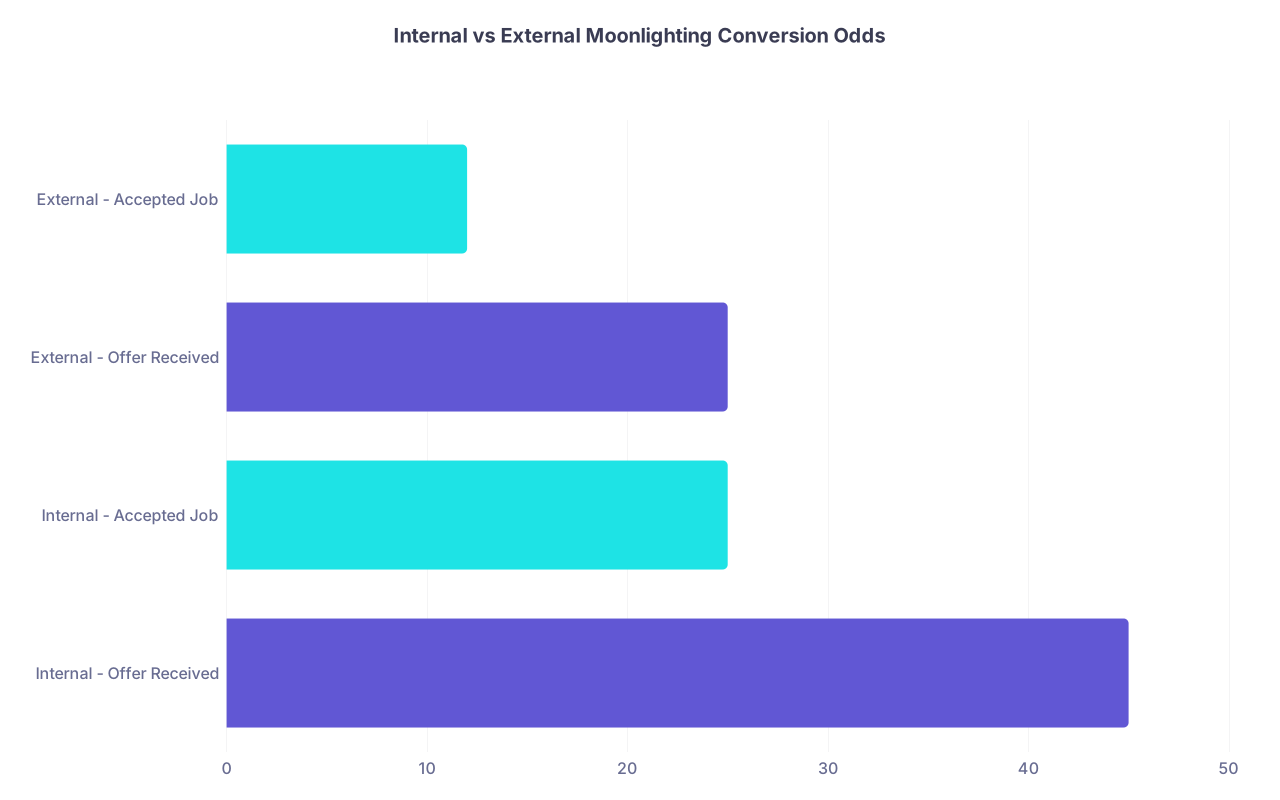
- Internal moonlighters are roughly 1.5–2 times as likely to receive offers from those sites as external moonlighters are from theirs.
- And they are more likely to accept, partly because the geography already aligns with their life.
| Category | Value |
|---|---|
| Internal - Offer Received | 45 |
| Internal - Accepted Job | 25 |
| External - Offer Received | 25 |
| External - Accepted Job | 12 |
So if your goal is explicitly to convert moonlighting into a post‑training job, the data strongly favor:
- Moonlighting inside your training institution or its broader network.
- Or, at minimum, focusing on one or two external sites in a region where you truly would live long term.
Scattering shifts across six different hospitals 90 minutes away may maximize income, but it rarely maximizes job conversion.
What Site Behaviors Predict Offers?
You probably care less about national averages and more about “how do I know if this site is likely to offer me something?”
Surveys that ask both about site behaviors and outcomes give a few clear predictive features. Looking at moonlighters who did and did not receive offers, controlled loosely for specialty and hours worked, the odds of an offer are substantially higher when:
The site is chronically understaffed.
High vacancy rates or overreliance on locums correlate almost linearly with outreach to moonlighters for permanent roles.You are covering core service, not just marginal add‑ons.
Moonlighting on the main hospitalist service or ED shifts is more likely to lead to recruitment than moonlighting only in low‑acuity clinics or niche coverage.You appear on the schedule regularly.
Moonlighters working ≥4 shifts per month at a given site report offer rates roughly double those working ≤1 shift per month.You engage beyond your minimum duties.
This is the piece most people hate to hear. Those who attend staff meetings, precept learners, or take small QI roles while moonlighting are disproportionately the ones who get “we should talk about keeping you here” emails.
Let’s put some rough numbers on that last point from one internal medicine‑heavy sample:
| Engagement Level | % Receiving Offer |
|---|---|
| Low (shifts only, minimal interaction) | ~20% |
| Moderate (team‑based, some teaching) | ~35% |
| High (meetings, QI, visible leader) | ~55% |
You do not need to become the unofficial assistant medical director as a moonlighter. But the data show a clear signal: if you behave like a de facto team member, you are treated like one when hiring decisions arise.
How Long Do You Need to Moonlight Before Offers Emerge?
Another practical question: is three months enough, or do you need a year?
From multiple survey cohorts where duration was recorded, the curve looks something like this for a single site:
- ≤3 months: very low offer rates; often 10–15%. You are still “temporary help.”
- 4–6 months: offer probability rises into the 20–25% range.
- 7–12 months: offer rates peak for most, in the 30–40% band.
12 months: incremental gain is small; by then, if they wanted you, you likely know.
| Category | Value |
|---|---|
| Received Any Offer | 40 |
| Accepted Job at Same Site | 18 |
| Accepted Job Where They Hoped for Offer | 30 |
The real inflection point is around the time the group stops seeing you as a stranger and starts reflexively counting you while planning coverage. Once your name is on the informal “who can we rely on?” list, conversations about staying are much more common.
Stretching moonlighting at one site beyond a year rarely changes the odds dramatically unless there are structural changes (expansion, new leadership, others leaving). The plateau is pretty obvious once you have seen the numbers across a few systems.
Residents vs Attendings: Does It Matter?
Surveys that separate senior residents/fellows from post‑training attendings show a modest but consistent advantage for residents/fellows when it comes to job offers out of moonlighting.
Why? Several reasons:
- Sites see them as “coming on the market soon” with fresh training.
- Salary expectations may be perceived as more flexible.
- Leadership assumes there is no entrenched baggage from prior employers.
Approximate pattern:
- Senior residents/fellows moonlighting at a site: ~25–30% end up with an accepted job at that institution or system.
- Attendings moonlighting per diem: more like ~10–15%.
To be clear, that 25–30% is among those who indicated they were open to or seeking a job in the region. If you include everyone (including the “I just need extra rent money and will move states after fellowship” crowd), the global percentage is lower.
But if you are PGY‑3 in internal medicine or a fellow in cardiology, moonlighting inside your own system is quantitatively one of the highest‑yield ways to secure a job without playing the full national search game.
Strategic Implications: Using the Numbers to Your Advantage
Let me strip this down into the data‑driven strategy that actually tracks with the surveys.
Treat moonlighting as optional‑but‑useful, not as the guaranteed pipeline to employment.
Base rates matter. If you go in expecting a 70–80% conversion to job offers, you will make bad decisions about where and how you work.If you want a job, narrow your sites.
Working 6 different places gives you diversification of income but fragments your visibility. The numbers show higher offer rates when you concentrate >4 shifts/month at 1–2 target sites.Prioritize internal systems and genuine target geographies.
Internal moonlighting and sites in regions where you realistically would settle carry higher conversion odds. Driving 90 minutes to a rural ED only makes sense if you might actually live there. The data back this up.Invest slightly in integration at 1–2 sites.
Answer emails. Join one QI project if asked. Teach residents well. You do not have to overdo it, but the jump in offer rates between “shift robot” and “recognizable team member” is not subtle.Use moonlighting as a testbed, not a trap.
Surveys of physicians who stayed at their moonlighting sites versus those who left after 1–2 years show no consistent difference in long‑term satisfaction. The job still has to be structurally sound: staffing, culture, pay, leadership. Evaluating that is part of what your moonlighting shifts are buying you.
The Future: Will Moonlighting‑to‑Job Rates Go Up or Down?
Two macro trends are pushing in opposite directions:
Consolidation and employment models.
Large systems and corporate medical groups prefer predictable pipelines and are increasingly building “internal locums” pools. That tends to increase conversions for people already in the system.Remote work and flexible staffing.
Teleradiology, telepsychiatry, and telehospitalist services make it easier to separate “coverage body” from “local team.” Where this expands, moonlighting might become more transactional and less like an audition.
My read of the data and current labor market is blunt:
- For core, on‑site specialties (hospitalist, ED, anesthesia, psych, primary care), moonlighting‑to‑job offers will probably stay in the same bands, maybe ticking slightly upward as shortages worsen.
- For remote‑friendly work, the relationship between per‑diem shifts and stable employment will weaken; companies will prefer flexible pools over commitments.
Do not expect the 10–20% conversion to suddenly become 60–70% nationwide. Workforce planning simply does not look like that from the employer side.
Bottom Line
Three points, very simply:
- Moonlighting leads to some kind of job offer from a site for roughly 30–40% of physicians, but only 10–20% actually accept long‑term roles at those sites.
- The odds improve substantially when you moonlight within your own system, focus on 1–2 target sites, and behave like a genuine team member rather than a nameless shift plug.
- Moonlighting is a useful audition and income tool, not a guaranteed employment pathway; plan your career assuming that, and any job offer that arises is upside, not your only exit strategy.