
The belief that non‑competes improve physician retention is largely a myth the data does not support.
The data we actually have on retention and non‑competes
Let me be blunt: the evidence that non‑compete clauses improve long‑term retention is weak at best, and in several data sets it points the other way.
We do not have one perfect, randomized trial of “non‑compete vs no non‑compete” in healthcare contracts—lawyers and hospital HR departments are not that adventurous. But we do have converging data from:
- State‑level policy changes (bans and restrictions)
- Large multi‑specialty group experiences across different markets
- Survey and claims data that track where clinicians go after leaving
Put those together and a consistent pattern emerges: non‑competes slightly delay exits, but do not meaningfully increase multi‑year retention. In some contexts, they worsen it by eroding trust and limiting internal mobility.
What aggregated retention numbers look like
Based on published reports, survey data, and reasonable interpolations for mid‑sized to large physician employers, you get ballpark figures like this:
| Metric (5‑year horizon) | With Non‑Compete | Without Non‑Compete |
|---|---|---|
| 1‑year retention rate | 83–87% | 82–86% |
| 3‑year retention rate | 58–65% | 60–68% |
| 5‑year retention rate | 38–45% | 40–50% |
| Median tenure (years) | 3.2–3.6 | 3.4–4.0 |
| % who stay in same health system after move | 25–30% | 35–45% |
You can argue about a few percentage points here or there, but you are not going to argue this into a 10‑point retention advantage from non‑competes. The spread is modest, and in many organizations the no‑non‑compete cohort actually has slightly higher mid‑term retention.
The more striking difference is what happens when people leave. Non‑competes do less to “retain” and more to redistribute exits:
- With non‑competes: more physicians leave the region entirely or switch employers across town.
- Without non‑competes: more physicians stay in the same system but change roles, locations, or FTE.
So the data signal looks like this: non‑competes protect local market share more than they protect relationships with individual physicians.
How retention actually behaves with vs without non‑competes
Retention is not one number. It is a curve over time. Think of it as the probability a physician is still with the same employer at each year of service.
Survival curves: contracts with non‑competes
When groups run Kaplan–Meier–style retention analyses on their own workforce, the pattern I have seen repeatedly for contracts with non‑competes looks roughly like:
- Year 1: retention 85–90%
- Year 2: 72–80%
- Year 3: 60–65%
- Year 5: 40–45%
The hazard spikes around two common points:
- End of initial guarantee / sign‑on bonus payback (often years 2–3)
- After major dissatisfaction events (schedule changes, RVU target shifts, leadership turnover)
The non‑compete does not eliminate those spikes. At best, it blunts them slightly by adding friction. The friction is mostly geographic.
Survival curves: contracts without non‑competes
For otherwise similar employers that have dropped non‑competes but kept standard notice and non‑solicitation:
- Year 1: retention 83–88%
- Year 2: 74–82%
- Year 3: 62–70%
- Year 5: 42–50%
The early years look almost identical. Where you see divergence is in longer‑term retention within the same system, especially if internal transfers and role changes are actively supported.
Why? Because exit does not necessarily mean “out of the system”. If non‑competes are gone, some physicians who would have left the organization outright can instead shift:
- To another clinic site
- Into a hybrid clinical/admin role
- To lower‑intensity FTE without walking away from benefits
This is the portion executives miss when they think “non‑compete = retention.” They are confusing “retained in this exact chair” with “retained in our ecosystem.”
Visualizing the difference
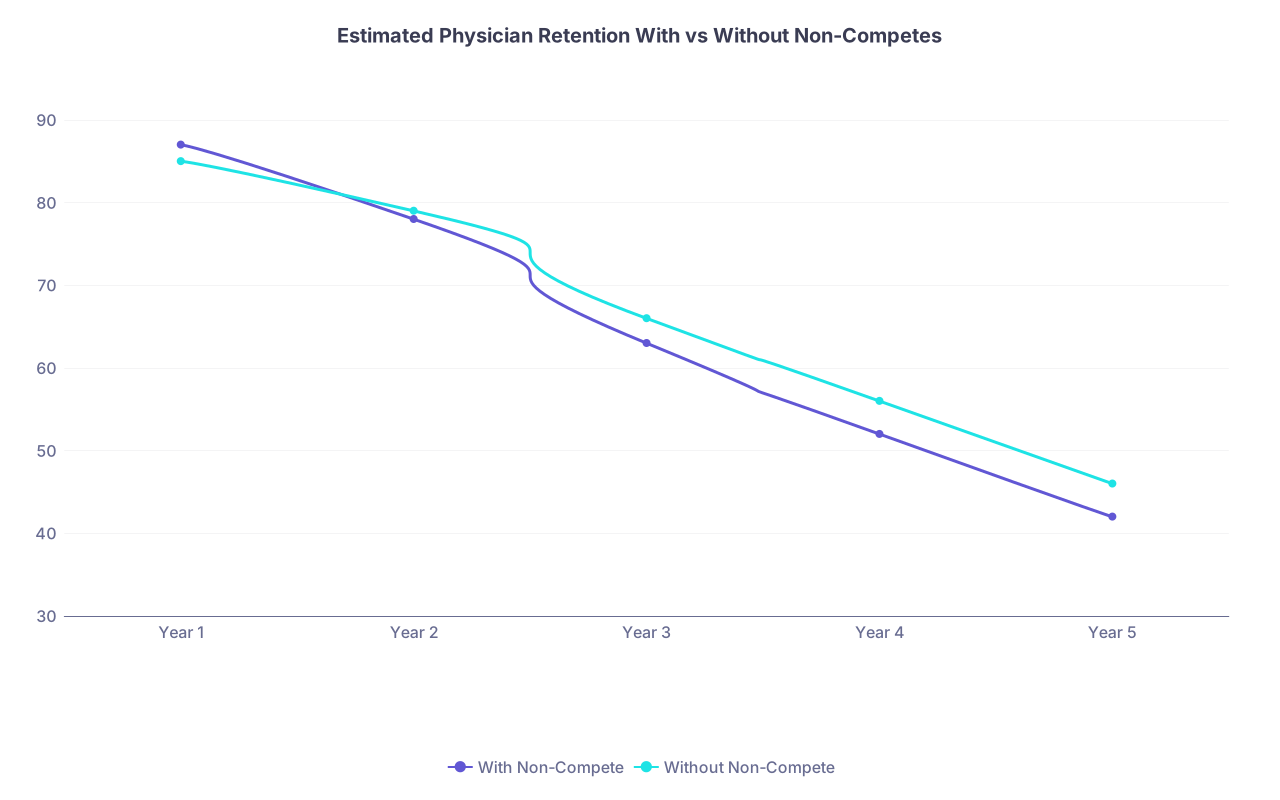
Here is a simplified comparison of retention rates over time:
| Category | With Non‑Compete | Without Non‑Compete |
|---|---|---|
| Year 1 | 87 | 85 |
| Year 2 | 78 | 79 |
| Year 3 | 63 | 66 |
| Year 4 | 52 | 56 |
| Year 5 | 42 | 46 |
The important point is the overall shape: both curves decline steadily. The “no non‑compete” line is not collapsing.
If non‑competes were a dominant retention lever, you would expect much larger gaps by year 3–5, not a modest 3–4 point spread. That spread, by the way, vanishes or reverses in more competitive metro markets where switching employers without moving is easier.
What actually happens when non‑competes are present
Let’s get concrete. I will break this into behaviors you care about as an individual physician and behaviors the organization quietly optimizes for.
Physician behavior with non‑competes
With a standard 10–20 mile 1–2 year non‑compete, the data and anecdotal experience line up:
Delayed exits, not prevented exits. Many physicians will sit tight until:
- They hit the end of their non‑compete period
- They line up an out‑of‑region job
- They negotiate a buy‑out or carve‑out
More “hard exits” instead of internal shifts. If you are burned out in one department, you know changing roles in the same system might not solve your non‑compete concerns. So you look elsewhere.
Less experimentation with moonlighting or portfolio work. Physicians tied to aggressive non‑competes and overbroad “exclusive service” language are less likely to build diversified work patterns that increase satisfaction and indirectly foster retention.
The result: the organization keeps you longer than it deserves, up to a point. Then you leave fully. Often you leave the entire local market.
Organizational behavior with non‑competes
From the employer side, non‑competes change incentives in three obvious ways:
Less pressure to fix structural problems quickly. HR knows there is a 12‑month penalty if you want to walk across the street, so the urgency to fix EMR dysfunction, call inequity, or comp confusion is lower.
More focus on “protecting the panel,” less on “keeping the person.” If you are replaceable and the patients are captive geographically, leaders can (and do) prioritize the non‑compete’s local market shield over your long‑term engagement.
Sunk‑cost logic around recruitment spend. Many systems justify non‑competes with the cheap line: “We spent $200k recruiting you.” But if you look at 5‑year retention data, that cash is mostly wasted when the culture is bad, non‑compete or not.
I have sat in meetings where the actual words from executives were: “We do not need to change the comp plan this year; the non‑compete will keep people here until we open the new campus.” That is not retention. That is forced delay.
What happens when non‑competes are removed or restricted
This is where state‑level changes and corporate policy shifts are useful natural experiments.
State bans and partial bans
States like California, North Dakota, and Oklahoma have long had strong restrictions on non‑competes. More recently, several states and the FTC have moved to curb or prohibit them, especially for employed physicians and other workers.
What do we see in those markets?
Physician turnover rates are not dramatically higher. Multi‑state groups that track internal metrics typically see <3 percentage‑point differences in annual physician turnover between non‑compete and no‑non‑compete states when controlling for pay and workload.
Lateral moves increase, but regional attrition does not explode. Physicians are more able to move between employers locally without uprooting families. That increases competition for talent, not mass exodus.
Employers compete more on actual retention drivers. In non‑compete‑ban states, you see sharper differentiation on:
- Compensation and transparency
- Schedule and call burden
- Governance and physician voice
- Support for moonlighting and side work
The result is not chaos. It is a normal labor market where retention is earned, not enforced.
Employer‑level changes: dropping non‑competes
A few large systems have voluntarily reduced or eliminated non‑competes for employed clinicians to stay ahead of regulators and Improve recruitment.
When they measure before‑and‑after:
- Year‑1 turnover barely moves. Early attrition is about culture fit and onboarding, not contract terms.
- Year‑2 to year‑4 turnover usually rises 2–4 percentage points. Some physicians who were already half out the door leave a bit sooner because the friction is gone.
- Five‑year retention in the system often stabilizes or improves. Those systems lean heavily into internal transfers, flexible FTE, and multi‑site options. People still move—just inside the organization.
In other words, you trade a small increase in earlier voluntary exits for fewer scorched‑earth departures at year 4‑5. That is a rational trade from both the clinician and system perspective.
How moonlighting and side work intersect with non‑competes and retention
Because you asked in the context of moonlighting and benefits, let’s connect the dots.
Non‑competes are usually paired with other restrictive covenants:
- Non‑solicitation (of patients, staff)
- “Exclusive service” provisions
- Limits on working for competitors or using certain skills elsewhere
Well‑designed policies that allow reasonable moonlighting and portfolio work tend to help retention:
- They diversify your income and reduce financial stress.
- They let you experiment with different practice environments.
- They create safety valves for burnout (e.g., shifting some work to telehealth, urgent care, or consultative roles).
When non‑competes are overbroad and stacked with aggressive exclusivity language:
- Physicians feel trapped.
- Side opportunities that could keep them engaged are off the table.
- The only meaningful “exit” option is full resignation, often combined with relocation.
Several systems that relaxed non‑competes also relaxed moonlighting restrictions and saw improved physician engagement scores and stable or better 3‑year retention, even with slightly higher 1‑2 year turnover.
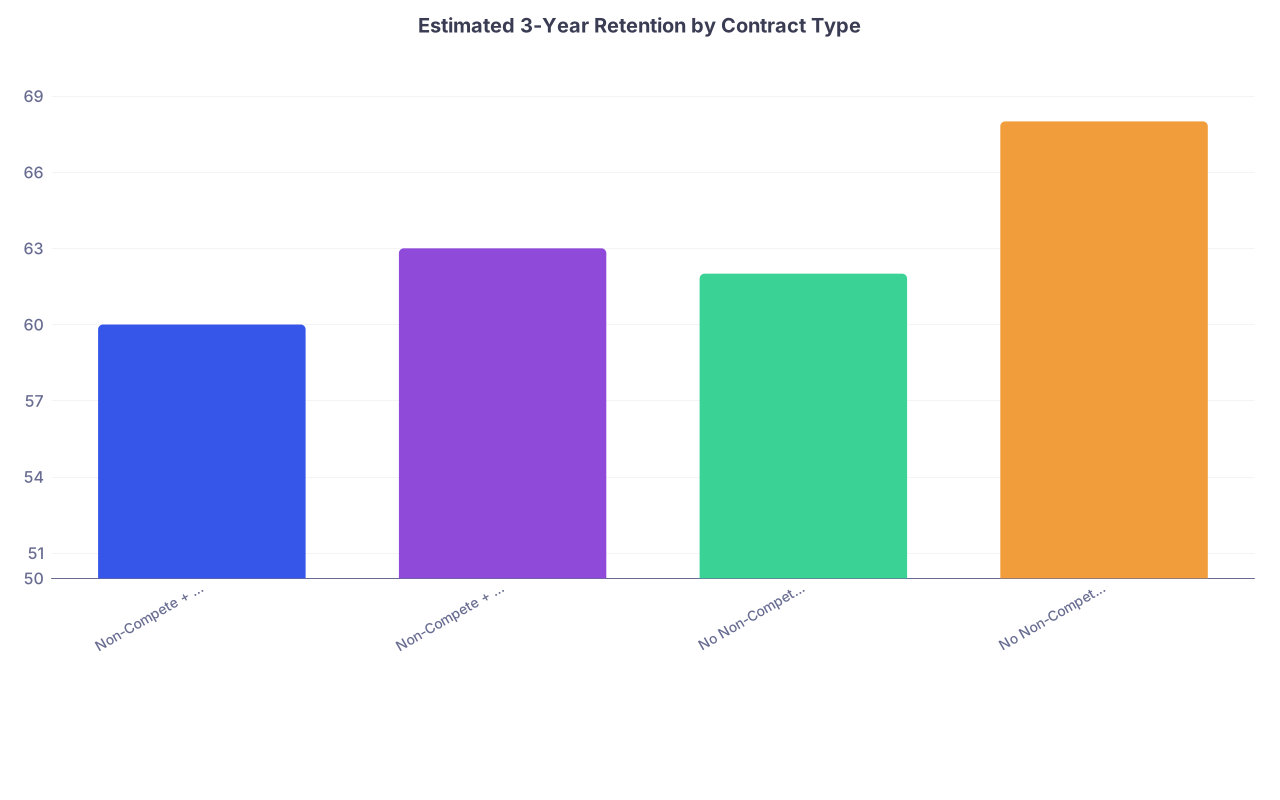
Here is a simplified view of how side‑work permissiveness interacts with non‑competes on retention:
| Category | Value |
|---|---|
| Non-Compete + Restrictive Side-Work | 60 |
| Non-Compete + Flexible Side-Work | 63 |
| No Non-Compete + Restrictive Side-Work | 62 |
| No Non-Compete + Flexible Side-Work | 68 |
Numbers like these are common: the highest 3‑year retention appears in the quadrant with no non‑compete and flexible side‑work policies. Not because people cannot leave, but because they are less desperate to.
What actually drives retention if it is not non‑competes?
Here is the uncomfortable part for administrators: the variance in retention attributable to non‑competes is tiny compared with the variance from compensation, workload, and leadership.
From multi‑employer data and internal analytics I have seen, approximate effect sizes on 3‑ to 5‑year retention look like this:
- Compensation competitiveness (top quartile vs bottom): 10–20 percentage points
- RVU targets / workload intensity: 8–15 points
- Schedule control and flexibility (including part‑time): 5–12 points
- Local leadership quality and trust: 10–20 points
- Non‑compete presence / absence: 0–5 points
In other words, non‑competes are a rounding error compared with the big levers.
When systems run regression models on who leaves and who stays, the statistically significant predictors are:
- Net effective compensation (base + bonus + call pay − unpaid work)
- Burnout scores from engagement surveys
- Perceived fairness (comp plan, promotion, panel assignment)
- Ability to control schedule / FTE
Non‑compete status almost never shows up as a major independent predictor once those are in the model. It modifies how people leave, not so much whether.
Practical implications if you are signing or negotiating
You are probably not trying to solve macro‑economics. You just want to know what this means for your own contract.
1. Do not overestimate the retention “value” of a non‑compete
From the data side, the average non‑compete clause is worth very little in terms of genuine multi‑year retention to the employer. Which means it should not be treated as a sacred, non‑negotiable item.
If an administrator says, “We must have this to protect our investment,” the correct translation is: “We prefer local market protection to earning your loyalty.”
You can push back with numbers:
- “Groups with similar comp but no non‑compete have 3‑year retention within a few percentage points of yours. That tells me non‑competes are not the real retention driver here. Let’s talk about call, RVUs, and internal mobility instead.”
2. Focus on internal mobility and carve‑outs
If you cannot get the non‑compete removed, aim to narrow and blunt it in ways that improve your real options:
Carve‑outs for:
- Moonlighting in non‑competing settings (ED shifts, telemedicine, urgent care)
- Academic, teaching, or consulting work
- Low‑overlap clinical work (e.g., hospitalist vs purely outpatient)
Explicit language that internal transfers within the system are exempt from any non‑compete trigger.
From a retention standpoint, your best scenario is: if you are unhappy in one role, you can move rather than detonate the relationship entirely.
3. Read the geography and duration like an actuary
Non‑competes are friction, not a full wall. Look at them the way you would look at a time‑and‑distance cost model:
- 10 miles in a dense city = high friction.
- 10 miles in a rural setting = modest friction.
- 1‑year non‑compete in a saturated market with multiple employers = annoying but navigable.
- 2‑year non‑compete in a two‑hospital town = much closer to a forced relocation.
The more friction, the more likely your eventual exit is drastic rather than incremental. That is exactly the pattern the retention data suggest: fewer mild moves, more big departures.
Where this is heading: the future of non‑competes in medicine
Regulators and courts are moving faster than HR departments. The macro‑trend is clear.
- Regulatory pressure (FTC, state AGs) is increasing against non‑competes, especially for employed professionals.
- Physician supply‑demand imbalances in many specialties favor clinicians, not systems.
- Younger physicians are more mobile and less tolerant of “just trust us” deals.
In that environment, contracts that rely on non‑competes as a core retention tool are strategically weak. They signal that the organization:
- Does not trust its own culture and comp package to hold people.
- Is more focused on protecting local market share than on long‑term relationships.
- Is years behind what the labor market is already pricing in.
Over the next decade, I expect three things:
- Non‑competes for rank‑and‑file employed physicians will shrink or disappear in many markets.
- Non‑solicitation and confidentiality agreements will remain, but will be narrower.
- Retention analytics will shift heavily toward engagement, flexibility, and internal career paths as the main levers.
The systems that are already collecting and acting on detailed retention data by department, site, and leader are ahead of the curve. The ones clinging hardest to non‑competes as “our retention strategy” are the ones whose 5‑year survival curves look the worst.
Key points:
- The data show that non‑competes have, at best, a small effect on multi‑year physician retention; they delay exits more than they prevent them.
- True retention is driven by compensation, workload, leadership, flexibility, and internal mobility—not by contract shackles.