Are Competitive Specialties Only for Extroverts? Personality Myths Examined
So who actually gets derm, ortho, plastics, ENT, neurosurgery – the loudest person in the room, or the best doctor in the making?
If you hang around M3/M4s for a week, you’ll hear the same line on repeat:
“Derm is for pretty extroverts.”
“Ortho is for jocks who can talk forever.”
“Rads is where the introverts hide.”
It sounds plausible. It’s also mostly wrong, and in the ways that actually matter for you, dangerously misleading.
Let’s pull this apart using data, not hallway folklore.
What the Evidence Actually Says About Personality and Specialty
First, there is hard data here. Not vibes.
Psych studies have been poking at physician personality for decades using the Big Five traits:
- Extraversion
- Agreeableness
- Conscientiousness
- Neuroticism (emotional stability)
- Openness to experience
Large samples from multiple countries show consistent patterns: certain specialties skew on some traits. But “skew” is not the same as “require.” Think “slight bump,” not “hard gate.”
Here’s the key pattern that keeps showing up:
- Surgeons (including ortho, neurosurg, ENT, plastics)
- Higher extraversion on average
- Higher conscientiousness
- Slightly lower neuroticism
- Medicine / primary care
- Higher agreeableness
- Moderate extraversion
- Psych
- Higher openness
- Slightly higher neuroticism
- Radiology / pathology
- Lower extraversion
- Higher conscientiousness
Note what’s missing:
No study worth anything says, “below X extraversion, you’re doomed in ortho.”
The traits are overlapping bell curves, not separate species.
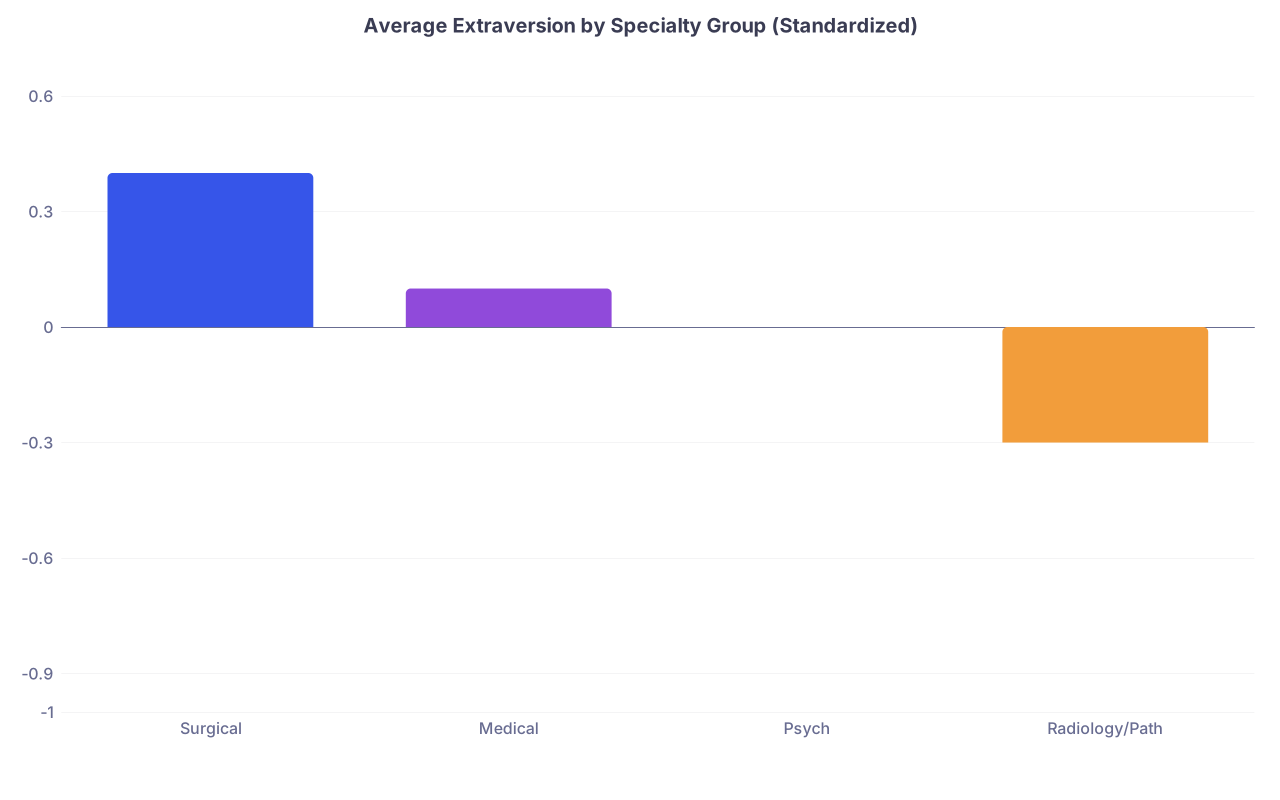
| Category | Value |
|---|---|
| Surgical | 0.4 |
| Medical | 0.1 |
| Psych | 0 |
| Radiology/Path | -0.3 |
This kind of standardized difference is exactly what I’m talking about:
- Surgical fields: a bit more extroverted than average
- Radiology/path: more introvert-friendly
But a “0.4” bump is not “all are extroverts.” It’s “the average shifts a bit.”
You’ll absolutely meet quiet, almost painfully reserved ortho interns, and you’ll see loud, center-of-attention radiologists. I have.
So the claim “competitive specialties are only for extroverts” just collapses immediately when you look at actual distributions.
But let’s deal with where the myth comes from, because that’s what’s really tripping people up.
The Hidden Confounder: It’s Not Your Personality, It’s Your Application
When students say, “It’s easier for extroverts,” they usually mean something more specific but less honest:
“Extroverts seem to get:
- Better letters
- More ‘fit’ comments
- More face time with attendings
- Stronger networking with PDs and residents”
That part is not fantasy. Outgoing people often rack up visible advantages in social spaces. Away rotations are basically 4-week social-audition marathons with medicine wrapped around them.
But you have to separate personality traits from skills and behaviors. People mix these up constantly.
- Personality trait: baseline extraversion (how much you naturally seek stimulation and social interaction)
- Behavior/skill: ability to introduce yourself, ask for feedback, present concisely, not vanish on service
You can be introverted and still:
- Make a point to talk to the attending once per day
- Ask, “Is there anything I can read tonight that would help tomorrow’s cases?”
- Present efficiently and confidently because you practiced, not because you “love talking”
Most of what programs call “fit” is interpreted through social behavior – but that behavior can be learned. You are not chained to your default temperament.
Here’s the pattern I’ve seen again and again:
Quiet student + high performance + deliberate visible engagement → strong letters, great match.
Loud student + mediocre work ethic + weak fund of knowledge → tanked by behind-the-scenes evaluations.
Extroversion opens some doors more easily. It doesn’t carry you through them.
Specialty Myths, One by One
Let’s burn through the most persistent caricatures.
“Derm is only for attractive, bubbly extroverts”
Reality: Derm is for people with monster applications:
- Top 5–10% board scores (historically; Step 1 pass/fail shifted this, but Step 2 still matters)
- Strong research (often multiple pubs/posters)
- High class ranking / AOA
Personality? Programs do like socially appropriate, collegial people. You’re working in clinics, counseling patients for chronic disease, dealing with cosmetic expectations. Extreme social awkwardness or arrogance will hurt you. But that’s true in family med too.
The myth persists because:
- You see some loud, charismatic derm residents and generalize from a tiny, visible sample.
- People who fail to match explain it with “I’m not the right personality,” instead of “I didn’t have the numbers/research this cycle.”
“Ortho is for jocky extroverts”
Reality: Ortho absolutely has a culture stereotype – sports, bro-y humor, outgoing. But again, this is vibe, not a requirement in the application criteria.
Programs select for:
- Work capacity (signaled by grades, rotation performance, sub-I reviews)
- Technical interest and stamina in the OR
- Team behavior under stress
On ortho away rotations, what kills students is not introversion. It’s passivity. They don’t speak up, ask to scrub, or own their patients. But I’ve watched very quiet students do just fine once they decide, “Alright, each day I’ll ask two specific questions and volunteer for one thing.” That’s a skill choice, not a personality transplant.
“Neurosurgery is only for intense alpha extroverts”
Neurosurgery residents skew toward high dominance and assertiveness. Sure. But watch time-stamped behavior: most of their life is not giving speeches; it’s grinding through long OR days, meticulous pre-op/post-op care, a ton of imaging review, and constantly reading.
You can be socially low-key and thrive, as long as you:
- Communicate clearly when it counts
- Handle pressure without melting down
- Show up consistently, on time, and prepared
If you need constant social downtime and hate any kind of team environment, neurosurg will hurt. But that’s not “introversion”; that’s poor fit with a very interdependent, high-acuity team sport.
“Radiology and pathology are for introverts running from people”
Let’s flip the script.
Rad and path do attract people who prefer more controlled, less chaotic patient interaction. But if you think you can be a non-communicative hermit and thrive, you haven’t seen modern practice.
Radiologists who succeed:
- Communicate constantly with surgeons, ED, medicine teams
- Explain complex imaging findings over the phone in 60 seconds
- Lead tumor boards
Pathologists: - Discuss margins, staging, urgent frozen sections with surgeons in real time
- Teach residents and students
Low extraversion is not a problem. Inability to communicate clearly under time pressure is.
What Program Directors Actually Care About (Spoiler: Not MBTI Letters)
Program directors are not sitting in rank meetings saying, “She’s INTJ, reject.”
They’re asking three blunt questions:
- Will this person do the work?
- Will they be safe with patients?
- Can we stand being on call with them at 3 a.m.?
Personality comes in as a proxy for those. PDs and faculty use quick, flawed impressions:
- Consistent eye contact and clear speech → “probably confident and competent”
- Never asks questions, avoids interaction → “might not engage, might struggle under pressure”
- Dominates conversations, interrupts others → “high maintenance, possible problem resident”
Notice none of this requires true extraversion. It requires normal adult communication with some self-awareness.
| PD Concern | Student Myth Translation |
|---|---|
| Teamwork under stress | "They only want extroverts" |
| Ownership of patients | "You must be ultra confident" |
| Teachable, takes feedback | "You can never look unsure" |
| Reliability and follow-through | "It’s all about charisma" |
I’ve watched painfully shy MS4s match ortho and neurosurg because their attendings told rank committees:
“Quiet, but always prepared, never dropped the ball, and improved week to week.”
That line matters more than “fun at parties.”
Introvert vs Extrovert: What Actually Helps or Hurts You
Let’s talk trade-offs honestly.
Built‑in advantages extroverts often have
- Easier time starting conversations with attendings and residents
- More natural in pre-round or post-op small talk
- Often appear confident even when they’re not
- More willing to network without it feeling like a chore
That does help. On away rotations and in interviews, perceived confidence and engagement can absolutely tip marginal decisions.
Built‑in advantages introverts often have
The part nobody tells you:
- Better at sustained, solitary work: research, reading, question banks
- Often listen more than they talk – attendings notice this, especially in surgery and ICU
- Less likely to overpromise and underdeliver
- Tend to think before speaking, which leads to fewer dumb, show-off questions in rounds
In competitive specialties, consistent preparation and follow-through matter more than being the loudest student in the room. The quiet student who knows the post-op protocol cold will outshine the charismatic one who keeps forgetting orders.
The real trap is not introversion or extroversion. It’s unexamined default behavior:
- Introvert who never stretches into visible engagement → overlooked
- Extrovert who never reins it in or listens → labeled “annoying” or “unsafe”
You need to lean into your strengths and sand down the rough edges. That’s it.
How to Compete in “Extrovert” Fields If You’re Not One
No fluff. Here’s the actual playbook I’ve seen work.
Separate skill from temperament
Tell yourself bluntly: “I may be introverted, but I can still:- Shake hands, introduce myself, and smile
- Ask one or two well-thought-out questions per day
- Present crisply because I practiced out loud.”
That mindset shift is non-negotiable.
Use structure, not willpower
On rotations, pre-decide behaviors:- “At pre-rounds, I’ll give a 30-second plan for each patient.”
- “Once each OR day, I’ll ask for feedback: ‘Anything I could do better next case?’”
This turns “being outgoing” into a checklist, not a personality contest.
Optimize what you’re naturally good at
If you’re quieter and more reflective, lean into:- Meticulous note-writing and follow-through
- Knowing your patients’ details cold
- Reading ahead on cases and bringing 1–2 high-yield points to discuss
Attendings notice the student who actually knows the literature on tomorrow’s case.
Practice performance moments
Presentations. Hand-offs. Interviews.
Those are performances. You can rehearse them into competence even if you hate them.I’ve watched introverted students go from shaky to solid in a week by recording themselves presenting, then tightening their wording.
Get honest feedback early
Ask a resident you trust:
“How am I coming across on rounds? Anything I’m doing that might hurt me on evaluations?”Then do not argue. Fix it.

| Step | Description |
|---|---|
| Step 1 | Self assessment |
| Step 2 | Identify 1-2 social behaviors to improve |
| Step 3 | Set daily micro goals |
| Step 4 | Ask for feedback after a week |
| Step 5 | Adjust and repeat |
None of this turns you into a fake extrovert. It just makes your actual competence visible.
So, Are Competitive Specialties Only for Extroverts?
No. That’s a lazy story med students tell to explain a much more uncomfortable reality:
Competitive specialties are for people who:
- Build very strong objective applications
- Show up on rotations as engaged, reliable, and teachable
- Communicate like adults under pressure
Extroversion can grease the wheels on some of that. It is not the engine.
If you’re introverted and aiming for derm, ortho, neurosurg, ENT, plastics, or any other high-demand field, stop asking “Is my personality wrong?” and start asking:
- Are my scores, grades, and research truly competitive for this field?
- Do my attendings actually see my strengths, or am I hiding behind “I’m just quiet”?
- Have I turned my communication weak spots into learnable skills, or have I written them off as “just my personality”?
Strip it down to this:
- Personality trends exist across specialties, but they’re loose averages, not eligibility criteria.
- Programs care about observable behavior and performance, not your MBTI letters or where you get your energy.
- Introverts can and do match the most competitive specialties when they make their competence visible and treat communication as a skill, not a fixed trait.