It’s late MS3. Your surgery clerkship just ended, or you finally rotated through derm, rads, ortho, EM, urology—pick your poison—and it hit you like a truck: this is what you actually want. Problem: you’ve been telling everyone (and documenting everywhere) that you’re going into something less competitive. FM. IM. Psych. Peds. Maybe even prelim-only.
Your CV screams “chill specialty.” Your Step 2 date is later than ideal. You have zero home-away rotations scheduled in this new field. No specialty-specific research. And everyone around you is already quietly locking in mentors and aways for the field you are now abandoning.
You’re asking the right question: Is it too late to pivot into a competitive specialty?
Short answer: no, not automatically. But you’ve got almost no room for sloppy moves now. You’re about to run a tight, high-risk play. I’ll walk you through how to do it as safely and strategically as possible.
Step 1: Get brutally honest about your starting position
Before you “follow your passion,” you need to know where you actually stand. Competitive specialties don’t care about your revelation during week 3 of your sub-I. They care about numbers, commitment, and proof.
Here’s what you need to know today:
- Your Step 1 (if numerical) and/or Step 2 status
- Your class ranking / quartile / AOA possibility
- Your school’s reputation and home program situation
- Your existing letters and who they’re from
- Your real timeline (when MS3 ends, when MS4 starts, when ERAS opens)
If your school gives you at least a rough quartile and you know your Step 1 or early practice Step 2 scores, you can place yourself in a realistic range for different specialties.
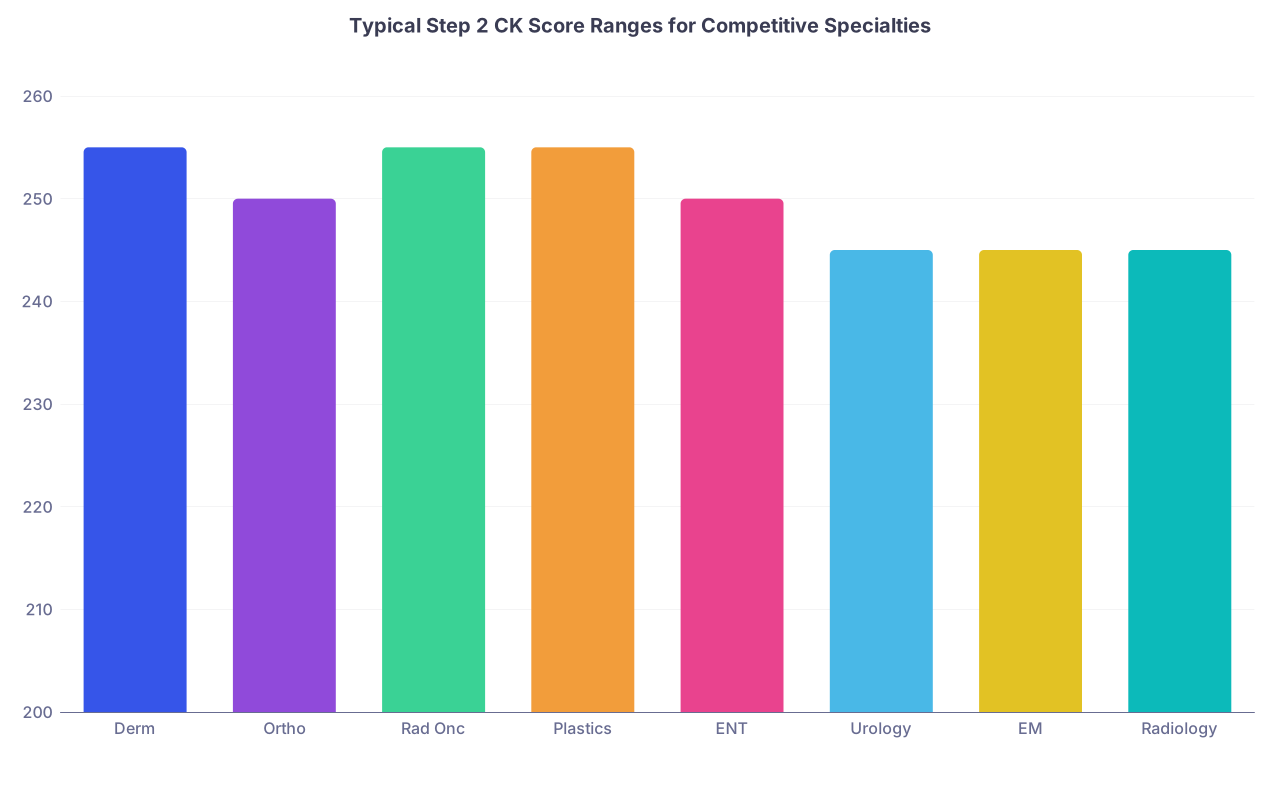
| Category | Value |
|---|---|
| Derm | 255 |
| Ortho | 250 |
| Rad Onc | 255 |
| Plastics | 255 |
| ENT | 250 |
| Urology | 245 |
| EM | 245 |
| Radiology | 245 |
These aren’t cutoff numbers, they’re reality checks. If you’re sitting on a 226 Step 1 and your NBME practice for Step 2 is hovering at 230, flipping to derm in late MS3 is not a “stretch goal.” It’s delusional. Switch targets or fix the foundation (usually via a year off for research).
Be honest about:
- Do you have any research?
- Are you at a school with a home program in your new field?
- Are you willing to delay graduation or take a research year if needed?
- Are you geographically flexible, or locked to a city for family/visa reasons?
If you can’t be brutally honest with yourself now, the Match will do it for you later. Less gently.
Step 2: Map the calendar you actually have left
You don’t have “time later.” You have specific weeks between now and ERAS submission. Treat them like limited OR time.
Make a literal month-by-month map from now until ERAS submission. Write:
- What rotations you’re currently scheduled for
- What can be moved, swapped, or converted into an elective/sub-I
- When your school requires a capstone/bootcamp/etc.
- When ERAS locks and when your school needs LORs by
Then overlay what you must do for a competitive switch:
- At least 1, often 2, rotations in your new specialty (home or away)
- 2–3 strong specialty-specific letters
- A high Step 2 score (if Step 1 is pass, or if Step 1 is weak)
- Some visible specialty “commitment” on paper (research, involvement, presentations)
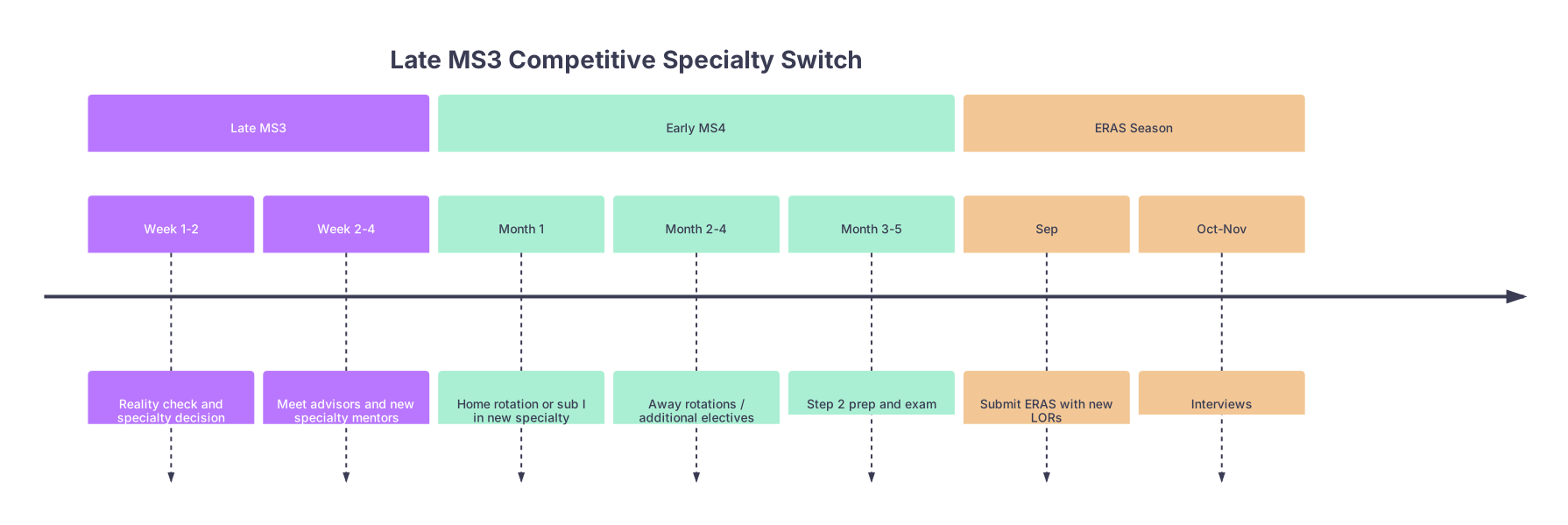
| Period | Event |
|---|---|
| Late MS3 - Week 1-2 | Reality check and specialty decision |
| Late MS3 - Week 2-4 | Meet advisors and new specialty mentors |
| Early MS4 - Month 1 | Home rotation or sub I in new specialty |
| Early MS4 - Month 2-4 | Away rotations / additional electives |
| Early MS4 - Month 3-5 | Step 2 prep and exam |
| ERAS Season - Sep | Submit ERAS with new LORs |
| ERAS Season - Oct-Nov | Interviews |
You’re going to have to move things around: swap an outpatient elective for a specialty sub-I, shift Step 2 earlier, push non-essential electives later. Expect resistance from scheduling. Push anyway. Politely but firmly.
Step 3: Have the hard conversations—fast
You need three groups on board, or at least not actively against you:
- Your original specialty mentor / advisor
- Your dean’s office / academic advising
- Faculty in the new competitive specialty
Don’t send long dramatic emails. You need short, clear, “this is my plan” conversations.
Talking to your old specialty mentor
Something like:
“Dr. Smith, I wanted to update you. During my surgery rotation I realized I’m much more engaged in the OR and procedural environment than I expected. After thinking hard about it, I’ve decided to pursue general surgery instead of internal medicine. I’m really grateful for your guidance so far and I hope I can still ask you for career advice. In the short term I need to reorganize my schedule to fit in a surgery sub-I and potentially an away rotation. Any advice or concerns from your perspective?”
Do not ask them for a letter to a specialty they don’t believe you actually want. Do not vanish and ghost. Burned bridges travel fast in academic medicine.
Talking to your dean / advisor
You need practical help:
- Moving rotations
- Getting approval for away rotations (VSLO)
- Getting Step 2 scheduled appropriately
- Understanding your school’s LOR and MSPE timeline
Be specific: “I want to switch from FM to EM. I need at least 2 EM rotations before ERAS, and I’m willing to adjust my schedule as needed. What’s possible?”
Talking to the new specialty
This is where you prove you’re not a tourist.
Email or in-person, something like:
“Dr. Lee, I’m an MS3 at [School] and recently completed my anesthesiology rotation. I had previously planned on internal medicine but found I was much more engaged in the OR environment and perioperative care. I’m strongly considering applying in anesthesiology and wanted to ask for honest feedback about my competitiveness and what I need to do between now and ERAS to make a credible application.”
You want:
- A reality check on your competitiveness
- Concrete must-do’s (home sub-I, away, research)
- Potential mentors who actively write letters and place students
If nobody in that department seems interested in helping you… that’s data. Competitive fields are small. Lack of support at home makes the hill steeper.
Step 4: Decide which competitive specialties are actually in-range
Not all “competitive” fields are created equal, and not all backgrounds pivot the same way.
Here’s a rough reality grid for late MS3 pivots:
| Target Specialty | Pivot Feasibility | Often Needed to Make It Work |
|---|---|---|
| Dermatology | Very Low | Research year, strong Step 2, home support |
| Plastic Surgery | Very Low | Research year, portfolio, mentor sponsorship |
| ENT | Low | Research, otolaryngology rotation, high Step 2 |
| Ortho | Low–Moderate | Awaways, good Step 2, letters from ortho |
| Urology | Low–Moderate | Early rotations, research, advisor backing |
| Radiology | Moderate | Strong Step 2, some imaging exposure |
| EM | Moderate–Good | EM rotations, SLOEs, early Step 2 helpful |
| Anesthesiology | Good | Solid scores, a couple of rotations, LORs |
This table assumes: average US MD student, no red flags, late MS3 decision. If you’ve got a 260 Step 2 and existing research, some “very low” might become “maybe,” but the principle stands: derm/ENT/plastics from a dead start in late MS3 is usually a 2-cycle project, not a 6-month one.
If you’re currently in:
- FM/IM/Peds -> jumping to EM, anesthesia, rads is relatively more realistic
- Psych -> jumping to neurology, EM is sometimes doable
- IM -> jumping to radiology, anesthesia, EM is common
- Non-procedural -> trying for ortho, urology, ENT, plastics this late usually needs a research year or a backup strategy
This is where you choose:
Do you want to try to match this cycle with a realistic competitive field,
or are you willing to delay graduation / add a year to chase a very hard target?
Both are valid. Pretending you can do a 2-year buildup in 5 months is not.
Step 5: Rebuild your application around the new story
Programs don’t just want stats; they want a coherent story that makes sense.
Right now your story is probably: “I like continuity of care, outpatient medicine, and holistic patient relationships” or some version of that.
You need to reframe, without lying.
Personal statement
You’re not writing, “I have always dreamed of being an anesthesiologist since childhood.” You’re writing:
- What you liked about your original path
- The specific experiences that shifted you
- Why the new specialty fits your psychological profile and strengths better
- How your prior interests/skills actually help in this new field
Example pivot from IM to anesthesia:
“During third year, I expected to find my place in internal medicine. I enjoyed the diagnostic reasoning and longitudinal follow-up I experienced in clinic. But during my anesthesia rotation I found myself energized by the combination of physiology in real time and procedural work in the OR. The same satisfaction I took in untangling complex medicine cases I now felt while managing hemodynamics during surgery. I realized I preferred working in acute, focused episodes of care where I could see the immediate effects of my decisions.”
You’re not apologizing for changing your mind. You’re demonstrating thoughtful evolution, not impulsiveness.
CV and activities
You don’t need to hide your older interests. You do need to add:
- New specialty-specific activities: interest group leadership, case reports, QI projects, quick-turnaround research
- Updated descriptions that connect skills to the new field (teaching, procedures, team leadership, ICU experiences)
If you were president of the FM interest group, fine. Keep it. But don’t let your entire application look like you’re still half in that world. Programs can smell “backup specialty” from a mile away.
Step 6: Fix the two things that matter most now—Step 2 and letters
At this point, two things will rescue or sink this plan:
- Your Step 2 score (especially if Step 1 is pass or weak)
- Your new specialty letters, ideally from people known in the field
Step 2: stop treating it as “just another exam”
Late switchers love to say, “I’ll crush Step 2” while still on busy rotations, not moving their date, and studying on fumes.
If your new field is even moderately competitive, Step 2 is now a core strategic weapon, not a box to check.
Minimum non-negotiables:
- Dedicated study time (real days, not scraps of evenings after 14-hour shifts)
- A clear NBME-based target: know what range your chosen field typically sees
- Date selection that lets you include the score in ERAS (ideally back by early September)
If your practice tests are not where they need to be one month out, talk to your dean. Delay the exam a few weeks and adjust rotations if you can. A mediocre Step 2 plus a rushed EM or anesthesia away is worse than a slightly later application with a clear score bump.
Letters: you need the right kind, not just more of them
For competitive fields, letters are political currency. Some carry more weight than others.
You’re aiming for:
- 2 letters from your new specialty
- 1 letter from core faculty (IM, surgery, etc.) who can vouch for your work ethic and clinical ability
- Optional: research mentor letter if it’s strong and specialty-adjacent
On your rotations, don’t be subtle. Say to attendings:
“I’m strongly considering applying in [field]. I’m working hard to see if I’m a good fit. If by the end of this rotation you feel you can write me a strong letter, I’d be very grateful.”
Yes, say “strong letter.” If they hesitate, you just saved yourself a mediocre LOR that would sink you.
For EM, you specifically need SLOEs; for ortho, big-name faculty mean a lot; for derm, research mentors often matter more than generic clinical letters.
Step 7: Decide your backup strategy before you hit submit
A late pivot to a competitive specialty without a backup plan is gambling, not planning.
You’ve got a few realistic structures:
Dual-apply in a related less-competitive field
- Example: EM + IM, Anesthesia + IM, Rads + IM
- Pros: better match odds; Cons: your story gets diluted
- Only works if you’re genuinely okay training in either
Categorical + preliminary / transitional year strategy
- Common in fields like anesthesia, rads, derm, etc.
- But prelim-only with no solid follow-up plan can backfire
Commit to a research year if you don’t match
- Especially for derm, ENT, plastics, ortho, urology
- Needs planning and a mentor before you go unmatched
Apply only to the new competitive specialty and accept the risk
- I’ve seen this work for strong applicants with faculty support
- If you’re an average student with average scores, this is reckless
Whatever you choose, make that decision before interview season. Not after you get 3 interviews and start panicking.
Step 8: Protect your mental health and your reputation while you pivot
People will have opinions. Some will be supportive. Some will be quietly offended you “left” their field. Some will think you’re unrealistic. A few will say it out loud.
Your job is not to convince everyone you’re right. Your job is to:
- Be professional with everyone, including the old specialty
- Be consistent in what you’re telling people (don’t say three different things)
- Avoid trashing your previous field (“I could never do peds, it’s so boring” will absolutely come back to you)
- Keep doing good work on every rotation—word spreads fast in small departments
And yes, this is stressful. You’re compressing a year’s worth of career planning into a few months while still working full-time as a student. Block off at least a few hours a week where you’re not thinking about applications at all. If you’re crashing, talk to someone—student mental health, trusted attending, whatever’s available.
Quick specialty-specific notes
Not everything, but enough to matter:
Derm / Plastics / ENT / Ortho / Urology
If you’re starting from zero in late MS3 and you’re not top tier (scores, school, research, connections), assume you’ll need:- A research year
- Multiple aways
- Strong national-level mentor backing
Trying to brute-force this in 5 months is how people go unmatched.
Anesthesia / Radiology
Very reasonable to pivot into late MS3 if:- You can get at least one home rotation + maybe an away
- You get strong letters and a solid Step 2
Dual-applying with IM is common if you’re nervous.
EM
EM is its own beast.- You need 2 SLOEs ideally
- Timing of EM rotations matters a lot
- If your school doesn’t have EM, aways are mandatory
Late switch? You need your dean and EM advisors on board ASAP.
General Surgery
Late pivot is possible.- Strong performance and letter on your surgery clerkship/sub-I
- Realistic program list; community and mid-tier academic places are achievable
- Consider whether you’re okay with general surgery only or aiming for a competitive fellowship later.
FAQ (exactly 4 questions)
1. Is it “dishonest” if my MSPE and earlier evals mention a different specialty?
No. Students change their minds. This is normal. What looks bad is chaos: saying you’re going into psych on half your evals, then FM in your personal statement, then EM in your interview answers. You fix this by having a clear, consistent narrative from now on: “I initially planned on X, but after Y clinical experience I realized Z about what kind of work suits me best.” If your dean’s letter has old info, that’s fine—interviewers understand it’s written earlier and based on MS3 impressions.
2. Do I absolutely need an away rotation for a competitive specialty if I’m deciding late?
Not absolutely, but for many fields it moves the needle a lot. For EM, ortho, ENT, urology, away rotations are often expected and function like extended interviews. For anesthesia and rads, a strong home rotation plus a second experience (home or away) usually suffices. If your school doesn’t have a home program, aways become more critical. If VSLO spots are gone, you need to email coordinators directly and ask about waitlists or off-cycle blocks. People do land last-minute spots—but only if they hustle.
3. Should I take a research year or try to match now with a weaker application?
If you’re aiming for the ultra-competitive fields (derm, plastics, ENT, some ortho/urology situations) and you’re significantly behind—no research, average scores, no mentors—taking a structured research year at a strong institution is usually the smarter move. It lets you build real capital in the field: papers, presentations, deeper relationships. Applying early with a “just okay” application in these fields commonly leads to zero interviews. For moderately competitive fields (anesthesia, EM, rads, gen surg), a research year is less often required; a smart, targeted application this cycle might be enough.
4. How many programs should I apply to if I’m switching late?
More than your classmates who have been gunning for this field for years. Competitive switch + average stats = broad net. For anesthesia or rads, many late switchers end up in the 60–80 program range. For EM, people often apply to 40–60 depending on geography and SLOE strength. For super-competitive fields, people sometimes push 80–100—but that’s pointless if your application is fundamentally not ready. Volume doesn’t fix a weak core; it only wastes money. Build a realistic list with a specialty-specific advisor who knows your stats and your story.
Open your calendar right now and block a 60-minute slot within the next 48 hours. In that slot, you’re going to email: (1) your dean’s office, (2) your original specialty mentor, and (3) one faculty member in your new target specialty. No perfect plan. Just three concrete contacts to start turning this from anxiety in your head into an actual, actionable pivot.